Results by title
1832 books match the query 'Essays' and 59 start with o
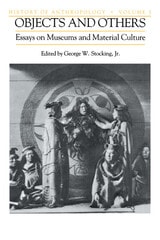
Objects and Others
Essays on Museums and Material CultureEdited by George W. Stocking, Jr.
University of Wisconsin Press, 1988
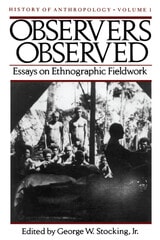
Observers Observed
Essays on Ethnographic FieldworkEdited by George W. Stocking, Jr.
University of Wisconsin Press, 1985
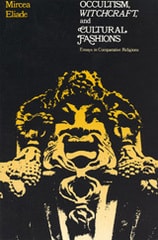
Occultism, Witchcraft, and Cultural Fashions
Essays in Comparative ReligionMircea Eliade
University of Chicago Press, 1978
Since all of the essays except the last were originally delivered as lectures, their introductory character and lively oral style make them particularly accessible to the intelligent nonspecialist. Rather than a popularization, Occultism, Witchcraft, and Cultural Fashions is the fulfillment of Eliade's conviction that the history of religions should be read by the widest possible audience.
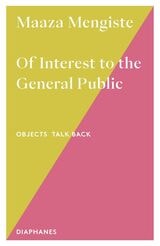
Of Interest to the General Public
About a Coronation Cloak from EthiopiaMaaza Mengiste
Diaphanes, 2026
The work of Maaza Mengiste draws from voices and stories that have been excluded, from gaps that seem inexplicable, from images, objects, and places that pulse with pasts unresolved. While exploring the African collections at the Ethnological Museum of Berlin, she was struck by an elaborate coronation cloak from Ethiopia on display. Inspired by the history of the 1868 British Expedition to Abyssinia (now Ethiopia) and the burning of the palace fortress at Magdala, Of Interest to the General Public uses photography and words to reimagine the journey of the royal mantle—out of battle, through fire, over mountains, to cross the waters into Berlin.
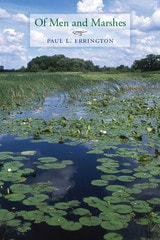
Of Men and Marshes
Paul Errington
University of Iowa Press, 1957
This classic of twentieth-century nature writing, a landmark work that is still a joy to read, offers a stirring portrait of the Midwest’s endangered glacial marshland ecosystems by one of the most influential biologists of his day. A cautionary book whose advice has not been heeded, a must-read of American environmental literature, Of Men and Marshes should inspire a new generation of conservationists.
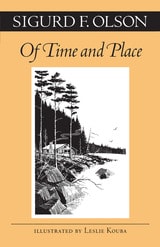
Of Time And Place
Sigurd F. Olson
University of Minnesota Press, 1998
Olson’s final work, available in paperback for the first time.
Of Time and Place is a legacy from one of the best-loved nature writers of our time. In this, his last book completed just before his death, Sigurd F. Olson guides readers through his wide-ranging memories of a lifetime dedicated to the preservation of the wilderness. Like his other best-selling books, Of Time and Place is filled with beauty, adventure, and wonder.
Olson recalls his many friendships of trail and woods and portage, his favorite campsites, the stories behind the artifacts and mementos hanging in his cabin at Listening Point. Whether he is remembering canoe trips with his friends, admiring the playful grace of the otter, or pondering the Earth’s great cycles of climatic change, these moving and evocative essays reaffirm Olson’s stature as one of the greatest nature writers of this century.
Old English Tradition
Essays in Honor of J. R. HallEdited by Lindy Brady
Arizona Center for Medieval and Renaissance Studies, 2021
Old English Tradition contains eighteen new essays by leading scholars in the field of Old English literary studies. The collection is centered around five key areas of research—Old English poetics, Anglo-Saxon Christianity, Beowulf, codicology, and early Anglo-Saxon studies—on which the work of scholar J. R. Hall, the volume’s honorand, has been influential over the course of his career.
The volume’s contents range from fresh insights on individual Old English poems such as The Wife’s Lament and Beowulf; new studies in Old English metrics and linguistics; codicological examinations of individual manuscripts; fresh editions of understudied texts; and innovative examinations of the role of early antiquarians in shaping the field of Old English literary studies as we know it today.
Olimpismo
The Olympic Movement in the Making of Latin America and the CaribbeanAntonio Sotomayor
University of Arkansas Press, 2020
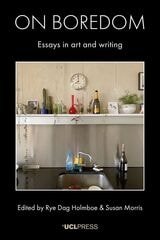
On Boredom
Essays in Art and WritingEdited by Rye Dag Holmboe and Susan Morris
University College London, 2021
What do we mean when we say that we are bored? Contributors to this volume, which include artists, art historians, psychoanalysts, and a novelist, examine boredom in its manifold and uncertain reality. Each part of the book takes up a crucial moment in the history of boredom and presents it in a new light, taking the reader from the trials of the consulting room to the experience of hysteria in the nineteenth century. The book pays particular attention to boredom’s relationship with the sudden and rapid advances in technology that have occurred in recent decades, specifically technologies of communication, surveillance, and automation. On Boredom is idiosyncratic for its combination of image and text, and the artworks included in its pages—featuring Mathew Hale, Martin Creed, and Susan Morris—help turn this volume into a material expression of boredom itself. It will appeal to readers in the fields of art history, literature, cultural studies, and visual culture.

On Emerson
The Best from American LiteratureEdwin H. Cady and Louis J. Budd, eds.
Duke University Press, 1988
Presented in order of their first appearance, the articles in each volume constitute a revealing record of developing insights and important shifts of critical emphasis. Each article has opened a fresh line of inquiry, established a fresh perspective on a familiar topic, or settled a question that engaged the interest of experts.
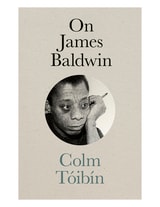
On James Baldwin
Colm Tóibín
Brandeis University Press, 2024
Acclaimed Irish novelist Colm Tóibín first read James Baldwin just after turning eighteen. He had completed his first year at an Irish university and was struggling to free himself from a religious upbringing. He had even considered entering a seminary and was searching for literature that would offer illumination and insight. Inspired by the novel Go Tell It on the Mountain, Tóibín found a writer who would be a lifelong companion and exemplar.
From On James Baldwin
Baldwin was interested in the hidden and dramatic areas in his own being, and was prepared as a writer to explore difficult truths about his own private life. In his fiction, he had to battle for the right of his protagonists to choose or influence their destinies. He knew about guilt and rage and bitter privacies in a way that few of his White novelist contemporaries did. And this was not simply because he was Black and homosexual; the difference arose from the very nature of his talent, from the texture of his sensibility. “All art,” he wrote, “is a kind of confession, more or less oblique. All artists, if they are to survive, are forced, at last, to tell the whole story, to vomit the anguish up.”
On James Baldwin is a magnificent contemporary author’s tribute to one of his most consequential literary progenitors.
On Metaphor
Edited by Sheldon Sacks
University of Chicago Press, 1979
Because of its comprehensive scope, the volume is useful both as a resource for those interested in contemporary philosophy and theories of language and as a text for courses in such areas as the philosophy of language, critical theory, and the philosophy of knowledge. Originally published as a special issue of Critical Inquiry, the present collection includes two new contributions by Max Black and Nelson Goodman, along with a comprehensive index to the work.
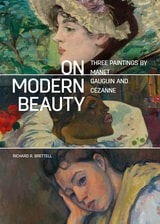
On Modern Beauty
Three Paintings by Manet, Gauguin, and CézanneRichard R. Brettell
J. Paul Getty Trust, The, 2019
Brettell shapes his manifesto around three masterworks from the collection of the J. Paul Getty Museum: Édouard Manet’s Jeanne (Spring), Paul Gauguin’s Arii Matamoe (The Royal End), and Paul Cézanne’s Young Italian Woman at a Table. The provocative discussion reveals how each of these exceptional paintings, though depicting very different subjects—a fashionable actress, a preserved head, and a weary working woman—enacts a revolutionary, yet enduring, icon of beauty.
On Not Knowing
How to Love and Other EssaysEmily Ogden
University of Chicago Press, 2022
Moments of clarity are rare and fleeting; how can we become comfortable outside of them, in the more general condition of uncertainty within which we make our lives? Written by English professor Emily Ogden while her children were small, On Not Knowing forays into this rich, ambivalent space. Each of her sharply observed essays invites the reader to think with her about questions she can’t set aside: not knowing how to give birth, to listen, to hold it together, to love.
Unapologetically capacious in her range of reference and idiosyncratic in the canon she draws on, Ogden moves nimbly among the registers of experience, from the operation of a breast pump to the art of herding cattle; from one-night stands to the stories of Edgar Allan Poe; from kayaking near a whale to a psychoanalytic meditation on drowning. Committed to the accumulation of knowledge, Ogden nonetheless finds that knowingness for her can be a way of getting stuck, a way of not really living. Rather than the defensiveness of willful ignorance, On Not Knowing celebrates the defenselessness of not knowing yet—possibly of not knowing ever. Ultimately, this book shows how resisting the temptation of knowingness and embracing the position of not knowing becomes a form of love.
On Our Way Home from the Revolution
Reflections on UkraineSonya Bilocerkowycz
The Ohio State University Press, 2019
In 2014 Sonya Bilocerkowycz is a tourist at a deadly revolution. At first she is enamored with the Ukrainians’ idealism, which reminds her of her own patriotic family. But when the romantic revolution melts into a war with Russia, she becomes disillusioned, prompting a return home to the US and the diaspora community that raised her. As the daughter of a man who studies Ukrainian dissidents for a living, the granddaughter of war refugees, and the great-granddaughter of a gulag victim, Bilocerkowycz has inherited a legacy of political oppression. But what does it mean when she discovers a missing page from her family’s survival story—one that raises questions about her own guilt?
In these linked essays, Bilocerkowycz invites readers to meet a swirling cast of post-Soviet characters, including a Russian intelligence officer who finds Osama bin Laden a few weeks after 9/11; a Ukrainian poet whose nose gets broken by Russian separatists; and a long-lost relative who drives a bus into the heart of Chernobyl. On Our Way Home from the Revolution muddles our easy distinctions between innocence and culpability, agency and fate.
On Petrocultures
Globalization, Culture, and EnergyImre Szeman
West Virginia University Press, 2019
On Petrocultures brings together key essays by Imre Szeman, a leading scholar in the field of energy humanities and a critical voice in debates about globalization and neoliberalism. Szeman’s most important and influential essays, in dialogue with exciting new pieces written for the book, investigate ever-evolving circuits of power in the contemporary world, as manifested in struggles over space and belonging, redefinitions of work and individual autonomy, and the deep links between energy use and climate change.
These essays explore life lived in the twenty-first century by examining critically the vocabulary through which capitalism makes sense of itself, focusing on concepts like the nation, globalization, neoliberalism, creativity, and entrepreneurship. At the heart of the volume is the concept of “petrocultures,” which demands that we understand a fundamental fact of modern life: we are shaped by and through fossil fuels. Szeman argues that we cannot take steps to address global warming without fundamentally changing the social, cultural, and political norms and expectations developed in conjunction with the energy riches of the past century. On Petrocultures maps the significant challenge of our dependence on fossil fuels and probes ways we might begin to leave petrocultures behind.
On Robert Antelme's The Human Race
Essays and CommentaryRobert Antelme
Northwestern University Press, 2003
In this volume, the extraordinary nature and extent of Robert Antelme's accomplishment, and of the reverberations he set in motion in French life and literature, finds eloquent expression. The pieces Antelme wrote for journals—including essays on "principles put to the test," man as the "basis of right," and the question of revenge—appear here alongside appreciations of The Human Race by authors from Perec to Maurice Blanchot to Sarah Kofman. Also included are Antelme's personal recollections and interviews with, among others, Dionys Mascolo (who brought Antelme back from Dachau), Marguerite Duras (Antelme's wife, who tells of his return from Germany), and Mitterand.
Also available: Antelme's The Human Race
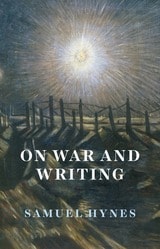
On War and Writing
Samuel Hynes
University of Chicago Press, 2018
Samuel Hynes knows war personally: he served as a Marine Corps pilot in the Pacific Theater during World War II, receiving the Distinguished Flying Cross. He has spent his life balancing two careers: pilot and professor of literature. Hynes has written a number of major works of literary criticism, as well as a war-memoir, Flights of Passage, and several books about the World Wars. His writing is sharp, lucid, and has provided some of the most expert, detailed, and empathetic accounts of a disappearing generation of fighters and writers.
On War and Writing offers for the first time a selection of Hynes’s essays and introductions that explore the traditions of war writing from the twentieth century to the present. Hynes takes as a given that war itself—the battlefield uproar of actual combat—is unimaginable for those who weren’t there, yet we have never been able to turn away from it. We want to know what war is really like: for a soldier on the Somme; a submariner in the Pacific; a bomber pilot over Germany; a tank commander in the Libyan desert. To learn, we turn again and again to the memories of those who were there, and to the imaginations of those who weren’t, but are poets, or filmmakers, or painters, who give us a sense of these experiences that we can’t possibly know.
The essays in this book range from the personal (Hynes’s experience working with documentary master Ken Burns, his recollections of his own days as a combat pilot) to the critical (explorations of the works of writers and artists such as Thomas Hardy, E. E. Cummings, and Cecil Day-Lewis). What we ultimately see in On War and Writing is not military history, not the plans of generals, but the feelings of war, as young men expressed them in journals and poems, and old men remembered them in later years—men like Samuel Hynes.
On a Clear Night
Essays from the HeartlandMarnie O. Mamminga
Wisconsin Historical Society Press, 2017
Combining elements of the personal and the universal, these essays chart the passage of time from childhood to adulthood, sickness to health, working life to retirement, parenthood to grandparenthood, and everything in between. These sharply observed vignettes highlight the importance of taking time to appreciate the ordinary occurrences that profoundly shape our lives and the places we call home.
On the Digital Humanities
Essays and ProvocationsStephen Ramsay
University of Minnesota Press, 2023
A witty and incisive exploration of the philosophical conundrums that animate the digital humanities
Since its inception, the digital humanities has been repeatedly attacked as a threat to the humanities: warnings from literary and cultural theorists of technology overtaking English departments and the mechanization of teaching have peppered popular media. Stephen Ramsay’s On the Digital Humanities, a collection of essays spanning the personal to the polemic, is a spirited defense of the field of digital humanities.
A founding figure in what was once known as “humanities computing,” Ramsay has a well-known and contentious relationship with what is now called the digital humanities (DH). Here Ramsay collects and updates his most influential and notorious essays and speeches from the past fifteen years, considering DH from an array of practical and theoretical perspectives. The essays pursue a broad variety of themes, including the nature of data and its place in more conventional notions of text and interpretation, the relationship between the constraints of computation and the more open-ended nature of the humanities, the positioning of practical skills and infrastructures in both research and pedagogical contexts, the status of DH as a program for political and social action, and personal reflections on the author’s journey into the field as both a theorist and a technologist.
These wide-ranging essays all center around one idea: that DH not forsake its connection to the humanities. While “digital humanities” may sound like an entirely new form of engagement with the artifacts of human culture, Ramsay argues that the field well reveals what is most essential to humanistic inquiry.
On the Margins
Essays on the History of Jews in EstoniaAnton Weiss-Wendt
Central European University Press, 2017
Estonia is perhaps the only country in Europe that lacks a comprehensive history of its Jewish minority. Spanning over 150 years of Estonian Jewish history, On the Margins is a truly unique book. Rebuilding a life beyond so-called Pale of Jewish Settlement in the Russian Empire, the Jewish cultural autonomy in interwar Estonia, and the trauma of Soviet occupation of 1940–41 are among the issues addressed in the book but most profoundly, the book wrestles with the subject of the Holocaust and its legacy in Estonia.
Specifically, it examines the quasi-legal system of murder instituted in Nazi-occupied Estonia, confiscation of Jewish property, and Jewish forced labor camps and develops an analysis of the causes of collaboration during the Holocaust. The book also explores the dynamics of war crimes trials in the Soviet Union since the 1960s and so-called denaturalization trials in the United States in the 1980s. The haunting memory of Soviet and Nazi rule, the book concludes, prevents a larger segment of today’s Estonian population from facing up to the Holocaust and the universal message that it carries.E
On the Principles of Taxing Beer
and Other Brief Philosophical EssaysJames V. Schall
St. Augustine's Press, 2015
The advantage of a collection of essays is that it is free to talk about many things. It can speak of them in a learned way or in an amused and humorous way. As Chesterton said, there is no necessary conflict between what is true and what is funny. Oftentimes, the greatest things we learn are through laughter, even laughter at ourselves and our own foibles and faults.
So these essays are “brief.” And they are largely of philosophical import. At first sight, taxing beer may seem to have no serious principle, except perhaps for the brewer and the consumer. But wherever there is reality, we can find something to learn.
Each of these essays begins with the proposition “on”—this is a classical form of essay in the English language. Belloc, one the essay’s greatest masters, wrote a book simply entitled “ON”—and several other books with that introductory “ON” to begin it. The word has the advantage of focusing our attention on some idea, place, book, person, or reality that we happen to come across and notice, then notice again, then wonder about.
These essays are relatively short, often lightsome, hopefully always with a consideration that illumines the world through the mind of the reader. These essays are written in the spirit that the things we encounter provoke us, our minds. We need to come to terms, to understand what we come across in our pathways through this world. Often the best way to know what we observe or confront is to write about it, preferably briefly and with some philosophical insight. This is what we do here.
On the Run
Finding the Trail HomeCatherine Doucette
Oregon State University Press, 2021
For over a decade, Doucette chased winter around the world to ski, from the White Mountains of her native New Hampshire to the slopes of Alaska, British Columbia, California, Argentina, Switzerland, and beyond. But she always kept one eye toward living a more settled life and putting her heart on the line if someone would just ask her to. Like other women who choose or yearn to be in the wilderness, she wrestled to reconcile her outdoor ambitions with society’s expectations of women.
The personal essays collected in On the Run touch on the author’s origins in New Hampshire while focusing on the lure of big mountains in the West. They celebrate the comfort, challenge, and community found in expanses of wilderness while confronting the limitations and sacrifices that come with a transient, outdoor lifestyle. In a voice both searching and deeply grounded, Doucette contends with avalanches and whitewater along with the less dramatic but equally important questions of belonging. Anyone who has searched to define home, who has been called by mountains, or by movement, will feel at home in these pages.
On the Shoreline of Knowledge
Irish WanderingsChris Arthur
University of Iowa Press, 2012
Bringing a diverse range of material into play, from fifteenth-century Japanese Zen Buddhism to how we look at paintings, and from the nature of a briefcase to the ancient nest-sites of gyrfalcons, Chris Arthur reveals the extraordinary dimensions woven invisibly into the ordinary things around us. Compared to Loren Eiseley, George Eliot, Seamus Heaney, Aldo Leopold, V. S. Naipaul, W. G. Sebald, W. B. Yeats, and other literary luminaries, he is a master essayist whose work has quietly been gathering an impressive cargo of critical acclaim. Arthur speaks with an Irish accent, rooting the book in his own unique vision of the world, but he addresses elemental issues of life and death, love and loss, that circle the world and entwine us all.
Once I Was Cool
Personal EssaysMegan Stielstra
Northwestern University Press, 2021
With conversational flourishes and on-the-mark descriptions, Stielstra’s essays evoke the richness of her everyday life and the memories that are never far away. She remembers learning how to shoot a gun, a cancer scare, and—in a piece that was anthologized in The Best American Essays 2013—the time she eavesdropped on another new mother using her son’s baby monitor. “I shouldn’t have listened,” she writes. “But it was the first time since my son was born that I didn’t feel alone.” Combining footnotes, electric sentences, and uproariously funny anecdotes (have you ever run into an ex while rolling on ecstasy?), Stielstra shows us that maturity is demanding, but its rewards are a gift.
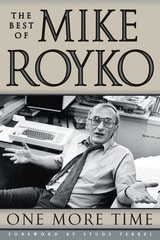
One More Time
The Best of Mike RoykoMike Royko
University of Chicago Press, 1999
"A treasure trove lies between these covers. Royko was in a class by himself. He was a true original."—Ann Landers
"The joy of One More Time is Royko in his own words."—Mary Eileen O'Connell, New York Times Book Review
"Reading a collection of Royko's columns is even more of a pleasure than encountering them one by one, and that is a large remark for he rarely wrote a piece that failed to wake you up with his hard-earned moral wit. Three cheers for Royko!"—Norman Mailer
"Powerful, punchy, amazingly contemporary."—Neil A. Grauer, Cleveland Plain Dealer
"This crackling collection of his own favorite columns as well as those beloved by his fans reminds us just how much we miss the gruff, compassionate voice of Mike Royko."—Jane Sumner, Dallas Morning News
"A marvelous road map through four decades of America."—Elizabeth Taylor, Chicago Tribune Books
"Royko was an expert at finding universal truths in parochial situations, as well as in the larger issues—war and peace, justice and injustice, wealth and poverty—he examined. Think of One More Time as one man's pungent commentary on life in these United States over the last few decades."—Booklist
"Royko was one of the most respected and admired people in the business, by readers and colleagues alike. . . . Savor [his sketches] while you can."—Jonathan Yardley, Washington Post Book World
"Book collections of columns aren't presumed to be worth reading. This one is, whether or not you care about newspapering or Chicago."—Neil Morgan, San Diego Union-Tribune
"A treasure house for journalism students, for would-be writers, for students of writing styles, for people who just like to laugh at the absurdity of the human condition or, as Studs Terkel said, for those who will later seek to learn what it was really like in the 20th century."—Georgie Anne Geyer, Washington Times
"Full of astonishments, and the greatest of these is Royko's technical mastery as a writer."—Hendrik Hertzberg, New Yorker
"A great tribute to an American original, a contrarian blessed with a sense of irony and a way with words."—Bob Minzesheimer, USA Today
"In this posthumous collection of his columns, journalist Royko displays the breezy wit that made him so beloved in the Windy City."—People
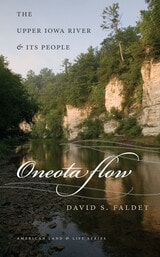
Oneota Flow
The Upper Iowa River and Its PeopleDavid S. Faldet
University of Iowa Press, 2009
Whether profiling the chief of the last hunter-gatherers on the river, an early settler witnessing her first prairie fire and a modern wildlife biologist using fire to manage prairies, the manager of the Granger Farmer’s Co-op Creamery, or a landowner whose bottomlands are continually eaten away by floods, Faldet steadily develops the central idea that people are walking tributaries of the river basin in which they make their homes.
Faldet moves through the history of life along the now-polluted Upper Iowa, always focusing on the ways people depend on the river, the environment, and the resources of the region. He blends contemporary conversations, readings from the historical record, environmental research, and personal experience to show us that the health of the river is best guaranteed by maintaining the biological communities that nurture it. In return, taking care of the Upper Iowa is the best way to take care of our future.
Open Access Musicology
Volume OneLouis Epstein
Lever Press, 2020
In the fall of 2015, a collection of faculty at liberal arts colleges began a conversation about the challenges we faced as instructors: Why were there so few course materials accessible to undergraduates and lay readers that reflected current scholarly debate? How can we convey the relevance of studying music history to current and future generations of students? And how might we represent and reflect the myriad, often conflicting perspectives, positions, and identities that make up both music’s history and the writers of history?
Here we offer one response to those questions. Open Access Musicology is a collection of essays, written in an accessible style and with a focus on modes of inquiry rather than content coverage. Our authors draw from their experience as scholars but also as teachers. They have been asked to describe why they became musicologists in the first place and how their individual paths led to the topics they explore and the questions they pose. Like most scholarly literature, the essays have all been reviewed by experts in the field. Unlike all scholarly literature, the essays have also been reviewed by students at a variety of institutions for clarity and relevance.
These essays are intended for undergraduates, graduate students, and interested readers without any particular expertise. They can be incorporated into courses on a range of topics as standalone readings or used to supplement textbooks. The topics introduce and explore a variety of subjects, practices, and methods but, above all, seek to stimulate classroom discussion on music history’s relevance to performers, listeners, and citizens.
Open Access Musicology
Volume ThreeEdited by Daniel Barolsky and Trudi Wright
Lever Press, 2025
These essays are intended for undergraduates, graduate students, and interested readers without any particular expertise. The topics introduce and explore a variety of subjects, practices, and methods but, above all, seek to stimulate classroom discussion on music history’s relevance to performers, listeners, and citizens. Open Access Musicology will never pretend to present complete histories, cover all elements of a subject, or satisfy the agenda of every reader. Rather, each essay provides an opening to further contemplation and study.
The third volume of Open Access Musicology presents provocative case studies and analyses through which readers can choose their own path while also putting these essays in conversations from those in previous volumes of OAM. This new volume challenges us to ask difficult questions about the place and function of music in our societies, on our stages, and in our institutions. The authors demonstrate ways in which the past can be re-imagined as well as the ways legacies of the past are inscribed in present-day practices, structures, histories, and beliefs. We invite readers to follow the thematic links between essays, pursue notes and other online resources, or simply repurpose the essay’s questions into new and exciting forms of research and creativity.
Open Access Musicology
Volume Twoedited by Daniel Barolsky and Louis Epstein
Lever Press, 2023
In service of our student- and access-centered mission, Open Access Musicology is a free collection of essays, written in an engaging style and with a focus on modes of inquiry rather than coverage of content. Our authors draw from their experience as scholars but also as teachers. They not only make arguments, but also describe why they became musicologists in the first place and explain how their individual paths led to the topics they explore. Like most scholarly literature, the essays have all been reviewed by experts in the field. Unlike most scholarly literature, the essays have also been reviewed by students at a variety of institutions for clarity and relevance.
These essays are intended for undergraduates, graduate students, and interested readers without any particular expertise. They can be incorporated into courses on a range of topics as standalone readings, used to supplement textbooks, or read with an eye to new scholarly insights. The topics introduce and explore a variety of subjects, practices, and methods but, above all, seek to stimulate classroom discussion on music history’s relevance to performers, listeners, and citizens. Open Access Musicology will never pretend to present complete histories, cover all elements of a subject, or satisfy the agenda of every reader. Rather, each essay provides an opening to further contemplation and study. We invite readers to follow the thematic links between essays, pursue notes or other online resources provided by authors, or simply repurpose the essay’s questions into new and exciting forms of research and creativity.
Volume 2 of OAM expands the disciplinary, topical, and geographical ranges of our endeavor, with essays that rely on ethnographic and music theoretical methods as well as historical ones. The essays in this volume touch on music from Europe, South America, and Asia, spanning the 16th century to the present. Throughout, the contributing authors situate music in political, religious, racial, economic, and other cultural and disciplinary contexts. This volume therefore expands what scholars generally mean when they refer to “musicology” and “music,” always with an eye toward relevance and accessibility.

Open Horizons
Sigurd F. Olson
University of Minnesota Press, 1998
Olson’s inspirational life story, told in his own words, now available in paperback.
Sigurd Olson’s love affair with the wilderness began in a stream near his house in Wisconsin-he caught his first trout there with a tamarack wand, black thread, and a grasshopper as bait. Open Horizons is his autobiography, and in it he recounts a life lived on and for the land, from the wonder of boyhood fishing expeditions to decades-long conservation battles.
Writing always with the sensitive, lyric prose that characterizes his works, Olson recalls his pioneering youth on a remote Wisconsin farm, his summers as a wilderness canoe guide, and his thousands of miles of travel through the wilds of this country and Canada. “Open Horizons is the story of the unknowns I have discovered, and gone through,” he writes. While telling his story, Olson makes a compelling case for preserving the wilderness. He puts forth his own life as an example of how nature can have a spiritual effect on the human soul, and proposes diligence on behalf of those who fight to conserve our forests, wetlands, and dunes. “If we can move into an open horizon where we can live in our modern world with ancient dreams that have always stirred us, then our work will have been done.”ISBN 0-8166-3037-2 Paper $14.95256 pages 12 line drawings 5 1/2 x 8 1/4 SeptemberFesler-Lampert Minnesota Heritage Book SeriesTranslation inquiries: University of Minnesota Press
Open House
Essays on Community in Literary ArtsEdited by Kristina Marie Darling
Tupelo Press, 2025
This book offers a practical guide to building community, fostering collaboration, and inspiring generosity through the creative arts. This collection of original essays features an accomplished roster of contributors with backgrounds in diverse fields, including literary translation, magazine editing, publishing, higher education, and curriculum design. By featuring successful writers who represent such a wide range of skillsets and career paths, this book helps students envision themselves as leaders in the university and well beyond its boundaries.
In a cultural moment where graduates often seek meaningful careers outside of academia, this essay collection also offers an introduction to alt-ac career paths and the unique opportunities for effecting social change in these roles. Focusing on techniques that have broad applications for high school teachers, nonprofit leaders, community outreach organizations, and college classrooms, each chapter includes an original essay from a contemporary writer, editor, or nonprofit leader in the arts, culminating in a set of exercises for individuals and groups, which focus on empathy, citizenship, and community stewardship.
Contributors include Traci Brimhall, Chris Campanioni, Wendy Chen, Kristina Marie Darling, Ming Lauren Holden, John James, Dean Rader, and Zach Savich.

Opening the Books
Essays on the Cultural and Social History of the British Communist PartyGeoff Andrews
Pluto Press, 1995
Opposing Poetries
Part One: Issues and InstitutionsHank Lazer
Northwestern University Press, 1996
Volume One examines the shift in the governing assumptions of contemporary poetic practice. Lazer inspects the key critical works addressing poetries in the 1980s and 1990s, as well as the political and aesthetic impact of modern critics, poetry reading programs, and of the publishing industry and libraries on contemporary poetic practice.
Opposing Poetries
Part Two: ReadingsHank Lazer
Northwestern University Press, 1996
In Volume Two, Lazer presents a series of sustained readings of important experimental texts. Included are the poets Susan Howe, Lyn Hejinian, Bruce Andrews, and James Sherry. Lazer places these poets in the context of contemporary literary theory, and inspects both the successes and failures of said theory to interpret these works.
Oppression and Liberty
Simone Weil
University of Massachusetts Press, 1973
Simone Weil was an extraordinary woman whose brief life was intensely devoted to searching for answers to some of the gravest questions inherent in the human condition: the nature of justice, the reasons for human exploitation, the problem of faith. Although debate still lingers about the interpretation of her life and her writings, many contemporary scholars consider her one of the most brilliant, original minds of the twentieth century. This collection of essays by Simone Weil deals with the controversial sociopolitical issues which have confronted us since the time of the French Revolution. The first essay was written in 1932 or 1933 when she was still in her twenties. The last remained unfinished when she died in England at the age of 34, a French-Jewish refugee from Nazi-occupied France.
The essays take a long, close look at Marx and Marxism, and at socialism versus capitalism vis-à-vis labor and the working class. Weil evaluates individuals, ideologies, and institutions with reference to two kinds and uses of power: oppression, which leads ultimately to enslavement or death; and liberty, which leads to humaneness, justice, and charity.
Orange Alert
essays on poetry, art, and the architecture of silenceKazim Ali
University of Michigan Press, 2010
"Orange Alert is a poetic and yogic salvo across the bows of our defensive imperial posturing. Kazim Ali's essays leap deftly from homages to avant-garde artists (Yoko Ono, Agnes Martin, John Cage) to awestruck meditations on ancient architecture, from analyses of poets (Jane Cooper, Agha Shahid Ali, Mahmoud Darwish, Lucille Clifton) to twitter aphorisms. Orange Alert is a revelation, a salve, an invitation to breathe again."
---Philip Metres, Associate Professor, Department of English, John Carroll University
"With their delicacy of attention and bold range of subjects, Kazim Ali's essays hold many quiet surprises. In each art he searches for insight and craft---the virtues of his own patient writing."
---Susan Stewart, Chancellor, Academy of American Poets; and Professor, Princeton University
"Kazim Ali's essays, like his poems, are alive with curiosity and humanity. . . . Orange Alert makes a compelling case for the necessity of poetry on a planet wracked by war and devastation."
---Timothy Yu, Associate Professor, English and Asian American Studies, University of Wisconsin-Madison
A volume in the Poets on Poetry series, which collects critical works by contemporary poets, gathering together the articles, interviews, and book reviews by which they have articulated the poetics of a new generation.
Whether he is discussing the way cell phones have altered physical intimacy and introduced new verb forms, or the way Emily Dickinson's mysteries are more clearly revealed in French translation, Kazim Ali is at once clear and complex, rigorous and charming, accessible and demanding.
In Orange Alert, Ali discusses poets including Agha Shahid Ali, Jane Cooper, Bhanu Kapil, Semezdin Mehmedinovic, and Samuel Beckett. He considers painters Agnes Martin and Piet Mondrian, musicians Alice Coltrane and Yoko Ono, and philosophers Slavoj Žižek and Jean Baudrillard. Ali links the poetic endeavor to such diverse texts as Moby-Dick, Battlestar Galactica, and Marilyn Buck's prison journals.
Ali discusses contemporary poetry in relation to other art forms and to contemporary television; film; and electronic media, including the Internet, YouTube, and Facebook.
He shines a light on the intersections between cultures in these essays on the craft of poetry, offering a hand to poets either geographically or metaphorically outside the mainstream of Western culture.
Kazim Ali is the author of two books of poetry, The Far Mosque and The Fortieth Day; two novels, Quinn's Passage and The Disappearance of Seth; and a memoir, Bright Felon: Autobiographyand Cities. He is Assistant Professor of Creative Writing at Oberlin College. He has been a regular columnist for American Poetry Review.
Ordinary Language Criticism
Literary Thinking after Cavell after WittgensteinKenneth Dauber and Walter Jost
Northwestern University Press, 2003
Resisting master formulations and overarching theories, Ordinary Language Criticism does not so much dismiss the excitement of the last two decades of literary theorizing as it reminds us of the excitement of the shared common enterprises to which theory may still contribute. In this, the volume and the model it offers have wide implications for the academy, in which a widespread ersatz-sophistication has shorted the circuit between literary works and the real lives of those reading and teaching them.
With a definitive introduction by editors Kenneth Dauber and Walter Jost, and elaborations and practical examples by major figures such as Cavell himself, Martha Nussbaum, Marjorie Perloff, Anthony Cascardi, and Charles Altieri, among others, this volume clearly shows and explains how ordinary language criticism differs from current trends and what it exactly it can accomplish in theory and practice. These essays prove that by attending more faithfully to what we actually do when we read, we can make reading more productive--can reveal how extraordinary and rich, how really sophisticated, the ordinary actually is.
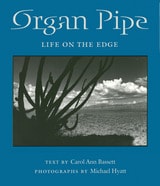
Organ Pipe
Life on the EdgeText by Carol Ann Bassett; Photographs by Michael Hyatt
University of Arizona Press, 2004
A terrain where one learns to pay attention to the details: the tracks of a sidewinder in the sand, the tiny eggs of a cactus wren, the flash of a vermilion flycatcher against the azure sky.
Organ Pipe Cactus National Monument lies in southwestern Arizona on the Mexican border. It is an isolated park that for Carol Ann Bassett has long been a place of solitude—a silent refuge where she often camped out alone to capture the natural rhythms of the desert. Photographer Michael Hyatt hiked through Organ Pipe to visually document its subtle beauty in the Ajo Mountains and the valley of the Ajo, and at Quitobaquito, a rare desert oasis.
Few visitors may brave Organ Pipe during summer, when the temperature can reach 120 degrees, but for Bassett and Hyatt the searing heat is but a harbinger of rain, when normally dry arroyos surge with rust-colored water and desert tarantulas come out to mate. Bassett introduces readers to Organ Pipe’s cultural heritage as well: Spanish missionaries, Anglo settlers, and the Tohono O’odham and the Hia Ced O’odham people who still travel there to gather cactus fruit during Hasan Bakmasad, "saguaro moon." She also considers the changes taking place throughout the park, including the onrush of immigrants passing through in search of better lives in the United States.
This small, lyrical book is a sensitive reflection on the heart of the Sonoran Desert. It reminds us of the beauty to be found in unexpected places—and of our intimate connection with the wild.
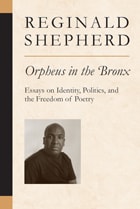
Orpheus in the Bronx
Essays on Identity, Politics, and the Freedom of PoetryReginald Shepherd
University of Michigan Press, 2010
"Orpheus in the Bronx not only extols the freedom language affords us; it embodies that freedom, enacting poetry's greatest gift---the power to recognize ourselves as something other than what we are. These bracing arguments were written by a poet who sings."
---James Longenbach
A highly acute writer, scholar, editor, and critic, Reginald Shepherd brings to his work the sensibilities of a classicist and a contemporary theorist, an inheritor of the American high modernist canon, and a poet drawing and playing on popular culture, while simultaneously venturing into formal experimentation.
In the essays collected here, Shepherd offers probing meditations unified by a "resolute defense of poetry's autonomy, and a celebration of the liberatory and utopian possibilities such autonomy offers." Among the pieces included are an eloquent autobiographical essay setting out in the frankest terms the vicissitudes of a Bronx ghetto childhood; the escape offered by books and "gifted" status preserved by maternal determination; early loss and the equivalent of exile; and the formation of the writer's vocation. With the same frankness that he brings to autobiography, Shepherd also sets out his reasons for rejecting "identity politics" in poetry as an unnecessary trammeling of literary imagination. His study of the "urban pastoral," from Baudelaire through Eliot, Crane, and Gwendolyn Brooks, to Shepherd's own work, provides a fresh view of the place of urban landscape in American poetry.
Throughout his essays---as in his poetry---Shepherd juxtaposes unabashed lyricism, historical awareness, and in-your-face contemporaneity, bristling with intelligence.

Orpheus in the Underworld
Essays on MusicTheodor W. Adorno
Seagull Books, 2024
Theodor W. Adorno is recognized as one of the twentieth century’s most prominent social theorists. Though best known for his association with the Frankfurt School of critical theory, Adorno began his career as a composer and successful music critic.
Comprehensive and illuminating, Orpheus in the Underworld centers on Adorno’s concrete and immediate engagement with musical compositions and their interpretation in the concert hall and elsewhere. Here, Adorno registers his initial encounters with the compositions of the Second Viennese School, when he had yet to integrate them into a broad aesthetics of music. Complementarily essays on Bela Bartók, Jean Sibelius, and Kurt Weill afford insight into his understanding of composers who did not fit neatly into the dialectical schema propounded in the Philosophy of New Music. Additionally, essays on recording and broadcasting show Adorno engaging with these media in a spirit that is no less productive than polemical and focused as sharply on their potentialities as on their shortcomings.
Orpheus in the Underworld offers a captivating exploration of Adorno’s musical compositions, shedding new light on his understanding of influential composers and his critical perspectives on recording and broadcasting.
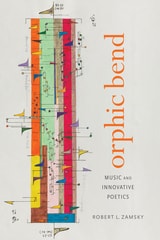
Orphic Bend
Music and Innovative PoeticsRobert L. Zamsky
University of Alabama Press, 2021
WINNER OF THE ELIZABETH AGEE PRIZE IN AMERICAN LITERATURE
Exploring how music reshapes the possibilities of poetry.
Orphic Bend: Music and Innovative Poetics explores the impact of music on recent pioneering literary practices in the United States. Adopting the myth of Orpheus as its framework, Robert L. Zamsky argues that works by Charles Bernstein, Robert Creeley, John Taggart, Tracie Morris, and Nathaniel Mackey restage ancient debates over the relationship between poetry and music even as they develop work that often sharply diverges from traditional literary forms. Opening each chapter with a consideration of the orphic roots of lyric, Zamsky integrates contemporary debates over the prospects and limitations of humanism, the meaningfulness of gesture and performance, and the nature of knowledge with the poetics of the writers under consideration, grounding his analysis in close readings of their work.
The myth of Orpheus is used as a lens throughout the book, its different facets illuminating sometimes dramatically different aspects of the shared framework of poetry and music. In the case of Bernstein, for instance, Zamsky highlights Ezra Pound’s meditations on the relationship between poetry and music (the ground upon which Pound seeks to recapture the lost possibilities of the Renaissance) and Bernstein’s incisive critique of Pound. For her part, Morris emphasizes the performative power of spoken language, foregrounding the fact that all spoken language bears cultural, communal, and personal marks of the speaker, improving an ensemble self even within the most elemental features of language. Meanwhile, in Mackey’s work, the orphic voice of the poet powerfully reaches toward an order of knowledge in which poetry and music are nearly indecipherable from one another. In this sense, music and the musicality of poetic language are the gateways for Mackey’s Gnosticism, the mechanisms of initiation into a realm, not of secrets to be learned, but of visionary knowing that continuously unfolds.
The text explores a range of musical influences on the writers under consideration, from opera to different iterations of jazz, and underscores the variety of ways in which music informs their work. Many of these writers effectively present a theory of music in their invocations of it as an inspiration for, or as an analog to, poetic practice. Zamsky’s focus on poetry and music echoes important interdisciplinary studies on literary modernism, a period for which the importance of music to literary practice is well established and extends that discussion to the contemporary context. In doing so, Orphic Bend provides an important opportunity to consider both the specific legacy of modernism, and to situate contemporary writers in broader historical contexts.
Osler's A Way of Life and Other Addresses, with Commentary and Annotations
Sir William Osler. Edited by Shigeaki Hinohara and Hisae Niki.
Duke University Press, 2001
While Osler’s talks were frequently published during his lifetime and they have been published individually and in different compilations since his death, none contain the over 1500 annotations that appear here, notes that serve to explain the many philosophical, biblical, historical, and literary allusions contained in Osler’s writings.
This thoroughly explicated selection of Sir William Osler’s writings will be cherished by physicians, medical students, nurses, philosophers, theologians, and ethicists in this—and future—generations.
Other Inquisitions, 1937-1952
By Jorge Luis Borges
University of Texas Press, 1964
This remarkable book by one of the great writers of the twentieth century includes essays on a proposed universal language, a justification of suicide, a refutation of time, the nature of dreams, and the intricacies of linguistic forms. Borges comments on such literary figures as Pascal, Coleridge, Cervantes, Hawthorne, Whitman, Valéry, Wilde, Shaw, and Kafka. With extraordinary grace and erudition, he ranges in time, place, and subject from Omar Khayyam to Joseph Conrad, from ancient China to modern England, from world revolution to contemporary slang.
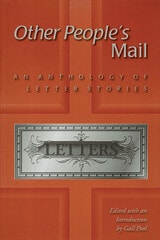
Other People's Mail
An Anthology of Letter StoriesEdited & Intro by Gail Pool
University of Missouri Press, 2000
While the art and craft of letter writing have declined in this century, letter stories have thrived. Cast as love letters and Dear John letters, as thank-you notes and suicide notes, as memos, letters to the editor, and exchanges with the United States Post Office, examples of epistolary fiction have been published by the hundreds, among them the work of many of our most notable authors. Why has this form of fiction writing remained so popular? As Gail Pool answers, "Who, after all, is immune to the seduction of reading other people's mail?"
Although epistolary fiction enjoyed its greatest popularity in the eighteenth and nineteenth centuries, a time when letters were central to daily life, this style of writing has a decidedly postmodern air. Letter stories are about communication, and they are effective in framing our modern concerns: the struggle to find meaningful stories, relationships, and lives amid the social and moral disarray of the era and the blurred boundaries between fact and fiction, artist and audience, private and public domains. These are the themes of our time, and the themes of the stories in Other People's Mail.
Offering seventeen stories written by a culturally diverse group of authors, Other People's Mail represents what letter tales, at their best, can do. They may be written from the Canadian wilderness, a private school in Geneva, a concentration camp, or beyond the grave. They may be comic or satirical, poignant or tragic, but all are united in their distinctive format.
The first collection of its kind, Other People's Mail is a unique and important anthology. Pool's highly informative introduction explores the nature of letter fiction, and her individual preface to each story provides background information on both the author and the tale. A select listing additional letter stories rounds out the anthology. Literature and writing instructors in search of a fresh approach to stories and readers looking for an anthology with a lively theme will enjoy this collection.
Our Americas
Political and Cultural Imaginings, Volume 2004Sandhya Shukla and Heidi Tinsman, eds.
Duke University Press, 0
This special issue of Radical History Review takes as its inspiration Cuban writer and revolutionary José Martí’s famous 1891 essay “Our America.” Focusing on Martí’s appropriation of the term “America”—used to refer to a transnational, regional project of solidarity in Latin America and to suggest a new epistemology that challenged the ideologies underpinning U.S. imperialism—Our Americas: Political and Cultural Imaginings investigates the highly contested concept of “the Americas” as it has been defined and deployed in differing strategic and politically informed ways across history. The issue is dedicated to probing the transnational political and social possibilities that emerge when the discursive boundaries established by fields such as “Latin American studies” and “American studies”—as well as the geopolitical boundaries drawn during the colonial era—are expanded or transgressed.
Drawing on history, cultural anthropology, literary criticism, and memoirs, the works in this collection, gathered from contributors from an array of geographic locales, seek to integrate “Latin America,” “North America,” “the Caribbean,” and other regions. Striving to move beyond a simple joining of “Latin America” and the United States, the transnational concept of “the Americas” is explored and complicated through essays that examine the contrasting visions of Latin American independence embodied in the writings of revolutionaries from different nations; discuss the ramifications of a political treaty that institutionalized a separation between Mexico and the United States; deconstruct the exclusionary discourses of U.S. nationalism; and expose the ways in which institutionalized racism and homophobia are roadblocks to social and political solidarity in Latin America. In discussion forums, contributors plumb the history and current relevance of the concept of “Latin America” for intellectual, social, and political work and address the unique challenges facing those who seek to teach “the Americas.”
Contributors. Arturo Arias, John Beck, John D. Blanco, Nestor Garcia Canclini, Patricio Del Real, Ian Christopher Fletcher, Paul Giles, Salah D. Hassan, Martin Hopenhayn, Aisha Khan, R. J. Lambrose, Ian Lekus, Kate Masur, Enrique C. Ochoa, Diana Paton, Rossana Reguillo, Gemma Robinson, Aimee Carillo Rowe, Maria Josefina Saldana-Portillo, Sandhya Shukla, Heidi Tinsman, Carlos E. Bojorquez Urzaiz
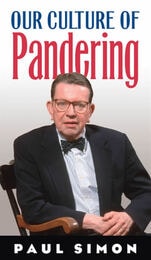
Our Culture of Pandering
Paul Simon
Southern Illinois University Press, 2006
As we broaden our views, embrace our differences, foster advancements in science and technology, and collaboratively strengthen the political, social, and educational underpinnings from which we build informed and productive lives, we have much to be proud of as a nation and as a people.
But we are tempted—particularly during times of political unrest and unbridled patriotism—to ignore the far-reaching repercussions of a society that caters to money and power. In Our Culture of Pandering, former U.S. Senator Paul Simon interrogates the arenas of politics, media, religion, and education to decry the disturbing practices that confuse public service with profit-making ventures or popularity contests, that compromise the best interests of the broader population to appease a powerful few. Boldly and eloquently contributing to a cumulative understanding of how we can build a sturdier, more ethical foundation for the future, Simon suggests proactive, long-term solutions to the problems that threaten our country’s moral, financial, and intellectual well-being—problems that are increasingly exacerbated by our culture of pandering.
Lest we grow complacent and our nation static, Simon urges us to demand more from the political candidates who chase dollar signs and cater to polls, to raise our expectations of local and national media outlets that recycle gossip and peddle scandals while foreign policy and international news receive back-page treatment or no treatment at all. He asks us to consider the implications of churches that spend more money remodeling their buildings than helping those in need within their own communities and throughout the world, and he presses us to acknowledge the staggering, long-term consequences of schools that drop their academic standards to sustain their reputations and maintain funding.
Our Culture of Pandering is a stalwart and earnest call to action from a steadfast and trusted advocate of progressive public policy. Leavened with altruism and rich with compassion for citizens of America and beyond, present and future, this important and cautioning treatise advocates genuine leadership in the realms of politics, media, religion, and education. In his trademark lucid and synoptic style, Simon supplements up-to-date examples of pandering in our society from a breadth of sources with commentary and interpretive wisdom garnered from a lifetime of public service.

Our National Parks
John Muir
University of Wisconsin Press, 2026
Our National Parks is a guidebook supreme, an exciting introduction to Yosemite and several other magnificent parks by the man who, more than any other person, helped create them. After this fast-paced trip with Muir, past visitors to the parks will want to revisit them with new insights, and those who have never wandered these trails will not rest until they have done so.
The book was originally published in 1901, its ten essays having previously appeared as articles in the Atlantic Monthly. Muir wrote them with a single purpose—to entice people, by his descriptions, to come to the parks, to see and enjoy them. If enough people did so, reasoned Muir, they would surely love the wilderness as he did, and the parks would be preserved.
Muir carried out his public relations mission with remarkable success. Every page of this book carries his unbridled and irresistible enthusiasm. Our National Parks is part reminiscence, part philosophy, and mostly enticing description. It is all vintage Muir.
Although the book treats Yellowstone, Sequoia, General Grant, and other national parks of the Western U.S., Muir devotes the bulk of the work to his first love—Yosemite, settled into the heart of the Sierra Nevada. The concluding essay is an impassioned plea to save American forests.
All visitors to the great western national parks—and all who will one day visit them—will be captivated by Muir’s descriptions. The grandeur of this wilderness is reflected in the very spirit of John Muir. Both shine through every page of this remarkable book. Richard F. Fleck’s introduction and Todd Johnson’s foreword for the 125th anniversary edition place Muir’s life and legacy in the environmental movement of the United States in context and reveal how our need for nature and our responsibility to public lands remain as important as ever.
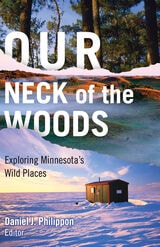
Our Neck of the Woods
Exploring Minnesota's Wild PlacesDaniel J. Philippon
University of Minnesota Press, 2009
What are the odds of finding Minnesota's tiniest orchid? Why take a Breathalyzer test to study frogs? How does ice fishing warm the heart? Who would live in such a cold, lean region? Our Neck of the Woods takes on these and other urgent (and sometimes quirky) questions, showcasing writers' own experiences in the best-loved places in Minnesota, including the North Shore, Lake Bemidji, the western prairies and grasslands, the Boundary Waters, and the Mesabi Iron Range.
The outdoor experiences described here range from sweeping natural history observations to adventurous tales of coming-of-age camping and hunting trips. We follow notable writers and conservationists Sigurd F. Olson, Paul Gruchow, Bill Holm, Jan Zita Grover, Greg Breining, Laurie Allmann, and many others as they descend a frozen river toward Lake Superior, explore a crystalline palace at minus 20 degrees, and trace a family's history along the Mississippi River. Writing on such themes as embracing winter, making camp, and finding wildness even amid development, these authors tell of hunting, fishing, birding, canoeing, and other great outdoor activities that help define what it means to be Minnesotan.
Drawn from the pages of Minnesota Conservation Volunteer magazine-published by the Department of Natural Resources since 1940-these writings evoke a strong sense of place and suggest that the outdoor experiences we share with others come to mean the most to us. With rich observations and spirited tales, Our Neck of the Woods beckons Minnesotans to work, play, and explore in the natural places close to their homes and hearts.
Our Primary Expertise
A Future for the Study of ReligionRussell T. McCutcheon
Rutgers University Press, 2026