Results by title
338 books match the query 'Ethnology' and 7 start with o
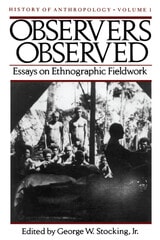
Observers Observed
Essays on Ethnographic FieldworkEdited by George W. Stocking, Jr.
University of Wisconsin Press, 1985

On Not Dying
Secular Immortality in the Age of TechnoscienceAbou Farman
University of Minnesota Press, 2020
An ethnographic exploration of technoscientific immortality
Immortality has long been considered the domain of religion. But immortality projects have gained increasing legitimacy and power in the world of science and technology. With recent rapid advances in biology, nanotechnology, and artificial intelligence, secular immortalists hope for and work toward a future without death.
On Not Dying is an anthropological, historical, and philosophical exploration of immortality as a secular and scientific category. Based on an ethnography of immortalist communities—those who believe humans can extend their personal existence indefinitely through technological means—and an examination of other institutions involved at the end of life, Abou Farman argues that secular immortalism is an important site to explore the tensions inherent in secularism: how to accept death but extend life; knowing the future is open but your future is finite; that life has meaning but the universe is meaningless. As secularism denies a soul, an afterlife, and a cosmic purpose, conflicts arise around the relationship of mind and body, individual finitude and the infinity of time and the cosmos, and the purpose of life. Immortalism today, Farman argues, is shaped by these historical and culturally situated tensions. Immortalist projects go beyond extending life, confronting dualism and cosmic alienation by imagining (and producing) informatic selves separate from the biological body but connected to a cosmic unfolding.
On Not Dying interrogates the social implications of technoscientific immortalism and raises important political questions. Whose life will be extended? Will these technologies be available to all, or will they reproduce racial and geopolitical hierarchies? As human life on earth is threatened in the Anthropocene, why should life be extended, and what will that prolonged existence look like?
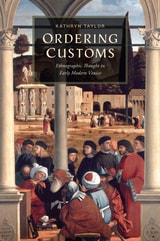
Ordering Customs
Ethnographic Thought in Early Modern VeniceKathryn Taylor
University of Delaware Press, 2023
Orientalists, Propagandists, and Ilustrados
Filipino Scholarship and the End of Spanish ColonialismMegan C. Thomas
University of Minnesota Press, 2012
The writings of a small group of scholars known as the ilustrados are often credited for providing intellectual grounding for the Philippine Revolution of 1896. Megan C. Thomas shows that the ilustrados’ anticolonial project of defining and constructing the “Filipino” involved Orientalist and racialist discourses that are usually ascribed to colonial projects, not anticolonial ones. According to Thomas, the work of the ilustrados uncovers the surprisingly blurry boundary between nationalist and colonialist thought.
By any measure, there was an extraordinary flowering of scholarly writing about the peoples and history of the Philippines in the decade or so preceding the revolution. In reexamining the works of the scholars José Rizal, Pardo de Tavera, Isabelo de los Reyes, Pedro Paterno, Pedro Serrano Laktaw, and Mariano Ponce, Thomas situates their writings in a broader account of intellectual ideas and politics migrating and transmuting across borders. She reveals how the ilustrados both drew from and refashioned the tools and concepts of Orientalist scholarship from Europe.
Interrogating the terms “nationalist” and “nationalism,” whose definitions are usually constructed in the present and then applied to the past, Thomas offers new models for studying nationalist thought in the colonial world.
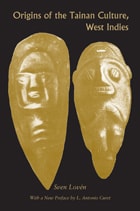
Origins of the Tainan Culture, West Indies
Sven Loven, with a new preface by L. Antonio Curet
University of Alabama Press, 2010
When originally published in German in 1924, this volume was hailed as the first modern, comprehensive archaeological overview of an emerging area of the world. Yes, the Caribbean islands had long been known and owned, occupied, or traded among by the economically advanced nations of the world. However, the original inhabitants—as well as their artifacts, languages, and culture—had been treated by explorers and entrepreneurs alike as either slaves or hindrances to progress, and were used or eliminated. There was no publication that treated seriously the region and the peoples until this work. In the following ten years, additional pertinent publications emerged, along with a request to translate the original into Spanish. Based on those recent publications, Loven decided to update and reissue the work in English, which he thought to be the future international language of scholarship. This work is a classic, with enduring interpretations, broad geographic range, and an eager audience.
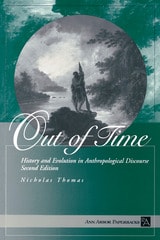
Out of Time
History and Evolution in Anthropological DiscourseNicholas Thomas
University of Michigan Press, 1996
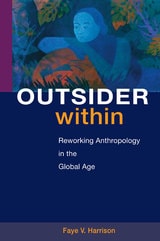
Outsider Within
Reworking Anthropology in the Global AgeFaye Harrison
University of Illinois Press, 2007
Outsider Within presents an approach to critically reconstructing the anthropology discipline to better encompass issues of gender and race. Among the nine key changes to the field that Faye V. Harrison advocates are researching in an ethically and politically responsible manner, promoting greater diversity in the discipline, rethinking theory, and committing to a genuine multicultural dialogue. In drawing from materials developed during her distinguished twenty-five year career in Caribbean and African American studies, Harrison analyzes anthropology’s limits and possibilities from an African American woman’s perspective, while also recognizing similarities between peoples, despite social, cultural, and political differences. In seeking to productively engage anthropologists of diverse geographical, cultural, and national origins, Harrison challenges them to work together to transcend stark gender, racial, and national hierarchies.