Results by title
517 books match the query 'In literature' and 6 start with o
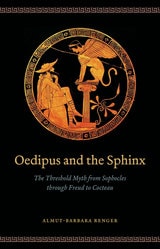
Oedipus and the Sphinx
The Threshold Myth from Sophocles through Freud to CocteauAlmut-Barbara Renger
University of Chicago Press, 2013
Oedipus; or, The Legend of a Conqueror
Marie Delcourt
Michigan State University Press, 2020
Orientalism and Modernism
The Legacy of China in Pound and WilliamsZhaoming Qian
Duke University Press, 1995
Consulting rare and unpublished materials, Qian traces Pound’s and Williams’s remarkable dialogues with the great Chinese poets—Qu Yuan, Li Bo, Wang Wei, and Bo Juyi—between 1913 and 1923. His investigation reveals that these exchanges contributed more than topical and thematic ideas to the Americans’ work and suggests that their progressively modernist style is directly linked to a steadily growing contact and affinity for similar Chinese styles. He demonstrates, for example, how such influences as the ethics of pictorial representation, the style of ellipsis, allusion, and juxtaposition, and the Taoist/Zen–Buddhist notion of nonbeing/being made their way into Pound’s pre-Fenollosan Chinese adaptations, Cathay, Lustra, and the Early Cantos, as well as Williams’s Sour Grapes and Spring and All. Developing a new interpretation of important work by Pound and Williams, Orientalism and Modernism fills a significant gap in accounts of American Modernism, which can be seen here for the first time in its truly multicultural character.
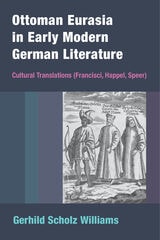
Ottoman Eurasia in Early Modern German Literature
Cultural Translations (Francisci, Happel, Speer)Gerhild Scholz Williams
University of Michigan Press, 2021
Even a casual perusal of seventeenth-century European print production makes clear that the Turk was on everyone’s mind. Europe’s confrontation of and interaction with the Ottoman Empire in the face of what appeared to be a relentless Ottoman expansion spurred news delivery and literary production in multiple genres, from novels and sermons to calendars and artistic representations. The trans-European conversation stimulated by these media, most importantly the regularly delivered news reports, not only kept the public informed but provided the basis for literary conversations among many seventeenth-century writers, three of whom form the center of this inquiry: Daniel Speer (1636-1707), Eberhard Werner Happel (1647-1690), and Erasmus Francisci (1626-1694). The expansion of the Ottoman Empire during the sixteenth and seventeenth centuries offers the opportunity to view these writers' texts in the context of Europe and from a more narrowly defined Ottoman Eurasian perspective.
Ottoman Eurasia in Early Modern German Literature: Cultural Translations (Francisci, Happel, Speer) explores the variety of cultural and commercial conversations between Europe and Ottoman Eurasia as they negotiated their competing economic and hegemonic interests. Brought about by travel, trade, diplomacy, and wars, these conversations were, by definition, “cross-cultural” and diverse. They eroded the antagonism of “us and them,” the notion of the European center and the Ottoman periphery that has historically shaped the view of European-Ottoman interactions.
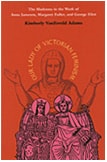
Our Lady Of Victorian Feminism
The Madonna in the Work of Anna Jameson, Margaret Fuller, and George EliotKimberly VanEsveld Adams
Ohio University Press, 2000
Our Lady of Victorian Feminism is about three nineteenth-century women, Protestants by background and feminists by conviction, who are curiously and crucially linked by their extensive use of the Madonna in arguments designed to empower women.
In the field of Victorian studies, few scholars have looked beyond the customary identification of the Christian Madonna with the Victorian feminine ideal—the domestic Madonna or the Angel in the House. Kimberly VanEsveld Adams shows, however, that these three Victorian writers made extensive use of the Madonna in feminist arguments. They were able to see this figure in new ways, freely appropriating the images of independent, powerful, and wise Virgin Mothers.
In addition to contributions in the fields of literary criticism, art history, and religious studies, Our Lady of Victorian Feminism places a needed emphasis on the connections between the intellectuals and the activists of the nineteenth-century women's movement. It also draws attention to an often neglected strain of feminist thought, essentialist feminism, which proclaimed sexual equality as well as difference, enabling the three writers to make one of their most radical arguments, that women and men are made in the image of the Virgin Mother and the Son, the two faces of the divine.
Ovid's Literary Loves
Influence and Innovation in the AmoresBarbara Weiden Boyd
University of Michigan Press, 1997
Boyd's thoughtful approach to imitation in Latin poetry brings into prominence the formative role played by Virgil in shaping Ovid's "poetic memory," even in the Amores. The detailed examination of Ovidian extended similes shows how the poet exploits the literary past precisely in order to free himself from generic restraint and to expand the narrow horizons of elegy. Boyd argues that this paradox is the essence of Ovidian poetics.
Ovid's Literary Loves is an imaginative approach to imitation in Latin poetry and makes a significant contribution to current discussions of the subject. This is one of the first contemporary scholarly monographs on the Amores, and it will find a large and welcoming audience of Latinists at all levels of study.
Barbara Weiden Boyd is Associate Professor of Classics, Bowdoin College, Brunswick, Maine.