Results by title
171 books match the query 'Labor unions' and 11 start with o
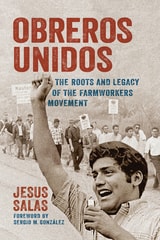
Obreros Unidos
The Roots and Legacy of the Farmworkers MovementJesus Salas
Wisconsin Historical Society Press, 2023
Taking inspiration from César Chávez, as a young man Salas and others led a historic march from Wautoma to Madison to demand that lawmakers address rampant violations of Wisconsin’s minimum wage laws and housing codes. These young labor leaders founded Obreros Unidos—Workers United—to continue the fight for fairness and respect, as well as to provide much-needed services to migrant families. This memoir of a movement details how their work went beyond the fields to have lasting impacts on representation in community organizations and access to education, empowering later generations to demand better.
Winner of the 2024 Benjamin Franklin Award for Multicultural Books
Winner of the 2024 Hamlin Garland Prize in Popular History from the Midwest History Association
“In recounting the story of Tejano settlement and struggle in Wisconsin, Salas unsettles this story line and, in the process, demonstrates the power of personal narrative and the lasting political implications of retrieving and restoring Latino history.”
—Sergio M. González, author of Mexicans in Wisconsin
“Salas’s story is an essential chapter in the history of Wisconsin and Milwaukee and mirrors the growth, progress and dreams of the Latinx community. His reflections speak to not only the importance of the Latinx community, but the need to build alliances across lines of race and gender and fulfill the promise of a multiracial democracy.”
—Barbara Miner, Milwaukee Magazine
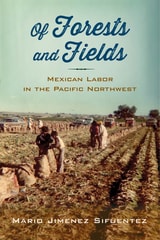
Of Forests and Fields
Mexican Labor in the Pacific NorthwestMario Jimenez Sifuentez
Rutgers University Press, 2016
Just looking at the Pacific Northwest’s many verdant forests and fields, it may be hard to imagine the intense work it took to transform the region into the agricultural powerhouse it is today. Much of this labor was provided by Mexican guest workers, Tejano migrants, and undocumented immigrants, who converged on the region beginning in the mid-1940s. Of Forests and Fields tells the story of these workers, who toiled in the fields, canneries, packing sheds, and forests, turning the Pacific Northwest into one of the most productive agricultural regions in the country.
On the Waves of Empire
U.S. Imperialism and Merchant Sailors, 1872-1924William D. Riddell
University of Illinois Press, 2023
Sophisticated and innovative, On the Waves of Empire reveals how maritime labor and shipping capital stitched together, tore apart, and re-stitched the seams of empire.
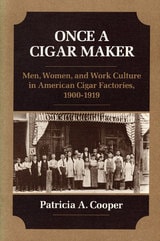
Once a Cigar Maker
Men, Women, and Work Culture in American Cigar Factories, 1900-1919Patricia A. Cooper
University of Illinois Press, 1987
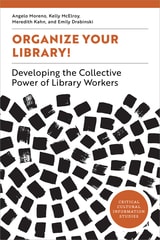
Organize Your Library!
Developing the Collective Power of Library WorkersAngelo Moreno, Kelly McElroy, Meredith Kahn, and Emily Drabinski
American Library Association, 2025
Interest in unions and the real, day-to-day benefits they secure for employees is on the rise—including among library workers, who are beginning to realize that on their own they have little leverage. But with a union they have the power of numbers, and their working conditions are decided by a collectively negotiated agreement rather than by the malleable judgement of an individual administrator or library board. This handbook will equip readers with the knowledge, skills, and strategies necessary for organizing and maintaining a union at their library. Peppered throughout by illuminating stories from successful library union leaders and members, this book
- discusses why library workers need unions and explores some of the benefits that a collective bargaining agreement can assure, such as job security, increased salaries, codification of the rules for overtime pay and time off, and protection from harassment by patrons;
- explains why a contract won't limit employees' autonomy;
- walks readers through how to launch a union drive, including the basics of talking with co-workers, combating apathy and fear, and running a campaign;
- offers an overview of the steps involved in building a new union, from forming an organizing committee to getting recognition and setting up a governance structure;
- sketches out the key issues relating to contracts, the details of bargaining and negotiation, and arbitration;
- lays out approaches and strategies for dealing with supervisors and administrators in the context of your union work, including effective communication between labor and management, contract enforcement, and handling bad behavior such as unfair labor practices and retaliation;
- gives advice on pursuing changes in your workplace in a right-to-work state;
- explores the constructive roles that bosses can play to support the union efforts of the workers who organize them; and
- provides an Action Plan at the end of each chapter with suggested readings, questions for reflection, and activities designed to help deepen your knowledge, broaden your network, and practice important skills.
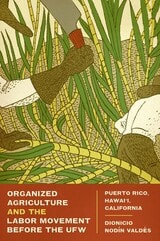
Organized Agriculture and the Labor Movement before the UFW
Puerto Rico, Hawai’i, CaliforniaBy Dionicio Nodín Valdés
University of Texas Press, 2011
Puerto Rico, Hawai'i, and California share the experiences of conquest and annexation to the United States in the nineteenth century and mass organizational struggles by rural workers in the twentieth. Organized Agriculture and the Labor Movement before the UFW offers a comparative examination of those struggles, which were the era's longest and most protracted campaigns by agricultural workers, supported by organized labor, to establish a collective presence and realize the fruits of democracy.
Dionicio Nodín Valdés examines critical links between the earlier conquests and the later organizing campaigns while he corrects a number of popular misconceptions about agriculture, farmworkers, and organized labor. He shows that agricultural workers have engaged in continuous efforts to gain a place in the institutional life of the nation, that unions succeeded before the United Farm Workers and César Chávez, and that the labor movement played a major role in those efforts. He also offers a window into understanding crucial limitations of institutional democracy in the United States, and demonstrates that the widespread lack of participation in the nation's institutions by agricultural workers has not been due to a lack of volition, but rather to employers' continuous efforts to prevent worker empowerment.
Organized Agriculture and the Labor Movement before the UFW demonstrates how employers benefitted not only from power and wealth, but also from imperialism in both its domestic and international manifestations. It also demonstrates how workers at times successfully overcame growers' advantages, although they were ultimately unable to sustain movements and gain a permanent institutional presence in Puerto Rico and California.
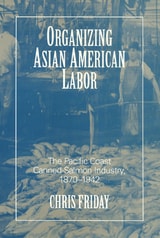
Organizing Asian-American Labor
The Pacific Coast Canned-Salmon Industry, 1870-1942Chris Friday
Temple University Press, 1995
Between 1870 and 1942, successive generations of Asians and Asian Americans—predominantly Chinese, Japanese, and Filipino—formed the predominant body of workers in the Pacific Coast canned-salmon industry.
This study traces the shifts in the ethnic and gender composition of the cannery labor market from its origins through it decline and examines the workers' creation of work cultures and social communities. Resisting the label of cheap laborer, these Asian American workers established formal and informal codes of workplace behavior, negotiated with contractors and recruiters, and formed alliances to organize the workforce.
Whether he is discussing Japanese women workers' sharing of child-care responsibilities or the role of Filipino workers in establishing the Cannery and Field Workers Union, Chris Friday portrays Asian and Asian American workers as people who, while enduring oppressive restrictions, continually attempted to shape their own lives.
In the series Asian American History and Culture, edited by Sucheng Chan, David Palumbo-Liu, Michael Omi, K. Scott Wong, and Linda Trinh Võ.
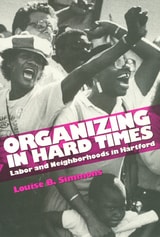
Organizing In Hard Times
Labor and Neighborhoods In HartfordLouise B. Simmons
Temple University Press, 1994
In 1990, Hartford, Connecticut, ranked as the eight poorest city in the country by the census; the real estate market was severely depressed; downtown insurance companies were laying off and the retail department stores were closing; public services were strained; and demolition sites abandoned for lack of funds pockmarked the streets. Hartford's problems are typical of those experienced in numerous U.S. cities affected by a lingering recession.
The harsh economic times felt throughout the city's workplaces and neighborhoods precipitated the formation of grassroots alliances between labor and community organizations. Coming together to create new techniques, their work has national implications for the development of alternative strategies for stimulating economic recovery.
Louise B. Simmons, a former Hartford City Councilperson, offers an insider's view of these coalitions, focusing on three activist unions—rhe New England Health Care Employees Union, the Hotel and Restaurant Employees, and the United Auto Workers—and three community groups—Hartford Areas Rally Together, Organized North Easterners-Clay Hill and North End, and Asylum Hill Organizing Project. Her in-depth analysis illustrates these groups' successes and difficulties in working together toward a new vision of urban politics.
In the series Labor and Social Change, edited by Paula Rayman and Carmen Sirianni.
Organizing Insurgency
Workers' Movements in the Global SouthImmanuel Ness
Pluto Press, 2021
Organizing Workers in the Shadow of Slavery
Global Inequality, Racial Boundaries, and the Rise of Unions in American and British Capitalism, 1870–1929Rudi Batzell
University of Chicago Press, 2025
During the rise of the labor movement in the late nineteenth century, why were American workers unable to organize inclusive trade unions like those formed by their counterparts in the United Kingdom? Comparing American and British capitalism in the port cities of Baltimore and Liverpool and the steel cities of Pittsburgh and Sheffield, Rudi Batzell reveals that the answer lies in the legacies of slavery and entrenched structures of racial inequality. Strikebreaking succeeded more often in the United States because landless Black Americans were, out of economic desperation, more likely to become scabs and fracture the class solidarity of any union movement. Batzell shows, in short, how racism was and is deeply connected to class, migration, and capitalism in a global economy marked by slavery and empire. In emphasizing the geography of economic inequality, this book offers new clarity on the late-nineteenth-century successes and failures of working-class formation. More broadly, Organizing Workers in the Shadow of Slavery makes it clear that the pursuit of justice today will require sustained economic reparations for slavery and colonialism.
Out in the Union
A Labor History of Queer AmericaMiriam Frank
Temple University Press, 2015
Out in the Union tells the continuous story of queer American workers from the mid-1960s through 2013. Miriam Frank shrewdly chronicles the evolution of labor politics with queer activism and identity formation, showing how unions began affirming the rights of lesbian, gay, bisexual, and transgender workers in the 1970s and 1980s. She documents coming out on the job and in the union as well as issues of discrimination and harassment, and the creation of alliances between unions and LGBT communities.
Featuring in-depth interviews with LGBT and labor activists, Frank provides an inclusive history of the convergence of labor and LGBT interests. She carefully details how queer caucuses in local unions introduced domestic partner benefits and union-based AIDS education for health care workers-innovations that have been influential across the U.S. workforce. Out in the Union also examines organizing drives at queer workplaces, campaigns for marriage equality, and other gay civil rights issues to show the enduring power of LGBT workers.