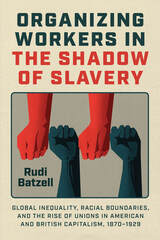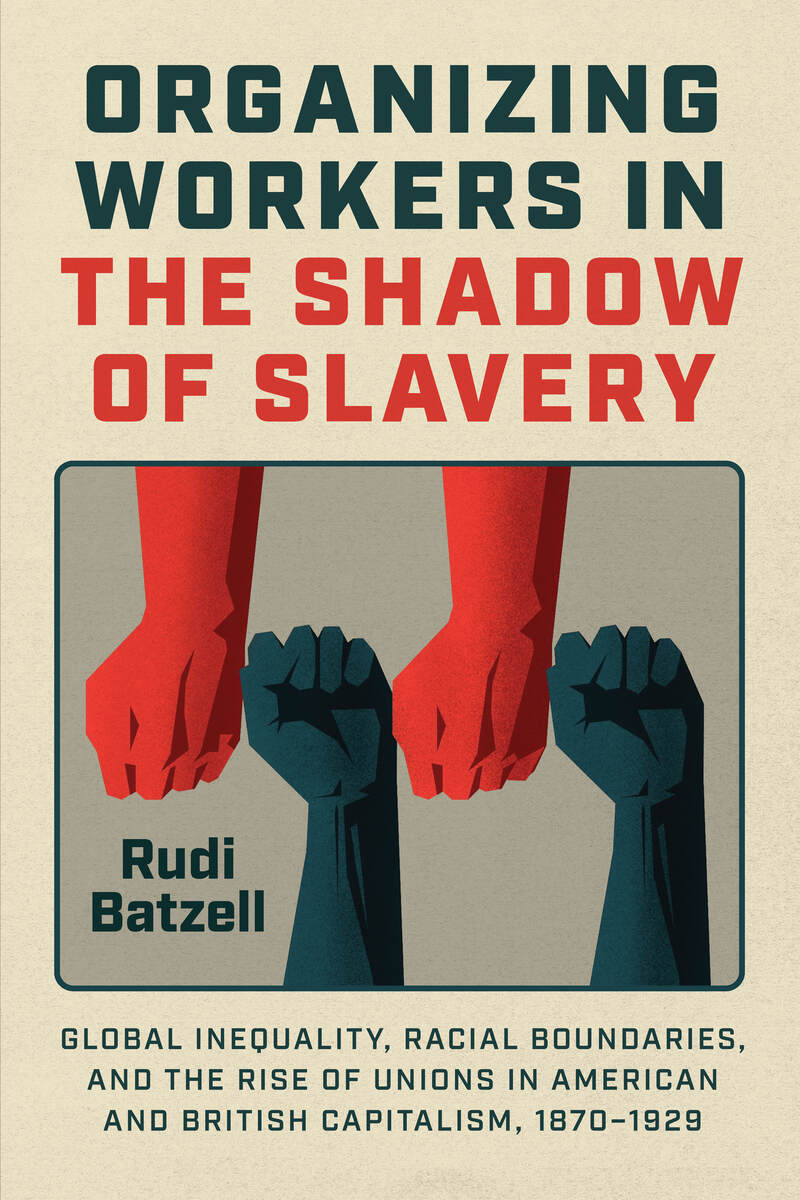
Organizing Workers in the Shadow of Slavery: Global Inequality, Racial Boundaries, and the Rise of Unions in American and British Capitalism, 1870–1929
University of Chicago Press, 2025
Cloth: 978-0-226-83876-2 | Paper: 978-0-226-83878-6 | eISBN: 978-0-226-83877-9 (all)
Library of Congress Classification HD6508.B38 2025
Dewey Decimal Classification 331.880973
Cloth: 978-0-226-83876-2 | Paper: 978-0-226-83878-6 | eISBN: 978-0-226-83877-9 (all)
Library of Congress Classification HD6508.B38 2025
Dewey Decimal Classification 331.880973
ABOUT THIS BOOK | AUTHOR BIOGRAPHY | REVIEWS | TOC | REQUEST ACCESSIBLE FILE
ABOUT THIS BOOK
An original analysis of the relationship between slavery and the labor movement in the late-nineteenth and early twentieth centuries.
During the rise of the labor movement in the late nineteenth century, why were American workers unable to organize inclusive trade unions like those formed by their counterparts in the United Kingdom? Comparing American and British capitalism in the port cities of Baltimore and Liverpool and the steel cities of Pittsburgh and Sheffield, Rudi Batzell reveals that the answer lies in the legacies of slavery and entrenched structures of racial inequality. Strikebreaking succeeded more often in the United States because landless Black Americans were, out of economic desperation, more likely to become scabs and fracture the class solidarity of any union movement. Batzell shows, in short, how racism was and is deeply connected to class, migration, and capitalism in a global economy marked by slavery and empire. In emphasizing the geography of economic inequality, this book offers new clarity on the late-nineteenth-century successes and failures of working-class formation. More broadly, Organizing Workers in the Shadow of Slavery makes it clear that the pursuit of justice today will require sustained economic reparations for slavery and colonialism.
During the rise of the labor movement in the late nineteenth century, why were American workers unable to organize inclusive trade unions like those formed by their counterparts in the United Kingdom? Comparing American and British capitalism in the port cities of Baltimore and Liverpool and the steel cities of Pittsburgh and Sheffield, Rudi Batzell reveals that the answer lies in the legacies of slavery and entrenched structures of racial inequality. Strikebreaking succeeded more often in the United States because landless Black Americans were, out of economic desperation, more likely to become scabs and fracture the class solidarity of any union movement. Batzell shows, in short, how racism was and is deeply connected to class, migration, and capitalism in a global economy marked by slavery and empire. In emphasizing the geography of economic inequality, this book offers new clarity on the late-nineteenth-century successes and failures of working-class formation. More broadly, Organizing Workers in the Shadow of Slavery makes it clear that the pursuit of justice today will require sustained economic reparations for slavery and colonialism.
See other books on: Discrimination in employment | Global Inequality | Labor unions | Racial Boundaries | Shadow
See other titles from University of Chicago Press