Results by title
1917 books match the query 'Law' and 32 start with o
Obligations in Roman Law
Past, Present, and FutureEdited by Thomas A. J. McGinn
University of Michigan Press, 2013
Long a major element of classical studies, the examination of the laws of the ancient Romans has gained momentum in recent years as interdisciplinary work in legal studies has spread. Two resulting issues have arisen, on one hand concerning Roman laws as intellectual achievements and historical artifacts, and on the other about how we should consequently conceptualize Roman law.
Drawn from a conference convened by the volume's editor at the American Academy in Rome addressing these concerns and others, this volume investigates in detail the Roman law of obligations—a subset of private law—together with its subordinate fields, contracts and delicts (torts). A centuries-old and highly influential discipline, Roman law has traditionally been studied in the context of law schools, rather than humanities faculties. This book opens a window on that world.
Roman law, despite intense interest in the United States and elsewhere in the English-speaking world, remains largely a continental European enterprise in terms of scholarly publications and access to such publications. This volume offers a collection of specialist essays by leading scholars Nikolaus Benke, Cosimo Cascione, Maria Floriana Cursi, Paul du Plessis, Roberto Fiori, Dennis Kehoe, Carla Masi Doria, Ernest Metzger, Federico Procchi, J. Michael Rainer, Salvo Randazzo, and Bernard Stolte, many of whom have not published before in English, as well as opening and concluding chapters by editor Thomas A. J. McGinn.
Obscenity and the Limits of Liberalism
Edited by Loren Glass and Charles Francis Williams
The Ohio State University Press, 2011
Over the course of the nineteenth century in both Europe and the United States, the state usurped the traditional authority of the church in regulating sexual expression and behavior. In the same century philosophers of classical liberalism identified that state function as a threat to individual liberty. Since then, liberalism has provided the framework for debates over obscenity around the globe.
Occupy
Three Inquiries in DisobedienceW. J. T. Mitchell, Bernard E. Harcourt, and Michael Taussig
University of Chicago Press, 2013

Ocean Yearbook, Volume 16
Edited by Elisabeth Mann Borgese, Aldo Chircop, and Moira L. McConnell
University of Chicago Press, 2002
Selected Documents and Proceedings include:
Report of the International Ocean Institute 1999 - 2000
Oceans and the Law of the Sea Report of the Secretary General, 2000
UN Convention on the Law of the Sea Report
The Hamburg Declaration on the Ocean
The Fiji Declaration on Islands in the New Millennium
The Appendix includes a Directory of Oceans-related Institutions
Since its inception in 1978, the Ocean Yearbook has proven an invaluable research tool to marine biologists, oceanographers, ocean development specialists, students of international law, as well as analysts of foreign policy and international security.
Ocean Yearbook, Volume 17
Edited by Elisabeth Mann Borgese, Aldo Chircop, and Moira L. McConnell
University of Chicago Press, 2003
Ocean Yearbook is a collaborative initiative of the International Ocean Institute and the Marine and Environmental Law Programme at Dalhousie University Law School.
Ocean Yearbook, Volume 18
Edited by Aldo Chircop and Moira L. McConnell
University of Chicago Press, 2004
The Ocean Yearbook is an invaluable research tool for marine biologists, oceanographers, students of international law, and analysts of foreign policy and international security.
Oh, What a Loansome Time I Had
The Civil War Letters of Major William Morel Moxley, Eighteenth Alabama Infantry, and Emily Beck MoxleyEmily Beck Moxley
University of Alabama Press, 2002
Most surviving correspondence of the Civil War period was written by members of a literate, elite class; few collections exist in which the woman's letters to her soldier husband have been preserved. Here, in the exchange between William and Emily Moxley, a working-class farm couple from Coffee County, Alabama, we see vividly an often-neglected aspect of the Civil War experience: the hardships of civilian life on the home front.
Emily's moving letters to her husband, startling in their immediacy and detail, chronicle such difficulties as a desperate lack of food and clothing for her family, the frustration of depending on others in the community, and her growing terror at facing childbirth without her husband, at the mercy of a doctor with questionable skills. Major Moxley's letters to his wife reveal a decidedly unromantic side of the war, describing his frequent encounters with starvation, disease, and bloody slaughter.

Ohio Canal Era
A Case Study of Government and the Economy, 1820–1861Harry N. Scheiber
Ohio University Press, 2012
Ohio Canal Era, a rich analysis of state policies and their impact in directing economic change, is a classic on the subject of the pre–Civil War transportation revolution. This edition contains a new foreword by scholar Lawrence M. Friedman, Professor of Law, Stanford Law School, and a bibliographic note by the author.
Professor Scheiber explores how Ohio—as a “public enterprise state,” creating state agencies and mobilizing public resources for transport innovation and control—led in the process of economic change before the Civil War. No other historical account of the period provides so full and insightful a portrayal of “law in action.” Scheiber reveals the important roles of American nineteenth-century government in economic policy-making, finance, administration, and entrepreneurial activities in support of economic development.
His study is equally important as an economic history. Scheiber provides a full account of waves of technological innovation and of the transformation of Ohio’s commerce, agriculture, and industrialization in an era of hectic economic change. And he tells the intriguing story of how the earliest railroads of the Old Northwest were built and financed, finally confronting the state-owned canal system with a devastating competitive challenge.
Amid the current debate surrounding “privatization,” “deregulation,” and the appropriate use of “industrial policy” by government to shape and channel the economy. Scheiber’s landmark study gives vital historical context to issues of privatization and deregulation that we confront in new forms today.
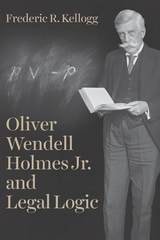
Oliver Wendell Holmes Jr. and Legal Logic
Frederic R. Kellogg
University of Chicago Press, 2018
Conventional legal logic tends to focus on the role of judges in deciding cases. Holmes recognized input from outside the law—the importance of the social dimension of legal and logical induction: how opposing views of “many minds” may converge. Drawing on analogies from the natural sciences, Holmes came to understand law as an extended process of inquiry into recurring problems.
Rather than vagueness or contradiction in the meaning or application of rules, Holmes focused on the relation of novel or unanticipated facts to an underlying and emergent social problem. Where the meaning and extension of legal terms are disputed by opposing views and practices, it is not strictly a legal uncertainty, and it is a mistake to expect that judges alone can immediately resolve the larger issue.
On Interpretive Conflict
John Frow
University of Chicago Press, 2019
On Interpretive Conflict delves into four case studies where sharply different sets of values come into play—gun control, anti-Semitism, the religious force of images, and climate change. In each case, Frow lays out the way these controversies unfold within interpretive regimes that establish what counts as an interpretable object and the protocols of evidence and proof that should govern it. Whether applied to a Shakespeare play or a Supreme Court case, interpretation, he argues, is at once rule-governed and inherently conflictual. Ambitious and provocative, On Interpretive Conflict will attract readers from across the humanities and beyond.
On Transits and Transitions
Trans Migrants and U.S. Immigration LawTristan Josephson
Rutgers University Press, 2023
On the Dignity of Society
Catholic Social Teaching and Natural LawF. Russell Hittinger
Catholic University of America Press, 2024
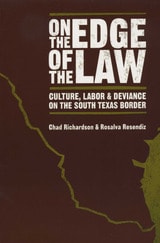
On the Edge of the Law
Culture, Labor, and Deviance on the South Texas BorderBy Chad Richardson and Rosalva Resendiz
University of Texas Press, 2006
The Valley of South Texas is a region of puzzling contradictions. Despite a booming economy fueled by free trade and rapid population growth, the Valley typically experiences high unemployment and low per capita income. The region has the highest rate of drug seizures in the United States, yet its violent crime rate is well below national and state averages. The Valley's colonias are home to the poorest residents in the nation, but their rates of home ownership and intact two-parent families are among the highest in the country for low-income residential areas. What explains these apparently irreconcilable facts?
Since 1982, faculty and students associated with the Borderlife Research Project at the University of Texas-Pan American have interviewed thousands of Valley residents to investigate and describe the cultural and social life along the South Texas-Northern Mexico border. In this book, Borderlife researchers clarify why Valley culture presents so many apparent contradictions as they delve into issues that are "on the edge of the law"—traditional health care and other cultural beliefs and practices, displaced and undocumented workers, immigration enforcement, drug smuggling, property crime, criminal justice, and school dropout rates. The researchers' findings make it plain that while these issues present major challenges for the governments of the United States and Mexico, their effects and contradictions are especially acute on the border, where residents must daily negotiate between two very different economies; health care, school, and criminal justice systems; and worldviews.
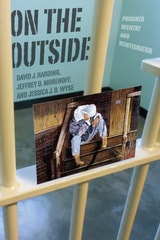
On the Outside
Prisoner Reentry and ReintegrationDavid J. Harding, Jeffrey D. Morenoff, and Jessica J. B. Wyse
University of Chicago Press, 2019
America’s high incarceration rates are a well-known facet of contemporary political conversations. Mentioned far less often is what happens to the nearly 700,000 former prisoners who rejoin society each year. On the Outside examines the lives of twenty-two people—varied in race and gender but united by their time in the criminal justice system—as they pass out of the prison gates and back into the world. The book takes a clear-eyed look at the challenges faced by formerly incarcerated citizens as they try to find work, housing, and stable communities. Standing alongside these individual portraits is a quantitative study conducted by the authors that followed every state prisoner in Michigan who was released on parole in 2003 (roughly 11,000 individuals) for the next seven years, providing a comprehensive view of their postprison neighborhoods, families, employment, and contact with the parole system. On the Outside delivers a powerful combination of hard data and personal narrative that shows why our country continues to struggle with the social and economic reintegration of the formerly incarcerated.
For further information, including an instructor guide and slide deck, please visit: http://ontheoutsidebook.us/home/instructors
One Law for All?
Western Models and Local Practices in (Post-) Imperial ContextsEdited by Stefan B. Kirmse
Campus Verlag, 2012
Examining new archival material from the nineteenth and early twentieth centuries, One Law for All? discusses legal transfer and practice in imperial and post-imperial societies, including Russia, Latin America, Africa, and East Asia. The essays collected here analyze the legal sphere as a site of struggle, both in debate and in everyday life, from the level of universal aspirations to particular local practices. The contributors explore the ways in which both lawmakers and ordinary people talk about and actively use the law, thereby telling a story of contested European hegemony, local assertions, and multiple legal borrowings.
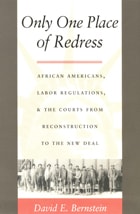
Only One Place of Redress
African Americans, Labor Regulations, and the Courts from Reconstruction to the New DealDavid E. Bernstein
Duke University Press, 2001
A pioneer in applying the insights of public choice theory to legal history, Bernstein contends that the much-maligned jurisprudence of the Lochner era—with its emphasis on freedom of contract and private market ordering—actually discouraged discrimination and assisted groups with little political clout. To support this thesis he examines the motivation behind and practical impact of laws restricting interstate labor recruitment, occupational licensing laws, railroad labor laws, minimum wage statutes, the Davis-Bacon Act, and New Deal collective bargaining. He concludes that the ultimate failure of Lochnerism—and the triumph of the regulatory state—not only strengthened racially exclusive labor unions but contributed to a massive loss of employment opportunities for African Americans, the effects of which continue to this day.
Scholars and students interested in race relations, labor law, and legal or constitutional history will be fascinated by Bernstein’s daring—and controversial—argument.
Operation Fly Trap
L. A. Gangs, Drugs, and the LawSusan A. Phillips
University of Chicago Press, 2012
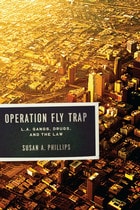
In 2003, an FBI-led task force known as Operation Fly Trap attempted to dismantle a significant drug network in two Bloods-controlled, African American neighborhoods in Los Angeles. The operation would soon be considered an enormous success, noted for the precision with which the task force targeted and removed gang members otherwise entrenched in larger communities. In Operation Fly Trap, Susan A. Phillips questions both the success of this operation and the methods used to conduct it. Based on in-depth ethnographic research with Fly Trap participants, Phillips’s work brings together police narratives, crime statistics, gang cultural histories, and extensive public policy analysis to examine the relationship between state persecution and the genesis of violent social systems.
Crucial to Phillips’s contribution is the presentation of the voices and perspectives of both the people living in impoverished communities and the agents that police them. Phillips positions law enforcement surveillance and suppression as a critical point of contact between citizen and state. She tracks the bureaucratic workings of police and FBI agencies and the language, ideologies, and methods that prevail within them, and shows how gangs have adapted, seeking out new locations, learning to operate without hierarchies, and moving their activities more deeply underground. Additionally, she shows how the targeted efforts of task forces such as Fly Trap wreak sweeping, sustained damage on family members and the community at large. Balancing her roles as even-handed reporter and public scholar, Phillips presents multiple flaws within the US criminal justice system and builds a powerful argument that many law enforcement policies in fact nurture, rather than prevent, violence in American society.
Operation Mind
A Brief Documentary Account of the House Committee on Un-American Activities. And Why It Matters Now.Natalie Zemon Davis and Elizabeth Douvan
Disobedience Press, 2025
The 2025 reprint of Operation Mind offers a foreword by comparatist Silke-Maria Weineck, an essay by historian Alan Wald connecting Operation Mind’s history of McCarthyism with present-day attacks on academic freedom, and a new (2023) introduction to the text by Natalie Zemon Davis.

Opposing Patriarchy
Women and the Law in Action in Pre-Unification Italy (1815–1865)Sara Delmedico
University of London Press, 2021
In Italy and beyond, the nineteenth century was a time of great political change. Shifts in state boundaries and socio-economic structures deeply affected the Italian political landscape, including the nation’s legal system. Many Italian women, who had lived within a strict patriarchal and hierarchical society, began to redefine their identities beyond the traditional domestic roles of daughter, wife, and mother. This volume charts that process by focusing on women’s attitudes towards the law and their interaction with the legal system. Sara Delmedico seeks to recover the forgotten voices and lives of those ordinary women who, in their everyday lives, reacted against the limitations and constraints imposed upon them by society and who refused to accept their status passively. As this volume shows, the women of the period understood the law, questioned obedience, challenged authority, and stood up for themselves. Even though they did not always achieve their goals, their actions contributed to shaping our present.
Optional Law
The Structure of Legal EntitlementsIan Ayres
University of Chicago Press, 2005
Ayres identifies flaws in the current system and shows how option theory can radically expand and improve the ways that lawmakers structure legal entitlements. An option-based system, Ayres shows, gives parties the option to purchase—or the option to sell—the relevant legal entitlement. Choosing to exercise a legal option forces decisionmakers to reveal information about their own valuation of the entitlement. And, as with auctions, entitlements in option-based law naturally flow to those who value them the most. Seeing legal entitlements through this lens suggests a variety of new entitlement structures from which lawmakers might choose. Optional Law provides a theory for determining which structure is likely to be most effective in harnessing parties' private information.
Proposing a practical approach to the foundational question of how to allocate and protect legal rights, Optional Law will be applauded by legal scholars and professionals who continue to seek new and better ways of fostering both equitable and efficient legal rules.
Oral Arguments and Coalition Formation on the U.S. Supreme Court
A Deliberate DialogueRyan C. Black, Timothy R. Johnson, and Justin Wedeking
University of Michigan Press, 2014
The U.S. Supreme Court, with its controlled, highly institutionalized decision-making practices, provides an ideal environment for studying coalition formation. The process begins during the oral argument stage, which provides the justices with their first opportunity to hear one another's attitudes and concerns specific to a case. This information gathering allows them eventually to form a coalition.
In order to uncover the workings of this process, the authors analyze oral argument transcripts from every case decided from 1998 through 2007 as well as the complete collection of notes kept during oral arguments by Justice Lewis F. Powell and Justice Harry A. Blackmun. Both justices clearly monitored their fellow justices' participation in the discussion and used their observations to craft opinions their colleagues would be likely to support. This study represents a major step forward in the understanding of coalition formation, which is a crucial aspect of many areas of political debate and decision making.
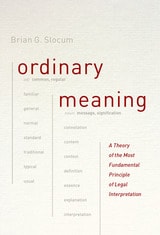
Ordinary Meaning
A Theory of the Most Fundamental Principle of Legal InterpretationBrian G. Slocum
University of Chicago Press, 2015
Legal interpretation is built around one key question: by what standard should legal texts be interpreted? The traditional doctrine is that words should be given their “ordinary meaning”: words in legal texts should be interpreted in light of accepted standards of communication. Yet often, courts fail to properly consider context, refer to unsuitable dictionary definitions, or otherwise misconceive how the ordinary meaning of words should be determined. In this book, Brian Slocum builds his argument for a new method of interpretation by asking glaring, yet largely ignored, questions. What makes one particular meaning the “ordinary” one, and how exactly do courts conceptualize the elements of ordinary meaning? Ordinary Meaning provides a much-needed, revised framework, boldly instructing those involved with the law in how the components of ordinary meaning should properly be identified and developed in our modern legal system.

Osiris, Volume 36
Therapeutic Properties: Global Medical Cultures, Knowledge, and LawEdited by Helen Tilley
University of Chicago Press Journals, 2021
The contributions draw upon source material from the Americas, Africa, Western Europe, the Caribbean, and Asia to trace the influence of penal and civil codes, courts and constitutions, and patents and intellectual properties on not only health practices but also the very foundations of state-sanctioned medicine. The authors explore, too, how institutions of global governance, including those underpinning empires and trade, have historically created feedback loops that enabled laws and regulatory regimes to spread, amplifying their effects and standardizing approaches to diseases, drugs, professions, personhood, and well-being along the way. Highlighting the payoff of interdisciplinary and transnational analyses, this volume adroitly teases apart how different actors fought to write the rules of global health, rendering certain approaches to life and death irrelevant and invisible, others pathological and punishable by law, and others still, normal and natural.
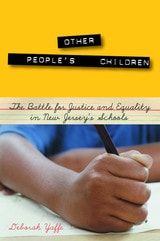
Other People's Children
The Battle for Justice and Equality in New Jersey's SchoolsYaffe, Deborah
Rutgers University Press, 2007
Winner of the 2008 NJ Studies Academic Alliance author's award for an outstanding non-fiction work about New Jersey
In 1981, when Raymond Abbott was a twelve-year-old sixth-grader in Camden, New Jersey, poor city school districts like his spent 25 percent less per student than the state’s wealthy suburbs did. That year, Abbott became the lead plaintiff in a landmark class-action lawsuit demanding that the state provide equal funding for rich and poor schools. Over the next twenty-five years, as the non-profit law firm representing the plaintiffs won ruling after ruling from the New Jersey Supreme Court, Abbott dropped out of school, fought a cocaine addiction, and spent time in prison before turning his life around.
Raymond Abbott’s is just one of the many human stories that have too often been forgotten in the policy battles New Jersey has waged for two generations over equal funding for rich and poor schools. Other People’s Children, the first book to tell the story of this decades-long school funding battle, interweaves the public story—an account of legal and political wrangling over laws and money—with the private stories of the inner-city children who were named plaintiffs in the state’s two school funding lawsuits, Robinson v. Cahill and Abbott v. Burke. Although these cases have shaped New Jersey’s fiscal and political landscape since the 1970s, most recently in legislative arguments over tax reform, the debate has often been too abstract and technical for most citizens to understand. Written in an accessible style and based on dozens of interviews with lawyers, politicians, and the plaintiffs themselves, Other People’s Children crystallizes the arguments and clarifies the issues for general readers.
Beyond its implications for New Jersey, this book is an important contribution to the conversations taking place in all states about the nation’s responsibility for its poor, and the role of public schools in providing equal opportunities and promising upward mobility for hard-working citizens, regardless of race or class.

Our Energy Future
Lincoln Davies
University of Utah Press, 2025
In Our Energy Future, Lincoln Davies shines a bright light on the challenges the transition presents, including energy equity, political partisanship, the need for holistic solutions, and adaptability in the face of change. Our Energy Future makes the case for why the United States’ current transition to clean energy provides our world with something we so desperately need today: hope.
Our Town
Race, Housing, and the Soul of SuburbiaKirp, David L
Rutgers University Press, 1997
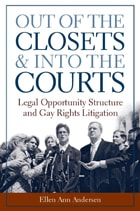
Out of the Closets and into the Courts
Legal Opportunity Structure and Gay Rights LitigationEllen Ann Andersen
University of Michigan Press, 2004
Out of the Closets and into the Courts explores both the promise and the limits of using legal mobilization to effect social change. Crossing disciplinary boundaries, Ellen Andersen draws on the accumulated knowledge of political science, law, and sociology to explain the origins and outcomes of gay rights litigation. The resulting book is essential reading for anyone interested in gay rights, legal change, and social movements.

Outbreak
Foodborne Illness and the Struggle for Food SafetyTimothy D. Lytton
University of Chicago Press, 2019
With Outbreak, Timothy D. Lytton provides an up-to-date history and analysis of the US food safety system. He pays particular attention to important but frequently overlooked elements of the system, including private audits and liability insurance.
Lytton chronicles efforts dating back to the 1800s to combat widespread contamination by pathogens such as E. coli and salmonella that have become frighteningly familiar to consumers. Over time, deadly foodborne illness outbreaks caused by infected milk, poison hamburgers, and tainted spinach have spurred steady scientific and technological advances in food safety. Nevertheless, problems persist. Inadequate agency budgets restrict the reach of government regulation. Pressure from consumers to keep prices down constrains industry investments in safety. The limits of scientific knowledge leave experts unable to assess policies’ effectiveness and whether measures designed to reduce contamination have actually improved public health. Outbreak offers practical reforms that will strengthen the food safety system’s capacity to learn from its mistakes and identify cost-effective food safety efforts capable of producing measurable public health benefits.
Outlawed Pigs
Law, Religion, and Culture in IsraelDaphne Barak-Erez
University of Wisconsin Press, 2007
Daphne Barak-Erez specifically traces the course of two laws, one that authorized municipalities to ban the possession and trading in pork within their jurisdiction and another law that forbids pig breeding throughout Israel, except for areas populated mainly by Christians. Her analysis offers a comprehensive, decade-by-decade discussion of the overall relationship between law and culture since the inception of the Israeli nation-state.
By examining ever-fluctuating Israeli popular opinion on Israel's two laws outlawing the trade and possession of pigs, Barak-Erez finds an interesting and accessible way to explore the complex interplay of law, religion, and culture in modern Israel, and more specifically a microcosm for the larger question of which lies more at the foundation of Israeli state law: religion or cultural tradition.
Overseers of the Poor
Surveillance, Resistance, and the Limits of PrivacyJohn Gilliom
University of Chicago Press, 2001
This powerful book lets us in on the conversations of low-income mothers from Appalachian Ohio as they talk about the welfare bureaucracy and its remarkably advanced surveillance system. In their struggle to care for their families, these women are monitored and assessed through a vast network of supercomputers, caseworkers, fraud control agents, and even grocers and neighbors.
In-depth interviews show that these women focus less on the right to privacy than on a critique of surveillance that lays bare the personal and political conflicts with which they live. And, while they have little interest in conventional forms of politics, we see widespread patterns of everyday resistance as they subvert the surveillance regime when they feel it prevents them from being good parents. Ultimately, Overseers of the Poor demonstrates the need to reconceive not just our understanding of the surveillance-privacy debate but also the broader realms of language, participation, and the politics of rights.
We all know that our lives are being watched more than ever before. As we struggle to understand and confront this new order, Gilliom argues, we need to spend less time talking about privacy rights, legislatures, and courts of law and more time talking about power, domination, and the ongoing struggles of everyday people.
Overturned
The Rhetoric of Overruling in the United States Supreme CourtClarke Rountree
University of Alabama Press, 2025
A timely and lively summary and analysis of the Supreme Court’s justifications for overruling nearly 300 prior rulings in its history
An audacious US Supreme Court is overturning a number of long-standing precedents, and Overturned offers a lively account of the court’s history of overturning prior cases and examples and analyses of 300 cases overruled in its history.
The immense controversy surrounding the case of Dobbs v. Jackson Women’s Health Organization in 2022, which overruled Roe v. Wade and erased the constitutional right to abortion in the United States, has focused public attention on how and why the Supreme Court knocks down long-established precedents.
In his vivid and accessible style, scholar Clarke Rountree recounts the rhetorical pirouettes and linguistic acrobatics the court has deployed to explain its reversal of Dobbs and numerous other landmark decisions. He reviews strategies the court uses to undermine a previous court’s standing without undermining its own. He analyzes overrulings across time, by type (constitutional cases versus statutory and common law cases), by the ages of the overturned precedents, with changes in the court’s membership, and through other variables.
Rountree gives engrossing accounts of pivotal overrulings in the past, such as when Lincoln’s Treasury Secretary Salmon Chase used the Legal Tender Act in 1862 to raise money for the Civil War then ruled the same law unconstitutional in 1870 when he served as chief justice. Rountree retells Thomas Edison’s attempt to monopolize the burgeoning film industry, which was stopped only when the Supreme Court overturned an earlier patent-rights case in 1917. Finally, Rountree applies his myriad insights to the politically fraught Dobbs case.
Overturned makes a valuable contribution to law, rhetoric, politics, and history, and readers interested in the role and function of America’s highest court will find Rountree’s account fast-paced, lively, and engaging.
Owning Performance | Performing Ownership
Literary Property and the Eighteenth-Century British StageJane Wessel
University of Michigan Press, 2022
Owning Performance follows the careers of some of the 18th century’s most influential playwrights, actors, and theater managers as they vied for control over the period’s most popular shows. Without protection for dramatic literary property, these figures developed creative extra-legal strategies for controlling the performance of drama—quite literally performing their ownership. Their various strategies resulted in a culture of ephemerality, with many of the period’s most popular works existing only in performance and manuscript copies. Author Jane Wessel explores how playwrights and actors developed strategies for owning their works and how, in turn, theater managers appropriated these strategies, putting constant pressure on artists to innovate. Owning Performance reveals the wide-reaching effects of property law on theatrical culture, tracing a turn away from print that affected the circulation, preservation, and legacy of 18th century drama.