Results by title
8113 books match the query 'Literary Criticism' and 189 start with o
O'Neill's Shakespeare
Normand Berlin
University of Michigan Press, 1993
In O'Neill's Shakespeare , Normand Berlin explores the relationship of William Shakespeare and Eugene O'Neill through detailed, often surprising, intertextual readings of the two great playwrights' work. "Of course, it would have been impossible for O'Neill not to have been influenced by Shakespeare," acknowledges Berlin. But this is an influence of an unusual and extraordinary sort, "a family romance" that transcends their obvious differences—a romance that "takes in all O'Neill's life and art."
In the first book-length study of this crucial literary and dramatic relationship, Berlin probes far beyond the usual listing of allusions and references. This is the exploration of an "essential, basic, even natural" connection, in which Shakespeare is shown to have fundamentally shaped O'Neill's creative imagination. Following O'Neill's career chronologically, Berlin divides his study into two parts. The "first career" (culminating in Mourning Becomes Electra) is explored through recurring themes that evoke Shakespeare: the sea, black and white, and the family. O'Neill's "second career" (from Ah! Wilderness until the last plays) is examined through Shakespearean genre classifications: comedy, history, tragedy, and tragicomedy. Though always grounded in close textual readings, Berlin's analysis spirals outward to encompass O'Neill's artistic and psychological development and touches on the questions of tradition, transcendence, and human nature inevitably raised when such literary connections across history are drawn.
O'Neill's Shakespeare is more than a reminder that Shakespeare continues to haunt Western culture; it is a careful and fascinating analysis of a particular legacy in American drama. The book has insights to offer to specialists in Shakespeare and O'Neill, and to any reader interested in the transmission of ideas through Western culture. Berlin's study of the unconscious and conscious uses of Shakespeare by O'Neill provide a valuable new understanding of O'Neill's artistry. It is also an eloquent, thoughtful account that blends the transcendence of Shakespeare's influence with the particular ways in which every era must refashion Shakespeare so that "the past becomes the present."
Object Lessons
Robyn Wiegman
Duke University Press, 2012
Object Lessons
The Novel as a Theory of ReferenceJami Bartlett
University of Chicago Press, 2016
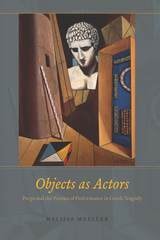
Objects as Actors
Props and the Poetics of Performance in Greek TragedyMelissa Mueller
University of Chicago Press, 2015
As Mueller shows, props such as weapons, textiles, and even letters were often fully integrated into a play’s action. They could provoke surprising plot turns, elicit bold viewer reactions, and provide some of tragedy’s most thrilling moments. Whether the sword of Sophocles’s Ajax, the tapestry in Aeschylus’s Agamemnon, or the tablet of Euripides’s Hippolytus, props demanded attention as a means of uniting—or disrupting—time, space, and genre.
Insightful and original, Objects as Actors offers a fresh perspective on the central tragic texts—and encourages us to rethink ancient theater as a whole.
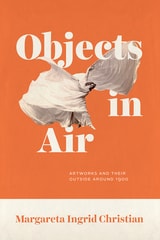
Objects in Air
Artworks and Their Outside around 1900Margareta Ingrid Christian
University of Chicago Press, 2021
Writers created an early theory of unbounded form that described what Christian calls an artwork’s ecstasis or its ability to stray outside its limits and engender its own space. Objects viewed in this perspective complicate the now-fashionable discourse of empathy aesthetics, the attention to self-projecting subjects, and the idea of the modernist self-contained artwork. For example, Christian invites us to historicize the immersive spatial installations and “environments” that have arisen since the 1960s and to consider their origins in turn-of-the-twentieth-century aesthetics. Throughout this beautifully written work, Christian offers ways for us to rethink entrenched narratives of aesthetics and modernism and to revisit alternatives.
Objects of Liberty
British Women Writers and Revolutionary SouvenirsPamela Buck
University of Delaware Press, 2024
Obscene Things
Sexual Politics in Jin Ping MeiNaifei Ding
Duke University Press, 2002
The story of a seductive bondmaid-concubine, sexual opportunism, domestic intrigue, adultery and death, Jin Ping Mei has often been critiqued based on the coherence of the text itself. Concentrating instead on the processes of reading and on the social meaning of this novel, Ding looks at the various ways the tale has been received since its first dissemination, particularly by critiquing the interpretations offered by seventeenth-century Ming literati and by twentieth-century scholars. Confronting the gender politics of this “pornographic” text, she troubles the boundaries between premodern and modern readings by engaging residual and emergent Chinese gender and hierarchic ideologies.
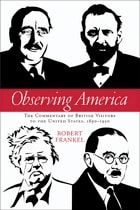
Observing America
The Commentary of British Visitors to the United States, 1890–1950Robert Frankel
University of Wisconsin Press, 2006
Robert Frankel examines the New World experiences of these commentators and the books they wrote about America. He also probes similar writings by other prominent observers from the British Isles, including Beatrice Webb, Rudyard Kipling, and George Bernard Shaw. The result is a book that offers keen insights into America’s national identity in a time of vast political and cultural change.
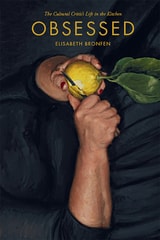
Obsessed
The Cultural Critic’s Life in the KitchenElisabeth Bronfen
Rutgers University Press, 2019
Even the most brilliant minds have to eat. And for some scholars, food preparation is more than just a chore; it’s a passion. In this unique culinary memoir and cookbook, renowned cultural critic Elisabeth Bronfen tells of her lifelong love affair with cooking and demonstrates what she has learned about creating delicious home meals. She recounts her cherished food memories, from meals eaten at the family table in postwar Germany to dinner parties with friends. Yet, in a thoughtful reflection on the pleasures of cooking for one, she also reveals that some of her favorite meals have been consumed alone.
Though it contains more than 250 mouth-watering recipes, Obsessed is anything but a conventional cookbook. As she shares a lifetime of knowledge acquired in the kitchen, Bronfen hopes to empower both novice and experienced home chefs to improvise, giving them hints on how to tweak her recipes to their own tastes. And unlike cookbooks that assume readers have access to an unlimited pantry, this book is grounded in reality, offering practical advice about food storage and reusing leftovers. As Bronfen serves up her personal stories and her culinary wisdom, reading Obsessed is like sitting down to a home-cooked meal with a clever friend.
Obsession, Aesthetics, and the Iberian City
The Partial Madness of Modern Urban CultureBenjamin Fraser
Vanderbilt University Press, 2021
This book investigates the social relationships implied in our urban modernity by concentrating on four cities that are in broad strokes representative of the cultural and linguistic heterogeneity of the Iberian peninsula. Each chapter introduces but moves well beyond an identifiable urban area in a given city, noting the cultural obsession implicit in its reconstruction as well as the role of obsession in its artistic representation of the urban environment. These areas are Barcelona’s Eixample district, Madrid’s Linear City, Lisbon’s central Baixa area, and Bilbao’s Seven Streets, or Zazpikaleak. The theme of obsession—which as explored is synonymous with the concept of partial madness—provides a point of departure for understanding the interconnection of both urbanistic and artistic discourses.

Obsessive Images
Symbolism in Poetry of the 1930s and 1940sJoseph Warren BeachWilliam Van O’Connor, Editor
University of Minnesota Press, 1960
Obsessive Images was first published in 1960. Minnesota Archive Editions uses digital technology to make long-unavailable books once again accessible, and are published unaltered from the original University of Minnesota Press editions.
As Mark Schorer comments, this is "the last, unfinished work of a distinguished, well loved critic, poet, and professor." After the death of Joseph Warren Beach, his colleague and friend William Van O'Connor, professor of English at the University of Minnesota, prepared the unfinished manuscript of this work for publication and wrote the foreword.
The work is primarily a study of certain words, phrases, and images that turn up with unusual frequency in modern American poetry, especially that of the decades of the 1930's and 1940's, and which are used in unusual senses, to carry special symbolisms, or to imply peculiar philosophical attitudes. Since the study is concerned with such recurring images and themes, many poets of distinction, in whose work they are not to be found, are left out, but Professor Beach also discusses the significance of the absence of these poets.
Students and critics will gain insight through this work into the characteristic attitudes of a generation of poets. The book is, moreover, a delight to read, reflecting, as it does, Mr. Beach's own love for the study of poetry. As Professor O'Connor points out, the tone is much more personal than that of Mr. Beach's other books.
Obstruction
Nick Salvato
Duke University Press, 2016
Ocean Passages
Navigating Pacific Islander and Asian American LiteraturesErin Suzuki
Temple University Press, 2021
In her pathbreaking book, Ocean Passages, Erin Suzuki explores how movement through—and travel across—the ocean mediates the construction of Asian American and Indigenous Pacific subjectivities in the wake of the colonial conflicts that shaped the modern transpacific. Ocean Passages considers how Indigenous Pacific scholars have emphasized the importance of the ocean to Indigenous activism, art, and theories of globalization and how Asian American studies might engage in a deconstructive interrogation of race in conversation with this Indigenous-centered transnationalism.
The ocean passages that Suzuki addresses include the U.S. occupation and militarization of ocean space; refugee passage and the history and experiences of peoples displaced from the Pacific Islands; migratory circuits and the labors required to cross the sea; and the different ways that oceans inform postcolonial and settler colonial nationalisms. She juxtaposes work by Indigenous Pacific and Asian American artists and authors including James George, Maxine Hong Kingston, Kathy Jetñil-Kijiner, lê thi diếm thúy, Ruth Ozeki, and Craig Santos Perez. In Ocean Passages, Suzuki explores what new ideas, alliances, and flashpoints might arise when comparing and contrasting Asian and Pacific Islander passages across a shared sea.
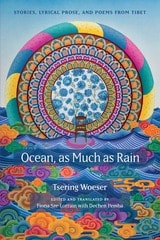
Ocean, as Much as Rain
Stories, Lyrical Prose, and Poems from TibetTsering Woeser. Edited and Translated by Fiona Sze-Lorrain with Dechen Pemba.
Duke University Press, 2026
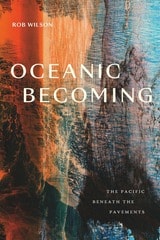
Oceanic Becoming
The Pacific beneath the PavementsRob Wilson
Duke University Press, 2025
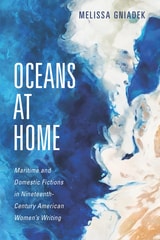
Oceans at Home
Maritime and Domestic Fictions in Nineteenth-Century American Women's WritingMelissa Gniadek
University of Massachusetts Press, 2021
Melissa Gniadek explores the role of the ocean, with particular attention to the Pacific, in a diverse range of literary texts spanning the late 1820s through the mid-1860s from Lydia Maria Child, Caroline Kirkland, Harriet Beecher Stowe, Elizabeth Stoddard, and Harriet Prescott Spofford. Oceans at Home shows that authors employed maritime plots and stories from distant locations to probe contemporary concerns facing the continental United States, ranging from issues of gender restrictions in the domestic sphere to the racial prejudices against indigenous peoples that lay at the heart of settler colonialism.
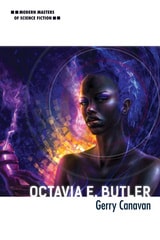
Octavia E. Butler
Gerry Canavan
University of Illinois Press, 2016
Gerry Canavan offers a critical and holistic consideration of Butler's career. Drawing on Butler's personal papers, Canavan tracks the false starts, abandoned drafts, tireless rewrites, and real-life obstacles that fed Butler's frustrations and launched her triumphs. Canavan departs from other studies to approach Butler first and foremost as a science fiction writer working within, responding to, and reacting against the genre's particular canon. The result is an illuminating study of how an essential SF figure shaped themes, unconventional ideas, and an unflagging creative urge into brilliant works of fiction.
Octavio Paz
A MeditationIlan Stavans
University of Arizona Press, 2001
Odd Affinities
Virginia Woolf’s Shadow GenealogiesElizabeth Abel
University of Chicago Press, 2024
In recent decades, Virginia Woolf’s contribution to literary history has been located primarily within a female tradition. Elizabeth Abel dislodges Woolf from her iconic place within this tradition to uncover her shadowy presence in other literary genealogies. Abel elicits unexpected echoes of Woolf in four major writers from diverse cultural contexts: Nella Larsen, James Baldwin, Roland Barthes, and W. G. Sebald. By mapping the wayward paths of what Woolf called “odd affinities” that traverse the boundaries of gender, race, and nationality, Abel offers a new account of the arc of Woolf’s career and the transnational modernist genealogy constituted by her elusive and shifting presence. Odd Affinities will appeal to students and scholars working in New Modernist studies, comparative literature, gender and sexuality studies, and African American studies.
Odes
Horace, Translated with commentary by David R. Slavitt
University of Wisconsin Press, 2014
This edition is also notable for Slavitt’s extensive notes and commentary about the art of translation. He presents the problems he encountered in making the translation, discussing possible solutions and the choices he made among them. The effect of the notes is to bring the reader even closer to the original Latin and to understand better how to gauge the distance between the two languages.

Odyssean Identities in Modern Cultures
The Journey HomeHunter Gardner
The Ohio State University Press, 2014
These retellings raise fresh questions about the relationship between home and the identities we expect to find rooted there and stress the elusiveness of a satisfying homecoming. They remind us that the Odyssey’s happy ending is itself qualified by the hero’s unsettled future, the violence of his return, and the independent desires of his friends and family members. At the same time, they highlight new obstacles to homecoming posed by the modern world with its political and economic upheavals, newly configured family relations and gender roles, and diminished confidence in the stability of identity. The authors discussed include Charlotte Yonge, James Joyce, Virginia Woolf, Rebecca West, George Seferis, Yannis Ritsos, Gwendolyn Brooks, Charles Frazier, W. B. Sebald, Marilynne Robinson, and Zachary Mason.
Odyssey of a Wandering Mind
The Strange Tale of Sara Mayfield, AuthorJennifer Horne
University of Alabama Press, 2024
A carefully rendered portrait of a brilliant but troubled daughter of the Old South who struggled against the conventions of gender, class, family, and ultimately of sanity, yet survived to define a creative life of her own
Sara Mayfield was born into Alabama’s governing elite in 1905 and grew up in a social circle that included Zelda Sayre, Sara Haardt, and Tallulah and Eugenia Bankhead. After winning a Goucher College short story contest judged by H. L. Mencken, Mayfield became friends with Mencken and his circle, then visited with Scott and Zelda Fitzgerald and hobnobbed with the literati while traveling in Europe after a failed marriage. Returning to Alabama during the Depression, she briefly managed the family landholdings before departing for New York City where she became involved in the theater. Inventing a plastic compound while working on theatrical sets, she applied for a patent and set her sights on a livelihood as an inventor and businesswoman. With the advent of World War II, Mayfield returned to her family home in Tuscaloosa where she expanded her experiments, freelanced as a journalist, and doggedly pursued a bizarre series of military and intelligence schemes, prompting temporary hospitalization. In 1945, she mingled with a host of cultural figures, including Frida Kahlo, Diego Rivera, Orson Welles, Rita Hayworth, and even a young John F. Kennedy, while reporting on the creation of the United Nations from Mexico and California. Back in Tuscaloosa after the war, however, she struggled to find her way with both work and family, becoming increasingly paranoid about perceived conspiracies arrayed against her. Finally, her mother and brother committed her to Bryce Hospital for the Insane, where she remained for the next seventeen years.
Throughout her life, Mayfield kept journals, wrote fiction, and produced thousands of letters while nursing the ambition that had driven her since childhood: to write and publish books. During her confinement, Mayfield assiduously recorded her experiences and her determined efforts—sometimes delusional, always savvy—to overturn her diagnosis and return to the world as a sane, independent adult. At 59, she was released from Bryce and later obtained a decree of “having been restored to sanity,” enabling her to manage her own financial affairs and to live how and where she pleased. She went on to publish noteworthy literary biographies of the Menckens and the Fitzgeralds plus a novel based on the life of Mona Lisa, finally achieving her quest to become the author of books and her own life. In Odyssey of a Wandering Mind, noted writer Jennifer Horne draws on years of research and an intimate understanding of the vast archive Sara Mayfield left behind to sensitively render Mayfield’s struggle to move through the world as the person she was—and her ultimate success in surviving to define the terms of her story.
Odyssey of the Psyche
Jungian Patterns in Joyce's UlyssesJean Kimball
Southern Illinois University Press, 1997
The result of the interaction between Bloom and Dedalus, Kimball argues as a central tenet in her unique reading of Ulysses, is the gradual development of a relationship between the two protagonists that parallels C. G. Jung’s descriptions of the encounter between the Ego and the Shadow in that stage of his theoretical individuation process called "the realization of the shadow." These parallels form a unifying strand of meaning that runs throughout this multidimensional novel and is supported by the text and contexts of Ulysses.
Kimball has provided the first comprehensive study of the relationship between Jungian psychology and Joyce’s Ulysses. Bucking critical trends, she focuses on Stephen rather than Bloom. She also notes certain parallels—synchronicities—in the lives of both Jung and Joyce, not because the men influenced one another but because they speculated about personality at the same historical time. Finally, noting that both Jung and Joyce came from strong Christian backgrounds, she asserts that the doubleness of the human personality fundamental to Christian theology is carried over into Jung’s psychology and Joyce’s fiction.
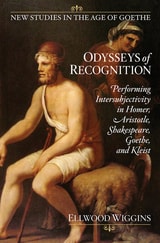
Odysseys of Recognition
Performing Intersubjectivity in Homer, Aristotle, Shakespeare, Goethe, and KleistWiggins, Ellwood
Bucknell University Press, 2019
Published by Bucknell University Press. Distributed worldwide by Rutgers University Press.
Oedipus Rex
David Sophocles
University of Wisconsin Press, 2011
Oedipus Rex is the greatest of the Greek tragedies, a profound meditation on the human condition. The story of the mythological king, who is doomed to kill his father and marry his mother, has resonated in world culture for almost 2,500 years. But Sophocles’ drama as originally performed was much more than a great story—it was a superb poetic script and exciting theatrical experience. The actors spoke in pulsing rhythms with hypnotic forward momentum, making it hard for audiences to look away. Interspersed among the verbal rants and duels were energetic songs performed by the chorus.
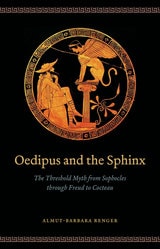
Oedipus and the Sphinx
The Threshold Myth from Sophocles through Freud to CocteauAlmut-Barbara Renger
University of Chicago Press, 2013
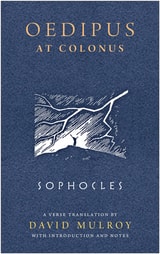
Oedipus at Colonus
Sophocles, A verse translation by David Mulroy, with introduction and notes
University of Wisconsin Press, 2014
As in his previous translations of Oedipus Rex and Antigone, Mulroy combines scrupulous scholarship and textual accuracy with a fresh poetic style. He uses iambic pentameter for spoken passages and short rhymed stanzas for choral songs, resulting in a text that is accessible and fun to read and perform.
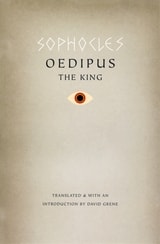
Oedipus the King
Sophocles
University of Chicago Press, 2010
Available for the first time as an independent work, David Grene’s legendary translation of Oedipus the King renders Sophocles’ Greek into cogent, vivid, and poetic English for a new generation to savor. Over the years, Grene and Lattimore’s Complete Greek Tragedies have been the preferred choice of millions of readers—for personal libraries, individual study, and classroom use. This new, stand-alone edition of Sophocles’ searing tale of jealousy, rage, and revenge will continue the tradition of the University of Chicago Press’s classic series.
Praise for David Grene and Richmond Lattimore’s Complete Greek Tragedies
“This is it. No qualifications. Go out and buy it everybody.”—Kenneth Rexroth, Nation
“The translations deliberately avoid the highly wrought and affectedly poetic; their idiom is contemporary. . . . They have life and speed and suppleness of phrase.”—Times Education Supplement
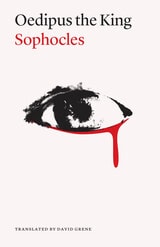
Oedipus the King, Second Edition
Sophocles
University of Chicago Press, 2013
Over the years, David Grene and Richmond Lattimore’s Complete Greek Tragedies have been the preferred translations of millions of readers—for personal libraries, individual study, and classroom use. Drawn from the authoritative third edition of the University of Chicago Press’s classic series, this updated stand-alone edition of Grene’s Oedipus the King renders the original Greek in clear, vivid, and poetic English for a new generation to savor.
Mark Griffith and Glenn W. Most’s introduction to Sophocles’s searing tale of jealousy, rage, and revenge provides essential information about the play’s first production, plot, and reception in antiquity and beyond.
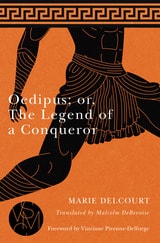
Oedipus; or, The Legend of a Conqueror
Marie Delcourt
Michigan State University Press, 2020
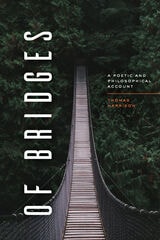
Of Bridges
A Poetic and Philosophical AccountThomas Harrison
University of Chicago Press, 2021
Offers a philosophical history of bridges—both literal bridges and their symbolic counterparts—and the acts of cultural connection they embody.
“Always,” wrote Philip Larkin, “it is by bridges that we live.” Bridges represent our aspirations to connect, to soar across divides. And it is the unfinished business of these aspirations that makes bridges such stirring sights, especially when they are marvels of ingenuity.
A rich compendium of myths, superstitions, and literary and ideological figurations, Of Bridges organizes a poetic and philosophical history of bridges into nine thematic clusters. Leaping in lucid prose between distant times and places, Thomas Harrison questions why bridges are built and where they lead. He probes links forged by religion between life’s transience and eternity as well as the consolidating ties of music, illustrated by the case of the blues. He investigates bridges in poetry, as flash points in war, and the megabridges of our globalized world. He illuminates real and symbolic crossings facing migrants each day and the affective connections that make persons and societies cohere. In readings of literature, film, philosophy, and art, Harrison engages in a profound reflection on how bridges form and transform cultural communities. Of Bridges is a mesmerizing, vertiginous tale of bridges both visible and invisible, both lived and imagined.
Of Farming and Classics
A MemoirDavid Grene
University of Chicago Press, 2006
A fiercely independent thinker, colorful storyteller, and spirited teacher, David Grene devoted his life to two things: farming, which he began as a boy in Ireland and continued into old age; and classics, which he taught for several decades that culminated in his translating and editing, with Richmond Lattimore, of The Complete Greek Tragedies.
In this charming memoir, which he wrote during the years leading up to his death in 2002 at the age of eighty-nine, Grene weaves together these interests to tell a quirky and absorbing story of the sometimes turbulent and always interesting life he split between the University of Chicago—where he helped found the Committee on Social Thought—and the farm he kept back in Ireland.
Charting the path that took him from Europe to Chicago in 1937, and encompassing his sixty-five-year career at the university, Grene’s book draws readers into the heady and invigorating climate of his time there. And it is elegantly balanced with reflections stemming from his work on the farm where he hunted, plowed and regularly traveled on horseback to bring his cows home for milking. Grene’s form and humor are quite his own, and his brilliant storytelling will enthrall anyone interested in the classics, rural Ireland, or twentieth-century intellectual history, especially as it pertains to the University of Chicago.
Of Gardens and Graves
Kashmir, Poetry, PoliticsSuvir Kaul
Duke University Press, 2017
Of Sondry Folk
The Dramatic Principle in the Canterbury TalesBy R. M. Lumiansky
University of Texas Press, 1955
Two hundred years before Shakespeare observed that “all the world’s a stage,” another writer with a flair for drama realized the same fact. This writer was Geoffrey Chaucer.
Chaucer, however, presented his dramatic efforts through the medium of short stories, and he is regularly referred to as one of the world’s great storytellers. Yet there are certain questions which arise time and again in the minds of literary scholars. Most of the tales in the Canterbury collection are excellent, but why did Chaucer include such obviously poor recitals as the dull “Melibeus” and the lengthy “Parson’s Tale”? Did he fail to recognize their lack of literary merit? Or were those of his stories which seem so dull to modern readers really popular in fourteenth-century England?
Of Sondry Folk is Lumiansky’s answer to such questions. But it is more than that. It is the revelation of Chaucer as dramatic writer. Chaucer, says Lumiansky, did not intend primarily to tell a series of good tales. Instead, he chose tales which suited his purpose of dramatic exposition of character. And the characters, though drawn from many walks of life, are not stereotypes. Their tales not only disclose what the Pilgrims think of themselves but reveal these Pilgrims as they really are—dull, romantic, egotistical, pious, or lustful.
Not all readers will agree with Lumiansky’s conclusions in this book. But his scholarship, his clear, uninvolved prose, and his wit and frankness make of it an excellent handbook for the student of the Canterbury Tales. Of Sondry Folk will increase the enjoyment and understanding of Chaucer’s art for any reader, lay or scholarly.
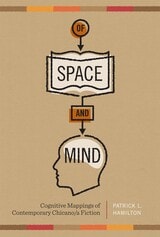
Of Space and Mind
Cognitive Mappings of Contemporary Chicano/a FictionBy Patrick L. Hamilton
University of Texas Press, 2011
Chicano/a fiction is often understood as a literature of resistance to the dominant U.S. Anglo culture and society. But reducing this rich literary production to a single, binary opposition distorts it in fundamental ways. It conflates literature with life, potentially substituting a literature of protest for social activism that could provoke real changes in society. And it overlooks the complex range of responses to Anglo society that actually animates Chicano/a fiction.
In this paradigm-shifting book, Patrick L. Hamilton analyzes works by Rudolfo Anaya, Ana Castillo, Denise Chávez, Rolando Hinojosa, Arturo Islas, John Rechy, Alfredo Véa, and Helena María Viramontes to expand our understandings of the cultural interactions within the United States that are communicated by Chicano/a fiction. He argues that the narrative ethics of "resistance" within the Chicano/a canon is actually complemented by ethics of "persistence" and "transformation" that imagine cultural differences within the United States as participatory and irreducible to simple oppositions. To demonstrate these alternative ethics, Hamilton adapts the methodology of cognitive mapping; that is, he treats the chosen fictional texts as mental maps that are constructed around and communicative of the narrative's ethics. As he reads these cognitive maps, which envision Chicano/a culture as being part of U.S. society rather than as "resistant" and separate, Hamilton asserts that the authors' conception of cultural difference speaks more usefully to current sociopolitical debates, such as those about gay marriage and immigration reform, than does the traditional "resistant" paradigm.
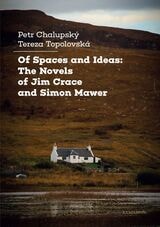
Of Spaces and Ideas
The Novels of Jim Crace and Simon MawerPetr Chalupský and Tereza Topolovská
Karolinum Press, 2024
Of Spaces and Ideas provides a deeper insight into the work of two contemporary British novelists, Jim Crace and Simon Mawer, with a particular emphasis on spatial sensibility as one of the defining elements of their poetics. Drawing on a range of literary-theoretical approaches to space, the study analyzes selected novels by the two writers to demonstrate the ways in which they render space and place and, above all, the ways in which their spatial representations allow them to express the key ideas behind their stories, namely those of identity, history, and the relationship between an individual and the environment in which they live.
Of Two Minds
Hypertext Pedagogy and PoeticsMichael Joyce
University of Michigan Press, 1996
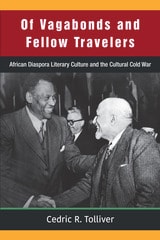
Of Vagabonds and Fellow Travelers
African Diaspora Literary Culture and the Cultural Cold WarCedric R. Tolliver
University of Michigan Press, 2019
Off-Screen Cinema
Isidore Isou and the Lettrist Avant-GardeKaira M. Cabañas
University of Chicago Press, 2015
Off-Screen Cinema is the first monograph in English of the Lettrists. Offering a full portrait of the avant-garde scene of 1950s Paris, it focuses on the film works of key Lettrist figures like Gil J Wolman, Maurice Lemaître, François Dufrêne, and especially the movement's founder, Isidore Isou, a Romanian immigrant whose “discrepant editing” deliberately uncoupled image and sound. Through Cabañas's history, we see not only the full scope of the Lettrist project, but also its clear influence on Situationism, the French New Wave, the New Realists, as well as American filmmakers such as Stan Brakhage.
Ogier's Youth (Les Enfances Ogier)
A Thirteenth-Century Epic by Adenet le RoiAnna Moore Morton
Arizona Center for Medieval and Renaissance Studies, 2020
Ogimawkwe Mitigwaki (Queen of the Woods)
Simon Pokagon
Michigan State University Press, 2010
Simon Pokagon, the son of tribal patriarch Leopold Pokagon, was a talented writer, advocate for the Pokagon Potawatomi community, and tireless self-promoter.
In 1899, shorty after his death, Pokagon's novel Ogimawkwe Mitigwaki (Queen of the Woods)—only the second ever published by an American Indian—appeared. It was intended to be a testimonial to the traditions, stability, and continuity of the Potawatomi in a rapidly changing world. Read today, Queen of the Woods is evidence of the author's desire to mark the cultural, political, and social landscapes with a memorial to the past and a monument to a future that included the Pokagon Potawatomi as distinct and honored people.
This new edition offers a reprint of the original 1899 novel with the author's introduction to the language and culture of his people. In addition, new accompanying materials add context through a cultural biography, literary historical analysis, and linguistic considerations of the unusual text.
Oh, Say, Can You See
The Semiotics of the Military in Hawai’iKathy E. Ferguson
University of Minnesota Press, 1998
Considers what the military presence in Hawai’i tells us about colonialism, gender, race, and class.
Everywhere you look in Hawai’i, you might see the military. And yet, in daily life few residents see the military at all-it is hidden in plain sight. This paradox of invisibility and visibility, of the available and the hidden, is the subject of Oh, Say, Can You See?, which maps the power relations involving gender, race, and class that define Hawai’i in relation to the national security state.
Western intruders into Hawai’i-from the early explorers, missionaries, and sugar planters to the military, tourists, and foreign investors-have seen the island nation as a feminine place, waiting to embrace those who come to penetrate, protect, mold, and develop, yet conveniently lacking whatever the newcomers claim to possess. Thus feminized, this book contends, the islands and the people have been reinscribed with meanings according to the needs, fears, and desires of outsiders. Authors Kathy E. Ferguson and Phyllis Turnbull locate and “excavate” sites of memory, such as cemeteries, memorials, monuments, and museums, to show how the military constructs its gendered narrative upon prior colonial discourses. Among the sites considered are Fort DeRussy, Pearl Harbor, and Punchbowl Cemetery, as well as the practices of citizenship that are produced or foreclosed by the narratives of order and security written upon Hawai’i by the military.This semiotic investigation of ways the military marks Hawai’i necessarily explores the intersection of immigration, colonialism, military expansion, and tourism on the islands. Attending to the ways in which the military represents itself and others represent the military, the authors locate the particular representational elements that both conceal and reveal the military’s presence and power; in doing so, they seek to expand discursive space so that other voices can be heard. ISBN 0-8166-2978-1 Cloth $49.95xxISBN 0-81662979-X Paper $19.95x240 pages 5 7/8 x 9 DecemberBorderlines Series, Volume 10Translation inquiries: University of Minnesota Press
Old English Literature in its Manuscript Context
JOYCE T. LIONARONS
West Virginia University Press, 2004
In Old English Literature in its Manuscript Context, editor Joyce Tally Lionarons has developed a multifaceted collection examining the issues facing the textual transmission of Anglo-Saxon writings. Eight established scholars consider the ideas of textual identity, authorship and translation, and editorial standards and obligations. This work also features a scholarly exchange of ideas and photographs of the original Anglo-Saxon manuscripts, making this essential reading for anyone interested in the history of Old English literature. The essays published in this text were originally composed at an NEH summer seminar conducted by Paul Szarmach and Timothy Graham at the Parker Library of Corpus Christi College, Cambridge in 1997.
Old English Tradition
Essays in Honor of J. R. HallEdited by Lindy Brady
Arizona Center for Medieval and Renaissance Studies, 2021
Old English Tradition contains eighteen new essays by leading scholars in the field of Old English literary studies. The collection is centered around five key areas of research—Old English poetics, Anglo-Saxon Christianity, Beowulf, codicology, and early Anglo-Saxon studies—on which the work of scholar J. R. Hall, the volume’s honorand, has been influential over the course of his career.
The volume’s contents range from fresh insights on individual Old English poems such as The Wife’s Lament and Beowulf; new studies in Old English metrics and linguistics; codicological examinations of individual manuscripts; fresh editions of understudied texts; and innovative examinations of the role of early antiquarians in shaping the field of Old English literary studies as we know it today.
Old Thiess, a Livonian Werewolf
A Classic Case in Comparative PerspectiveCarlo Ginzburg and Bruce Lincoln
University of Chicago Press, 2020
In this book, eminent scholars Carlo Ginzburg and Bruce Lincoln offer a uniquely comparative look at the trial and startling testimony of Old Thiess. They present the first English translation of the trial transcript, in which the man’s own voice can be heard, before turning to subsequent analyses of the event, which range from efforts to connect Old Thiess to shamanistic practices to the argument that he was reacting against cruel stereotypes of the “Livonian werewolf” a Germanic elite used to justify their rule over the Baltic peasantry. As Ginzburg and Lincoln debate their own and others’ perspectives, they also reflect on broader issues of historical theory, method, and politics. Part source text of the trial, part discussion of historians’ thoughts on the case, and part dialogue over the merits and perils of their different methodological approaches, Old Thiess, a Livonian Werewolf opens up fresh insight into a remarkable historical occurrence and, through it, the very discipline of history itself.
Old Time Stories
A Modernist Classic of Native CaliforniaJaime de Angulo
University of Chicago Press, 2026
Dismantled and scattered just before his death, Jaime de Angulo’s poetic masterpiece Old Time Stories is now reconstituted for the first time in this edition.
Jaime de Angulo’s Old Time Stories, a visual prose-poem drawing on his anthropological research among Indigenous communities in California, is a forgotten modernist treasure. Completed shortly before de Angulo’s death, the work has survived only in fragments, divided between an abridged 1953 publication and a limited edition from the 1970s. This new reconstituted edition gives contemporary readers—whether interested in experimental literature, linguistics, cultural anthropology, or Native American history—their first chance to engage with the complete work.
Structured around children’s stories inspired by the Indigenous tales and legends de Angulo encountered directly during his studies, Old Time Stories uses illustrations, different typefaces, and other experimental formatting techniques to translate rich oral and pictographic traditions into the condensed form of print. Beyond its significance as an innovative work of American literary modernism, it interrogates the colonialist foundations of Western modernity through this very reworking of Western literary conventions.
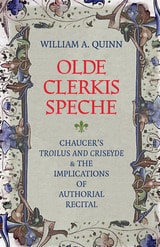
Olde Clerkis Speche
Chaucer's Troilus and Criseyde and the Implications of Authorial RecitalWilliam A. Quinn
Catholic University of America Press, 2013

Olesha's "Envy"
A Critical CompanionRimgaila Salys
Northwestern University Press, 1999
In addition, this critical companion presents documents from the period pertaining to the novel, excerpts from Olesha's memoirs, and a listing of important criticism.
Olfactory Worldmaking
Hsuan L. Hsu
University of Minnesota Press, 2026
Exploring the power of smell to build connections and transform our world
Smell is a vital, if underappreciated, medium through which we inhabit and imagine the world. In Olfactory Worldmaking, Hsuan L. Hsu traces how olfactory experience communicates across visceral, material, and affective registers to offer new ways of relating, which challenge the extractive logics of racial and colonial capitalism. Blending environmental humanities, sensory studies, and critical ethnic studies, the book highlights how scent animates suppressed histories and marginalized memories.
Hsu theorizes olfaction as a speculative, reparative practice. Examining projects from historical novels, memoirs, and speculative fiction to conceptual art and experimental perfumes, he reveals how these works mobilize scent to imagine alternative ways of sensing, relating, and creating more equitably livable worlds.
Retail e-book files for this title are screen-reader friendly with images accompanied by short alt text and/or extended descriptions.
Ollie Miss
George Wylie Henderson
University of Alabama Press, 2007
A forgotten classic of African American life, identity, and resilience in rural Alabama.
Ollie Miss by George Wylie Henderson is a landmark work of African American fiction that offers a vivid portrayal of rural Black life in Alabama during the early twentieth century. Set in the backwoods communities of Macon County, Alabama, the novel follows the journey of Ollie Miss, a young woman determined to find purpose, independence, and personal fulfillment in a world shaped by poverty, isolation, and limited opportunities. Through her struggles and aspirations, Henderson creates a compelling portrait of individual resilience and self-discovery.
More than a personal story, Ollie Miss serves as an important social document, preserving the customs, relationships, and daily realities of a Black Southern community before the transformative changes brought about by the Civil Rights Movement. Henderson's richly detailed narrative captures the rhythms of rural life, the bonds of community, and the challenges faced by African Americans in the segregated South. At the same time, the novel explores universal themes of loneliness, belonging, love, and the search for dignity.
Originally published in 1935 during the era of the Harlem Renaissance, Ollie Miss stands today as a rediscovered classic that broadens our understanding of African American literary history. Both a moving coming-of-age story and an invaluable cultural record, the novel remains essential reading for anyone interested in Southern literature, Black history, women's experiences, and the rich diversity of American fiction.