914 books match the query 'Medieval' and 8 start with o

cover of Octavia Hill, social activism and the remaking of British society

Octavia Hill, social activism and the remaking of British society

Edited by Elizabeth Baigent and Ben Cowell

University of London Press, 2016
This volume reassesses the life and work of Octavia Hill, housing reformer, open space campaigner, co-founder of the National Trust, founder of the Army Cadet Force, and the first woman to be invited to sit on a royal commission. In her lifetime she was widely regarded as an authority on a broad range of social problems. Yet despite her early pre-eminence, and the remarkable success of the institutions which she helped to found, Hill fell from public favour in the twentieth century. This book provides a nuanced portrait of Hill and her work in a broader context of social change, reflecting recent scholarship on nineteenth-century society in general, and on philanthropy and preservation, and women’s role in them, in particular.
[more]
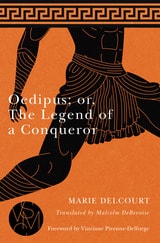
cover of Oedipus; or, The Legend of a Conqueror

Oedipus; or, The Legend of a Conqueror

Marie Delcourt

Michigan State University Press, 2020
Marie Delcourt’s brilliant study of the Oedipus legend, an unjustly neglected monument of twentieth-century classical scholarship published in 1944 and issued here for the first time in English translation, bridges the gap between Carl Robert’s influential Oidipus (1915) and the work of Lowell Edmunds seventy years later. Delcourt studies the legend in its various aspects, six episodes that have equal weight and that stress the same themes: greatness, conquest, domination, the right to rule—all of them bound up with the idea of kingship. Together they form the biography of a Theban hero, the fullest account that has come down to us about the prehistory of sovereign power among the ancient Greeks. Delcourt does not suppose that Oedipus, or indeed any other Greek hero, was a historical figure. The personality familiar to us from the plays of the tragedians of the fifth century—our oldest source, and a very late one—was the result of their extraordinary artistry in linking together themes rooted in very ancient social and religious rites that in the interval had come to describe the feats of Oedipus, then his life, and finally his character. It was in order to explain these rites, whose meaning had ceased to be understood, that myths and legends were invented in the first place. Oedipus, Delcourt argues, is the archetype of all heroes of essentially (if not exclusively) ritual origin, whose acts were prior to their person. This is a very different— and far more complex—Oedipus than the one rather implausibly imagined by Freud. More generally, the origin and transmission of the Oedipus legend tells us a great deal about the strength and persistence of public memories in prehistoric societies.
[more]
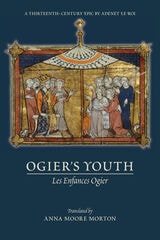
cover of Ogier's Youth (Les Enfances Ogier): A Thirteenth-Century Epic by Adenet le Roi

Ogier's Youth (Les Enfances Ogier)

A Thirteenth-Century Epic by Adenet le Roi

Anna Moore Morton

Arizona Center for Medieval and Renaissance Studies, 2020
Ogier’s Youth is the first English prose translation of Les Enfances Ogier, an epic poem written in Old French in the late thirteenth century by Adenet le Roi, who lived in Brabant and Flanders. It concerns the exploits of a young knight, Ogier, who rose from his status as Charlemagne’s captive to become the hero of Charlemagne’s army in the latter’s campaign to recover Rome from a pagan army and restore the Pope to his holy seat. Ogier came to symbolize the hero who saves the city, the land from monstrous enemies. His legend as conquering hero persisted for centuries; versions of his story were written in many forms and many European languages. Reminders of Ogier’s fame are found from Belgium to Italy even today in such events as processions and puppet shows. Adenet’s version of the Ogier story is considered the most important and influential in the development of the enduring Ogier legend. Throughout Adenet’s story, we witness the development of a strong friendship between Ogier and Carahuel, a noble Saracen (Muslim) knight of the opposing army. The two warriors save one another’s lives when treachery threatens. We get a full and constant picture of Carahuel as a human being of complete integrity, honor and loyalty—qualities which also characterize Ogier. In addition, Carahuel’s faithful fiancée Gloriande, a strong, influential woman whose efforts are also crucial to the safety of both Ogier and Carahuel, plays an important part.
 
[more]
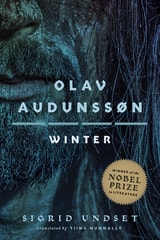
cover of Olav Audunssøn: IV. Winter

Olav Audunssøn

IV. Winter

Sigrid Undset

University of Minnesota Press, 2023

The fourth and final volume in the Nobel Prize–winning writer’s epic of one man’s fateful life in medieval Norway


Set in thirteenth-century Norway, a land racked by political turmoil, bloody family vendettas, and rising tensions between secular powers and an ascendant church, Sigrid Undset’s spellbinding masterpiece now follows the fortunes of Olav Audunssøn to the final, dramatic chapter of his life as it unfolds in Winter, the last volume of the tetralogy. When the orphaned Olav and his foster sister Ingunn became betrothed in their youth, a chain of events was set in motion that eventually led to violence, banishment, and a family separation lasting years. The consequences fracture their marriage and threaten the lineage for generations. Now, at the end of his life, Olav continues to grapple with the guilt of his sins as he watches his children, especially Eirik, make disastrous choices and struggle to find their rightful place in a family haunted by the past.


With its precise details and sweeping vision, Olav Audunssøn summons a powerful picture of Northern life in medieval times, as noted by the Swedish Academy in awarding Undset the Nobel Prize in 1928. Conveying both the intimate drama and the epic proportions of Olav’s story at its conclusion, Winter is a moving and masterly recreation of a vanished world tainted by bloodshed and haunted by sin and retribution—yet one that might still offer a chance for redemption. 


As with Kristin Lavransdatter, her earlier medieval epic, Sigrid Undset wrote Olav Audunssøn after immersive research in the legal, religious, and historical writings of the time to create an astoundingly authentic and compelling portrait of Norwegian life in the Middle Ages. And as in her translation of Kristin Lavransdatter, Tiina Nunnally does full justice to Undset’s natural, fluid prose—in a style by turns plainspoken and delicately lyrical—to convey the natural world, the complex culture, and the fraught emotional territory against which Olav’s story inexorably unfolds.
[more]
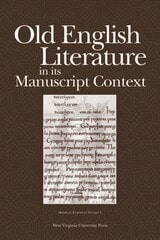
cover of Old English Literature in its Manuscript Context

Old English Literature in its Manuscript Context

JOYCE T. LIONARONS

West Virginia University Press, 2004

In Old English Literature in its Manuscript Context, editor Joyce Tally Lionarons has developed a multifaceted collection examining the issues facing the textual transmission of Anglo-Saxon writings. Eight established scholars consider the ideas of textual identity, authorship and translation, and editorial standards and obligations. This work also features a scholarly exchange of ideas and photographs of the original Anglo-Saxon manuscripts, making this essential reading for anyone interested in the history of Old English literature. The essays published in this text were originally composed at an NEH summer seminar conducted by Paul Szarmach and Timothy Graham at the Parker Library of Corpus Christi College, Cambridge in 1997.
[more]
cover of Old English Tradition: Essays in Honor of J. R. Hall

Old English Tradition

Essays in Honor of J. R. Hall

Edited by Lindy Brady

Arizona Center for Medieval and Renaissance Studies, 2021

Old English Tradition contains eighteen new essays by leading scholars in the field of Old English literary studies. The collection is centered around five key areas of research—Old English poetics, Anglo-Saxon Christianity, Beowulf, codicology, and early Anglo-Saxon studies—on which the work of scholar J. R. Hall, the volume’s honorand, has been influential over the course of his career.  

The volume’s contents range from fresh insights on individual Old English poems such as The Wife’s Lament and Beowulf; new studies in Old English metrics and linguistics; codicological examinations of individual manuscripts; fresh editions of understudied texts; and innovative examinations of the role of early antiquarians in shaping the field of Old English literary studies as we know it today.
[more]
cover of On Resurrection

On Resurrection

Irven M. St. Albert the Great

Catholic University of America Press, 2020
According to 1 Cor 15.44 and 1 Cor 15.52, the human body “is sown an animal body, [but] it will rise a spiritual body” and “the dead will rise again incorruptible, and we will be changed.” These passages prompted many questions: What is a spiritual body? How can a body become incorruptible? Where will the resurrected body be located? And, what will be the nature of its experience? Medieval theologians sought to answer such questions but encountered troubling paradoxes stemming from the conviction that the resurrected body will be an “impassible body” or constituted from “incorruptible matter.” By the thirteenth century the resurrection demanded increased attention from Church authorities, not only in response to certain popular heresies but also to calm heated debates at the University of Paris. William of Auvergne, Bishop of Paris, officially condemned ten errors in 1241 and in 1244, including the proposition that the blessed in the resurrected body will not see the divine essence. In 1270 Parisian Bishop Étienne Tempier condemned the view that God cannot grant incorruption to a corruptible body, and in 1277 he rejected propositions that a resurrected body does not return as numerically one and the same, and that God cannot grant perpetual existence to a mutable, corruptible body. The Dominican scholar Albert the Great was drawn into the university debates in Paris in the 1240s and responded in the text translated here for the first time. In it, Albert considers the properties of resurrected bodies in relation to Aristotelian physics, treats the condition of souls and bodies in heaven, discusses the location and punishments of hell, purgatory, and limbo, and proposes a “limbo of infants” for unbaptized children. Albert’s On Resurrection not only shaped the understanding of Thomas Aquinas but also that of many other major thinkers.
[more]
cover of Out of the Mouths of Babes: Infant Voices in Medieval French Literature

Out of the Mouths of Babes

Infant Voices in Medieval French Literature

Julie Singer

University of Chicago Press, 2025

A wide-ranging study of the rich questions raised by speaking infants in medieval French literature.
 
Medieval literature is full of strange moments when infants (even fetuses) speak. In Out of the Mouths of Babes, Julie Singer explores the unsettling questions raised by these events, including What is a person? Is speech fundamental to our humanity? And what does it mean, or what does it matter, to speak truth to power?

Singer contends that descriptions of baby talk in medieval French literature are far from trivial. Through treatises, manuals, poetry, and devotional texts, Singer charts how writers imagined infants to speak with an authority untainted by human experience. What their children say, then, offers unique insight into medieval hopes for universal answers to life’s deepest wonderings.
[more]