Results by title
479 books match the query 'Methodology' and 9 start with o

Of Joints and Other Articulations
The Futures of ArthrosophyMichael Marder
Northwestern University Press, 2026
What if we were to reimagine bodies of all kinds—biological and ecosystemic, political and textual, cosmic and artistic—from the perspective of their joints? This is the wager of Michael Marder’s philosophical treatise, which skirts the extremes of totalization and fragmentation by following the model of the joints, the structures that both articulate and disarticulate complex living unities.
Of Joints and Other Articulations: The Futures of Arthrosophy proposes that, as embodied figures of relations, joints shed new light on the question of time and the meaning of art, the activity of language and the fluctuations of good and ill health, political violence and humility, conversions and perversions. Arthrosophy, the wisdom of joints, supplements and substantiates philosophy itself, teaching us how to think through and with our knees and elbows, hips and shoulders, sutures and pivot joints.
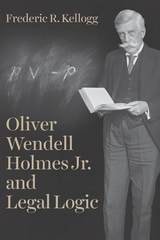
Oliver Wendell Holmes Jr. and Legal Logic
Frederic R. Kellogg
University of Chicago Press, 2018
Conventional legal logic tends to focus on the role of judges in deciding cases. Holmes recognized input from outside the law—the importance of the social dimension of legal and logical induction: how opposing views of “many minds” may converge. Drawing on analogies from the natural sciences, Holmes came to understand law as an extended process of inquiry into recurring problems.
Rather than vagueness or contradiction in the meaning or application of rules, Holmes focused on the relation of novel or unanticipated facts to an underlying and emergent social problem. Where the meaning and extension of legal terms are disputed by opposing views and practices, it is not strictly a legal uncertainty, and it is a mistake to expect that judges alone can immediately resolve the larger issue.

On Knowing--The Natural Sciences
Richard P. McKeon
University of Chicago Press, 1994
In his lectures, McKeon outlines the entire history of Western thinking on the sciences. Treating the central concepts of motion, space, time, and cause, he traces modern intellectual debates back to the ancient Greeks, notably Plato, Aristotle, Democritus, and the Sophists. As he brings the story of Western science up to the twentieth century, he uses his fabled semantic schema (reproduced here for the first time) to uncover new ideas and observations about cosmology, mechanics, dynamics, and other aspects of physical science.
Illustrating the broad historical sweep of the lectures are a series of discussions which give detail to the course's intellectual framework. These discussions of Plato, Aristotle, Galileo, Newton, and Maxwell are perhaps the first published rendition of a philosopher in literal dialogue with his students. Led by McKeon's pointed questioning, the discussions reveal the difficulties and possibilities of learning to engage in serious intellectual communication.
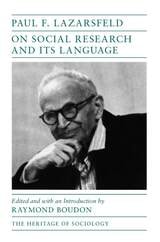
On Social Research and Its Language
Paul F. Lazarsfeld
University of Chicago Press, 1993
Lazarsfeld's systematic criticism of observational, conceptual, and inferential procedures in sociology led to the the formation of universally applied observational and analytical techniques, such as the panel design of observation and contextual and multivariate analysis. His methodology for empirical social research had a profound effect on all the social sciences.
The eighteen essays in On Social Research and Its Language illustrate the diversity of Lazarsfeld's substantive, methodological, and organizational interests. Spanning the years 1933 to 1972, they encompass his own works of social research, as well as writings on methodology and the history and sociology of social research. Articles on methodology—observing, classifying and building typologies, analyzing the relations between variables, qualitative analysis, and macrosociology—form the bulk of the book. In addition, Raymond Boudon provides a revealing biography of Lazarsfeld and his influence on sociology.
These classic writings by a formative figure of modern social science will be an indispensable reference for scholars across the historical and social science disciplines.
On the Shoulders of Giants
The Post-Italianate EditionRobert K. Merton
University of Chicago Press, 1993
"This book is the delightful apotheosis of donmanship: Merton parodies scholarliness while being faultlessly scholarly; he scourges pedantry while brandishing his own abstruse learning on every page. The most recondite and obscure scholarly squabbles are transmuted into the material of comedy as the ostensible subject is shouldered to one side by yet another hobby horse from Merton's densely populated stable. He has created a jeu d'esprit which is profoundly suggestive both in detail and as a whole."—Sean French, Times Literary Supplement

Open Data in Ancient and Byzantine Studies
Edited by Valeria Vitale and Gabriel Bodard
University of London Press, 2026
Exploring the impact of open-access and openly licensed data and code in classical and Byzantine studies.
Open Data in Ancient and Byzantine Studies shows how openness supports transparency, collaboration, the identification of biases, and new interpretive and data‑driven approaches to ancient sources. Through practical case studies, the book demonstrates how methods such as epigraphic transcription, textual criticism, and archaeological modeling have advanced open data standards and practices.
This book highlights the potential of interoperability, documentation, and open workflows for broader approaches to the ancient world. Bringing together work from classics, Byzantine studies, archaeology, linguistics, and digital humanities, it presents open scholarship as a transformative model for academic knowledge production.
Open to Disruption
Time and Craft in the Practice of Slow SociologyAnita Ilta Garey
Vanderbilt University Press, 2014
Some researchers describe how disruptions prompted them to expand the boundaries of their discipline and invent concepts that could more accurately describe phenomena that previously had no name and no scholarly history. Sometimes scholars themselves caused the disruption as they circled back to work they had considered "done" and allowed the possibility of rethinking earlier findings.
Oral Tradition as History
Jan M. Vansina
University of Wisconsin Press, 1985
Jan Vansina’s 1961 book, Oral Tradition, was hailed internationally as a pioneering work in the field of ethno-history. Originally published in French, it was translated into English, Spanish, Italian, Arabic, and Hungarian. Reviewers were unanimous in their praise of Vansina’s success in subjecting oral traditions to intense functional analysis.
Now, Vansina—with the benefit of two decades of additional thought and research—has revised his original work substantially, completely rewriting some sections and adding much new material. The result is an essentially new work, indispensable to all students and scholars of history, anthropology, folklore, and ethno-history who are concerned with the transmission and potential uses of oral material.
“Those embarking on the challenging adventure of historical fieldwork with an oral community will find the book a valuable companion, filled with good practical advice. Those who already have collected bodies of oral material, or who strive to interpret and analyze that collected by others, will be forced to subject their own methodological approaches to a critical reexamination in the light of Vansina’s thoughtful and provocative insights. . . . For the second time in a quarter of a century, we are profoundly in the debt of Jan Vansina.”—Research in African Literatures
“Oral Traditions as History is an essential addition to the basic literature of African history.”—American Historical Review
Orienting to Chance
Probabilism and the Future of Social TheoryMichael Strand and Omar Lizardo
University of Chicago Press, 2025
Since the founding of the discipline, sociologists have endeavored to understand the structures of groups, organizations, and societies, and how these entities condition our behavior. While some of the foundational theorists saw these processes as largely deterministic, sociological theory has increasingly insisted on the importance of culture in shaping our position in and responses to social groups. In Orienting to Chance, sociologists Michael Strand and Omar Lizardo aim to show that the social order bears an unmistakable link to chance and urge us to think about how it conditions our actions.
Strand and Lizardo provide a sweeping overview of a new social theory framework that they call probabilism. Using examples of probabilism in sociology, particularly in the work of Max Weber, W. E. B. Du Bois, and Pierre Bourdieu, they describe probabilism’s place in multiple fields of science. As the authors argue, their effort at redefinition and recovery helps position sociology as a field of the future, while also keeping it grounded in core issues of action, structure, culture, inequality, and inequity. By sharing these groundbreaking insights and revealing wider theoretical claims about mortality, fate, and technology in the contemporary era, Strand and Lizardo demonstrate how probabilism is an essential intervention for understanding the inevitable role of uncertainty in social life.