Results by title
3785 books match the query 'Poetry' and 116 start with o
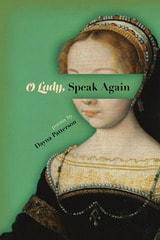
O Lady, Speak Again
Patterson, Dayna
Signature Books, 2023
In these pages you’ll meet Cordelia, third wife of polygamous Lear. You’ll meet Miranda, sailing away from her father and his faith. You’ll encounter Ophelia, who enters an amphibious torpor when buried, and is reborn as forest ecologist, far from her father’s ghost. Lady Macbeth and the weird sisters get a retrial, and Juliet finds her way to a different ending. Shadowy goddesses like Hecate, mother of witches, are invoked and act within these pages. Rosalind from As You Like It is given the final word. These poems delve into faith crisis, queerness, abandonment, transgressive power, rebirth, and dream. Prepare to be entranced.
O Paradise
PoemsWilliam Trowbridge
University of Arkansas Press, 1995
As Howard Nemerov has said in praise of William Trowbridge’s first poetry collection: “he is very much up on the peculiarities of our little world … He is both funny and serious, seriously funny; probably the best, if not the only, way of dealing with the complex predicament.”
Continuing in this third collection of poems to work in the realm of the serio-comic, Trowbridge explores other borderlands—between the tangible world and the intuitive one, between actuality and memory, between consciousness and unconsciousness, between self as flesh and blood and self as ghost.
This is fast-faced, nervy poetry whose witty, vernacular language moves surprisingly toward transcendence.
Objects of Hunger
E. C. Belli
Southern Illinois University Press, 2019
Objects of Hunger explores in reflective, raw lyrics the dread and beauty of our inner worlds as expressed through our struggles against the self and the other. Each poem is a slender organism that speaks its own mind, unafraid of pathos; the emotions here have been tried on and lived in, and the work accrues, lyric after lyric, page after page. In the second section, World War I poems are broken down and dismantled, as the voices of that era’s poets meld with that of a postpartum mother, exposing a shared vernacular among these disparate experiences. Other poems in the collection explore the unraveling and entrapments of the domestic, but with tenacity in place of softness, using a lexicon gathered from Virginia Woolf’s The Waves and Djuna Barnes’s Nightwood, among others.
What emerges is a finely chiseled portrait of intimacy, one that takes seriously love and all discord, the fracas of reticence and familiarity. Belli gives this world to us by way of a throbbing asceticism, in an exploration of resignation, concession, persistence, and monstrosity. This collection tells what it is to need with abandon.
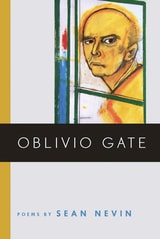
Oblivio Gate
Sean Nevin
Southern Illinois University Press, 2008
Suffused with lyrical grace and the language of loss, Sean Nevin's Oblivio Gate explores the mental and emotional struggles of Solomon, a veteran battling the onslaught of Alzheimer's disease. Set against Solomon's memories of the Korean War, Nevin's poems draw us into an intimate view of a man's confusion as everything he knows slowly unravels around him, leaving him abandoned in the suddenly unfamiliar landscape of his own mind. Readers experience first- hand Solomon's dismay as he watches himself inexorably slip away from reality, fighting to hold on to the shreds of his identity. Intertwined with his perspective are the voices of loved ones and caregivers who can only watch helplessly as Solomon is ravaged by the illness. Also central to the collection are the figures of Aurora and Tithonus, the famously doomed couple of mythology whose own happiness was destroyed by the inevitability of age and the betrayal of the body. But if this evocative portrait of Alzheimer's disease is tragic, it is also at moments inspiring.
Oblivio Gate reveals not only what is lost, but also what is found, what is pure, and even what is funny in our fleeting lives. Ultimately, Sean Nevin crafts an unforgettable collection of contemporary poetry that yields heartbreaking insight into memory, the mind, and an affliction that has left millions lost and looking for themselves.
Oblivion and Stone
A Selection of Bolivian Poetry and FictionSandra Reyes
University of Arkansas Press, 1998
In a literature where recognition is hard earned, this anthology demonstrates what distinguishes contemporary Bolivian fiction and poetry from the rest of Latin American writing and shows clearly how Bolivian writers relate to that tradition.
Bolivia is a landlocked nation of mountains and high, arid plains, a place native writer Jesús Urzagasti calls the “Land of Silence.” This crucible of indigenous and European influences has contributed to the creation of a writing style that is always down-to-earth, often grittily realistic.
From this fundamental base, Bolivian writers express provincial customs and values, decry political oppression, and sound universal themes of isolation, even resignation; but, more often, they show the will to move forward as a people. This rich thematic mix encourages what critic Edgar Lora has called the “dynamic and vigorous social dis course” and the resulting “subversive, militant, and revolutionary” qualities of Bolivian literature.
Editor Sandra Reyes has gathered a panoramic sampling of twenty two poets and eighteen fiction writers. Focusing predominantly on living, practicing writers, this anthology defines the current literary voice of Bolivia and gives us a distillation of the contemporary Bolivian consciousness.
Obsession
Sestinas in the Twenty-First CenturyEdited by Carolyn Beard Whitlow and Marilyn Krysl
Dartmouth College Press, 2014

Obsessive Images
Symbolism in Poetry of the 1930s and 1940sJoseph Warren BeachWilliam Van O’Connor, Editor
University of Minnesota Press, 1960
Obsessive Images was first published in 1960. Minnesota Archive Editions uses digital technology to make long-unavailable books once again accessible, and are published unaltered from the original University of Minnesota Press editions.
As Mark Schorer comments, this is "the last, unfinished work of a distinguished, well loved critic, poet, and professor." After the death of Joseph Warren Beach, his colleague and friend William Van O'Connor, professor of English at the University of Minnesota, prepared the unfinished manuscript of this work for publication and wrote the foreword.
The work is primarily a study of certain words, phrases, and images that turn up with unusual frequency in modern American poetry, especially that of the decades of the 1930's and 1940's, and which are used in unusual senses, to carry special symbolisms, or to imply peculiar philosophical attitudes. Since the study is concerned with such recurring images and themes, many poets of distinction, in whose work they are not to be found, are left out, but Professor Beach also discusses the significance of the absence of these poets.
Students and critics will gain insight through this work into the characteristic attitudes of a generation of poets. The book is, moreover, a delight to read, reflecting, as it does, Mr. Beach's own love for the study of poetry. As Professor O'Connor points out, the tone is much more personal than that of Mr. Beach's other books.
Ocean Power
Poems from the DesertOfelia Zepeda
University of Arizona Press, 1995
Poet Ofelia Zepeda centers these poems on her own experiences growing up in a Tohono O'odham family, where desert climate profoundly influenced daily life, and on her perceptions as a contemporary Tohono O'odham woman. One section of poems deals with contemporary life, personal history, and the meeting of old and new ways. Another section deals with winter and human responses to light and air. The final group of poems focuses on the nature of women, the ocean, and the way the past relationship of the O'odham with the ocean may still inform present day experience. These fine poems will give the outside reader a rich insight into the daily life of the Tohono O'odham people.
Ocean, as Much as Rain
Stories, Lyrical Prose, and Poems from TibetTsering Woeser. Edited and Translated by Fiona Sze-Lorrain with Dechen Pemba.
Duke University Press, 2026
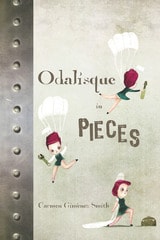
Odalisque in Pieces
Carmen Giménez Smith
University of Arizona Press, 2009
In these poems we encounter such strange beauties as a girl assembling and disassembling, a moth trapped in a glass of water, new-age fairy godmothers, and a lark who sings for the milkman. Yet we are also made aware of how these beauties reflect the speaker’s troubles—her effort to employ, in the words of one of her most memorable poems, “Only the invisible post where she writes the encounters / with air’s lusters. Only the imagined hour / with which she’s made a fragile craft.”
Vivid and charged with an inner light, these are poems that linger and expand in the mind and memory.
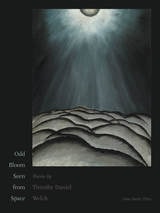
Odd Bloom Seen from Space
Timothy Daniel Welch
University of Iowa Press, 2017
But it’s in the act of discovery, through the hero’s immediate ancestry that Welch’s debut collection confronts big questions about family, music, art, and memory. Like a contemporary Diogenes who pursues meaning one small gesture at a time, Welch comes to learn truth is a “brutal commerce,” beauty is “white legs / upon which she shed her childhood,” time is “Michael Jackson / hooting in the trees,” and “Love is gradual, a bottle / by sips, a bottle / poured onto the floor.” There is wisdom to be gained from these inventive pursuits, but in the end it’s not what is said, but how it’s said with terse rhetoric, deep imagery, and surprising humor that makes Odd Bloom Seen from Space such a gorgeous, original, and baffling collection.
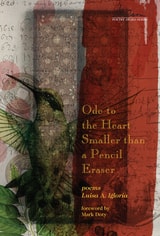
Ode to the Heart Smaller than a Pencil Eraser
Luisa A. Igloria
Utah State University Press, 2014
“When Luisa Igloria cites Epictetus—‘as soon as a thing has been seen, it is carried away, and another comes in its place’—she introduces the crowded and contradictory world her poems portray: a realm of transience, yes, where the vulnerable come to harm and everything disappears, but also a scene of tremendous, unpredictable bounty, the gloriously hued density this poet loves to detail. ‘I was raised / to believe not only the beautiful can live on / Parnassus,’ she tells us, and she makes it true, by including in the cyclonic swirl of her poems practically everything: a gorgeous, troubling over-brimming universe."
—Mark Doty, judge for the 2014 Swenson Award
The May Swenson Poetry Award, an annual competition named for May Swenson, honors her as one of America's most provocative and vital writers. During her long career, Swenson was loved and praised by writers from virtually every school of American poetry. She left a legacy of fifty years of writing when she died in 1989. She is buried in Logan, Utah, her hometown.
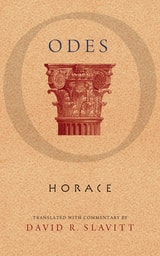
Odes
Horace, Translated with commentary by David R. Slavitt
University of Wisconsin Press, 2014
This edition is also notable for Slavitt’s extensive notes and commentary about the art of translation. He presents the problems he encountered in making the translation, discussing possible solutions and the choices he made among them. The effect of the notes is to bring the reader even closer to the original Latin and to understand better how to gauge the distance between the two languages.
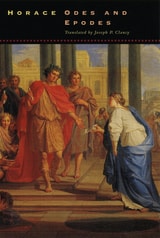
Odes and Epodes
Horace
University of Chicago Press, 1960
In 23 B.C., when he published the first three books of his lyrics, Horace was 42 years old, secure in the favor of the emperor Augustus, and living in ease and comfort as a country gentleman on his Sabine farm. Serenity is reflected in these lyrics, certainly, but so are other experiences, for Horace had lived through three major political crises in a society that was the center of the world, that was sophisticated, refined—and beginning to decay. A worldly, high-spirited, cultivated man, Horace responds in his poetry to the myriad elements of Roman life he knew so well.
The Odes and Epodes of Horace collects the entirety of his lyric poetry, comprising all 103 odes, the Carmen Saeculare ("Festival Hymn"), and the earlier epodes. Joseph P. Clancy has achieved a mirroring of the originals that is worthy in its own right as English verse, and his introductions to each book of lyrics are both lively and informed.
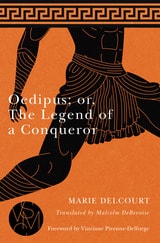
Oedipus; or, The Legend of a Conqueror
Marie Delcourt
Michigan State University Press, 2020
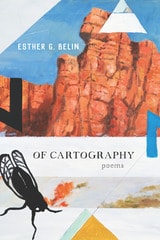
Of Cartography
PoemsEsther G. Belin
University of Arizona Press, 2017
In this long-anticipated collection, Belin daringly maps the poetics of womanhood, the body, institution, family, and love. Depicting the personal and the political, Of Cartography is an exploration of identity through language. With poems ranging from prose to typographic and linguistic illustrations, this distinctive collection pushes the boundaries of traditional poetic form.
Marking territory and position according to the Diné cardinal points, Of Cartography demands much from the reader, gives meaning to abstraction, and demonstrates the challenges of identity politics.
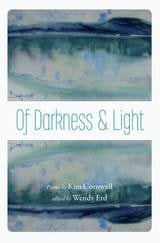
Of Darkness and Light
Poems by Kim CornwallEdited by Wendy Erd
University of Alaska Press, 2019
An honest work, stunningly passionate: Kim Cornwall’s spirit-infused poetry weaves family and myth—strong women, wild landscapes, the search for reconciliation in circumstances beyond control—in a radiant language of pain, solace, wonder, and gratitude. This remarkable first and last collection of poetry celebrates and chronicles the borderless area between joy and suffering, like breath after long submersion: for one must breech the surface/where what we most need/ lives.
Of Gardens and Graves
Kashmir, Poetry, PoliticsSuvir Kaul
Duke University Press, 2017
Of Gods & Strangers
Tina Chang
Four Way Books, 2011
Of No Country I Know
New and Selected Poems and TranslationsDavid Ferry
University of Chicago Press, 1999
"Though Ferry is perhaps best known for his eloquent translations of Horace and Virgil, "Of No Country I Know" demonstrates that he deserves acclaim for his own poetry as well."—Carmela Ciuraru, New York Times Book Review

Of Such a Nature/Índole
José Kozer, introduced and translated by Peter Boyle
University of Alabama Press, 2018
José Kozer is one of the most influential contemporary Cuban poets working today. A key figure in the neobaroque movement within contemporary Latin American poetry, he is one of only three Cubans to ever win the Pablo Neruda Prize given by the Neruda Foundation in Chile. He is the author of close to ninety books, including Este judío de números y letras, Bajo este cien, La garza sin sombras, Carece de causa, and Y del esparto la invariabilidad. Kozer is also noteworthy as a key poet of the Cuban diaspora, having left Cuba in 1960 and residing ever since in the United States.
Of Such a Nature/Índole is a bilingual edition translated into English by Peter Boyle. In addition, Boyle provides an extensive introduction placing Kozer’s work in a critical context.
The Spanish word “índole” can be translated as: “a type,” “a sort,” or “that sort of thing.” The title, Índole, therefore suggests that the poems gathered in this collection, are all instances of specific types of situations, things, or experiences. Kozer has gathered a collection of poems about everyday life—cleaning one’s dentures, a woman leaning over a bowl of oatmeal, a salamander glimpsed while eating breakfast—but always with death not far away.
Of Such a Nature/Índole is a remarkable collection of poems published in Cuba in 2012, covering such materials as Kozer’s Jewish heritage, his Cuban childhood and ongoing connection to the Island, Buddhist and East Asian traditions of spiritual practice, his everyday life in Florida with Guadalupe, ageing, illness, and the shadow of death. Irony and humor are there as well, and to read these poems is to be in the presence of the full seriousness of poetry and its playfulness, its ability to undercut all pretensions.
Of This River
Noah Davis
Michigan State University Press, 2020

Off Message
Joel Brouwer
Four Way Books, 2016
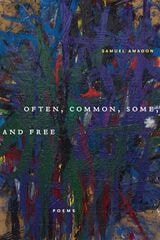
Often, Common, Some, and Free
Samuel Amadon
Omnidawn, 2021
This is a book about transformation. Moving across varied formal and aesthetic terrains, these poems take on the subject of change, considering the construction and demolition of buildings, roaming between cities, and drawing together an image of a world in flux. The speaker is in movement—walking, flying, swimming, and taking the train, while also constantly twisting in his sentences, turning into different versions of himself, and braiding his voice with others. These poems take on subjects that encompass creation and loss from Robert Moses’s career transforming the cityscape of New York to the robbery of works from Boston’s Gardner Museum. But, ultimately, these poems aim to resist destruction, to focus on the particular, and to hold still their world and their ever-shifting speaker.
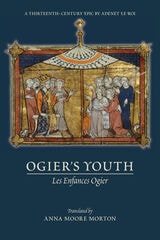
Ogier's Youth (Les Enfances Ogier)
A Thirteenth-Century Epic by Adenet le RoiAnna Moore Morton
Arizona Center for Medieval and Renaissance Studies, 2020
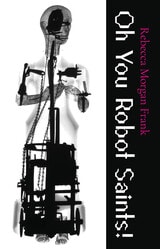
Oh You Robot Saints!
Rebecca Morgan Frank
Carnegie Mellon University Press, 2021
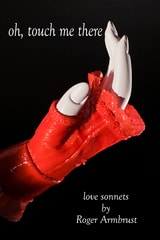
Oh, Touch Me There
Love SonnetsRoger Armbrust
Parkhurst Brothers, Inc., 2013
Witty, humorous and wise reflections on loving
There is a mythic quality to the poetry of Roger Armbrust. Whether his subject is surgery or angels, his language and vision—while expressed in an earthly lexicon—are focused on the life of the spirit.
We constantly heal each other, love, true
to our senses, sharing our secret vaults
of fear and longing, faith and confusion,
doubt and delight.
Armbrust’s love poems are not ethereal, however, but rooted in real bodies…
My poetry honors your architecture’s mystery.
Fanciful, yet rooted in real experience, Armbrust’s one hundred-plus sonnets incite passion and introspection, so that the collection makes an inspired lover’s gift.
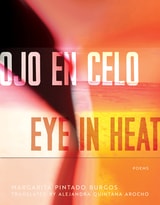
Ojo en Celo / Eye in Heat
PoemsMargarita Pintado Burgos; Translated by Alejandra Quintana Arocho
University of Arizona Press, 2024
Aflame with desire, the eye conjures, dreams, invents itself, sees what it wants. The eye sees what it is able to see.
Ojo en celo / Eye in Heat brings into sharp relief the limits of our gaze. It shows us what it is to escape the mirror and move beyond mirages. Margarita Pintado Burgos invites us to ponder the impasse while showing us ways to see better, to break the habit of lying, and to confront images along with language.
With devastating clarity, Pintado Burgos’s poems, presented in both Spanish and English, give voice to the world within and beyond sight: the plants, the trees, the birds, the ocean waves, the fruit forgotten in the kitchen, the house’s furniture. Light takes on new dimensions to expose, manipulate, destroy, and nourish. Alejandra Quintana Arocho’s sensitive English translation renders the stark force of these poems without smoothing over the language of the original.
This collection is for anyone who has felt the weight of beauty that remains hidden. It is for those who have left behind a mother, a father, a country. It is for those who know that there is no way out of the poem, for those who have had to live off a house of words and need that house to be as real as possible. Pintado Burgos writes as a woman, exile, daughter, sister, lover, and artist empowered by the restorative potential of the creative phenomenon.
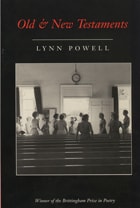
Old And New Testaments
Lynn Powell
University of Wisconsin Press, 1995
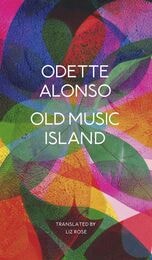
Old Music Island
Odette Alonso
Seagull Books, 2026
A translated collection from one of the defining poetic voices in Cuban and Mexican literature.
Old Music Island is a sensuous, dreamlike poetry collection by Odette Alonso, a leading voice in contemporary Cuban and Mexican literature. Born in Santiago de Cuba and living in Mexico since 1992, Alonso is an award-winning poet whose work transforms exile, desire, and memory into sites of lyrical and emotional intensity.
These poems move to the rhythm of nostalgia and smoke. The collection begins with a dream of light and song. The intimate encounter, always an island, is surrounded by the sea experience, and an exchange of glances is but a threshold into the vast expanse. Then comes fear, the fuss of hands, brackish tongue, a conflagration. Only those daring to enter will learn the patterns of the tide and the arrhythmia of the heart. The collection is a somatic encounter of tastes, touch, comings and goings, surprise, and seduction.
Translated by Liz Rose, whose work bridges lyric practice, trans theory, and feminist thought, Old Music Island offers an English-language rendering that honors the book’s lush musicality and charged physical presence. This is poetry of fleeting contact and lasting imprint—an invitation to listen closely, and to cross the threshold.
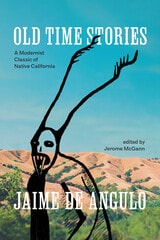
Old Time Stories
A Modernist Classic of Native CaliforniaJaime de Angulo
University of Chicago Press, 2026
Dismantled and scattered just before his death, Jaime de Angulo’s poetic masterpiece Old Time Stories is now reconstituted for the first time in this edition.
Jaime de Angulo’s Old Time Stories, a visual prose-poem drawing on his anthropological research among Indigenous communities in California, is a forgotten modernist treasure. Completed shortly before de Angulo’s death, the work has survived only in fragments, divided between an abridged 1953 publication and a limited edition from the 1970s. This new reconstituted edition gives contemporary readers—whether interested in experimental literature, linguistics, cultural anthropology, or Native American history—their first chance to engage with the complete work.
Structured around children’s stories inspired by the Indigenous tales and legends de Angulo encountered directly during his studies, Old Time Stories uses illustrations, different typefaces, and other experimental formatting techniques to translate rich oral and pictographic traditions into the condensed form of print. Beyond its significance as an innovative work of American literary modernism, it interrogates the colonialist foundations of Western modernity through this very reworking of Western literary conventions.
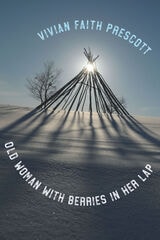
Old Woman with Berries in Her Lap
Vivian Faith Prescott
University of Alaska Press, 2022
Vivian Faith Prescott’s use of language is both a celebration of the richness of the Sámi languages and a mourning of the loss of language that occurs when a population is displaced and forced to exist in a totally foreign language space. According to Sámilinguist, professor, and politician Ole Henrik Magga, the Sámi languages have “very easily . . . one thousand lexemes with connections to snow, ice, freezing, and melting.” These lexemes frame many of Prescott’s poems, introducing ideas and feelings around the loss of language and culture.
A compelling insight into the Sámi culture from a contemporary poet’s eye, Old Woman with Berries in Her Lap juxtaposes past and present in an act of reclamation.
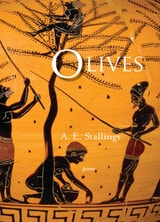
Olives
PoemsA.E. Stallings
Northwestern University Press, 2012
Finalist, 2012 NBCC Award in the Poetry category
Recipient, 2011 MacArthur Fellowship and Guggenheim Fellowship
A. E. Stallings has established herself as one of the best American poets of her generation. In addition to a lively dialogue with both the contemporary and ancient culture of her adopted homeland, Greece, this new collection features poems that, in her inimitable voice, address the joys and anxieties of marriage and motherhood. This collection builds on previous accomplishments with some longer poems and sequences of greater philosophical scope, such as “On Visiting a Borrowed Country House in Arcadia.” Stallings possesses the rare ability to craft precise poems that pulsate with deeply felt emotion. Like the olives of the title, the book embraces the bitter but savory fruits of the ancient tree, and the tears and sweetness we harvest in our temporary lives. These poems show Stallings in complete command of her talent, able to suggest the world in a word.
Ollie Miss
George Wylie Henderson
University of Alabama Press, 2007
A forgotten classic of African American life, identity, and resilience in rural Alabama.
Ollie Miss by George Wylie Henderson is a landmark work of African American fiction that offers a vivid portrayal of rural Black life in Alabama during the early twentieth century. Set in the backwoods communities of Macon County, Alabama, the novel follows the journey of Ollie Miss, a young woman determined to find purpose, independence, and personal fulfillment in a world shaped by poverty, isolation, and limited opportunities. Through her struggles and aspirations, Henderson creates a compelling portrait of individual resilience and self-discovery.
More than a personal story, Ollie Miss serves as an important social document, preserving the customs, relationships, and daily realities of a Black Southern community before the transformative changes brought about by the Civil Rights Movement. Henderson's richly detailed narrative captures the rhythms of rural life, the bonds of community, and the challenges faced by African Americans in the segregated South. At the same time, the novel explores universal themes of loneliness, belonging, love, and the search for dignity.
Originally published in 1935 during the era of the Harlem Renaissance, Ollie Miss stands today as a rediscovered classic that broadens our understanding of African American literary history. Both a moving coming-of-age story and an invaluable cultural record, the novel remains essential reading for anyone interested in Southern literature, Black history, women's experiences, and the rich diversity of American fiction.
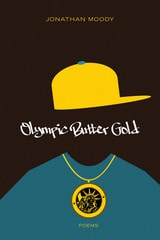
Olympic Butter Gold
PoemsJonathan Moody
Northwestern University Press, 2015
Jonathan Moody grew up during the Golden Ages of hip-hop and listened to rap that was as adventurous and diverse as his military upbringing. When rap’s Golden Ages expired, the music’s innovativeness and variety diminished. Moody’s second book, Olympic Butter Gold, winner of the 2014 Cave Canem Northwestern University Press Poetry Prize, responds to Chuck D’s claim that "if there was a HIP-HOP or Rap Olympics, I really don’t think the United States would get Gold, Silver or Brass." From the poem "Opening Ceremony," in the voice of a heroin addict struggling to use Lady Liberty’s torch to cook "The American Dream," to "Dear 2Pac," an autobiographical account of teaching Tupac Shakur’s poetry to engage high school students indifferent to literature, Moody shares a worldview that is simultaneously apocalyptic and promising.

Omitting All That Is Usually Said
Robin Caton
Omnidawn, 2024
In Omitting All That is Usually Said, Robin Caton explores the nature of light, form, language, meaning, and thought, alongside the complexity of their interwoven relationships. Caton interrogates the workings of the human mind and explores the way we integrate disparate perceptions. Caton questions whether we can be certain that things really exist and that all we experience isn’t simply a play of light and shadow. She considers how we live with all the limitations and emotional turmoil imbedded in humanity, while also maintaining a sense of something we call perfection. The poems of Omitting All That is Usually Said investigate how we might capture the depths of conflicting experiences and lived knowledge in ways that we can comprehend, and they marvel at how we find delight in all of it.
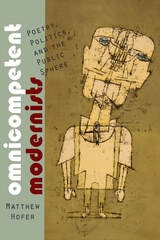
Omnicompetent Modernists
Poetry, Politics, and the Public SphereMatthew Hofer
University of Alabama Press, 2022
An innovative exploration of early twentieth-century avant-garde poetry’s relationship to the public sphere
“It is difficult / to get the news from poems / yet men die miserably every day / for lack / of what is found there,” as the poet William Carlos Williams memorably declared. In Omnicompetent Modernists: Poetry, Politics, and the Public Sphere, Matthew Hofer examines, through a multilayered literary critique of interwar modernist poetry, what it might mean to get the news, and more, from a poet.
Using pragmatist ideas about the public sphere as a tool, Hofer reveals how Langston Hughes, Ezra Pound, and Mina Loy sought to use literature to both express and enable thought. In Hughes, Pound, and Loy, Hofer attends to poets whose work vigorously imagined possible new relationships between language, thinking, and public society. Each poet had different goals and used different methods, but all found both inspiration and encouragement in popular political theory. Hughes advocated for a more just vision of color and class in the United States. Pound sought to condemn those whom he associated with public harm, linguistically, socially, economically, and politically. Loy championed the “psycho-democratic” representation of women, in both public and private life.
Although Hughes, Pound, and Loy are rarely considered together, what unites these three writers is how each reconceived the public realm, and revolutionized aesthetic form to articulate those visions. Hofer combines sharp intellectual historiography with rigorous literary criticism and the result is a study that reinvigorates both the poems and poets under consideration and speaks to the immense power of language in manipulating public opinion—with pertinent implications for the politics of the present.
On Burning Ground
Thirty Years of Thinking About PoetrySandra M. Gilbert
University of Michigan Press, 2009
The highly esteemed literary critic and poet Sandra M. Gilbert is best known for her feminist literary collaborations with Susan Gubar, with whom she coauthored The Madwoman in the Attic: The Woman Writer and the Nineteenth-Century Literary Imagination, as well as the three-volume No Man's Land: The Place of the Woman Writer in the Twentieth Century.
The essays assembled in On Burning Ground display Gilbert's astonishing range and explore poetics, personal identity, feminism, and modern and contemporary literature. Among the pieces gathered here are essays on D. H. Lawrence, Robert Lowell, Sylvia Plath, and Louise Glück, as well as reviews and previously unpublished articles.
Sandra M. Gilbert is Distinguished Professor of English Emerita at the University of California, Davis. She is the recipient of Guggenheim, Rockefeller, NEH, and Soros Foundation fellowships and is the author of seven collections of poetry, including Kissing the Bread: New and Selected Poems 1969-1999 and, most recently, Belongings.
Praise for Sandra M.Gilbert
"Sandra Gilbert's poems are beautifully situated at the intersection of craft and feeling. Belongings is a stellar collection by a virtuoso with heart."
---Billy Collins
". . . brilliantly combines literary and cultural criticism with the intimacy of memoir."
---Joyce Carol Oates
"An enduring contribution to the literature of grief."
---New York Times Book Review
Poets on Poetry collects critical works by contemporary poets, gathering together the articles, interviews, and book reviews by which they have articulated the poetics of a new generation.
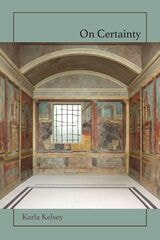
On Certainty
Karla Kelsey
Omnidawn, 2023
In the poems of On Certainty, an unnamed woman in a strangely familiar dystopia narrates a story of power and decline, where the Tyrant has gained ascendency and the Philosopher is dying. Here, the Tyrant rules over a decimated ecology filled with android deer, burnt towns, and exhausted individuals dependent on virtual reality augmentation. In choosing whether to take the Philosopher’s place in a struggle against the Tyrant, the narrator must consider how her decision may perpetuate the currently existing catastrophic systems.
Weaving together speculative fiction, philosophical aphorism, lyric fragment, and documentary technique, On Certainty echoes the contemporary world that can feel simultaneously quotidian and strange.
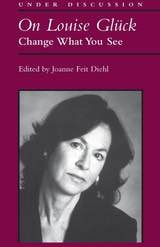
On Louise Gluck
Change What You SeeJoanne Feit Diehl, Editor
University of Michigan Press, 2005
Glück, author of nine books of poetry, including the Pulitzer Prize-winning The Wild Iris, is noted for her searing honesty and compelling first-person personae. Though compared to world-famous verse by Sappho and Dickinson, Glück's poetry has remained curiously undigested among readers of contemporary poetry for some time. On Louise Glück gathers for the first time a diverse array of essays by the leading critics of this preeminent poet. Featuring a probing, extended interview with Glück, On Louise Glück traces the critical reception of her work and offers new insights into her imaginative, mysterious poetry.
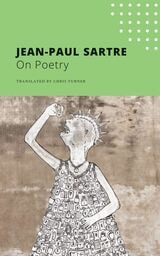
On Poetry
Jean-Paul Sartre
Seagull Books, 2021
Iconic French novelist, playwright, and essayist Jean-Paul Sartre is widely recognized as one of the most important philosophers of the twentieth century, and his work has remained relevant and thought-provoking through the decades. The Seagull Sartre Library now presents some of his most incisive philosophical, cultural, and literary critical essays in twelve newly designed and affordable editions.
On Poetry includes two long essays in this slim volume. The first explores the Négritude poetry movement by analyzing the work of several Black poets of the time. The second is a meditation on the poetry of renowned French author Francis Ponge (1899–1988), who, influenced by surrealism, developed his unique form of prose poetry.
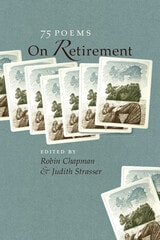
On Retirement
75 PoemsRobin Chapman
University of Iowa Press, 2007
This superb collection includes poems by men and women ranging in age from their fifties to their eighties and hailing from different cities, regions, and countries. The entire range of emotions and literary perspectives is represented here, whether the specter of death in Doug Anderson’s “Sixty One” or a sly grin in Roger Pfingston’s “Retired.”
Each poet—whether retired or just contemplating retirement—greets the prospect of this new chapter of life differently. George Bilgere purchases the complete works of Verdi and extravagant silk shirts, while Denise Levertov contemplates life alone. Alicia Ostriker implores readers to “keep on fighting, keep up the good work,” and Alberto Ríos recalls a lost love. However we contemplate retirement, this volume will illuminate the careful thoughts of those who have faced these questions before us.
Contributors Include:
Werner Aspenstrom, Chana Bloch, Philip Booth, Hayden Carruth, Lucille Clifton, Ruth Daigon, Susan Elbe, Sam Hamill, Mark Irwin, klipschutz, Ted Kooser, Maxine Kumin, Richard Moore, Naomi Shihab Nye, Grace Paley, Robert Pinsky, Carol Potter, Ishmael Reed, Claudette Mork Sigg, Ronald Wallace
On Spec
Tyrone Williams
Omnidawn, 2007
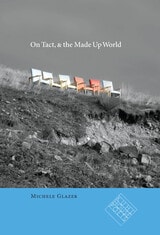
On Tact, & the Made Up World
Michele Glazer
University of Iowa Press, 2010
Michele Glazer’s poems take on questions of being and value, exploring not just what is, but how it is. The poems trouble borders—between self and other, old and young, sick and well, stranger and intimate; between physical states in processes of decay; and between line and phrase, sentence and interruption, prose and poem, resisting the desire for something irrefutable with an abiding skepticism.
The poems are drawn to missteps in perception and in language, those fractures that promise to crack open a surface to yield some other, greater meaning: “What is looked at is changed / what is looked for is gone.” From this collision of passion and severity come poems that are strange and darkly beautiful.

On The Front Line
Guerilla Poems of El SalvadorClaribel Alegria & Darwin J. Flakoll
Northwestern University Press, 1995
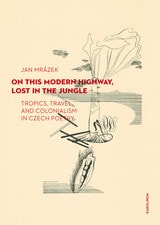
On This Modern Highway, Lost in the Jungle
Tropics, Travel, and Colonialism in Czech PoetryJan Mrázek
Karolinum Press, 2022
In 1926, the Communist avant-garde poet Konstantin Biebl (1898–1951) traveled from Czechoslovakia to the Dutch East Indies. In the writings from his journal—texts simultaneously poetic and comic—both landlocked Bohemia and the colonized tropical islands are seen in disorienting new perspectives, like “mirrors looking at themselves in each other.”
Jan Mrázek’s On This Modern Highway, Lost in the Jungle takes us on a journey of our own, crisscrossing Biebl’s life and work—with particular attention to his travel writing—as they mirror Mrázek’s own experiences as a multinational academic: a Prague conservatory graduate, educated at Michigan and Cornell, and now a scholar of Indonesia living in Singapore. Biebl’s writings are also the book’s point of departure for a broader exploration of the intersections of travel and poetry, issues of colonial and social injustice, and the representation of otherness in the Czech literary and visual imagination. In its attention to how poetic travel reflects the Czech historical experience in the shadow of imperial nations, Mrázek’s book elevates scholarly reflection on literary travel, modernity, and colonialism to a new level.
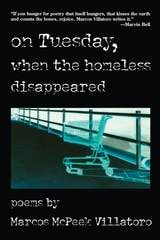
On Tuesday, When the Homeless Disappeared
Marcos McPeek Villatoro
University of Arizona Press, 2004
Villatoro is a writer with a keen political sensibility and a sense of humor besides. After confronting the reader with weighty issues, he pauses to have an encounter with a curandera in a cornfield; to speculate on a visit from extraterrestrials; and to pay tribute to his free-spirited, loose-living Uncle Jack, who "chewed forest mushrooms like a rabbit, / Then howled at a California night / While whispering querida above open thighs." Combining Borgean logic, the grit of Neruda, and a heady dose of Zen, Villatoro offers a primer on how to integrate a history of brutality and injustice with the privilege and comfort of life in America. A final section of poems is presented in Spanish only—a statement of ascendance, a strategy for identity preservation, a gift to the cognoscenti.
Reading On Tuesday, When the Homeless Disappeared may make you shift in your seat—perhaps even toss in your sleep—as you encounter a poignant human voice that is unafraid to speak from the heart.
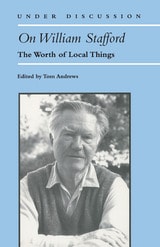
On William Stafford
The Worth of Local ThingsTom Andrews, Editor
University of Michigan Press, 1995
The late William Stafford's poetry and essays have had a major influence on contemporary American poetry. Since his book Traveling Through the Dark won the National Book Award in 1963, his awards have grown exponentially as new work has appeared. The range of writers in the past four decades who have celebrated Stafford's work-- from Margaret Atwood to James Dickey-- is remarkable. On William Stafford: The Worth of Local Things helps clarify the precise nature of Stafford's influence by assembling the responses of some of our best poets and critics to his work, including Richard Hugo, Charles Simic, Louis Simpson, Robert Coles, Linda Pastan, and Robert Creeley. This collection offers a unique view of Stafford's sometimes controversial work and insight into several of the liveliest recent debates in poetics.
Tom Andrews is Assistant Professor of English, Ohio University.
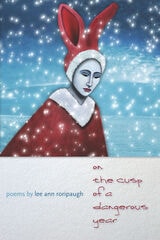
On the Cusp of a Dangerous Year
Lee Ann Roripaugh
Southern Illinois University Press, 2009
Lady Murasaki wrote in The Tale of Genji that thirty-seven is “a dangerous year” for women. Evoking the styles of Murasaki and other women writers of the Heian-period Japanese court, Lee Ann Roripaugh presents a collection of confessional poems charting the course of that perilous year. Roripaugh, in both an homage to and a dialogue with women writers of the past, explores the trials of women facing the treacherous waters of time while losing none of the grace and decadence of femininity. Often calling upon the passing of the seasons and revelations of nature, these lyrically elegant poems chronicle the dangers and delights of a range of issues facing contemporary women—from bisexuality and biracial culture and identity, to restless nights and lingering memories of the past. The pleasures of the senses collide with parallels of time and the natural world; tangible solitude lies down beside wistful memories of relationships gone by. What is ultimately revealed is both heartbreaking and illuminating. At once provocative, humorous, and bittersweet, On the Cusp of a Dangerous Year is a pillow book for the twenty-first century, providing a candid and whimsical look into the often tumultuous universe of the modern woman.
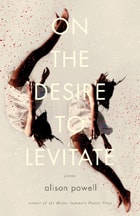
On the Desire to Levitate
PoemsAlison Powell
Ohio University Press, 2014
On the Desire to Levitate is the first collection of poems by Alison Powell. This striking collection includes vivid, unflinching meditations on aging, mythology, poetry, and family. In tight, elegant lines that alternate between homage and elegy, these poems explore known subjects with a rebellious eye: a defeated Hercules and a bitter Eurydice, a sympathetic Lucifer, and generations of adolescent girls as mythical adventurers moving within a beloved but confining Midwest. Yet in Powell’s skillful hands, hardship never overtakes: as judge Charles Hood writes, “There’s often a delicious humor in this work, and always a deep and lasting integrity.”