Results by title
424 books match the query 'Russian & Soviet' and 11 start with o

Olesha's "Envy"
A Critical CompanionRimgaila Salys
Northwestern University Press, 1999
In addition, this critical companion presents documents from the period pertaining to the novel, excerpts from Olesha's memoirs, and a listing of important criticism.
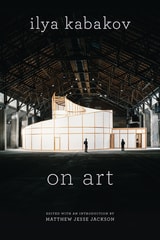
On Art
Ilya Kabakov
University of Chicago Press, 2018
Devoted to themes that range from the “cosmism” of pre-Revolutionary Russian modernism to the philosophical implications of Moscow’s garbage, Kabakov’s handmade booklets were typed out on paper, then stapled or sewn together using rough butcher paper for their covers. Among these writings are faux Socialist Realist verses, theoretical explorations, art historical analyses, accompaniments to installation projects, and transcripts of dialogues between the artist and literary theorists, critics, journalists, and other artists.
This volume offers for the first time in English the most significant texts written by Kabakov. The writings have been expressly selected for this English-language volume and there exists no equivalent work in any language.
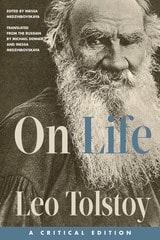
On Life
A Critical EditionLeo Tolstoy, Edited by Inessa Medzhibovskaya, Translated from the Russian by Michael Denner and Inessa Medzhibovskaya
Northwestern University Press, 2018
After its completion, On Life was suppressed by the tsars, attacked by the hierarchs of the Russian Orthodox Church, and then censored by the Stalinist regime. This critical edition is the first accurate translation of this unsung classic of Russian thought into English, based on a study of manuscript pages of Tolstoy's drafts, and the first scholarly edition of this work in any language. It includes a detailed introduction and annotations, as well as historical material, such as early drafts, documents related to the presentation of an early version at the Moscow Psychological Society, and responses to the work by philosophers, religious leaders, journalists, and ordinary readers of Tolstoy's day.
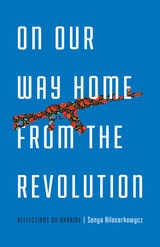
On Our Way Home from the Revolution
Reflections on UkraineSonya Bilocerkowycz
The Ohio State University Press, 2019
In 2014 Sonya Bilocerkowycz is a tourist at a deadly revolution. At first she is enamored with the Ukrainians’ idealism, which reminds her of her own patriotic family. But when the romantic revolution melts into a war with Russia, she becomes disillusioned, prompting a return home to the US and the diaspora community that raised her. As the daughter of a man who studies Ukrainian dissidents for a living, the granddaughter of war refugees, and the great-granddaughter of a gulag victim, Bilocerkowycz has inherited a legacy of political oppression. But what does it mean when she discovers a missing page from her family’s survival story—one that raises questions about her own guilt?
In these linked essays, Bilocerkowycz invites readers to meet a swirling cast of post-Soviet characters, including a Russian intelligence officer who finds Osama bin Laden a few weeks after 9/11; a Ukrainian poet whose nose gets broken by Russian separatists; and a long-lost relative who drives a bus into the heart of Chernobyl. On Our Way Home from the Revolution muddles our easy distinctions between innocence and culpability, agency and fate.
One Day in the Life of Ivan Denisovich
A Critical CompanionAlexis Klimoff
Northwestern University Press, 1996
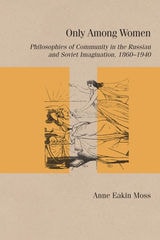
Only Among Women
Philosophies of Community in the Russian and Soviet Imagination, 1860–1940Anne Eakin Moss
Northwestern University Press, 2020
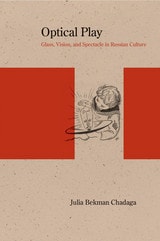
Optical Play
Glass, Vision, and Spectacle in Russian CultureJulia Bekman Chadaga
Northwestern University Press, 2014
Longlist finalist, 2015 Historia Nova Prize for Best Book on Russian Intellectual and Cultural History
Julia Bekman Chadaga’s ambitious study posits that glass—in its uses as a material and as captured in culture—is a key to understanding the evolution of Russian identity from the eighteenth century onward. From the contemporary perspective, it is easy to overlook how glass has profoundly transformed vision. Chadaga shows the far-reaching effects of this phenomenon.
Her book examines the similarities between glass and language, the ideological uses of glass, and the material’s associations with modernity, while illuminating the work of Lomonosov, Dostoevsky, Zamyatin, and Eisenstein, among others. In particular, Chadaga explores the prominent role of glass in the discourse around Russia’s contentious relationship with the West—by turns admiring and antagonistic—as the nation crafted a vision for its own future. Chadaga returns throughout to the spectacular aspect of glass and shows how both the tendentious capacity and the playfulness of this material have shaped Russian culture.
Organic Worldview of Nikolai Leskov
Irmhild Christina Sperrle
Northwestern University Press, 2002
Although little studied in the West, Nikolai Semenovich Leskov (1831-95) is accorded a place among major nineteenth-century writers in his native Russia. Irmhild Christina Sperrle's The Organic Worldview of Nikolai Leskov draws on previously unavailable archival and primary sources to offer English-speaking readers the opportunity to appreciate the work of this neglected author.
Leskov remarked to his contemporary Anatolii Faresov, "People talk about my 'language,' about its colorfulness and its national traits; about the richness of my plots, about my condensed way of writing, about 'similarity' and so on, but they do not notice the most important thing." It is this "most important thing," Leskov's consistent thematic adherence to an "organic" philosophical model, that Sperrle traces and elaborates here. Focusing on movement and transformation in "an organic manner"—a manner in which death and rebirth alternate and condition each other—Sperrle develops Leskov's notion of organicity and explores his relationship to the organic tradition in philosophy and literature. Her reading of key texts among his more than five hundred works entails a close look at Leskov's ideas about the Divine as freedom of belief, about truth as a continual renewal of previously held theories, and about death in both a physical and a spiritual sense. She examines Leskov's vexed relation to Tolstoyan ideas and shows how the notion of heresy—as a questioning rather than rejection of authority-is a crucial element in his worldview and his work.
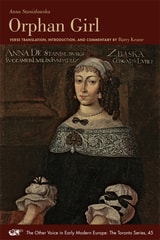
Orphan Girl
A Transaction, or an Account of the Entire Life of an Orphan Girl by way of Plaintful Threnodies in the Year 1685. The Aesop EpisodeAnna Stanislawska
Iter Press, 2016
Barry Keane's idiomatic and inventive verse translation brings to life this half-forgotten poetic account of a remarkable tale of triumph in the face of overwhelming oppression and allows Anna Stanislawska to take her place among the women poets of early modern Europe.
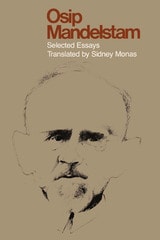
Osip Mandelstam
Selected EssaysTranslated by Sidney Monas
University of Texas Press, 1977
Osip Mandelstam, who died anonymously in a Siberian transit-camp in 1938, is now generally considered to be among the four or five greatest Russian poets of the twentieth century. The essays in this volume, presented in an exceptionally scrupulous and true translation, were selected because they represent Mandelstam's major poetic themes and his thought on literature, language and culture, and the work and place of the poet. Mandelstam's views on literature are profound and original, and they are expressed in striking and dramatic, if sometimes difficult, prose. These essays deal with such topics as the poetic process and the relationship of poetry to politics, culture, the traditions of the past, and the demands of the present.
Sidney Monas's lively introduction to the work and life of Mandelstam combines the virtues of both the critical essay and detached scholarship. Keeping biographical detail to a minimum, Monas concentrates on the pattern that runs through the essays and lends them that coherence often noted in Mandelstam's poetry.
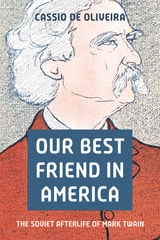
Our Best Friend in America
The Soviet Afterlife of Mark TwainCassio de Oliveira
University of Wisconsin Press, 2027
In 1960, the popular Soviet magazine Krokodil dubbed Mark Twain the USSR’s “American Friend No. 1.” This surprised neither the Kremlin nor the magazine’s readers: Twain and especially his Mississippi novels, The Adventures of Tom Sawyer and The Adventures of Huckleberry Finn, were favorites throughout the Soviet period, with the first translations dating to before the Bolshevik Revolution and film adaptations continuing to appear into the 1980s. Cassio de Oliveira explores why and how such a decidedly American writer came to occupy pride of place in a nation so emphatically opposed to American culture. How exactly did Twain become the Soviet Union’s “best friend in America”? How did that friendship change, and what did it signify, throughout the long and fickle decades of Soviet cultural policy and the Cold War?
What emerges from this complex history is not just the story of a single author’s foreign fortunes but also the history of Soviet literature as well as Soviet–American cultural interactions, which are revealed to have been more multifaceted and variable than might be assumed. Twain’s reception in the USSR also speaks to the largely hidden history of world literature in translation, even during decades of fraught geopolitical confrontation.