Results by title
527 books match the query 'Translations into English' and 19 start with o
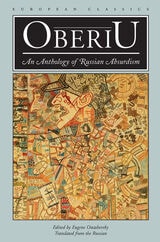
OBERIU
An Anthology of Russian AbsurdismEugene Ostashevsky
Northwestern University Press, 2006
Some called it the last of the Russian avant-garde, and others called it the first (and last) instance of Absurdism in Russia. Though difficulty to pigeon-hole, OBERIU and the pleasures of its poetry and prose are, with this volume, at long last fully open to English-speaking readers. Skillfully translated to preserve the weird charm of the originals, these poems and prose pieces display all the hilarity and tragedy, the illogical action and puppetlike violence and eroticism, and the hallucinatory intensity that brought down the wrath of the Soviet censors. Today they offer an uncanny reflection of the distorted reality they reject.
Oblivion and Stone
A Selection of Bolivian Poetry and FictionSandra Reyes
University of Arkansas Press, 1998
In a literature where recognition is hard earned, this anthology demonstrates what distinguishes contemporary Bolivian fiction and poetry from the rest of Latin American writing and shows clearly how Bolivian writers relate to that tradition.
Bolivia is a landlocked nation of mountains and high, arid plains, a place native writer Jesús Urzagasti calls the “Land of Silence.” This crucible of indigenous and European influences has contributed to the creation of a writing style that is always down-to-earth, often grittily realistic.
From this fundamental base, Bolivian writers express provincial customs and values, decry political oppression, and sound universal themes of isolation, even resignation; but, more often, they show the will to move forward as a people. This rich thematic mix encourages what critic Edgar Lora has called the “dynamic and vigorous social dis course” and the resulting “subversive, militant, and revolutionary” qualities of Bolivian literature.
Editor Sandra Reyes has gathered a panoramic sampling of twenty two poets and eighteen fiction writers. Focusing predominantly on living, practicing writers, this anthology defines the current literary voice of Bolivia and gives us a distillation of the contemporary Bolivian consciousness.
Odes
Horace, Translated with commentary by David R. Slavitt
University of Wisconsin Press, 2014
This edition is also notable for Slavitt’s extensive notes and commentary about the art of translation. He presents the problems he encountered in making the translation, discussing possible solutions and the choices he made among them. The effect of the notes is to bring the reader even closer to the original Latin and to understand better how to gauge the distance between the two languages.
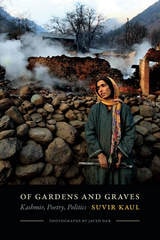
Of Gardens and Graves
Kashmir, Poetry, PoliticsSuvir Kaul
Duke University Press, 2017
Of No Country I Know
New and Selected Poems and TranslationsDavid Ferry
University of Chicago Press, 1999
"Though Ferry is perhaps best known for his eloquent translations of Horace and Virgil, "Of No Country I Know" demonstrates that he deserves acclaim for his own poetry as well."—Carmela Ciuraru, New York Times Book Review
Old Floating Cloud
Two NovellasCan Xue
Northwestern University Press, 1991
Yellow Mud Street tells of a street, its people, and a strange event that happens there. The street is dilapidated, though it once saw better times. The “S” Machinery Factory, which used to run day and night, is rusty and decaying, though people still deceive themselves into thinking this factory is a fine place, the envy of “foreign devils” and an important connection with “the authorities.” One day, “a thing” appears. No one is sure if it is a person, a flash of light, or a cloud of will-o'-the-wisp. It prompts rumor, superstition, political slogans, and an investigation by the authorities. A chorus of paranoid preoccupations wind up and down Yellow Mud Street, in a series of muttered refrains that build to a screaming frenzy.
Old Floating Cloud is the ruthlessly unsentimental story of a man who has an affair with his neighbor's wife. Can Xue describes the damage people do to each other, their obsessions, their lack of connection, and their attempts to exert power over one another. Lovers are not the only targets of Can Xue’s biting humor. Resentment flares between parents and children, in-laws spy, and employees abase themselves before their bosses. Like Yellow Mud Street, this novella teems with insects, excrement, and distorted bodies—visceral reminders of our earthbound state.
On Black Sisters Street
A NovelChika Unigwe
Ohio University Press, 2012
On the Incomprehensible Nature of God
Saint John Chrysostom
Catholic University of America Press, 1984
Once a Peacock, Once an Actress
Twenty-Four Lives of the Bodhisattva from Haribhatta's "Jatakamala"Haribhatta
University of Chicago Press, 2017
Haribhatta’s Jåtakamålå is a sophisticated and personal adaptation of popular stories, mostly non-Buddhist in origin, all illustrating the future Buddha’s single-minded devotion to the good of all creatures, and his desire, no matter what his incarnation—man, woman, peacock, elephant, merchant, or king—to assist others on the path to nirvana. Haribhatta’s insight into human and animal behavior, his astonishing eye for the details of landscape, and his fine descriptive powers together make this a unique record of everyday life in ancient India as well as a powerful statement of Buddhist ethics. This translation will be a landmark in the study of Buddhism and of the culture of ancient India.
Only the Road / Solo el Camino
Eight Decades of Cuban PoetryMargaret Randall, editor and translator
Duke University Press, 2016
Open Gate
An Anthology of Haitian Creole PoetryEdited by Paul Laraque and Jack Hirschman
Northwestern University Press, 2001
The editors focus on contemporary Creole poetry that reflects the struggle for human rights in Haiti. The book is divided into three sections: Pioneers of Modern Haitian Creole poetry, beginning with the founder of modern Haitian Creole literature, Felix Morisseu-Leroy (19131998); the flowering of Haitian poetry as represented by the literary movement, "Society of Butterflies," some of whose members were jailed or exiled by the bloody Duvalier dictatorship; and the New Generation featuring primarily those poets in the Diaspora whose work has been published in the last 15 years.
Original Buddhist Sources
A ReaderOlson, Carl
Rutgers University Press, 2005
Bringing together essential materials on the origins and development of Buddhist traditions from India, Sri Lanka, Tibet, China, and Japan, this anthology provides the broadest selection of primary source Buddhist literature available to date.
The volume is divided into two major parts: Theravada and Mahayana forms of Buddhism. The first section presents selections that explore major themes in Buddhist thought such as causality, Four Noble Truths, the doctrine of non-self, nibbana, meditation, and ethics, as well as literature about monastic life and regulations, women, and hagiography.
The second part includes selections from so-called wisdom literature and texts that represent the three major schools of Mahayana Buddhism: Pure Land, Madhyamika, and Yogacara. Selections also include sources from some of the major Chinese Buddhist schools such as Hua-yen, T'ien T'ai, Pure Land, and Ch'an. Readings by thinkers such as Tantric Buddhist reformer Tsong Khapa, Pure Land leaders Honen, Shinran, and Nichiren, as well as Zen Buddhists Dogen and Hakuin provide a perspective on regional and national traditions.
In addition to the general introduction, each major section is introduced by an essay that places the selections within the context of Buddhist history. This comprehensive reader stands on its own as an indispensable anthology of original textual sources for courses in Buddhism, while also serving as a companion volume to the text The Different Paths of Buddhism: A Narrative-Historical Introduction.
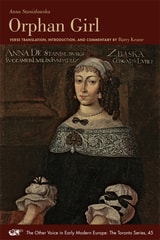
Orphan Girl
A Transaction, or an Account of the Entire Life of an Orphan Girl by way of Plaintful Threnodies in the Year 1685. The Aesop EpisodeAnna Stanislawska
Iter Press, 2016
Barry Keane's idiomatic and inventive verse translation brings to life this half-forgotten poetic account of a remarkable tale of triumph in the face of overwhelming oppression and allows Anna Stanislawska to take her place among the women poets of early modern Europe.
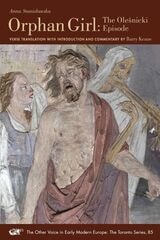
Orphan Girl
The Olesnicki Episode: One Body with Two Souls Entwined: An Epic Tale of Married Love in Seventeenth-Century PolandAnna Stanislawska
Iter Press, 2021
Written in 1685, Transaction or the Description of the Entire Life of an Orphan by Way of Plaintful Threnodies, often referred to as Orphan Girl, is a valuable, long-lost, seventeenth-century poetic text that documents women’s writing in the early modern period. In this autobiographical account, Anna Stanislawska speaks confessionally and unsparingly about her life, from her infancy to her widowhood and withdrawal from the world. Stanislawska was an incomparable memoirist, revealing the depths of her private life in a manner not to be matched until modern times. One Body with Two Souls Entwined brings together this spirited poetic account with an in-depth introductory and literary commentary by Barry Keane. Together the book offers a remarkable piece of scholarly, translational, and dramaturgical work and puts it in context amid the backdrop of Polish history.
Other Letters to Milena / Otras cartas a Milena
Reina María Rodríguez
University of Alabama Press, 2014
A parallel translation of a mixed-genre work by acclaimed Cuban writer Reina María Rodríguez in which poetry merges into creative nonfiction, culminating in a series of essays.
Published in Spanish as Otras cartas a Milena, Other Letters to Milena shows Rodríguez confronting pressing issues at the turn of the twenty-first century. These involve a new post-Soviet world and the realities of diasporic existence, which have a profound effect even on people like Rodríguez who have not migrated but continue to live and work in their home nation. The book’s title references Franz Kafka, whose Letters to Milena was published after his death in 1952. This signals that Rodríguez participates in her city’s long cosmopolitan tradition asserted by Cuban writers and scholars of Cuban literature. Rodríguez’s youngest daughter, featured most prominently in the letters making up the collection’s centerpiece, “A Girl’s Story,” was named after Milena Jesenská, the recipient of Kafka’s letters.
With the poems provided in a bilingual format, the collection will be of interest both to English readers in general (this will be the first English translation of a complete Rodríguez collection not excerpted from a larger work) and to Spanish readers unable to obtain the collection in any form, given the difficulty of distributing Cuban literature outside that country.
As an introduction to the book, Dykstra has included a critical commentary. It clarifies many of the author’s references, such as details pertaining to her family history—items Dykstra learned during lengthy discussions with the author about her work—and influences about her choices in the translation.
Our Caribbean
A Gathering of Lesbian and Gay Writing from the AntillesThomas Glave, ed.
Duke University Press, 2008
The thirty-seven authors hail from the Bahamas, Barbados, Cuba, the Dominican Republic, Grenada, Guyana, Haiti, Jamaica, Panama, Puerto Rico, St. Vincent, St. Kitts, Suriname, and Trinidad. Many have lived outside the Caribbean, and their writing depicts histories of voluntary migration as well as exile from repressive governments, communities, and families. Many pieces have a political urgency that reflects their authors’ work as activists, teachers, community organizers, and performers. Desire commingles with ostracism and alienation throughout: in the evocative portrayals of same-sex love and longing, and in the selections addressing religion, family, race, and class. From the poem “Saturday Night in San Juan with the Right Sailors” to the poignant narrative “We Came All the Way from Cuba So You Could Dress Like This?” to an eloquent call for the embrace of difference that appeared in the Nassau Daily Tribune on the eve of an anti-gay protest, Our Caribbean is a brave and necessary book.
Contributors: José Alcántara Almánzar, Aldo Alvarez, Reinaldo Arenas, Rane Arroyo, Jesús J. Barquet, Marilyn Bobes, Dionne Brand, Timothy S. Chin, Michelle Cliff, Wesley E. A. Crichlow,
Mabel Rodríguez Cuesta, Ochy Curiel, Faizal Deen, Pedro de Jesús, R. Erica Doyle, Thomas Glave,
Rosamond S. King, Helen Klonaris, Lawrence La Fountain-Stokes, Audre Lorde, Shani Mootoo,
Anton Nimblett, Achy Obejas, Leonardo Padura Fuentes, Virgilio Piñera, Patricia Powell, Kevin Everod Quashie, Juanita Ramos, Colin Robinson, Assotto Saint, Andrew Salkey, Lawrence Scott,
Makeda Silvera, H. Nigel Thomas, Rinaldo Walcott, Gloria Wekker, Lawson Williams
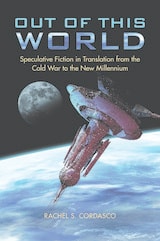
Out of This World
Speculative Fiction in Translation from the Cold War to the New MillenniumRachel S. Cordasco
University of Illinois Press, 2021
An informative and one-of-a-kind guide, Out of This World offers readers and scholars alike a tour of speculative fiction's new globalized era.
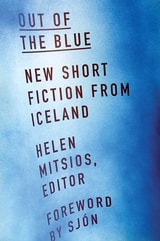
Out of the Blue
New Short Fiction from IcelandHelen Mitsios
University of Minnesota Press, 2017
A groundbreaking collection of fiction from Iceland’s best contemporary authors
This extraordinary collection, the first anthology of Icelandic short fiction published in English translation, features work by twenty of Iceland’s most popular and celebrated living authors—including Andri Snær Magnason, Jón Kalman Stefánsson, Kristín Ómarsdóttir, and Auður Jónsdóttir—granddaughter of Halldór Laxness, who won the 1955 Nobel Prize in Literature.
Celebrated in Europe and Scandinavia but less known in the English-speaking world, these writers traverse realms of darkness and light that will be familiar to readers who have fallen under the spell of Scandinavian fiction. While uniquely Icelandic in topography and tenor, with a touch of the island’s supernatural charm, the stories traffic in the enduring and universal complexities of human nature. Here is a fictional universe where the ghosts of Vikings and spirits tread, volcanoes grumble underfoot, and writers trip the Northern Lights fantastic across the landscape of the Icelandic imagination.
At long last, readers can enjoy award-winning stories now expertly rendered into English by the country’s most renowned translators. In “Killer Whale” a father contemplates euthanasia for a terminally ill child, in “Self Portrait” a vacationing family in Spain crosses paths with migrants, in “Escape for Men” a woman searches for an ex-lover in the South of France, and in “The Most Precious Secret” the nature of artists and the art world is mercilessly revealed. Both the Viking myths of Iceland’s forefathers and the cutting-edge modern world of the country today are brilliantly alive in these remarkable and original stories.
This collection is an excursion to an island where almost two million travelers descend yearly on a population of 345 thousand natives. Iceland is the place Björk calls home, the location where Game of Thrones was filmed—a place with open lava fields, glaciers, and iceberg lagoons among other natural wonders that is becoming one of the “hottest” tourist destinations on earth.
Out of the Blue transports readers to Iceland’s timeless and magical island of Vikings and geographical wonders, and it promises to be a seminal collection that will define Icelandic literature in translation for decades to come.
Contributors: Auður Ava Olafsdóttir, Kristín Eiríksdóttir, Þórarinn Eldjárn, Gyrðir Elíasson, Einar Örn Gunnarsson, Ólafur Gunnarsson, Einar Már Guðmundsson, Auður Jónsdóttir, Gerður Kristný, Andri Snær Magnason, Óskar Magnússon, Bragi Ólafsson, Kristín Ómarsdóttir, Óskar Árni Óskarsson, Magnús Sigurðsson, Jón Kalman Stefánsson, Ágúst Borgþór Sverrisson, Guðmundur Andri Thorsson, Þórunn Erlu-Valdimarsdóttir, Rúnar Helgi Vignisson.
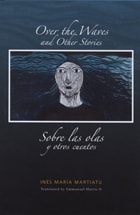
Over the Waves and Other Stories / Sobre las olas y otros cuentos
A Bilingual EditionInés María Martiatu
Swan Isle Press, 2009
The history of the Caribbean, as part of the African diaspora, is reflected in the textures of life in Cuba, its music, rituals and myths, the Church and Santería, past and present. While race is unquestionably fundamental to the stories, they are at the same time rooted in the universality of the human experience. The vantage is that of an unflinching, yet compassionate observer of society—one who simultaneously turns an introspective mirror on the complicated layers of self.