Results by title
18284 books match the query 'United States' and 384 start with o
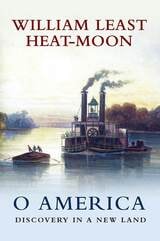
O America
Discovery in a New LandWilliam Least Heat-Moon
University of Missouri Press, 2027
Traveling by foot, horse, stage, canal boat, and steamer, Nathaniel and Nicodemus explore the backcountry and forge a deep friendship as they encounter a host of memorable characters who reveal the nature of the American experiment, one still in its early stages but already under the stress of social injustices and economic inequities.
OHIO
THE HISTORY OF A PEOPLEAndrew R. L. Cayton
The Ohio State University Press, 2002
ORDINATION
SCOTT A KAUKONEN
The Ohio State University Press, 2005
“If my mother were to tell the story . . .” So begins the title piece in this debut collection of short fiction, eight stories that explore the gap between the stories we tell ourselves and the stories we have lived. In “Punitive Damages,” a father, the beneficiary of a huge financial settlement in compensation for his son’s death, must confront the truth of the life that the son’s death has provided. In “Punnett’s Squares,” winner of the Chicago Tribune’s Nelson Algren Award, an adopted son seeks to prove, against all evidence to the contrary, that his adoptive father is in fact his biological father. In “Induction Ceremony,” a small-town basketball hero returns to his hometown no longer a man but now a woman, and his onetime teammate-and-friend must reconsider who they were and who they are now. In the pair of pieces that bookend the collection, “Ordination” and “Be a Missionary,” a Baptist preacher’s son must reconcile the distance between the evidence of things seen and the evidence of things unseen.
These are men and boys who like to see themselves as worthy of the titles of father, son, husband, lover, and friend, but who must fight their own instincts and desires to claim such honors. These are boys and men for whom questions of identity—biological, cultural, sexual, religious, moral—are unavoidable, men and boys always seeking to be who they want to be, always aware of who they are.
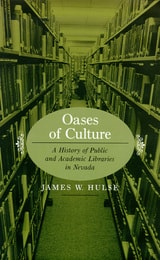
Oases Of Culture
A History Of Public And Academic Libraries In NevadaJames W. Hulse
University of Nevada Press, 2003
The cultural and intellectual history of the Silver State is examined through the creation of its libraries. In Oases of Culture, veteran Nevada historian James W. Hulse recounts the tortuous and often colorful history of Nevada’s libraries and the work of the dedicated librarians, educators, civic leaders, women’s organizations, philanthropists, and politicians who struggled to make the democratic vision of free libraries available to all Nevadans. From the establishment of the State Library in 1865, only one year after statehood, through the creation of tax-supported public libraries after passage of a library law in 1895, to the development of today’s modern university and community college libraries and the public-library information services that serve Nevada’s booming and increasingly diverse population, Hulse recounts the trials and triumphs of Nevada’s libraries. He also examines the role of Nevada librarians in fostering literacy and confronting the First Amendment controversies that have periodically shaken the nation’s cultural foundations.
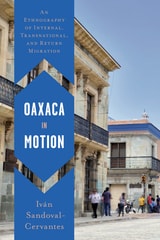
Oaxaca in Motion
An Ethnography of Internal, Transnational, and Return MigrationIván Sandoval-Cervantes
University of Texas Press, 2022
Migration is typically seen as a transnational phenomenon, but it happens within borders, too. Oaxaca in Motion documents a revealing irony in the latter sort: internal migration often is global in character, motivated by foreign affairs and international economic integration, and it is no less transformative than its cross-border analogue.
Iván Sandoval-Cervantes spent nearly two years observing and interviewing migrants from the rural Oaxacan town of Santa Ana Zegache. Many women from the area travel to Mexico City to work as domestics, and men are encouraged to join the Mexican military to fight the US-instigated “war on drugs” or else leave their fields to labor in industries serving global supply chains. Placing these moves in their historical and cultural context, Sandoval-Cervantes discovers that migrants’ experiences dramatically alter their conceptions of gender, upsetting their traditional notions of masculinity and femininity. And some migrants bring their revised views with them when they return home, influencing their families and community of origin. Comparing Oaxacans moving within Mexico to those living along the US West Coast, Sandoval-Cervantes clearly demonstrates the multiplicity of answers to the question, “Who is a migrant?”
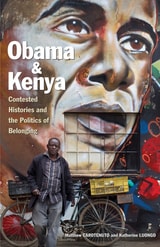
Obama and Kenya
Contested Histories and the Politics of BelongingMatthew Carotenuto
Ohio University Press, 2016
Barack Obama’s political ascendancy has focused considerable global attention on the history of Kenya generally and the history of the Luo community particularly. From politicos populating the blogosphere and bookshelves in the U.S and Kenya, to tourists traipsing through Obama’s ancestral home, a variety of groups have mobilized new readings of Kenya’s past in service of their own ends.
Through narratives placing Obama into a simplified, sweeping narrative of anticolonial barbarism and postcolonial “tribal” violence, the story of the United States president’s nuanced relationship to Kenya has been lost amid stereotypical portrayals of Africa. At the same time, Kenyan state officials have aimed to weave Obama into the contested narrative of Kenyan nationhood.
Matthew Carotenuto and Katherine Luongo argue that efforts to cast Obama as a “son of the soil” of the Lake Victoria basin invite insights into the politicized uses of Kenya’s past. Ideal for classroom use and directed at a general readership interested in global affairs, Obama and Kenya offers an important counterpoint to the many popular but inaccurate texts about Kenya’s history and Obama’s place in it as well as focused, thematic analyses of contemporary debates about ethnic politics, “tribal” identities, postcolonial governance, and U.S. African relations.

Obama's Race
The 2008 Election and the Dream of a Post-Racial AmericaMichael Tesler and David O. Sears
University of Chicago Press, 2010
Barack Obama’s presidential victory naturally led people to believe that the United States might finally be moving into a post-racial era. Obama’s Race—and its eye-opening account of the role played by race in the election—paints a dramatically different picture.
The authors argue that the 2008 election was more polarized by racial attitudes than any other presidential election on record—and perhaps more significantly, that there were two sides to this racialization: resentful opposition to and racially liberal support for Obama. As Obama’s campaign was given a boost in the primaries from racial liberals that extended well beyond that usually offered to ideologically similar white candidates, Hillary Clinton lost much of her longstanding support and instead became the preferred candidate of Democratic racial conservatives. Time and again, voters’ racial predispositions trumped their ideological preferences as John McCain—seldom described as conservative in matters of race—became the darling of racial conservatives from both parties. Hard-hitting and sure to be controversial, Obama’s Race will be both praised and criticized—but certainly not ignored.

Obama's Washington
Political Leadership in a Partisan EraEdited by Clodagh Harrington
University of London Press, 2014
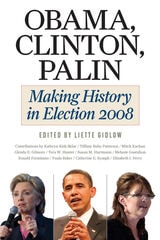
Obama, Clinton, Palin
Making History in Elections 2008Edited by Liette Gidlow
University of Illinois Press, 2011
Election 2008 made American history, but it was also the product of American history. Barack Obama, Hillary Clinton, and Sarah Palin smashed through some of the most enduring barriers to high political office, but their exceptional candidacies did not come out of nowhere. In these timely and accessible essays, a distinguished group of historians explores how the candidates both challenged and reinforced historic stereotypes of race and sex while echoing familiar themes in American politics and exploiting new digital technologies.
Contributors include Kathryn Kish Sklar on Clinton’s gender masquerade; Tiffany Ruby Patterson on the politics of black anger; Mitch Kachun on Michelle Obama and stereotypes about black women’s bodies; Glenda E. Gilmore on black women’s century of effort to expand political opportunities for African Americans; Tera W. Hunter on the lost legacy of Shirley Chisholm; Susan M. Hartmann on why the U.S. has not yet followed western democracies in electing a female head of state; Melanie Gustafson on Palin and the political traditions of the American West; Ronald Formisano on the populist resurgence in 2008; Paula Baker on how digital technologies threaten the secret ballot; Catherine E. Rymph on Palin’s distinctive brand of political feminism; and Elisabeth I. Perry on the new look of American leadership.
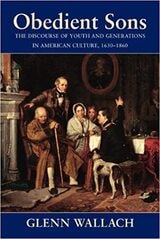
Obedient Sons
The Discourse of Youth and Generations in American Culture, 1630-1860Glenn Wallach
University of Massachusetts Press, 2009

Obesity among Poor Americans
Is Public Assistance the Problem?Patricia K. Smith
Vanderbilt University Press, 2009
This book investigates the controversial claim by welfare critics that public assistance programs like Food Stamps and the National School Lunch programs contribute to obesity among the poor. The author synthesizes empirical evidence from an array of disciplines--anthropology, economics, epidemiology, medicine, nutrition science, marketing, psychology, public health, sociology, and urban planning--to test this claim and to test whether other causal processes are at work.
With a lucid presentation that makes it a model for applying research to questions of social policy, the book lays out the different hypotheses and the possible causal pathways within each. The four central chapters test whether "public assistance causes obesity," "obesity causes public assistance," "poverty causes both public assistance and obesity," and "Factor X causes both." The factors in the last category that may relate to both public assistance and obesity include stress, disability, and physical abuse.
Object Lessons and the Formation of Knowledge
The University of Michigan Museums, Libraries, and Collections 1817–2017Kerstin Barndt and Carla M. Sinopoli, editors
University of Michigan Press, 2017
Objectifying China, Imagining America
Chinese Commodities in Early AmericaCaroline Frank
University of Chicago Press, 2011
With the ever-expanding presence of China in the global economy, Americans more and more look east for goods and trade. But as Caroline Frank reveals, this is not a new development. China loomed as large in the minds—and account books—of eighteenth-century Americans as it does today. Long before they had achieved independence from Britain and were able to sail to Asia themselves, American mariners, merchants, and consumers were aware of the East Indies and preparing for voyages there. Focusing on the trade and consumption of porcelain, tea, and chinoiserie, Frank shows that colonial Americans saw themselves as part of a world much larger than just Britain and Europe
Objects of Remembrance
A Memoir of American Opportunities and Viennese DreamsMonroe E. Price
Central European University Press, 2009
This is a memoir about the power of American assimilation and opportunity in the face of persisting refugee realities. Like Isaac Bashevis Singer, Monroe Price recounts the continuing impact of European identities as families, cast from their homes by the rise of Hitler and the Third Reich, struggle to find their way in a new and challenging environment.
In a series of reflections, Price, who was born to a Jewish family in Vienna in 1938 and left when he was seven months old, seeks to create the Vienna of his infancy, including Jewish life, anti-Semitism, the Anschluss, and Kristallnacht (during which his father was arrested). He shifts to scenes of American socialization in the places he moved with his parents:: Macon, Georgia, Cincinnati, Ohio, and the experience of New York City. Through these reflections, Price illuminates ideas about family, religion, friends and schooling as well as deeply personal issues such as home, food and intimacy.
Price’s memoir weaves complicated strands—his Viennese origins, campaigns to distribute Jewish refugees away from New York City, the special qualities of Midwestern Ohio life in the 1950s—and the contrasting patterns of adjustment by different generations in his family in the American landscape. As he traces the particular path of his own life, Price reveals a more universal story of adjustment, and the relationship between a marginal community and the drama of American citizenship.
Objects of Special Devotion
Fetishes and Fetishism in Popular CultureRay B. Browne
University of Wisconsin Press, 1982
This book demonstrates the importance of the study of fetishes and fetishism in the study of popular culture. Some of the essays cover rather "conventional" manifestations in the world today; others demonstrate the fetishistic qualities of some unusual items. But all illustrate without any doubt that, like the icon, the ritual, and many other items in society, fetishes, fetishism and fetishists must be studied and understood before we can begin to understand the complexity of present-day society.
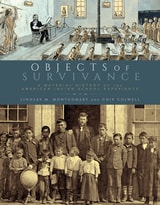
Objects of Survivance
A Material History of the American Indian School ExperienceLindsay M. Montgomery
University Press of Colorado, 2019
This visual and material archive serves as a lens through which to view a key moment in US history—when Native Americans were sequestered onto reservation lands, forced into unfamiliar labor economies, and attacked for their religious practices. Education, the government hoped, would be the final tool to permanently transform Indigenous bodies through moral instruction in Western dress, foodways, and living habits. Yet Lindsay Montgomery and Chip Colwell posit that Bratley’s collection constitutes “objects of survivance”—things and images that testify not to destruction and loss but to resistance and survival. Interwoven with documents and interviews, Objects of Survivance illuminates how the US government sought to control Native Americans and how Indigenous peoples endured in the face of such oppression.
Rejecting the narrative that such objects preserve dying Native cultures, Objects of Survivance reframes the Bratley Collection, showing how tribal members have reconnected to these items, embracing them as part of their past and reclaiming them as part of their contemporary identities. This unique visual and material record of the early American Indian school experience and story of tribal perseverance will be of value to anyone interested in US history, Native American studies, and social justice.
Co-published with the Denver Museum of Nature & Science
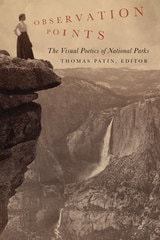
Observation Points
The Visual Poetics of National ParksThomas Patin
University of Minnesota Press, 2012
National parks are the places that present ideas of nature to Americans: Zion, Yosemite, Grand Canyon, Yellowstone bring to mind quintessential and awe-inspiring wilderness. By examining how rhetoric—particularly visual rhetoric—has worked to shape our views of nature and the “natural” place of humans, Observation Points offers insights into questions of representation, including the formation of national identity.
As Thomas Patin reveals, the term “nature” is artificial and unstable, in need of constant maintenance and reconstruction. The process of stabilizing its representation, he notes, is unavoidably political. America’s national parks and monuments show how visual rhetoric operates to naturalize and stabilize representations of the environment. As contributors demonstrate, visual rhetoric is often transparent, structuring experience while remaining hidden in plain sight. Scenic overlooks and turnouts frame views for tourists. Visitor centers, with their display cases and photographs and orientation films, provide their own points of view—literally and figuratively. Guidebooks, brochures, and other publications present still other ways of seeing. At the same time, images of America’s “natural” world have long been employed for nationalist and capitalist ends, linking expansionism with American greatness and the “natural” triumph of European Americans over Native Americans.
The essays collected here cover a wide array of subjects, including park architecture, landscape painting, public ceremonies, and techniques of display. Contributors are from an equally broad range of disciplines—art history, geography, museum studies, political science, American studies, and many other fields. Together they advance a provocative new visual genealogy of representation.
Contributors: Robert M. Bednar, Southwestern U, Georgetown, Texas; Teresa Bergman, U of the Pacific; Albert Boime, UCLA; William Chaloupka, Colorado State U; Gregory Clark, Brigham Young U; Stephen Germic, Rocky Mountain College; Gareth John, St. Cloud State U, Minnesota; Mark Neumann, Northern Arizona U; Peter Peters, Maastricht U; Cindy Spurlock, Appalachian State U; David A. Tschida, U of Wisconsin, Eau Claire; Sabine Wilke, U of Washington.
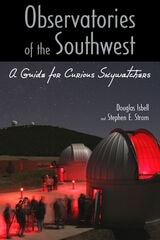
Observatories of the Southwest
A Guide for Curious SkywatchersDouglas Isbell and Stephen E. Strom
University of Arizona Press, 2009
Douglas Isbell and Stephen Strom, both intimately involved in southwestern astronomy, have written a practical guide to the major observatories of the region for those eager to learn what modern telescopes are doing, to understand the role each of these often quirky places has played in advancing our understanding of the cosmos, and hopefully to visit and see the tools of the astronomer up close. For each observatory, the authors describe its history, highlights of its contributions to astronomy—with an emphasis on recent results—and information for visitors. Also included are wide-ranging interviews with astronomers closely associated with each site.
Observatories covered range from McDonald in Texas to Palomar in California, with significant outposts in between: Arizona’s Kitt Peak National Observatory southwest of Tucson, the Lowell Observatory in Flagstaff, and the Whipple Observatory outside Amado; and New Mexico’s Very Large Array near Socorro and Sacramento Peak close to Sunspot. In addition to describing these established institutions, they also take a look ahead to the most powerful ground-based telescope in the world just beginning to operate at full power on Mount Graham in Safford, Arizona.
With more than three dozen illustrations, Observatories of the Southwest is accessible to amateur astronomers, tourists, students, and teachers—anyone fascinated with the contributions that astronomy has made to deepening our understanding of humanity’s place in the universe, whether exploring the solar system from Lowell Observatory or studying the birth of stars using the army of giant radio telescopes at the Very Large Array. This book aims to inspire visits to these sites by illuminating the major scientific questions being pursued every clear night beneath the dark skies of the Southwest and the amazing machinery that makes these pursuits possible.
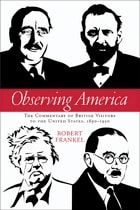
Observing America
The Commentary of British Visitors to the United States, 1890–1950Robert Frankel
University of Wisconsin Press, 2006
Robert Frankel examines the New World experiences of these commentators and the books they wrote about America. He also probes similar writings by other prominent observers from the British Isles, including Beatrice Webb, Rudyard Kipling, and George Bernard Shaw. The result is a book that offers keen insights into America’s national identity in a time of vast political and cultural change.
Observing America’s Jews
Marshall Sklare
Brandeis University Press, 1993
Obsessed
The Cultural Critic’s Life in the KitchenElisabeth Bronfen
Rutgers University Press, 2019
Even the most brilliant minds have to eat. And for some scholars, food preparation is more than just a chore; it’s a passion. In this unique culinary memoir and cookbook, renowned cultural critic Elisabeth Bronfen tells of her lifelong love affair with cooking and demonstrates what she has learned about creating delicious home meals. She recounts her cherished food memories, from meals eaten at the family table in postwar Germany to dinner parties with friends. Yet, in a thoughtful reflection on the pleasures of cooking for one, she also reveals that some of her favorite meals have been consumed alone.
Though it contains more than 250 mouth-watering recipes, Obsessed is anything but a conventional cookbook. As she shares a lifetime of knowledge acquired in the kitchen, Bronfen hopes to empower both novice and experienced home chefs to improvise, giving them hints on how to tweak her recipes to their own tastes. And unlike cookbooks that assume readers have access to an unlimited pantry, this book is grounded in reality, offering practical advice about food storage and reusing leftovers. As Bronfen serves up her personal stories and her culinary wisdom, reading Obsessed is like sitting down to a home-cooked meal with a clever friend.
Obstinate Heroism
The Confederate Surrenders after AppomattoxSteven Ramold
University of North Texas Press, 2020
Oceans at Home
Maritime and Domestic Fictions in Nineteenth-Century American Women's WritingMelissa Gniadek
University of Massachusetts Press, 2021
Melissa Gniadek explores the role of the ocean, with particular attention to the Pacific, in a diverse range of literary texts spanning the late 1820s through the mid-1860s from Lydia Maria Child, Caroline Kirkland, Harriet Beecher Stowe, Elizabeth Stoddard, and Harriet Prescott Spofford. Oceans at Home shows that authors employed maritime plots and stories from distant locations to probe contemporary concerns facing the continental United States, ranging from issues of gender restrictions in the domestic sphere to the racial prejudices against indigenous peoples that lay at the heart of settler colonialism.
Odd Man Out
A Memoir of the Holllywood TenEdward Dmytryk
Southern Illinois University Press, 1996
In 1947, the House Un-American Activities Committee rudely interrupted the successful career and life of Edward Dmytryk, citing him with contempt of Congress. As a result, Dmytryk was fired by RKO and spent three years in England before returning to the United States to serve a six-month jail sentence and undergo a second round of hearings, during which he recanted and provided evidence against several of his former colleagues.
In this personal and perceptive book, Dmytryk sharply chronicles the history of a particularly turbulent era in American political life while examining his own life before and after the events universally called the witch hunts. He details his brief membership in the Communist Party of America, explaining his initial commitment to what he perceived as communist ideals of civil liberties, economic justice, and antifacism, followed by his eventual disillusionment with the party as itbetrayed those ideals. He goes on to provide a fair assessment of what then happened to him and the effect it had on the rest of his life.
Dmytryk describes the activities, prejudices, and personal behaviors of all the parties enmeshed in the congressional hearings on communism in Hollywood. His reactions to other members of the Hollywood Ten and his recollection of conversations with them lend his book an immediacy that is not only informative but also absorbing. Most importantly, he does not uphold an ideology but rather presents the events as he perceived them, understood them, and responded to them. Dmytryk’s account is characterized by an openness born of a mature awareness of personal trial as history.
Odd Tribes
Toward a Cultural Analysis of White PeopleJohn Hartigan Jr.
Duke University Press, 2005
Odd Tribes engages debates in history, anthropology, sociology, and cultural studies over how race matters. Hartigan tracks the spread of “white trash” from an epithet used only in the South prior to the Civil War to one invoked throughout the country by the early twentieth century. He also recounts how the cultural figure of “white trash” influenced academic and popular writings on the urban poor from the 1880s through the 1990s. Hartigan’s critical reading of the historical uses of degrading images of poor whites to ratify lines of color in this country culminates in an analysis of how contemporary performers such as Eminem and Roseanne Barr challenge stereotypical representations of “white trash” by claiming the identity as their own. Odd Tribes presents a compelling vision of what cultural studies can be when diverse research methodologies and conceptual frameworks are brought to bear on pressing social issues.
Odd Wisconsin
Amusing, Perplexing, and Unlikely Stories from Wisconsin's PastErika Janik
Wisconsin Historical Society Press, 2007
While Bob La Follette's exploits as leader of progressive politics are legendary, his early morning exertions to save valuable government documents and executive department paintings during the disastrous 1904 capitol fire are largely unknown - until now. Odd Wisconsin captures the Wisconsin people, places, and events that didn't make it into conventional state histories, lowering a bucket into the depths of Wisconsin history and bringing to light curious fragments of forgotten lives.
This unique book unearths the stories that got lost to history even though they may have made local headlines at the time. No mythical hodags or eight-legged horses here! Odd Wisconsin features strange but true stories from Wisconsin's past, every one of which was documented (albeit by the standards of the day). These brief glimpses into Wisconsin's past will surprise, perplex, astonish, and otherwise connect readers with the state's fascinating history. From "the voyageur with a hole in his side" to "pigs beneath the legislature," Odd Wisconsin gathers 300 years of curiosities, all under the radar of traditional stories.
Odyssey of a Wandering Mind
The Strange Tale of Sara Mayfield, AuthorJennifer Horne
University of Alabama Press, 2024
A carefully rendered portrait of a brilliant but troubled daughter of the Old South who struggled against the conventions of gender, class, family, and ultimately of sanity, yet survived to define a creative life of her own
Sara Mayfield was born into Alabama’s governing elite in 1905 and grew up in a social circle that included Zelda Sayre, Sara Haardt, and Tallulah and Eugenia Bankhead. After winning a Goucher College short story contest judged by H. L. Mencken, Mayfield became friends with Mencken and his circle, then visited with Scott and Zelda Fitzgerald and hobnobbed with the literati while traveling in Europe after a failed marriage. Returning to Alabama during the Depression, she briefly managed the family landholdings before departing for New York City where she became involved in the theater. Inventing a plastic compound while working on theatrical sets, she applied for a patent and set her sights on a livelihood as an inventor and businesswoman. With the advent of World War II, Mayfield returned to her family home in Tuscaloosa where she expanded her experiments, freelanced as a journalist, and doggedly pursued a bizarre series of military and intelligence schemes, prompting temporary hospitalization. In 1945, she mingled with a host of cultural figures, including Frida Kahlo, Diego Rivera, Orson Welles, Rita Hayworth, and even a young John F. Kennedy, while reporting on the creation of the United Nations from Mexico and California. Back in Tuscaloosa after the war, however, she struggled to find her way with both work and family, becoming increasingly paranoid about perceived conspiracies arrayed against her. Finally, her mother and brother committed her to Bryce Hospital for the Insane, where she remained for the next seventeen years.
Throughout her life, Mayfield kept journals, wrote fiction, and produced thousands of letters while nursing the ambition that had driven her since childhood: to write and publish books. During her confinement, Mayfield assiduously recorded her experiences and her determined efforts—sometimes delusional, always savvy—to overturn her diagnosis and return to the world as a sane, independent adult. At 59, she was released from Bryce and later obtained a decree of “having been restored to sanity,” enabling her to manage her own financial affairs and to live how and where she pleased. She went on to publish noteworthy literary biographies of the Menckens and the Fitzgeralds plus a novel based on the life of Mona Lisa, finally achieving her quest to become the author of books and her own life. In Odyssey of a Wandering Mind, noted writer Jennifer Horne draws on years of research and an intimate understanding of the vast archive Sara Mayfield left behind to sensitively render Mayfield’s struggle to move through the world as the person she was—and her ultimate success in surviving to define the terms of her story.

Of "Good Laws" and "Good Men"
Law and Society in the Delaware Valley, 1680-1710William M. Offutt, Jr.
University of Illinois Press, 1995
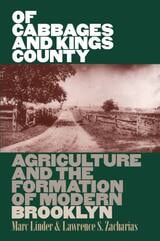
Of Cabbages and Kings County
Agriculture and the Formation of Modern BrooklynMarc Linder
University of Iowa Press, 1999
No one today thinks of Brooklyn, New York, as an agricultural center. Yet Kings County enjoyed over two centuries of farming prosperity. Even as late as 1880 it was one of the nation's leading vegetable producers, second only to neighboring Queens County.
In Of Cabbages and Kings County, Marc Linder and Lawrence Zacharias reconstruct the history of a lost agricultural community. Their study focuses on rural Kings County, the site of Brooklyn's tremendous expansion during the latter part of the nineteenth century. In particular, they question whether sprawl was a necessary condition of American industrialization: could the agricultural base that preceded and surrounded the city have survived the onrush of residential real estate speculation with a bit of foresight and public policies that the politically outnumbered farmers could not have secured on their own?
The first part of the book reviews the county's Dutch American agricultural tradition, in particular its conversion after 1850 from extensive farming (e.g., wheat, corn) to intensive farming of market garden crops. The authors examine the growing competition between local farmers and their southern counterparts for a share of the huge New York City market, comparing farming conditions and factors such as labor and transportation.
In the second part of the book, the authors turn their attention to the forces that eventually destroyed Kings County's farming—ranging from the political and ideological pressures to modernize the city's rural surroundings to unplanned, market-driven attempts to facilitate transportation for more affluent city dwellers to recreational outlets on Coney Island and, once transportation was at hand, to replace farms with residential housing for the city's congested population.
Drawing on a vast range of archival sources, the authors refocus the history of Brooklyn to uncover what was lost with the expansion of the city. For today, as urban planners, ecologists, and agricultural developers reevaluate urban sprawl and the need for greenbelts or agricultural-urban balance, the lost opportunities of the past loom larger.
Of Caves and Shell Mounds
Edited by Kenneth C. Carstens and Patty Jo Watson
University of Alabama Press, 1996
Ancient human groups in the Eastern Woodlands of North America were long viewed as homogeneous and stable hunter-gatherers, changing little until the late prehistoric period when Mesoamerican influences were thought to have stimulated important economic and social developments. The authors in this volume offer new, contrary evidence to dispute this earlier assumption, and their studies demonstrate the vigor and complexity of prehistoric peoples in the North American Midwest and Midsouth. These peoples gathered at favored places along midcontinental streams to harvest mussels and other wild foods and to inter their dead in the shell mounds that had resulted from their riverside activities. They created a highly successful, pre-maize agricultural system beginning more than 4,000 years ago, established far-flung trade networks, and explored and mined the world's longest cave—the Mammoth Cave System in Kentucky.
Contributors include:
Kenneth C. Carstens, Cheryl Ann Munson, Guy Prentice, Kenneth B. Tankersley, Philip J. DiBlasi, Mary C. Kennedy, Jan Marie Hemberger, Gail E. Wagner, Christine K. Hensley, Valerie A. Haskins, Nicholas P. Herrmann, Mary Lucas Powell, Cheryl Claassen, David H. Dye, and Patty Jo Watson
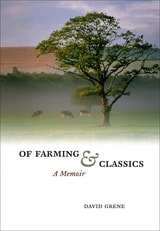
Of Farming and Classics
A MemoirDavid Grene
University of Chicago Press, 2006
A fiercely independent thinker, colorful storyteller, and spirited teacher, David Grene devoted his life to two things: farming, which he began as a boy in Ireland and continued into old age; and classics, which he taught for several decades that culminated in his translating and editing, with Richmond Lattimore, of The Complete Greek Tragedies.
In this charming memoir, which he wrote during the years leading up to his death in 2002 at the age of eighty-nine, Grene weaves together these interests to tell a quirky and absorbing story of the sometimes turbulent and always interesting life he split between the University of Chicago—where he helped found the Committee on Social Thought—and the farm he kept back in Ireland.
Charting the path that took him from Europe to Chicago in 1937, and encompassing his sixty-five-year career at the university, Grene’s book draws readers into the heady and invigorating climate of his time there. And it is elegantly balanced with reflections stemming from his work on the farm where he hunted, plowed and regularly traveled on horseback to bring his cows home for milking. Grene’s form and humor are quite his own, and his brilliant storytelling will enthrall anyone interested in the classics, rural Ireland, or twentieth-century intellectual history, especially as it pertains to the University of Chicago.

Of G-Men and Eggheads
The FBI and the New York IntellectualsJohn Rodden
University of Illinois Press, 2017
John Rodden cuts this tall tale down to its authentic pint size, refusing to indulge the public relations myth promoted by J. Edgar Hoover's FBI. In Of G-Men and Eggheads, Rodden portrays federal agents’ hilarious obsession with monitoring that ever-present threat to national security, the American literary intellectual. Drawing on government dossiers and archives, Rodden focuses on the onetime members of a radical political sect of ex-Trotskyists (barely numbering a thousand at its height), the so-called New York intellectuals. He describes the nonsensical decades-long pursuit of this group of intellectuals, especially Lionel Trilling, Dwight Macdonald, and Irving Howe. The Keystone Cops style of numerous FBI agents is documented carefully in Rodden's meticulous case studies of how Hoover's men recruited informants to snoop on the "Commies," opened their personal mail, tracked their movements, and reported on their wives and friends.
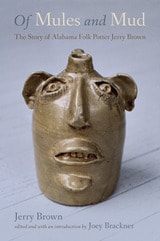
Of Mules and Mud
The Story of Alabama Folk Potter Jerry BrownJerry Brown, edited and with an introduction by Joey Brackner
University of Alabama Press, 2022
The life and times of Alabama folk potter Jerry Brown, as told in his own words
Born in 1942, Jerry Brown helped out in his father’s pottery shop as a young boy. There he learned the methods and techniques for making pottery in a family tradition dating back to the 1830s. His responsibilities included tending the mule that drove the mill that was used to mix clay (called “mud” by traditional potters). Business suffered as demand for stoneware churns, jugs, and chamber pots waned in the postwar years, and manufacture ceased following the deaths of Brown’s father and brother in the mid-1960s. Brown turned to logging for his livelihood, his skill with mules proving useful in working difficult and otherwise inaccessible terrain. In the early 1980s, he returned to the family trade and opened a new shop that relied on the same methods of production with which he had grown up, including a mule-powered mill for mixing clay and the use of a wood-fired rather than gas-fueled kiln.
Folklorist Joey Brackner met Brown in 1983, and the two quickly became close friends who collaborated together on a variety of documentary and educational projects in succeeding years—efforts that led to greater exposure, commercial success, and Brown’s recognition as a National Heritage Fellow by the National Endowment for the Arts. For years, Brown spoke of the urge to write his life story, but he never set pen to paper. In 2015, Brackner took the initiative and interviewed Brown, recording his life story over the course of a weekend at Brown’s home. Of Mules and Mud is the result of that marathon interview session, conducted one year before Brown passed away.
Brackner has captured Jerry Brown’s life in his own words as recounted that weekend, lightly edited and elaborated. Of Mules and Mud is illustrated with photos from all phases of Brown’s life, including a color gallery of 28 photos of vessel forms made by Brown throughout his career that collectors of folk pottery will find invaluable.

Of Others Inside
Insanity, Addiction And Belonging in AmericaDarin Weinberg, foreword by Bryan S. Turner
Temple University Press, 2005
Seeking to offer a new sociological understanding of the relationship between social exclusion and mental disability, Of Others Inside considers the general social conditions of homelessness, poverty, and social marginality in the U.S. Weinberg also explores questions about American perceptions of these conditions, and examines in great detail the social reality of mental disability and drug addiction without reducing people's suffering to simple notions of biological fate or social disorder.
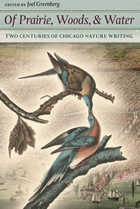
Of Prairie, Woods, and Water
Two Centuries of Chicago Nature WritingEdited by Joel Greenberg
University of Chicago Press, 2008
These writings tell the tale of a land in transition—one with abundant, unique, and incredibly lush flora and fauna, a natural history quite elusive today. Drawing on archives he uncovered while writing his acclaimed A Natural History of the Chicago Region, Greenberg hand-selected these first-person narratives, all written between 1721 and 1959. Not every author is familiar, but every contribution is distinctive. From a pioneer’s hilarious notes on life in the Kankakee marsh to Theodore Drieser’s poignant plea for conservation of the Tippecanoe River to infamous murderer Nathan Leopold’s charming description of a pet robin he kept in prison, the sources included are as diverse as the nature they describe.
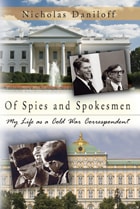
Of Spies and Spokesmen
My Life as a Cold War CorrespondentNicholas Daniloff
University of Missouri Press, 2008
An American reporter of Russian heritage assigned to Soviet-era Moscow might seem to have an edge on his colleagues, but when he’s falsely accused of spying, any advantage quickly evaporates. . . . .
As a young UPI correspondent in Moscow during the early 1960s, Nicholas Daniloff hoped to jump-start his career in his father’s homeland, but he soon learned that the Cold War had its own rules of engagement. In this riveting memoir, he describes the reality of journalism behind the Iron Curtain: how Western reporters banded together to thwart Soviet propagandists, how their “official sources” were almost always controlled by the KGB—and how those sources would sometimes try to turn newsmen into collaborators.
Leaving Moscow for Washington in 1965, Daniloff honed his skills at the State Department, then returned to Moscow in 1981 to find a more open society. But when the FBI nabbed a Soviet agent in 1986, Daniloff was arrested in retaliation and thrown into prison as a spy—an incident that threatened to undo the Reykjavik summit until top aides to Reagan and Gorbachev worked out a solution.
In addition to recounting a career in the thick of international intrigue, Of Spies and Spokesmen is brimming with inside information about historic events. Daniloff tells how the news media played a crucial role in resolving the Cuban Missile Crisis, recalls the emotional impact of the JFK assassination on Soviet leadership, and describes the behind-the-scenes struggles that catapulted Mikhail Gorbachev to power. He even shares facts not told to the public: how the SAC would warn Moscow that its submarines were too close to American shores, why the Soviets shot down the KAL airliner without visual identification, and how American reporters in Moscow sometimes did dangerous favors for our government that could easily have been mistaken for espionage.
Daniloff sheds light not only on prominent figures such as Nikita Khrushchev and Henry Kissinger but also on suspected spies Frederick Barghoorn, John Downey, and ABC correspondent Sam Jaffe—unfairly branded a Soviet agent by the FBI. In addition, he assesses the performance of Henry Shapiro, dean of American journalists in Moscow, whose forty years in the adversary’s capital often provoke questions about his role and reputation.
In describing how the Western press functioned in the old Soviet Union—and how it still functions in Washington today—Daniloff shows that the Soviet Russia he came to know was far more complex than the “evil empire” painted by Ronald Reagan: a web of propaganda and manipulation, to be sure, but also a place of hospitality and friendship. And with Russia still finding its way toward a new social and political order, he reminds us that seventy years of Communist rule left a deep impression on its national psyche. As readable as it is eye-opening, Of Spies and Spokesmenprovides a new look at that country’s heritage—and at the practice of journalism in times of crisis.
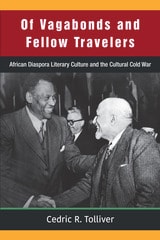
Of Vagabonds and Fellow Travelers
African Diaspora Literary Culture and the Cultural Cold WarCedric R. Tolliver
University of Michigan Press, 2019
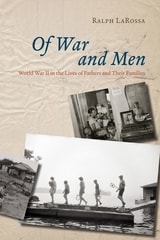
Of War and Men
World War II in the Lives of Fathers and Their FamiliesRalph LaRossa
University of Chicago Press, 2011
Fathers in the fifties tend to be portrayed as wise and genial pipe-smokers or distant, emotionless patriarchs. This common but limited stereotype obscures the remarkable diversity of their experiences and those of their children. To uncover the real story of fatherhood during this transformative era, Ralph LaRossa takes the long view—from the attack on Pearl Harbor up to the election of John F. Kennedy—revealing the myriad ways that World War II and its aftermath shaped men.
Offering compelling accounts of people both ordinary and extraordinary, Of War and Men digs deep into the terrain of fatherhood. LaRossa explores the nature and aftereffects of combat, the culture of fear during the Cold War, the ways that fear altered the lives of racial and sexual minorities, and how the civil rights movement affected families both black and white. Overturning some calcified myths, LaRossa also analyzes the impact of suburbanization on fathers and their kids, discovering that living in the suburbs often strengthened their bond. And finally, looking beyond the idealized dad enshrined in TV sitcoms, Of War and Men explores the brutal side of family life in the postwar years. LaRossa’s richly researched book dismantles stereotypes while offering up a fascinating and incisive chronicle of fatherhood in all its complexity.
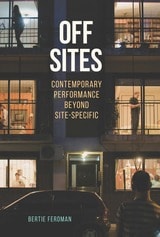
Off Sites
Contemporary Performance beyond Site-SpecificBertie Ferdman
Southern Illinois University Press, 2018
Contextualizing the techniques and methods of the incredibly rich and vital genre of site-specific performance, author Bertie Ferdman traces the evolution of that term. Originally used for experimental staging practices and then later also for engaged situational events, site-specific is no longer sufficient for the genre’s many contemporary variations.
Using the term off-site, Ferdman illustrates five distinct ways artists have challenged the disciplinary framework of site-specific theatre: blurring the traditional boundaries between the fictional and the real; changing how the audience and actor interact with each other and whether they are physically together or apart; fabricating sites from physically bound, conceptually constructed, or virtual spaces; staging live situations in real/nonreal and often mediated encounters; and challenging our preconceived notions of time and space. Tracing the genealogy of site-based work through the twentieth and twenty-first centuries, Ferdman outlines the theoretical groundwork for her study in the introduction. Individual chapters focus on distinct types of off-sites—the interdisciplinary discourse of disciplinary sites; the spaces of audience engagement with spectator sites; the dislocation of time for temporal sites; and the historiographical spaces of mapping for urban sites.
Ferdman examines site-based work being done in the Americas by contemporary companies and artists experimenting with new forms and practices for site-driven theatre. Key productions discussed include Private Moment by David Levine, Geyser Land by Mary Ellen Strom and Ann Carlson, Jim Findlay’s Dream of the Red Chamber, and Lola Arias’ Mi Vida Después.
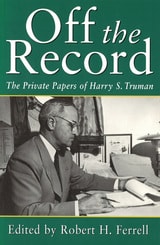
Off the Record
The Private Papers of Harry S. TrumanEdited by Robert H. Ferrell
University of Missouri Press, 1997
Gathered for the first time, Truman's private papers--diaries, letters, and memoranda--cover the period from his occupancy of the White House in 1945 to shortly before his death in 1972. Students and scholars will find valuable material on major events of the Truman years, from the Potsdam Conference to the Korean War.
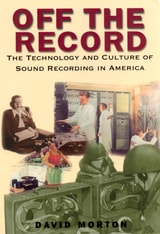
Off the Record
The Technology and Culture of Sound Recording in AmericaMorton, David
Rutgers University Press, 1999
David L. Morton examines the process of invention, innovation, and diffusion of communications technology, using the history of sound recording as the focus. Off the Record demonstrates how the history of both the hardware and the ways people used it is essential for understanding why any particular technology became a fixture in everyday life or faded into obscurity. Morton’s approach to the topic differs from most previous works, which have examined the technology’s social impact, but not the reasons for its existence. Recording culture in America emerged, Morton writes, not through the dictates of the technology itself but in complex ways that were contingent upon the actions of users.
Each of the case studies in the book emphasizes one of five aspects of the culture of recording and its relationship to new technology, at the same time telling the story of sound recording history. One of the misconceptions that Morton hopes to dispel is that the only important category of sound recording involves music. Unique in his broad-based approach to sound technology, the five case studies that Morton investigates are :- The phonograph record
- Recording in the radio business
- The dictation machine
- The telephone answering machine, and
- Home taping
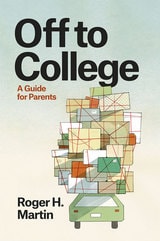
Off to College
A Guide for ParentsRoger H. Martin
University of Chicago Press, 2015
With Off to College, Roger H. Martin helps parents understand this important period of transition by providing the perfect tour of the first year on today’s campus. Martin, a twenty-year college president and former Harvard dean, spent a year visiting five very different colleges and universities across the United States—public and private, large and small, elite and non-elite—to get an insider’s view of modern college life. He observes an advising session as a student sorts out her schedule, unravels the mysteries of roommate assignments with a residence life director, and patrols campus with a safety officer on a rowdy Saturday night. He gets pointers in freshman English and tips on athletics and physical fitness from coaches. He talks with financial aid officers and health service providers. And he listens to the voices of the first–year students themselves. Martin packs Off to College with the insights and advice he gained and bolsters them with data from a wide variety of sources to deliver a unique and personal view of the current student experience.
The first year is not just the beginning of a student’s college education but also the first big step in becoming an adult. Off to College will help parents understand what to expect whether they’re new to the college experience or reconciling modern campus life with memories of their own college days.
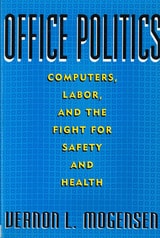
Office Politics
Computers, Labor, and the Fight for Safety and HealthMogensen, Vernon L
Rutgers University Press, 1996
The desktop computer has transformed office work. Business and social forecasters claimed that the use of video display terminals (VDTs) in the “Office of the Future” would free workers from routine tasks, giving them more time for creative work and chances for career advancement. Office Politics argues that, for many VDT workers––most of whom are nonunionized women in low-paying, dead-end jobs––exactly the opposite has been true. VDTs have been used to routinize office tasks; export work via satellite to low-wage, nonunion offshore offices; to de-skill workers and monitor their productivity. And the nature of the work has led to widespread health and safety problems, including vision, musculoskeletal (repetitive motion), and stress-related illnesses. Many have also charged that the electromagnetic fields (EMFs) emitted by computer terminals are responsible for miscarriages, for birth defects, and for promoting cancer.
As office workers sought to protect themselves against these new occupational health and safety problems, they found little help from organized labor, business, or the government. Office Politics is the first book to explain why. It shows how corporate interests successfully redefined the VDT health and safety crisis as a “comfort” problem, how the government refused to collect data on the true scope of VDT-related illnesses or to regulate Information Age industries, and how labor unions ignored women workers.
Office Politics is key reading for everyone who works at a computer. It will be of special interest to students, academics, and professionals in political science, sociology, occupational and environmental health, business, labor and management issues, women’s studies, computing, and public policy.

Official Guide to Texas State Parks and Historic Sites
New EditionLaurence Parent
University of Texas Press, 2024
The essential guide to Texas’s state parks and historic sites.
Updated with a new park, Palo Pinto Mountains State Park west of Forth Worth; new historic sites; and scores of beautiful new photographs, the Official Guide to Texas State Parks has all the essential information organized by geographical regions to help you plan your great Texas adventure. The only complete resource of its kind on Texas, Laurence Parent’s Official Guide to Texas State Parks is the trusted source, with more than sixty-five thousand copies sold over the past thirty years.
Praise for Previous Editions
“Texas state-park fans should be thrilled. . . . Official Guide to Texas State Parks is the ultimate book detailing Texas’s state parks.”—Dallas Morning News
“This book will make you want to hit the road to visit the natural splendor of Texas.”—Houston Chronicle
“It’s good enough for a coffee table or a campfire. The Official Guide to Texas State Parks gives you sleek photography, maps, narratives, and loads of information.”—Southern Living
“The newly updated Official Guide to Texas State Parks and Historic Sites . . . has beautiful color photographs and insights on camping, fishing, horseback riding, and other recreational opportunities around the state.”—Texas Journey
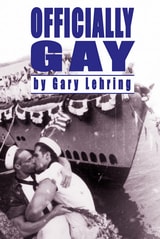
Officially Gay
The Political Construction Of SexualityGary L. Lehring
Temple University Press, 2003
Oglethorpe in Perspective
Georgia's Founder after Two Hundred YearsEdited by Phinizy Spalding and Harvey H. Jackson, III
University of Alabama Press, 1989
Oh, Say, Can You See
The Semiotics of the Military in Hawai’iKathy E. Ferguson
University of Minnesota Press, 1998
Considers what the military presence in Hawai’i tells us about colonialism, gender, race, and class.
Everywhere you look in Hawai’i, you might see the military. And yet, in daily life few residents see the military at all-it is hidden in plain sight. This paradox of invisibility and visibility, of the available and the hidden, is the subject of Oh, Say, Can You See?, which maps the power relations involving gender, race, and class that define Hawai’i in relation to the national security state.
Western intruders into Hawai’i-from the early explorers, missionaries, and sugar planters to the military, tourists, and foreign investors-have seen the island nation as a feminine place, waiting to embrace those who come to penetrate, protect, mold, and develop, yet conveniently lacking whatever the newcomers claim to possess. Thus feminized, this book contends, the islands and the people have been reinscribed with meanings according to the needs, fears, and desires of outsiders. Authors Kathy E. Ferguson and Phyllis Turnbull locate and “excavate” sites of memory, such as cemeteries, memorials, monuments, and museums, to show how the military constructs its gendered narrative upon prior colonial discourses. Among the sites considered are Fort DeRussy, Pearl Harbor, and Punchbowl Cemetery, as well as the practices of citizenship that are produced or foreclosed by the narratives of order and security written upon Hawai’i by the military.This semiotic investigation of ways the military marks Hawai’i necessarily explores the intersection of immigration, colonialism, military expansion, and tourism on the islands. Attending to the ways in which the military represents itself and others represent the military, the authors locate the particular representational elements that both conceal and reveal the military’s presence and power; in doing so, they seek to expand discursive space so that other voices can be heard. ISBN 0-8166-2978-1 Cloth $49.95xxISBN 0-81662979-X Paper $19.95x240 pages 5 7/8 x 9 DecemberBorderlines Series, Volume 10Translation inquiries: University of Minnesota Press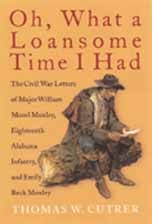
Oh, What a Loansome Time I Had
The Civil War Letters of Major William Morel Moxley, Eighteenth Alabama Infantry, and Emily Beck MoxleyEmily Beck Moxley
University of Alabama Press, 2002
Most surviving correspondence of the Civil War period was written by members of a literate, elite class; few collections exist in which the woman's letters to her soldier husband have been preserved. Here, in the exchange between William and Emily Moxley, a working-class farm couple from Coffee County, Alabama, we see vividly an often-neglected aspect of the Civil War experience: the hardships of civilian life on the home front.
Emily's moving letters to her husband, startling in their immediacy and detail, chronicle such difficulties as a desperate lack of food and clothing for her family, the frustration of depending on others in the community, and her growing terror at facing childbirth without her husband, at the mercy of a doctor with questionable skills. Major Moxley's letters to his wife reveal a decidedly unromantic side of the war, describing his frequent encounters with starvation, disease, and bloody slaughter.
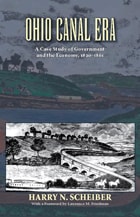
Ohio Canal Era
A Case Study of Government and the Economy, 1820–1861Harry N. Scheiber
Ohio University Press, 2012
Ohio Canal Era, a rich analysis of state policies and their impact in directing economic change, is a classic on the subject of the pre–Civil War transportation revolution. This edition contains a new foreword by scholar Lawrence M. Friedman, Professor of Law, Stanford Law School, and a bibliographic note by the author.
Professor Scheiber explores how Ohio—as a “public enterprise state,” creating state agencies and mobilizing public resources for transport innovation and control—led in the process of economic change before the Civil War. No other historical account of the period provides so full and insightful a portrayal of “law in action.” Scheiber reveals the important roles of American nineteenth-century government in economic policy-making, finance, administration, and entrepreneurial activities in support of economic development.
His study is equally important as an economic history. Scheiber provides a full account of waves of technological innovation and of the transformation of Ohio’s commerce, agriculture, and industrialization in an era of hectic economic change. And he tells the intriguing story of how the earliest railroads of the Old Northwest were built and financed, finally confronting the state-owned canal system with a devastating competitive challenge.
Amid the current debate surrounding “privatization,” “deregulation,” and the appropriate use of “industrial policy” by government to shape and channel the economy. Scheiber’s landmark study gives vital historical context to issues of privatization and deregulation that we confront in new forms today.
Ohio Farm
Wheeler McMillen
The Ohio State University Press, 1997
Uncomplicated when compared with the task of managing today's highly mechanized agricultural complexes, life on the early twentieth-century small farm entailed hard work and afforded simple pleasures that brought satisfaction and enjoyment to the farm and family. Farming on that scale and in the same manner has now become almost completely infeasible, yet in those times a good farmer could prosper and become independent. Wheeler McMillen’s father, Lewis, did both.
Relying frequently on his father’s account books and concise diaries, for this is primarily his father’s story, McMillen recounts the immense labor that farming demanded before the advent of the tractor and the combine harvester. He evokes the special excitements of having company for Sunday dinner, attending the annual oyster supper at the Grange Hall, and gathering on the Fourth of July with the interminable wait for darkness to fall. McMillen also portrays the quiet peace and ineffable joy of private moments, such as resting the horses during spring plowing to watch bronzed grackles search for food in the freshly turned furrows.
Wheeler McMillen’s slice of history will speak to those interested in what rural life was once like in the Midwest and to Ohioans who would like to learn more about their state’s recent past.