Results by title
5159 books match the query 'Biography' and 127 start with o
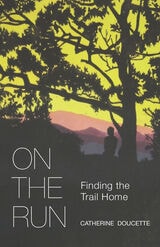
On the Run
Finding the Trail HomeCatherine Doucette
Oregon State University Press, 2021
For over a decade, Doucette chased winter around the world to ski, from the White Mountains of her native New Hampshire to the slopes of Alaska, British Columbia, California, Argentina, Switzerland, and beyond. But she always kept one eye toward living a more settled life and putting her heart on the line if someone would just ask her to. Like other women who choose or yearn to be in the wilderness, she wrestled to reconcile her outdoor ambitions with society’s expectations of women.
The personal essays collected in On the Run touch on the author’s origins in New Hampshire while focusing on the lure of big mountains in the West. They celebrate the comfort, challenge, and community found in expanses of wilderness while confronting the limitations and sacrifices that come with a transient, outdoor lifestyle. In a voice both searching and deeply grounded, Doucette contends with avalanches and whitewater along with the less dramatic but equally important questions of belonging. Anyone who has searched to define home, who has been called by mountains, or by movement, will feel at home in these pages.
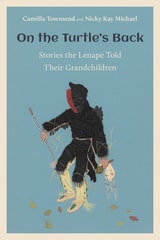
On the Turtle's Back
Stories the Lenape Told Their GrandchildrenCamilla Townsend
Rutgers University Press, 2023
The Lenape tribe, also known as the Delaware Nation, lived for centuries on the land that English colonists later called New Jersey. But once America gained its independence, they were forced to move further west: to Indiana, then Missouri, and finally to the territory that became Oklahoma. These reluctant migrants were not able to carry much from their ancestral homeland, but they managed to preserve the stories that had been passed down for generations.
On the Turtle’s Back is the first collection of Lenape folklore, originally compiled by anthropologist M. R. Harrington over a century ago but never published until now. In it, the Delaware share their cherished tales about the world’s creation, epic heroes, and ordinary human foibles. It features stories told to Harrington by two Lenape couples, Julius and Minnie Fouts and Charles and Susan Elkhair, who sought to officially record their legends before their language and cultural traditions died out. More recent interviews with Lenape elders are also included, as their reflections on hearing these stories as children speak to the status of the tribe and its culture today. Together, they welcome you into their rich and wondrous imaginative world.
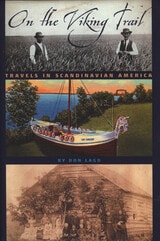
On the Viking Trail
Travels in Scandinavian AmericaDon Lago
University of Iowa Press, 2004
When his father developed Alzheimer’s disease, Don Lago realized that the stories and traditions of his Swedish ancestors would be lost along with the rest of his father’s memories. Haunted by this inevitable tragedy, Lago set out to fight back against forgetting by researching and reclaiming his long-lost Scandinavian roots.
Beginning his quest with a visit to his ancestral home of Gränna, Sweden, Lago explores all facets of Scandinavian America—Swedish, Danish, Finnish, Norwegian, and Icelandic—along the way. He encounters Icelanders living in the Utah desert, a Titanic victim buried beneath a gigantic Swedish coffee pot in Iowa, an Arkansas town named after the famous Swedish opera singer Jenny Lind, a real-life Legoland in southern California, and other unique remnants of America’s Scandinavian past. Visits to Sigurd Olson’s legendary cabin on the banks of Burntside Lake in the Boundary Waters of Minnesota and Carl Sandburg’s birthplace in Galesburg, Illinois, further provide Lago with an acute sense of the Scandinavian values that so greatly influenced, and continue to influence, American society.
More than just a travel memoir, On the Viking Trail places Scandinavian immigrants and their history within the wider sweep of American culture. Lago’s perceptive eye and amusing tales remind readers of all ethnic backgrounds that to truly appreciate America one must never forget its immigrant past.
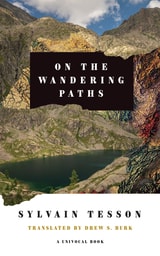
On the Wandering Paths
Sylvain Tesson
University of Minnesota Press, 2022
A walking journey through France’s vast interior becomes a meditation on both personal recovery and the role of history in the present—more than 425,000 copies sold in France
After a free-climbing accident lands him in a coma and a hospital for four months, the French writer Sylvain Tesson makes a promise to himself: if he’s ever able to walk again, he will traverse the entire country of France on foot.
Part literary adventure, part philosophical reflection on our contemporary consumer culture, On the Wandering Paths takes us deep into the heart of what Tesson terms France’s “hyperrural” zones. Tracing the obscure paths peasants once followed throughout the countryside, Tesson embarks on a three-month journey of solitude and personal contemplation as he walks along vast stretches of mountain ranges and rivers, encountering ancient Roman stone bridges and walkways, the French Foreign Legion, pagan prayer sites, Provençal villages, and the majestic Mont-Saint-Michel. Connecting deeply with the places he visits, his experiences inspire reflection on the essential need to disengage from the digital and immerse oneself in natural beauty.
Rich with humor, historical insight, and literary power, On the Wandering Paths is both a meditation on the act of recovery and a potent recognition of the traces of our past in the present. Asking us to reassess our values and our relationship to the land, Tesson’s exquisite chronicle through landscapes that continue to resist urbanization and technology is a thoughtful—and thought-provoking—glimpse into a poet’s adventurous life. Les Chemins de Pierre, a film based on the book starring Jean Dujardin, is due to release in 2022.

On the Way to the Sky
Remembering Bob BrookmeyerMichael Stephans
University of North Texas Press, 2025
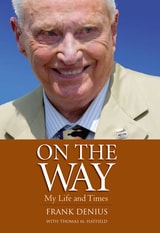
On the Way
My Life and TimesBy Frank Denius
University of Texas Press, 2016
Frank Denius was not yet twenty-one when he fought his way across Europe and was awarded four Silver Stars, a Presidential Unit Citation, and two Purple Hearts. On the Way describes Denius’s formative experiences during World War II in gripping detail and will cause any reader to wonder how he or she might have held up under similar pressure. The powerful opening chapters are followed by a detailed account of Denius’s life and career after the war, assembled into a first-person memoir from conversations between Denius and Thomas Hatfield, and published by the Briscoe Center for American History at the University of Texas at Austin.
Discharged from the army in October 1945, Denius enrolled at the University of Texas within a week. He is a lifelong supporter of the university: as part of the Texas Exes, as a donor to numerous academic programs, and as a fan of Longhorn football. Former UT football coach Mack Brown liked to say, “Frank has been to more practices than I have.”
Denius graduated from the University of Texas School of Law and joined one of Austin’s leading law firms in the late 1940s. Denius recounts how Texas operated in Lyndon Johnson’s prime, observes power plays in the Texas energy industry, and describes his role in building a regional university into a global leader.
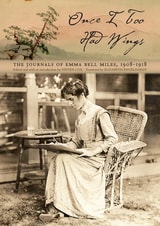
Once I Too Had Wings
The Journals of Emma Bell Miles, 1908–1918Emma Bell Miles
Ohio University Press, 2014
Emma Bell Miles (1879–1919) was a gifted writer, poet, naturalist, and artist with a keen perspective on Appalachian life and culture. She and her husband Frank lived on Walden’s Ridge in southeast Tennessee, where they struggled to raise a family in the difficult mountain environment. Between 1908 and 1918, Miles kept a series of journals in which she recorded in beautiful and haunting prose the natural wonders and local customs of Walden’s Ridge. Jobs were scarce, however, and as the family’s financial situation deteriorated, Miles began to sell literary works and paintings to make ends meet. Her short stories appeared in national magazines such as Harper’s Monthly and Lippincott’s, and in 1905 she published Spirit of the Mountains, a nonfiction book about southern Appalachia. After the death of her three-year-old son from scarlet fever in 1913, the journals took a more somber turn as Miles documented the difficulties of mountain life, the plight of women in rural communities, the effect of disparities of class and wealth, and her own struggle with tuberculosis.
Previously examined only by a handful of scholars, the journals contain both poignant and incisive accounts of nature and a woman’s perspective on love and marriage, death customs, child raising, medical care, and subsistence on the land in southern Appalachia in the early twentieth century. With a foreword by Elizabeth S. D. Engelhardt, this edited selection of Emma Bell Miles’s journals is illustrated with examples of her painting.
Once I Was Cool
Personal EssaysMegan Stielstra
Northwestern University Press, 2021
With conversational flourishes and on-the-mark descriptions, Stielstra’s essays evoke the richness of her everyday life and the memories that are never far away. She remembers learning how to shoot a gun, a cancer scare, and—in a piece that was anthologized in The Best American Essays 2013—the time she eavesdropped on another new mother using her son’s baby monitor. “I shouldn’t have listened,” she writes. “But it was the first time since my son was born that I didn’t feel alone.” Combining footnotes, electric sentences, and uproariously funny anecdotes (have you ever run into an ex while rolling on ecstasy?), Stielstra shows us that maturity is demanding, but its rewards are a gift.
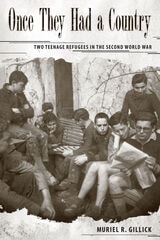
Once They Had a Country
Two Teenage Refugees in the Second World WarMuriel R. Gillick
University of Alabama Press, 2010
A powerful true story of survival, displacement, and hope in a world at war.
Muriel Gillick draws from a remarkable set of primary source materials, including letters, telegrams, and police records to relate the story of two teenage refugees during World War II. Once They Had a Country conveys well what it was like to establish a new life in a foreign country—over and over again and in constant fear for one’s life. The work tells of the extraordinary experiences of the author’s parents in Europe and demonstrates how citizens and the governments of Belgium, France, Switzerland, Brazil, America, China, and postwar Germany treated refugees. This story also reveals the origins of the Convention Relating to the Status of Refugees, the basis of contemporary international law affecting refugees in many countries today.
In addition to the dramatic human story it tells, this work brings the plight of refugees home to the reader—and with over 8 million refugees worldwide today, the subject of how individuals and nation states respond to these individuals is indeed timely.

Once Upon a Time in Texas
A Liberal in the Lone Star StateBy David Richards
University of Texas Press, 2002
Once upon a time in Texas...there were liberal activists of various stripes who sought to make the state more tolerant and more tolerable. David Richards was one of them. In this fast-paced, often humorous memoir, he remembers the players, the strategy sessions, the legal and political battles, and the wins and losses that brought significant gains in civil rights, voter rights, labor law, and civil liberties to the people of Texas from the 1950s to the 1990s.
In his work as a lawyer, Richards was involved in cases covering voters' rights, school finance reform, and a myriad of civil liberties and free speech cases. In telling these stories, he vividly evokes the "glory days" of Austin liberalism, when a who's who of Texas activists plotted strategy at watering holes such as Scholz Garden and the Armadillo World Headquarters. Likewise, he offers vivid portraits of liberal politicians from Ralph Yarborough to Ann Richards (his former wife), progressive journalists such as Molly Ivins and the Texas Observer staff, and the hippies, hellraisers, and musicians who all challenged Texas's conservative status quo.
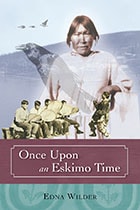
Once Upon an Eskimo Time
Edna Wilder
University of Alaska Press, 2009
Continuing the sacred tradition of her ancestors, in Once Upon an Eskimo Time Edna Wilder retells a year in her Eskimo mother’s life. Wilder eloquently captures the oral storytelling traditions of her people, and she employs descriptions of the weather and harsh climates of Alaska’s Norton Sound to illustrate the hardiness of her mother’s spirit. Family values, subsistence living, and the cycle’s of life form a narrative that captures the now-vanished lifestyle along the Bering Sea.
“Readers of whatever age will enjoy Nedercook’s delightful account of the day-to-day, legends, and beliefs of the ancient Eskimo village of Rocky Point.”—Ames Tribune

Once a Professor
A Memoir of Teaching in Turbulent TimesJerry Apps
Wisconsin Historical Society Press, 2018
“I never wanted to be a professor,” writes Jerry Apps in the introduction to Once a Professor. Yet a series of unexpected events and unplanned experiences put him on an unlikely path—and led to a thirty-eight-year career at the University of Wisconsin.
In this continuation of the Apps life story begun in his childhood memoir Limping through Life, Wisconsin’s celebrated rural storyteller shares stories from his years at the University of Wisconsin–Madison from 1957 to 1995, when he left the university to lecture and write fulltime. During those years Apps experienced the turmoil of protests and riots at the UW in the 1960s, the struggles of the tenure process and faculty governance, and the ever-present pressure to secure funding for academic research and programs.
Through it all, the award-winning writer honed a personal philosophy of education—one that values critical thinking, nontraditional teaching approaches, and hands-on experiences outside of the classroom. Colorful characters, personal photos, and journal entries from the era enrich this account of an unexpected campus career.

One Colonial Woman's World
The Life and Writings of Mehetabel Chandler CoitMichelle Marchetti Coughlin
University of Massachusetts Press, 2012
Michelle Marchetti Coughlin combs through these writings to create a vivid portrait of a colonial American woman and the world she inhabited. Coughlin documents the activities of daily life as well as dramas occasioned by war, epidemics, and political upheaval. Though Coit's opportunities were circumscribed by gender norms of the day, she led a rich and varied life, not only running a household and raising a family, but reading, writing, traveling, transacting business, and maintaining a widespread network of social and commercial connections. She also took a lively interest in the world around her and played an active role in her community.
Coit's long life covered an eventful period in American history, and this book explores the numerous—and sometimes surprising—ways in which her personal history was linked to broader social and political developments. It also provides insight into the lives of countless other colonial American women whose history remains largely untold.
One Day a Year
2001–2011Christa Wolf
Seagull Books, 2017
The book is both a personal record and a unique document of our times. With her characteristic precision and transparency, Wolf examines the interplay of the private, subjective, and major contemporary historical events. She writes about Germany after 9/11, about her work on her last great book City of Angels, and also about her exhausting confrontation with old age. One Day a Year is a compelling and personal glimpse into the life of one of the world’s greatest writers.
One Hour in Paris
A True Story of Rape and RecoveryKaryn L. Freedman
University of Chicago Press, 2014
At once deeply intimate and terrifyingly universal, One Hour in Paris weaves together Freedman’s personal experience with the latest philosophical, neuroscientific, and psychological insights on what it means to live in a body that has been traumatized. Using her background as a philosopher, she looks at the history of psychological trauma and draws on recent theories of posttraumatic stress disorder and neuroplasticity to show how recovery from horrific experiences is possible. Through frank discussions of sex and intimacy, she explores the consequences of sexual violence for love and relationships, and she illustrates the steep personal cost of sexual violence and the obstacles faced by individual survivors in its aftermath. Freedman’s book is an urgent call to face this fundamental social problem head-on, arguing that we cannot continue to ignore the fact that sexual violence against women is rooted in gender inequalities that exist worldwide—and must be addressed.
One Hour in Paris is essential reading for survivors of sexual violence as well as an invaluable resource for therapists, mental health professionals, and family members and friends of victims.
One Long Tune
The Life and Music of Lenny BreauRon Forbes-Roberts
University of North Texas Press, 2006

One Man's Music
The Life and Times of Texas Songwriter Vince BellVince Bell
University of North Texas Press, 2009
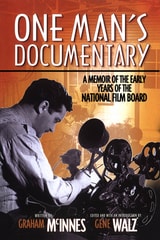
One Man’s Documentary
A Memoir of the Early Years of the National Film BoardGraham McInnes
University of Manitoba Press, 2004

One More Warbler
A Life with BirdsBy Victor Emanuel, with S. Kirk Walsh
University of Texas Press, 2017
Victor Emanuel is widely considered one of America’s leading birders. He has observed more than six thousand species during travels that have taken him to every continent. He founded the largest company in the world specializing in birding tours and one of the most respected ones in ecotourism. Emanuel has received some of birding’s highest honors, including the Roger Tory Peterson Award from the American Birding Association and the Arthur A. Allen Award from the Cornell Laboratory of Ornithology. He also started the first birding camps for young people, which he considers one of his greatest achievements.
In One More Warbler, Emanuel recalls a lifetime of birding adventures—from his childhood sighting of a male Cardinal that ignited his passion for birds to a once-in-a-lifetime journey to Asia to observe all eight species of cranes of that continent. He tells fascinating stories of meeting his mentors who taught him about birds, nature, and conservation, and later, his close circle of friends—Ted Parker, Peter Matthiessen, George Plimpton, Roger Tory Peterson, and others—who he frequently birded and traveled with around the world. Emanuel writes about the sighting of an Eskimo Curlew, thought to be extinct, on Galveston Island; setting an all-time national record during the annual Audubon Christmas Bird Count; attempting to see the Imperial Woodpecker in northwestern Mexico; and birding on the far-flung island of Attu on the Aleutian chain. Over the years, Emanuel became a dedicated mentor himself, teaching hundreds of young people the joys and enrichment of birding. “Birds changed my life,” says Emanuel, and his stories make clear how a deep connection to the natural world can change everyone’s life.
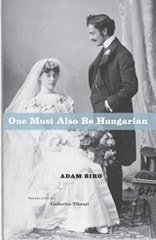
One Must Also Be Hungarian
Adam Biro
University of Chicago Press, 2006
The only country in the world with a line in its national anthem as desperate as “this people has already suffered for its past and its future,” Hungary is a nation defined by poverty, despair, and conflict. Its history, of course, took an even darker and more tragic turn during the Holocaust. But the story of the Jews in Hungary is also one of survival, heroism, and even humor—and that is the one acclaimed author Adam Biro sets out to recover in One Must Also Be Hungarian, an inspiring and altogether poignant look back at the lives of his family members over the past two hundred years.
A Hungarian refugee and celebrated novelist working in Paris, Biro recognizes the enormous sacrifices that his ancestors made to pave the way for his successes and the envious position he occupies as a writer in postwar Europe. Inspired, therefore, to share the story of his family members with his grandson, Biro draws some moving pictures of them here: witty and whimsical vignettes that convey not only their courageous sides, but also their inner fears, angers, jealousies, and weaknesses—traits that lend an indelible humanity to their portraiture. Spanning the turn of the nineteenth century, two destructive world wars, the dramatic rise of communism, and its equally astonishing fall, the stories here convey a particularly Jewish sense of humor and irony throughout—one that made possible their survival amid such enormous adversity possible.
Already published to much acclaim in France, One Must Also Be Hungarian is a wry and compulsively readable book that rescues from oblivion the stories of a long-suffering but likewise remarkable and deservedly proud people.
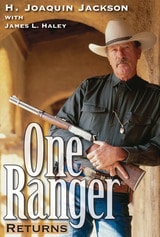
One Ranger Returns
By H. Joaquin Jackson, with James L. Haley
University of Texas Press, 2008
No Texas Ranger memoir has captured the public's imagination like Joaquin Jackson's One Ranger. Readers thrilled to Jackson's stories of catching criminals and keeping the peace across a wide swath of the Texas-Mexico border—and clamored for more. Now in One Ranger Returns, Jackson reopens his case files to tell more unforgettable stories, while also giving readers a deeply personal view of what being a Texas Ranger has meant to him and his family.
Jackson recalls his five-year pursuit of two of America's most notorious serial killers, Henry Lee Lucas and Ottis Toole. He sets the record straight about the role of the Texas Rangers during the United Farm Workers strike in the Rio Grande Valley in 1966-1967. Jackson also describes the frustration of trying to solve a cold case from 1938—the brutal murder of a mother and daughter in the lonely desert east of Van Horn. He presents a rogue's gallery of cattle rustlers, drug smugglers, and a teetotaling bootlegger named Tom Bybee, a modest, likeable man who became an ax murderer. And in an eloquent concluding chapter, Jackson pays tribute to the Rangers who have gone before him, as well as those who keep the peace today.
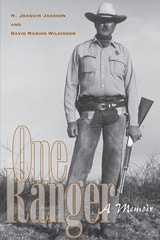
One Ranger
A MemoirBy H. Joaquin Jackson with David Marion Wilkinson
University of Texas Press, 2005
When his picture appeared on the cover of Texas Monthly, Joaquin Jackson became the icon of the modern Texas Rangers. Nick Nolte modeled his character in the movie Extreme Prejudice on him. Jackson even had a speaking part of his own in The Good Old Boys with Tommy Lee Jones. But the role that Jackson has always played the best is that of the man who wears the silver badge cut from a Mexican cinco peso coin—a working Texas Ranger. Legend says that one Ranger is all it takes to put down lawlessness and restore the peace—one riot, one Ranger. In this adventure-filled memoir, Joaquin Jackson recalls what it was like to be the Ranger who responded when riots threatened, violence erupted, and criminals needed to be brought to justice across a wide swath of the Texas-Mexico border from 1966 to 1993.
Jackson has dramatic stories to tell. Defying all stereotypes, he was the one Ranger who ensured a fair election—and an overwhelming win for La Raza Unida party candidates—in Zavala County in 1972. He followed legendary Ranger Captain Alfred Y. Allee Sr. into a shootout at the Carrizo Springs jail that ended a prison revolt—and left him with nightmares. He captured "The See More Kid," an elusive horse thief and burglar who left clean dishes and swept floors in the houses he robbed. He investigated the 1988 shootings in Big Bend's Colorado Canyon and tried to understand the motives of the Mexican teenagers who terrorized three river rafters and killed one. He even helped train Afghan mujahedin warriors to fight the Soviet Union.
Jackson's tenure in the Texas Rangers began when older Rangers still believed that law need not get in the way of maintaining order, and concluded as younger Rangers were turning to computer technology to help solve crimes. Though he insists, "I am only one Ranger. There was only one story that belonged to me," his story is part of the larger story of the Texas Rangers becoming a modern law enforcement agency that serves all the people of the state. It's a story that's as interesting as any of the legends. And yet, Jackson's story confirms the legends, too. With just over a hundred Texas Rangers to cover a state with 267,399 square miles, any one may become the one Ranger who, like Joaquin Jackson in Zavala County in 1972, stops one riot.
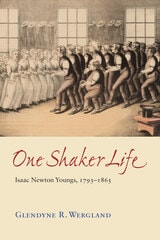
One Shaker Life
Isaac Newton Youngs, 1793-1865Glendyne R. Wergland
University of Massachusetts Press, 2006
A member of the United Society of Believers, better known as the Shakers, Isaac Newton Youngs spent most of his life in New Lebanon, New York, home of the society's central Ministry. As both a private diarist and the official village scribe, he kept meticulous records throughout those years of both his own experience and that of the community. All told, more than four thousand pages of Brother Isaac's journals have survived, documenting the history of the Shakers during the period of their greatest success and providing a revealing view of the daily life of a rank-and-file Believer.
In this deeply researched biography, Glendyne R. Wergland draws on Youngs's writings to tell his story and to explore “the tension between desire and discipline” at the center of his life. She follows Youngs from childhood and adolescence to maturity, through years of demanding responsibility into his fatal decline. In each of these stages, he remained a talented and committed yet independent Shaker, one who chose to stay with the community but often struggled to abide by its stringent rules, including the vow of celibacy. Perhaps above all, he was a man who spent most of his waking hours working diligently at a succession of tasks, making clocks, sewing clothes, fixing roofs, writing poetry, chronicling his daily acts and thoughts.
In his journals, Brother Isaac writes at length of his efforts to control his lust as a young man, and he complains repeatedly about overwork as he grows older. He defines the rules of his community and identifies transgressors, while enciphering his critical entries (and those chronicling his own sexual desires) to avoid detection and uphold the demand for conformity. At times he admits doubt, but without ever relinquishing the belief that he is on the straight and narrow path to salvation. What emerges in the end is the complex portrait of an ordinary man striving to live up to the imperatives of his faith.
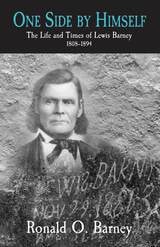
One Side By Himself
Ronald Barney
Utah State University Press, 2002
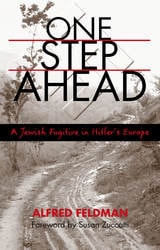
One Step Ahead
A Jewish Fugitive in Hitler's EuropeAlfred Feldman. Foreword by Susan Zuccotti
Southern Illinois University Press, 2001
Through compelling personal accounts and family correspondence, One Step Ahead documents Alfred Feldman’s harrowing flight into exile as he and his family fled the pogroms that flooded across Nazi-occupied Europe. It is a memoir of horror and hope recounted by a man who survived the organized terror of Hitler’s "Final Solution" as it destroyed entire generations of European Jewish life within ten catastrophic years in the mid-twentieth century. Feldman’s memoir conveys the searing pain that has never left him, while demonstrating the triumphant humanity of a survivor.
Feldman vividly describes the impact of the escalating anti-Semitic hatred and violence in Germany during the 1930s, the impact of the notorious Nuremberg Laws in 1935, and the terrifying Kristallnacht pogrom in 1938. By age sixteen, Feldman was living with his parents and three younger sisters in Antwerp, Belgium, during the 1939 German invasions of Poland, marking the start of World War II. In the face of increasing persecution, Feldman’s extended family scattered over the globe in a desperate attempt to remain one step ahead of their Nazi pursuers.
Recalling his life on the run, Feldman describes what few survivors have chosen to write about: the Vichy raids of August 26, 1942; the French labor brigades; the Comité Dubouchage; and life in super-vised residence in France under the Italians. While in the south of France, Feldman endured food shortages and Nazi anti-Semitic measures, beginning with work camps and culminating in the deportation and ultimate death of his mother and sisters at Auschwitz.
To evade the Germans, Feldman and his father fled into the Italian Alps in September of 1943, hiding between the Allies and the Germans. Aided by local villagers, the Feldmans survived precariously for over a year and a half, along with other Jewish refugees, until that region was liberated. Only then, and only gradually, did Feldman manage to piece together the fate of his surviving family and learn at last of the death of his mother and sisters.
Now, as an adult, Alfred Feldman has retraced his escape and exile, taking his wife and children to his hometown in Germany, the mountains in Italy, and Montagnac, where a plaque commemorates his mother and sisters.

One Sunny Day
A Child's Memories of HiroshimaHideko Tamura Snider
Oregon State University Press, 2023
Hideko was ten years old when the atomic bomb devastated her home in Hiroshima. In this eloquent and moving narrative, Hideko recalls her life before the bomb, the explosion itself, and the influence of that trauma upon her subsequent life in Japan and the United States. Her years in America have given her unusual insights into the relationship between Japanese and American cultures and the impact of Hiroshima on our lives.
This new edition includes two expanded chapters and revisions throughout. A new epilogue brings the story up to date. This poignant story of courage and resilience remains deeply relevant today, offering a profoundly personal testament against the ongoing threat of nuclear warfare.
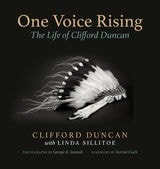
One Voice Rising
The Life of Clifford DuncanClifford Duncan with Linda Sillitoe, Photographs by George R. Janecek
University of Utah Press, 2019
“Everything was Indian then, when I was a boy. They had to explain to us about the white man's side. Now everything is in the white man's world and we teach Indian ways.”
—Clifford Duncan (from the book)
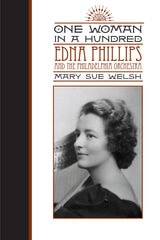
One Woman in a Hundred
Edna Phillips and the Philadelphia OrchestraMary Sue Welsh
University of Illinois Press, 2013
Oneota Flow
The Upper Iowa River and Its PeopleDavid S. Faldet
University of Iowa Press, 2009
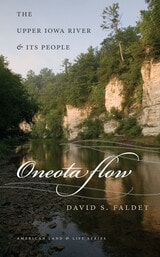
Whether profiling the chief of the last hunter-gatherers on the river, an early settler witnessing her first prairie fire and a modern wildlife biologist using fire to manage prairies, the manager of the Granger Farmer’s Co-op Creamery, or a landowner whose bottomlands are continually eaten away by floods, Faldet steadily develops the central idea that people are walking tributaries of the river basin in which they make their homes.
Faldet moves through the history of life along the now-polluted Upper Iowa, always focusing on the ways people depend on the river, the environment, and the resources of the region. He blends contemporary conversations, readings from the historical record, environmental research, and personal experience to show us that the health of the river is best guaranteed by maintaining the biological communities that nurture it. In return, taking care of the Upper Iowa is the best way to take care of our future.
Ono Ono Girl's Hula
Carolyn Lei-lanilau
University of Wisconsin Press, 1997
Both playful and serious, this audacious riff on ethnic and sexual identity by Hawaiian-Hakka Chinese-American writer Carolyn Lei-lanilau revolves around the persona she calls “Ono Ono Girl,” an icon that interweaves and transcends Lucille Ball, Little Lulu, Tina Turner, and Spottie Dottie. Challenging assumptions about genre and gender, and acting out the notion that language is a function of the body, these essays are transforming soundbytes of Ono Ono Girl inventing herself.
“Just when you thought American literature was canonized and commodified beyond saving, Carolyn Lei-lanilau’s intertextual, irreverent work, Ono Ono Girl’s Hula, brings language and philosophy back to the table. Her book is a miracle delivery: a rebirth of poetry, Third World Spam, and love wrapped around the hybrid vigor of Hawaiian, Hakka, French, Latin, and English. Soulful, powerful, and wise.”—Russell Leong, editor of Amerasia Journal
“A book enjoyable equally for its fun as for its profundity, Carolyn Lei-lanilau’s Ono Ono Girl’s Hula is irresistible must reading for feminists, anthropologists, contemporary culture buffs, and anyone who wants a refreshing take on some of our more vexing current disputes. Down-to-earth and poetic, serious and hilarious at once, her unconventional voice invites the reader to understand the paradoxes of identity—sexual and ethnic—in new ways.”—Robin Lakoff, author of Talking Power
Open Your Hand
Teaching as a Jew, Teaching as an AmericanIlana M. Blumberg
Rutgers University Press, 2019
Open the Door
The Life and Music of Betty CarterWilliam R. Bauer
University of Michigan Press, 2003
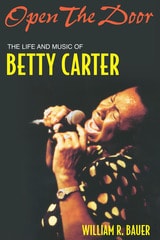
This book looks at Betty Carter's contribution to the music world and delves behind the scenes to show Carter's growth as a businesswoman who took charge of her career.
Drawing upon revealing interviews with Carter, the author shows how ever-changing shifts in the music industry affected the singer's life and influenced her music. Bauer shows through his analysis of her musical examples how Carter absorbed various musical influences, from Sarah Vaughan and Billie Holiday to Miles Davis, and made them her own. From her apprenticeship with Gladys Hampton, Carter grew to become a shrewd dealer who learned to do her own contracting, A&R, and marketing and distribution. By chronicling one of jazz's great singers and composers, the book sheds light on how early jazz musicians got their work to the public and how this process has changed during the past fifty years.

Opening Doors to Quaker Religious Education
Mary Snyder
QuakerPress, 1999
Opera Observed
Views of a Florentine Impresario in the Early Eighteenth CenturyWilliam C. Holmes
University of Chicago Press, 1993
A member of an illustrious Florentine family, Albizzi (1664-1745) served as one of the principal impresarios of the Pergola, Florence's earliest and greatest opera theater. He also carried on an active correspondence with impresarios in other cities, freely giving his advice on various economic and artistic concerns. Holmes uses the Albizzi family archives—the most abundant and varied material yet available about an eighteenth-century impresario and his theater—to deepen our knowledge of an extraordinary but little understood period in Italian opera.
This book will appeal to anyone curious about operatic history.
Operatic Lives
Alberto Savinio
Northwestern University Press, 1988
Operation Whisper
The Capture of Soviet Spies Morris and Lona CohenBarnes Carr
University Press of New England, 2016

Oppenheimer Is Watching Me
A MemoirJeff Porter
University of Iowa Press, 2007
Oppenheimer
The Tragic IntellectCharles Thorpe
University of Chicago Press, 2007

Orchid of the Bayou
A Deaf Woman Faces BlindessCathryn Carroll
Gallaudet University Press, 2001
In graduating from Gallaudet University, finding a job in Washington, D.C., and starting a family with her college sweetheart, Kitty Fischer tacitly abandoned the Louisiana Cajun culture that had exposed her to little more than prejudice and misery as a child. Upon discovering that she suffered from Usher syndrome (a genetic condition that causes both deafness and blindness), however, Fischer began an unlikely journey toward reclaiming her heritage. She and Cathryn Carroll tell the story of her heroic struggle and cultural odyssey in Orchid of the Bayou: A Deaf Woman Faces Blindness.
“By this time Mama knew I was ‘not right,’” Fischer says of her early childhood. “She knew the real words for ‘not right,’ too, though she never said those words. I was deaf and dumb.” Initially Fischer’s parents turned to folk healers to try and “cure” their daughter’s deafness, but an aunt’s fortunate discovery of the Louisiana School for the Deaf would rescue Fischer from misunderstanding and introduce her to sign language and Deaf culture. She weathered the school’'s experiments with oralism and soon rose to the top of her class, ultimately leaving Louisiana for the academic promise of Gallaudet.
While in college, Fischer met and married her future husband, Lance, a Jewish Deaf man from Brooklyn, New York, and each landed jobs close to their alma mater. After the birth of their first child, however, Fischer could no longer ignore her increasing tunnel vision. Doctors quickly confirmed that Fischer had Usher syndrome.
While Fischer struggled to come to terms with her condition, the high incidence of Usher syndrome among Cajun people led her to re-examine her cultural roots. “Could I still be me, Catherine Hoffpauir Fischer, had I not been born of a mix that codes for Usher syndrome?” she asks. “To some extent, the history of my people explains the constitution of my genes and the way my life has unfolded.” Today Fischer prospers, enjoying her time with family and friends and celebrating the Deaf, Cajun, Blind, and Jewish cultures that populate her life. Her lively story will resonate with anyone who recognizes the arduous journey toward claiming an identity.
Ordered West
The Civil War Exploits of Charles A. CurtisAlan D. Gaff
University of North Texas Press, 2017
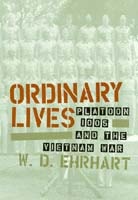
Ordinary Lives
Platoon 1005 and the Vietnam WarW. Ehrhart
Temple University Press, 1999
Twenty-seven years after basic training. Ehrhart began what became a five-year search for the men of his platoon. Who were these men alongside whom he trained? Why had they joined the Marines at a time when being sent to war and of the country that sent them to fight it? What does the Corps mean to them? What Ehrhart learned offers an extraordinary window into the complexities of the Vietnam Generation and the United States of America then and now.
Based on supporting materials from military records and family members as well as interviews -- some of which Ehrhart held in such active secondary roles as dairy farmhand, fishing companion, and impromptu guest at a family wedding -- this book records the more-than-30-year journey that each man took after his boot-camp graduation on August 12, 1966. Photos of the men, both then and now, accompany the profiles. Their stories are diverse, but as Ehrhart says, "It was, in short, history, and each of these men was and is a part of that history....There are, no doubt, scoundrels and liars and losers among these men, but as a group they have mostly impressed me with their decency and their loyalty and their hard work and their perseverance in the face of hardships and hurdles, the everyday obstacles that make ordinary lives extraordinary."
Ordinary Trauma
A MemoirJennifer Sinor
University of Utah Press, 2017
Finalist for the 15 Bytes Book Award for Creative Nonfiction
Interview with Tom Williams at Access Utah
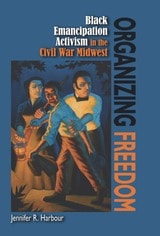
Organizing Freedom
Black Emancipation Activism in the Civil War MidwestJennifer R. Harbour
Southern Illinois University Press, 2020
Despite banning slavery, Illinois and Indiana share an antebellum history of severely restricting rights for free black people while protecting the rights of slaveholders. Nevertheless, as Harbour shows, black Americans settled there, and in a liminal space between legal slavery and true freedom, they focused on their main goals: creating institutions like churches, schools, and police watches; establishing citizenship rights; arguing against oppressive laws in public and in print; and, later, supporting their communities throughout the Civil War.
Harbour’s sophisticated gendered analysis features black women as being central to the seeking of emancipated freedom. Her distinct focus on what military service meant for the families of black Civil War soldiers elucidates how black women navigated life at home without a male breadwinner at the same time they began a new, public practice of emancipation activism. During the tumult of war, Midwestern black women negotiated relationships with local, state, and federal entities through the practices of philanthropy, mutual aid, religiosity, and refugee and soldier relief.
This story of free black people shows how the ideal of equality often competed against reality in an imperfect nation. As they worked through the sluggish, incremental process to achieve abolition and emancipation, Midwestern black activists created a unique regional identity.

Oriana Fallaci
The Woman and the MythSanto L. Aricò
Southern Illinois University Press, 1998
Internationally acclaimed as a journalist, war correspondent, interviewer, and novelist, Oriana Fallaci’s public persona reached almost mythic proportions. It is a myth Fallaci herself created, according to Santo L. Aricò, who probes the psychological forces that motivated one of the twentieth century’s most famous and successful women writers.
Using his own extensive interviews with the writer, Aricò maps out Fallaci’s journey through life, paying particular attention to her ongoing and painstaking attempts to establish her own mythical status. He first examines her career as a literary journalist, emphasizing the high quality of her writing. From there, he concentrates on how Fallaci’s personal image began to emerge in her writings, as well as the way in which, through her powerful narratives, she catapulted herself into the public eye as her own main character.
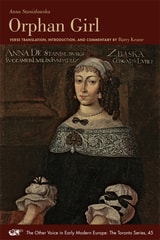
Orphan Girl
A Transaction, or an Account of the Entire Life of an Orphan Girl by way of Plaintful Threnodies in the Year 1685. The Aesop EpisodeAnna Stanislawska
Iter Press, 2016
Barry Keane's idiomatic and inventive verse translation brings to life this half-forgotten poetic account of a remarkable tale of triumph in the face of overwhelming oppression and allows Anna Stanislawska to take her place among the women poets of early modern Europe.
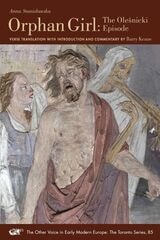
Orphan Girl
The Olesnicki Episode: One Body with Two Souls Entwined: An Epic Tale of Married Love in Seventeenth-Century PolandAnna Stanislawska
Iter Press, 2021
Written in 1685, Transaction or the Description of the Entire Life of an Orphan by Way of Plaintful Threnodies, often referred to as Orphan Girl, is a valuable, long-lost, seventeenth-century poetic text that documents women’s writing in the early modern period. In this autobiographical account, Anna Stanislawska speaks confessionally and unsparingly about her life, from her infancy to her widowhood and withdrawal from the world. Stanislawska was an incomparable memoirist, revealing the depths of her private life in a manner not to be matched until modern times. One Body with Two Souls Entwined brings together this spirited poetic account with an in-depth introductory and literary commentary by Barry Keane. Together the book offers a remarkable piece of scholarly, translational, and dramaturgical work and puts it in context amid the backdrop of Polish history.
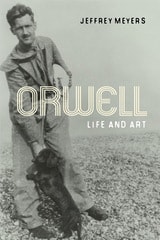
Orwell
Life and ArtJeffrey Meyers
University of Illinois Press, 2010

Oscar W. Underwood
A Political BiographyEvans C. Johnson
University of Alabama Press, 2006
Although Oscar W. Underwood was considered a titan of his age, few American political figures have suffered such neglect as he. Except for his candidacy for the Democratic nomination in 1924, his political career is largely forgotten even in Alabama. The one place in which Underwood is well remembered is in the folklore of Congress, where he is widely regarded as a great party leader who had mastered the rules perhaps as thoroughly as any member of Congress. This mastery, together with steady work, personal magnetism, and a willingness to compromise, made him effective as chairman of the Ways and Means Committee in formulating a majority program after the Democrats seized control of the House in 1910. Pat Harrison, Underwood's lieutenant as minority leader, referred to Underwood as the "greatest natural parliamentarian, the greatest leader of a law-making body that I ever saw."
--from the Preface to Oscar W. Underwood: A Political Biography
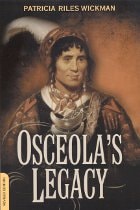
Osceola's Legacy
Patricia Riles Wickman
University of Alabama Press, 2006
A bestselling, re-evaluation of a major Native American resistance leader. Named an Outstanding Book by the Gustavus Myers Center for the Study of Human Rights.
Born in Alabama to a Muscogee/Creek Indian mother and an English father, Osceola, born Billy Powell, came to prominence in the 1830s for resisting the U. S. government's sweep into Florida. He protested the government's Florida Indian removal, killed a pro-emigration Indian leader and then made war on the US government.
Osceola's Legacy draws on a wealth of sources, including letters, diaries, and artifacts to bring this fascinating figure and the central role he played in the Second Seminole War into vivid focus. Of particular interest is a chapter on the forensic report on Osceola's grave as well as descriptions and the illustrations of his personal property at the time of his death.
Osceola's Legacy is significant for its genealogy and archaeological study of this Native American and his interaction with the federal government during the 1800s. The catalog of photographs of Osceola portraits and his personal possessions makes this a worthwhile reference book as well.
Osho Rajneesh
Studies in Contemporary ReligionJudith M. Fox
Signature Books, 2002
Highly unorthodox, he courted controversy and was condemned for being a “sex guru.” His Oregon headquarters, Rajneeshpuram, proved to be a short-lived utopia that provoked antagonism and only added to his notoriety. But his ashram in Poona, India, continues to thrive, as do Osho centers in Europe and elsewhere. His adherents number in the thousands. His books have become bestsellers around the globe.