Results by title
28164 books match the query 'History' and 581 start with o
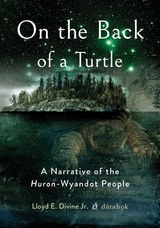
On the Back of a Turtle
A Narrative of the Huron-Wyandot PeopleLloyd Divine Jr.
The Ohio State University Press, 2019
As characters and tribes emerge in the Huron-Wyandot’s oral tradition of creation, and take their respective places upon the Great Island, the author reveals the most difficult element of the Huron-Wyandot’s history: how the tribal name was obtained. With the knowledge of how both Huron and Wyandot are relevant names for one tribe of people, the author then shares his tribe’s amazing history. The reader will be fascinated to learn how one of the smallest tribes, birthed amid the Iroquois Wars, rose to become one of the most respected and influential tribes of North America.

On the Back of an Envelope
A Life in WritingPeter Hennessy
Haus Publishing, 2025
As one of Britain’s foremost constitutional experts and contemporary historians, Peter Hennessy has spent his professional life unpicking the arcane world of Whitehall and Westminster. He began his career as a journalist for the Times, the Economist, and the Financial Times, developing a network of insider contacts who helped him shine a light on some of the dustiest corners of the British establishment. As a journalist, prize-winning contemporary historian, and political commentator, he has chronicled the workings of the British state with wit, affection, and a healthy sense of the absurd over a five-decade career. Now a crossbench peer, he has, in his own words, “moved in with his exhibits.” Hennessy is also a stalwart of BBC election night coverage and a regular commentator on BBC Radio 4, bringing a historical and constitutional perspective on current events.
In this new volume, he brings together selected journalism, unpublished lectures, and new writing alongside personal recollections and reflections on his time observing postwar Britain, how it is governed, and those who do the governing. He reflects on the making and unmaking of prime ministers from Attlee to Truss, life in the House of Lords, and the changing constitutional landscape in the wake of Brexit and amid uncertainty about the future of the Union. Interspersed with lectures, journalism, and new pieces, Hennessy also looks back at a fascinating career, reflecting on his own experiences as a young green graduate navigating the hard-nosed world of Fleet Street in the 1970s, bringing to life a cast of characters from a world now largely gone. He revisits his time as a public historian, academic, and crossbench peer with a levity reflected in his belief that history is “gossip with footnotes.”
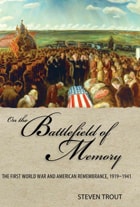
On the Battlefield of Memory
The First World War and American Remembrance, 1919–1941Steven Trout
University of Alabama Press, 2010
This work is a detailed study of how Americans in the 1920s and 1930s interpreted and remembered the First World War. Steven Trout asserts that from the beginning American memory of the war was fractured and unsettled, more a matter of competing sets of collective memories—each set with its own spokespeople— than a unified body of myth. The members of the American Legion remembered the war as a time of assimilation and national harmony. However, African Americans and radicalized whites recalled a very different war. And so did many of the nation’s writers, filmmakers, and painters.
Trout studies a wide range of cultural products for their implications concerning the legacy of the war: John Dos Passos’s novels Three Soldiers and 1919, Willa Cather’s One of Ours, William March’s Company K, and Laurence Stallings’s Plumes; paintings by Harvey Dunn, Horace Pippin, and John Steuart Curry; portrayals of the war in The American Legion Weekly and The American Legion Monthly; war memorials and public monuments like the Tomb of the Unknown Soldier; and commemorative products such as the twelve-inch tall Spirit of the American Doughboy statue.
Trout argues that American memory of World War I was not only confused and contradictory during the ‘20s and ‘30s, but confused and contradictory in ways that accommodated affirmative interpretations of modern warfare and military service. Somewhat in the face of conventional wisdom, Trout shows that World War I did not destroy the glamour of war for all, or even most, Americans and enhanced it for many.
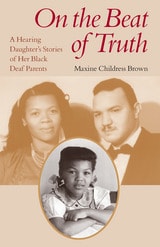
On the Beat of Truth
A Hearing Daughter’s Stories of Her Black Deaf ParentsMaxine Childress Brown
Gallaudet University Press, 2013
As an African American woman born in 1943, Maxine Childress Brown possessed a unique vantage point to witness the transformative events in her parents’ lives. Both came from the South -- her father, Herbert Childress, from Nashville, TN, and her mother, Thomasina Brown, from Concord, NC. The oldest of three daughters, Maxine was fascinated by her parents’ stories. She marveled at how they raised a well-respected, middle-class family in the midst of segregation with the added challenge of being deaf.
Her parents met in Washington, DC, where they married and settled down. Her father worked as a shoe repairman for $65 per week for more than 15 years. A gifted seamstress, her mother gave up sewing to clean houses. Because of their modest means, Maxine and her sisters lived more than modest lives. When Maxine’s tonsils became infected, her parents could not afford the operation to have them removed. For her high school prom, her mother bought her a dress on credit because she had no time to sew. Herbert Childress showed great love for his young daughters, but events turned him to bitterness and to drink. Throughout all, Thomasina encouraged her girls, always urging them to excel. She demanded their honest best with her signature phrase, her flat hand raised from her mouth straight up in the air, “on the beat of truth.”

On the Border of Belonging
Luisa Capetillo, Ofelia Rodríguez Acosta, and Evangelina Rodríguez PerozoStephanie Rivera Berruz
Rutgers University Press, 2027
On the Border of Belonging: Luisa Capetillo, Ofelia Rodríguez Acosta, and Evangelina Rodríguez Perozo is a philosophical-historiographical project that spearheads the construction of an intellectual tradition of women from the Hispanophone Caribbean at the turn of the 20th century. On the Border of Belonging engages Luisa Capetillo (Puerto Rico), Ofelia Rodríguez Acosta (Cuba), Evangelina Rodríguez Perozo (Dominican Republic) as interlocutors with the landfall of Western modernity revealing a tense intersection between a desire to belong to modernity while sitting on the margins of its possibilities. The vexed relationship with belonging creates a counter-archive of contradictions that reveals a vivid philosophical patchwork that spirals and repeats across the archipelago. In this crosscurrent of ideas, Luisa Capetillo defends the possibilities of a spiritual- anarchist political life; Ofelia Rodríguez Acosta challenges the norms of love and kinship; and Evangelina Rodríguez Perozo contests the standards of maternal and infant care.
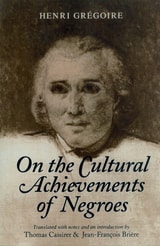
On the Cultural Achievements of Negroes
Henri Gregoire
University of Massachusetts Press, 1996
First published in French in 1808 and translated into English two years later under the title An Enquiry Concerning the Intellectual and Moral Faculties, and Literature of the Negroes, this book was a touchstone for nineteenth-century abolitionists in England and the United States. Written by Abbe Henri Gregoire (1750–1831), it argued vigorously against assumptions of black inferiority and in favor of the humanity, equality, and cultural achievements of people of African heritage. His treatise summarized most of the available written thought on race up to that time. A leading activist in the French Revolution, Gregoire reflected in his arguments the spirit of “libertie, egalite, and fraternite” and anticipated twentieth-century race inquiry and theory. Although influential in its time, the first translation of Gregoire's work was incomplete and flawed. This new edition presents a fresh, accurate, and complete text of this key document in the history of Western racial thought. The book includes a substantial biography of Gregoire and analysis of the historical context in which he wrote and the impact of his work.

On the Current Situation in the Ukraine
Serhii Mazlakh and Vasyl' Shakhrai
University of Michigan Press, 2025

On the Cusp
The Yale College Class of 1960 and a World on the Verge of ChangeDaniel Horowitz
University of Massachusetts Press, 2015
How did the 1950s become “The Sixties”? This is the question at the heart of Daniel Horowitz's On the Cusp. Part personal memoir, part collective biography, and part cultural history, the book illuminates the dynamics of social and political change through the experiences of a small, and admittedly privileged, generational cohort.
A Jewish “townie” from New Haven when he entered Yale College in fall 1956, Horowitz reconstructs the undergraduate career of the class of 1960 and follows its story into the next decade. He begins by looking at curricular and extracurricular life on the all-male campus, then ranges beyond the confines of Yale to larger contexts, including the local drama of urban renewal, the lingering shadow of McCarthyism, and decolonization movements around the world. He ponders the role of the university in protecting the prerogatives of class while fostering social mobility, and examines the growing significance of race and gender in American politics and culture, spurred by a convergence of the personal and the political. Along the way he traces the political evolution of his classmates, left and right, as Cold War imperatives lose force and public attention shifts to the civil rights movement and the war in Vietnam.
Throughout Horowitz draws on a broad range of sources, including personal interviews, writings by classmates, reunion books, issues of the Yale Daily News, and other undergraduate publications, as well as his own letters and college papers. The end product is a work consistent with much of Horowitz's previously published scholarship on postwar America, further exposing the undercurrent of discontent and dissent that ran just beneath the surface of the so-called Cold War consensus.
On the Dirty Plate Trail
Remembering the Dust Bowl Refugee CampsEdited with an introduction and commentaries by Douglas Wixson
University of Texas Press, 2007
Runner-up, National Council on Public History Book Award, 2008
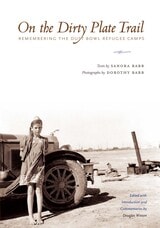
The 1930s exodus of "Okies" dispossessed by repeated droughts and failed crop prices was a relatively brief interlude in the history of migrant agricultural labor. Yet it attracted wide attention through the publication of John Steinbeck's The Grapes of Wrath (1939) and the images of Farm Security Administration photographers such as Dorothea Lange and Arthur Rothstein. Ironically, their work risked sublimating the subjects—real people and actual experience—into aesthetic artifacts, icons of suffering, deprivation, and despair. Working for the Farm Security Administration in California's migrant labor camps in 1938-39, Sanora Babb, a young journalist and short story writer, together with her sister Dorothy, a gifted amateur photographer, entered the intimacy of the dispossessed farmers' lives as insiders, evidenced in the immediacy and accuracy of their writings and photos. Born in Oklahoma and raised on a dryland farm, the Babb sisters had unparalleled access to the day-by-day harsh reality of field labor and family life.
This book presents a vivid, firsthand account of the Dust Bowl refugees, the migrant labor camps, and the growth of labor activism among Anglo and Mexican farm workers in California's agricultural valleys linked by the "Dirty Plate Trail" (Highway 99). It draws upon the detailed field notes that Sanora Babb wrote while in the camps, as well as on published articles and short stories about the migrant workers and an excerpt from her Dust Bowl novel, Whose Names Are Unknown. Like Sanora's writing, Dorothy's photos reveal an unmediated, personal encounter with the migrants, portraying the social and emotional realities of their actual living and working conditions, together with their efforts to organize and to seek temporary recreation. An authority in working-class literature and history, volume editor Douglas Wixson places the Babb sisters' work in relevant historical and social-political contexts, examining their role in reconfiguring the Dust Bowl exodus as a site of memory in the national consciousness.
Focusing on the material conditions of everyday existence among the Dust Bowl refugees, the words and images of these two perceptive young women clearly show that, contrary to stereotype, the "Okies" were a widely diverse people, including not only Steinbeck's sharecropper "Joads" but also literate, independent farmers who, in the democracy of the FSA camps, found effective ways to rebuild lives and create communities.
On the East-West Slope
Globalization, Nationalism, Racism and Discourses on Eastern EuropeAttila Melegh
Central European University Press, 2006

On the Edge of the Holocaust
The Shoah in Latin American Literature and CultureEdna Aizenberg
Brandeis University Press, 2015

On the Eve of Conquest
The Chevalier de Raymond's Critique of New France in 1754Joseph L. Peyser
Michigan State University Press, 1997
In 1754, Charles de Raymond, chevalier of the Royal and Military Order of Saint Louis and a captain in the Troupes de la Marine wrote a bold, candid, and revealing expose; on the French colonial posts and settlements of New France. On the Eve of the Conquest, more than an annotated translation, includes a discussion on the historical background of the start of the French and Indian War, as well as a concise biography of Raymond and Michel Le Courtois de Surlaville, the army colonel at the French court to whom the report was sent. The events surrounding Raymond's controversial year as commandant of the post (now Fort Wayne, Indiana) in 1749-50, his disputed recall by Governor General Jacques-Pierre de Taffanel de La Jonquier, and the subsequent friction between La Jonquiere's successor, Ange de Menneville Duqesne, and Raymond are presented in detail and illustrated by translations of their correspondence.

On the Eve of the Cybercultural Revolution
Black Power and Capitalism in the 1960sBrian Bartell
University of Minnesota Press, 2025
Uncovering the Black Power movement’s contributions to theorizing the politics of automation
On the Eve of the Cybercultural Revolution offers a comprehensive look at the Black Power movement’s theoretical work and insights into the entanglement of capitalism, technology, and racism. Drawing upon James and Grace Lee Boggs’s expanded notion of the cybercultural era, Brian Bartell demonstrates how a range of artists, writers, and activists from the 1960s prefigured the wider discourse around automation and made it a central concern of their politics.
Rather than reducing automation to an isolated technical phenomenon, theorists of the Black radical tradition identified its important historical antecedents in colonialism and plantation slavery, emphasizing how the emerging cyberculture joined with issues such as the reorganization of labor, ecological harm, and racial inequality. Examining the work of Martin Luther King Jr., Noah Purifoy, the Black Panthers, and others, On the Eve of the Cybercultural Revolution outlines the new forms of social reproduction conceived outside of the dominant structures of racial capitalism.
Bartell synthesizes a wide range of source texts, including political speeches, literature, and activist archives, to show how the Black Power movement sought to create a postscarcity, more-than-capitalist economy. By shedding light on the movement’s underexplored engagement with theories of technology, he provides a crucial key to understanding the historical dynamics responsible for our technocapitalist present.
Retail e-book files for this title are screen-reader friendly.
On the Excellence and Nobility of Women
A Defense of Women (1582–1583) for the Women of Belgica. A Bilingual EditionJehan Baptista Houwaert
Iter Press, 2025
Jehan Baptista Houwaert’s Excellence and Nobility of Women constitutes the eighth book of his Plain of the Nine Muses, or The Pleasure Garden of Virtuous Women (1582–1583), an immense conduct book for women in rhymed verse based on the many querelle texts of the French and Burgundian tradition but especially, in its French translation, on the pathbreaking Declamation on the Nobility and Preeminence of the Female Sex (1529) by Henricus Cornelius Agrippa von Nettesheim.
Like its model, Houwaert’s work asserts not merely the equality but the superiority of women. It is unique in that it is addressed not to a wealthy noblewoman or princess, as were most such defenses, but more democratically to the “girls, unmarried women, wives, and widows of Belgica”—all of them!

On the Formation of the Clergy
Bleeded Hrabanus Maurus
Catholic University of America Press, 2023
On the Fringes of History
A MemoirPhilip D. Curtin
Ohio University Press, 2005
In the 1950s, professional historians claiming to specialize in tropical Africa were no more than a handful. The teaching of world history was confined to high school courses, and even those were focused on European history, with a chapter added to account for the history of East and South Asia. The change over the ensuing decades was revolutionary.
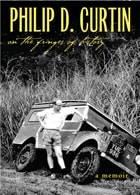
Philip D. Curtin was a leader among a new generation of historians that emerged after the Second World War. Written with characteristic economy and telling detail, On the Fringes of History: A Memoir follows Curtin from his beginnings in central West Virginia in the 1920s, through a distinguished academic career in which Curtin founded African studies at the University of Wisconsin. He began the programs in comparative world history at Wisconsin and Johns Hopkins, producing many of the most influential historians and Africanists from the 1950s to today.
Always an independent thinker and controversial figure, Curtin revived the study of the Atlantic slave trade. His career stands as an example of the kind of dissatisfaction and struggles that brought about a sea change in higher education. On the Fringes of History traces the movement of African history and world history from the fringes of the history profession into the mainstream. This stunningly illustrated memoir illuminates both the career of a leading historian and the history of twentieth-century academia.
On the Frontlines of Crisis
Intensive Care and the Challenge of COVID-19Jason Rodriquez
Rutgers University Press, 2025
A dramatic spike in mental health distress among these healthcare workers was a consequence of the pandemic, but was also a result of the changing dynamics within the healthcare system itself. Here, Rodriquez examines the impact of the development of the contemporary focus on “clinical empathy.” This clinical method, while intended to improve patient care, had profound implications for healthcare workers during the pandemic, often blurring the lines between professional distance and personal involvement, increasing the emotional demands on staff and heightened their vulnerability to anxiety, depression, post-traumatic stress, and burnout. Through the personal stories of those who were in the ICU, On the Frontlines of Crisis offers a sobering reflection on the social and emotional costs of caring for patients.

On the Future of History
The Postmodernist Challenge and Its AftermathErnst Breisach
University of Chicago Press, 2003
Breisach sees postmodernism as neither just a fad nor a universal remedy. In clear and concise language, he presents and critically evaluates the major views on history held by influential postmodernists, such as Derrida, Foucault, Lyotard, and the new narrativists. Along the way, he introduces to the reader major debates among historians over postmodern theories of evidence, objectivity, meaning and order, truth, and the usefulness of history. He also discusses new types of history that have emerged as a consequence of postmodernism, including cultural history, microhistory, and new historicism.
For anyone concerned with the postmodern challenge to history, both advocates and critics alike, On the Future of History will be a welcome guide.
On the Geographical Distribution of Plants
Alexander von Humboldt
University of Chicago Press, 2027
The first English translation of an essay that is among Alexander von Humboldt’s least known but most important scientific works.
In the nineteenth century, Alexander von Humboldt was arguably the world’s most famous celebrity after Napoleon. What started in 1799 as a serendipitous trip to the New World tropics with his friend Aimé Bonpland to collect plants and minerals expanded into a five-year exploration of Venezuela, Colombia, Ecuador, Perú, México, and Cuba. The discoveries the two amassed were nothing short of staggering, and much of our knowledge of tropical botany, zoology, geography, and geology can be traced back to these journeys. The voyage, and the publication of Humboldt’s travel narratives and scientific studies from these expeditions, which totaled dozens of books, elevated Humboldt to cult status.
In the past two decades, Humboldt’s writings have been rediscovered in multiple fields, including biogeography; Earth and environmental sciences; American and Latin American studies; nineteenth-century art, poetry, and literature; and transatlantic cultural history. His ideas are profoundly relevant to twenty-first-century thinking on the relationship between humans and nature, and the ecological framework in which he viewed the world remains essential two centuries after his travels.
Among his many interests, Humboldt invested considerable effort in explaining the underlying causes of the uneven distribution of plant species across the globe. His extended essay On the Geographical Distribution of Plants is among his least known but most important works, laying foundations for the development of ecology, climatology, and evolutionary biology in the following decades. It was first published in 1815 as an introduction to a seven-volume Latin botanical monograph, Nova genera et species plantarum (New Genera and Species of Plants). The essay, republished in 1817 as a standalone volume, held great influence over nineteenth-century naturalists. It is Humboldt’s most comprehensive and detailed treatment of plant geography. In the essay, he applies what he calls “botanical arithmetic” to reveal ecological and biogeographic patterns of plants, applications that still ground modern macroecology; and he provides frameworks to link vegetation patterns and climate, which are essential in modern Earth system science. Introduced and organized by ecologist Stephen T. Jackson and translated from Latin to English by Philip Holt, this book is essential for the libraries of scientists, historians, and all Humboldt admirers.

On the Heels of Ignorance
Psychiatry and the Politics of Not KnowingOwen Whooley
University of Chicago Press, 2019
On the Hunt
The History of Deer Hunting in WisconsinRobert C Willging
Wisconsin Historical Society Press, 2008
On the Left in America
Memoirs of the Scandinavian-American Labor MovementHenry Bengston. Translated by Kermit B. Westerberg. Edited and with an Introduction by Michael Brook
Southern Illinois University Press, 1999
Previously available only in an out-of-print Swedish edition published in 1955, Henry Bengston's firsthand account deals with what historian Dag Blanck calls the "other Swedish America."
Swedish immigrants in general were conservative, but Bengston and others—most notably Joe Hill—joined the working-class labor movement on the left, primarily as Debsian socialists, although their ranks included other socialists, communists, and anarchists. Involved in the radical labor movement on many fronts, Bengston was the editor of Svenska Socialisten from 1912 until he dropped out of the Scandinavian Socialist Federation in 1920. Even after 1920, however, his sympathies remained with the movement he had once strongly espoused.

On the Margins of Citizenship
Intellectual Disability and Civil Rights in Twentieth-Century AmericaAllison C. Carey
Temple University Press, 2010
Carey addresses the segregation of people with intellectual disabilities in schools and institutions along with the controversies over forced sterilization, eugenics, marriage and procreation, and protection from the death penalty. She chronicles the rise of the parents’ movement and the influence of the Kennedy family, as well as current debates that were generated by the impact of the Americans with Disabilities Act passed in 1990.
Presenting the shifting constitutional and legal restrictions for this marginalized group, Carey argues that policies tend to sustain an ambiguity that simultaneously promises rights yet also allows their retraction.
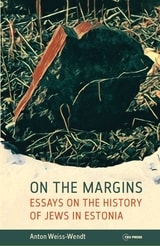
On the Margins
Essays on the History of Jews in EstoniaAnton Weiss-Wendt
Central European University Press, 2017
Estonia is perhaps the only country in Europe that lacks a comprehensive history of its Jewish minority. Spanning over 150 years of Estonian Jewish history, On the Margins is a truly unique book. Rebuilding a life beyond so-called Pale of Jewish Settlement in the Russian Empire, the Jewish cultural autonomy in interwar Estonia, and the trauma of Soviet occupation of 1940–41 are among the issues addressed in the book but most profoundly, the book wrestles with the subject of the Holocaust and its legacy in Estonia.
Specifically, it examines the quasi-legal system of murder instituted in Nazi-occupied Estonia, confiscation of Jewish property, and Jewish forced labor camps and develops an analysis of the causes of collaboration during the Holocaust. The book also explores the dynamics of war crimes trials in the Soviet Union since the 1960s and so-called denaturalization trials in the United States in the 1980s. The haunting memory of Soviet and Nazi rule, the book concludes, prevents a larger segment of today’s Estonian population from facing up to the Holocaust and the universal message that it carries.E

On the Moderation of Reason in Religious Matters
Ludovico Antonio Muratori
Catholic University of America Press, 2024
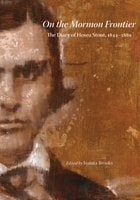
On the Mormon Frontier
The Diary of Hosea Stout, 1844-1889Juanita Brooks
University of Utah Press, 2009
This edition of On the Mormon Frontier presents Stout’s diary in a single volume, proving that it continues to be an essential work in the study of Mormon and American history.
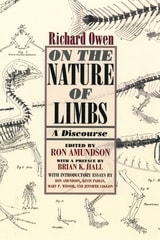
On the Nature of Limbs
A DiscourseRichard Owen
University of Chicago Press, 2007
Just as Darwin’s ideas continue to propel the modern study of adaptation, so too will Owen’s contributions fuel the new interest in homology, organic form, and evolutionary developmental biology. His theory of the archetype and his views on species origins were first offered to the general public in On the Nature of Limbs, published in 1849. It reemerges here in a facsimile edition with introductory essays by prominent historians, philosophers, and practitioners from the modern evo-devo community.
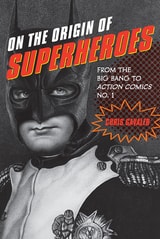
On the Origin of Superheroes
From the Big Bang to Action Comics No. 1Chris Gavaler
University of Iowa Press, 2015
From the creation of the universe, through mythological heroes and gods, to folklore, ancient philosophy, revolutionary manifestos, discarded scientific theories, and gothic monsters, the sweep and scale of the superhero’s origin story is truly epic. We will travel from Jane Austen’s Bath to Edgar Rice Burroughs’s Mars to Owen Wister’s Wyoming, with some surprising stops along the way. We’ll meet mad scientists, Napoleonic dictators, costumed murderers, diabolical madmen, blackmailers, pirates, Wild West outlaws, eugenicists, the KKK, Victorian do-gooders, detectives, aliens, vampires, and pulp vigilantes (to name just a few). Chris Gavaler is your tour guide through this fascinating, sometimes dark, often funny, but always surprising prehistory of the most popular figure in pop culture today. In a way, superheroes have always been with us: they are a fossil record of our greatest aspirations and our worst fears and failings.
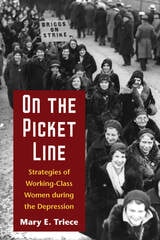
On the Picket Line
Strategies of Working-Class Women during the DepressionMary Triece
University of Illinois Press, 2006
Bonnie Ritter Book Award, National Communication Association's Feminist and Women Studies Division, 2008.
On the Picket Line uncovers the voices of working-class women, particularly those active in the Communist Party, U.S.A., in order to examine how these individuals confronted the tensions between their roles as workers, wives, mothers, and consumers. Combining critical analysis, Marxist and feminist theory, and labor history, Mary E. Triece analyzes the protest tactics employed by working class women to challenge dominant ideologies surrounding domesticity.
She details the rhetorical strategies used by women to argue for their rights as workers in the paid labor force and as caregivers in the home. Their overtly coercive tactics included numerous sit-ins, strikes, and boycotts that won tangible gains for working poor and unemployed women. The book also gives voice to influential figures in the 1930s labor movement (many of whom were members of the Communist Party, U.S.A.), such as Ella Reeve Bloor, Margaret Cowl, Anna Damon, Ann Burlak, and Grace Hutchins. Triece ultimately argues that these confrontational protest tactics of the 1930s remain relevant in today’s fights for more humane workplaces and better living conditions.
On the Plains in ’65
The 6th West Virginia Volunteer Cavalry in the WestGeorge H. Holliday
Ohio University Press, 2021
A new scholarly edition of an Ohio boy soldier’s revealing post-Civil War memoir.
This annotated edition of Holliday’s recollections—known primarily among historians of the American West—re-contextualizes his memoir to include his boyhood in southern Ohio and the largely untold story of the hundreds of Buckeyes who crossed the Ohio River to serve their country in Virginia (later West Virginia) regiments, ultimately traveling across Kansas, Nebraska, Colorado, and Wyoming to safeguard mail and stage routes along the celebrated Oregon Trail during a pivotal time in American history.
Glenn Longacre’s extensive research in federal, state, and local archives, manuscript collections, and period newspapers complements his correspondence with the living descendants of Holliday and other soldiers. His research integrates this story deservedly as part of Appalachian history before, during, and after the Civil War. From this perspective it addresses an entirely new audience of Appalachian studies scholars, Civil War and frontier history enthusiasts, students, and general readers.
On the Plains, and Among the Peaks
or, How Mrs. Maxwell Made Her Natural History Collection: by Mary DarttJulie McCown
University Press of Colorado, 2021
Dartt’s book tells the story of Maxwell’s lifelong passion and dedication to work and education that made her a pioneer in more ways than one. It catalogs her important scientific contributions and development of museum habitat groupings and lifelike taxidermy mounts, showcases engaging accounts of wilderness excursions on the frontier of the Western United States in the 1860s and 1870s, and testifies to her resolve to show that women were capable of succeeding in traditionally male-dominated fields.
This scholarly edition of On the Plains, and Among the Peaks will spark renewed interest in Maxwell and Dartt as neglected figures in nineteenth-century US history and literature, opening a conversation that other literary scholars and historians will join to further situate their work within the numerous disciplines to which it speaks, including nineteenth-century American literature; women’s, western, environmental, and natural history; and gender, museum, and animal studies.
On the Plaza
The Politics of Public Space and CultureBy Setha M. Low
University of Texas Press, 2000
Robert B. Textor Prize for Excellence in Anticipatory Anthropology, American Anthropological Association, 2000
Honorable Mention, Victor Turner Award, Society for Humanistic Anthropology, 2001
Leeds Prize, Society of Urban, National, and Transnational/Global Anthropology, 2001
Friendly gossip, political rallies, outdoor concerts, drugs, shoeshines, and sex-for-sale—almost every aspect of Latin American life has its place and time in the public plaza. In this wide-ranging, multi-disciplinary study, Setha M. Low explores the interplay of space and culture in the plaza, showing how culture acts to shape public spaces and how the physical form of the plaza encodes the social and economic relations within its city.
Low centers her study on two plazas in San José, Costa Rica, with comparisons to public plazas in the United States, Europe, and elsewhere. She interweaves ethnography, history, literature, and personal narrative to capture the ambiance and meaning of the plaza. She also uncovers the contradictory ethnohistories of the European and indigenous origins of the Latin American plaza and explains why the plaza is often a politically contested space.
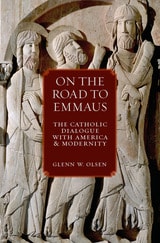
On the Road to Emmaus
The Catholic Dialogue with America and ModernityGlenn W. Olsen
Catholic University of America Press, 2012

On the Run in Siberia
Rane Willerslev
University of Minnesota Press, 2012
If I had let myself be ruled by reason alone, I would surely be lying dead somewhere or another in the Siberian frost.
The Siberian taiga: a massive forest region of roughly 4.5 million square miles, stretching from the Ural Mountains to the Bering Sea, breathtakingly beautiful and the coldest inhabited region in the world. Winter temperatures plummet to a bitter 97 degrees below zero, and beneath the permafrost lie the fossilized remains of mammoths, woolly rhinoceroses, and other ice age giants. For the Yukaghir, an indigenous people of the taiga, hunting sable is both an economic necessity and a spiritual experience—where trusting dreams and omens is as necessary as following animal tracks. Since the fall of Communism, a corrupt regional corporation has monopolized the fur trade, forcing the Yukaghir hunters into impoverished servitude.
Enter Rane Willerslev, a young Danish anthropologist who ventures into this frozen land on an idealistic mission to organize a fair-trade fur cooperative with the hunters. From the outset, things go terribly wrong. The regional fur company, with ties to corrupt public officials, proves it will stop at nothing to maintain its monopoly: one of Willerslev’s Yukaghir business partners is arrested on spurious charges of poaching and illegal trading; another drowns mysteriously. When police are sent to arrest him, Willerslev fears for his life, and he and a local hunter flee to a remote hunting lodge even deeper in the icy wilderness. Their situation turns even more desperate right away: they manage to kill a moose but lose the meat to predators and begin to starve, frostbitten and isolated in the frozen taiga.
Thus begins Willerslev’s extraordinary, chilling tale of one year living in exile among Yukaghir hunters in the stark Siberian taiga region. At turns shocking and quietly moving, On the Run in Siberia is a pulse-pounding tale of idealism, political corruption, starvation, and survival (with a timely assist from Vladimir Putin) as well as a striking portrait of the Yukaghirs’ shamanistic tradition and their threatened way of life, a drama unfolding daily in one of the world’s coldest, most enthralling landscapes.

On the Sacraments
Albert Marie St. Albert the Great
Catholic University of America Press, 2027

On the Semicivilized
Coloniality, Finance, and Embodied Sovereignty in CairoJulia Elyachar
Duke University Press, 2025
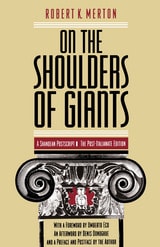
On the Shoulders of Giants
The Post-Italianate EditionRobert K. Merton
University of Chicago Press, 1993
"This book is the delightful apotheosis of donmanship: Merton parodies scholarliness while being faultlessly scholarly; he scourges pedantry while brandishing his own abstruse learning on every page. The most recondite and obscure scholarly squabbles are transmuted into the material of comedy as the ostensible subject is shouldered to one side by yet another hobby horse from Merton's densely populated stable. He has created a jeu d'esprit which is profoundly suggestive both in detail and as a whole."—Sean French, Times Literary Supplement
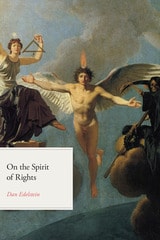
On the Spirit of Rights
Dan Edelstein
University of Chicago Press, 2018
In On the Spirit of Rights, Dan Edelstein answers this question by examining the complex genealogy of the rights that regimes enshrined in the American and French Revolutions. With a lively attention to detail, he surveys a sprawling series of debates among rulers, jurists, philosophers, political reformers, writers, and others who were all engaged in laying the groundwork for our contemporary systems of constitutional governance. Every seemingly new claim about rights turns out to be a variation on a theme, as late medieval notions were subtly repeated and refined to yield the talk of “rights” we recognize today. From the Wars of Religion to the French Declaration of the Rights of Man and of the Citizen to the 1948 Universal Declaration of Human Rights, On the Spirit of Rights is a sweeping tour through centuries of European intellectual history and an essential guide to our ways of thinking about human rights today.

On the Street of the Hidden Shops
One City Block, Two Thousand Years, and a Walk Through the Layered Lives of RomeElizabeth Rodini
University of Chicago Press, 2026
Delve into Rome’s lost history through the stories of a single city block.
Cutting through the heart of Rome is Via delle Botteghe Oscure, a time-worn street named for the mysterious “shops” said to run beneath it. History lies thick here, a museum atop a convent atop ancient ruins; layered in are traces of artisans and poets, pilgrims and saints, a Fascist deportation, a communist coffee bar, a political assassination, and shopkeepers, too. These stories all rest upon a single city block, the same place where, in 13 BCE, the triumphal Roman general Lucius Cornelius Balbus built a monumental theater complex in his own honor.
Elizabeth Rodini’s On the Street of the Hidden Shops digs deep into this corner of the city, uncovering a set of surprising, often poignant narratives that range across two thousand years. For as the walls of Balbus’s compound decayed and the neighborhood was rebuilt, this block would come to shelter Romans from all walks of life: the daughters of local prostitutes, an earnest young man in search of a bride, an entrepreneur determined to preserve the city’s colorful dialect, a Jewish family recently liberated from the nearby Ghetto, and a band of idealistic archaeologists unearthing a long-forgotten past, as well as a gifted baker, a medieval donkey, and a Renaissance ghost. Their stories survive in archives and artifacts but also in the enduring power of rumor and legend.
On the Street of the Hidden Shops invites us on a captivating journey to one place across many centuries. Its tight urban focus reveals a Rome most visitors miss, while uncovering some of the many Romes that have been largely lost to history.
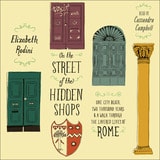
On the Street of the Hidden Shops
One City Block, Two Thousand Years, and a Walk Through the Layered Lives of RomeElizabeth Rodini
University of Chicago Press, 2026
Delve into Rome’s lost history through the stories of a single city block.
Cutting through the heart of Rome is Via delle Botteghe Oscure, a time-worn street named for the mysterious “shops” said to run beneath it. History lies thick here, a museum atop a convent atop ancient ruins; layered in are traces of artisans and poets, pilgrims and saints, a Fascist deportation, a communist coffee bar, a political assassination, and shopkeepers, too. These stories all rest upon a single city block, the same place where, in 13 BCE, the triumphal Roman general Lucius Cornelius Balbus built a monumental theater complex in his own honor.
Elizabeth Rodini’s On the Street of the Hidden Shops digs deep into this corner of the city, uncovering a set of surprising, often poignant narratives that range across two thousand years. For as the walls of Balbus’s compound decayed and the neighborhood was rebuilt, this block would come to shelter Romans from all walks of life: the daughters of local prostitutes, an earnest young man in search of a bride, an entrepreneur determined to preserve the city’s colorful dialect, a Jewish family recently liberated from the nearby Ghetto, and a band of idealistic archaeologists unearthing a long-forgotten past, as well as a gifted baker, a medieval donkey, and a Renaissance ghost. Their stories survive in archives and artifacts but also in the enduring power of rumor and legend.
On the Street of the Hidden Shops invites us on a captivating journey to one place across many centuries. Its tight urban focus reveals a Rome most visitors miss, while uncovering some of the many Romes that have been largely lost to history.
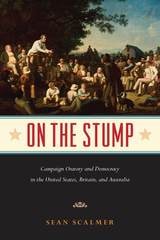
On the Stump
Campaign Oratory and Democracy in the United States, Britain, and AustraliaSean Scalmer
Temple University Press, 2017
"Stumping," or making political speeches in favor of a candidate, cause, or campaign has been around since before the 1800s, when speechmaking was frequently portrayed as delivered from the base of a tree. The practice, which has been strongly associated with the American frontier, British agitators, and colonial Australia, remains an effective component of contemporary democratic politics.
In his engaging book On the Stump, Sean Scalmer provides the first comprehensive, transnational history of the "stump speech." He traces the development and transformation of campaign oratory, as well as how national elections and public life and culture have been shaped by debate over the past century.
Scalmer presents an eloquent study of how "stumping" careers were made, sustained, remembered, and exploited, to capture the complex rhythms of political change over the years. On the Stump examines the distinctive dramatic and performative styles of celebrity orators including Davy Crockett, Henry Clay, and William Gladstone. Ultimately, Scalmer recovers the history of the stump speech and its historical significance in order to better understand how political change is forged.
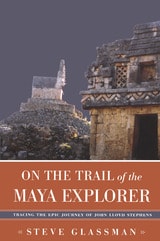
On the Trail of the Maya Explorer
Tracing the Epic Journey of John Lloyd StephensSteve Glassman
University of Alabama Press, 2003
A Mesoamerican travel book from two perspectives and two centuries.
In 1839 John Lloyd Stephens, then 31 years old, and his traveling companion, artist Frederick Catherwood, disappeared into the vast rain forest of eastern Guatemala. They had heard rumors that remains of a civilization of incomparable artistic and cultural merit were moldering in the steamy lowland jungles. They braved Indian uprisings, road agents, heat, and biting insects to eventually encounter what is today known as the lost civilization of the Maya.
In 1841 Stephens published Incidents of Travel in Central America, Chiapas, and Yucatan to instant acclaim with both American and international audiences. His conversational style was fresh and crisp and his subject matter, the search for lost cities on the Central American isthmus, was romantic and adventurous. Stephens's book has been characterized as the "great American nonfiction narrative of the 19th century." Indeed, what Stephens wrote about the Maya makes a major contribution to Maya studies.
Steve Glassman retraces Stephens's route, visiting the same archaeological sites, towns, markets, and churches and meeting along the way the descendants of those people Stephens described, from mestizo en route to the cornfields to town elders welcoming the Norte Americanos. Glassman's work interlaces discussion of the history, natural environment, and architecture of the region with descriptions of the people who live and work there. Glassman compares his 20th-century experience with Stephens's 19th-century exploration, gazing in awe at the same monumental pyramids, eating similar foods, and avoiding the political clashes that disrupt the governments and economies of the area.
Stephens's books are still widely available, but his importance to literary professionals has been overlooked. With this new travelogue, Glassman reaffirms Stephens's reputation and brings his work to wider critical and public attention.
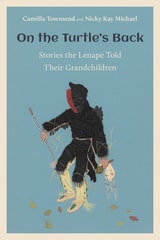
On the Turtle's Back
Stories the Lenape Told Their GrandchildrenCamilla Townsend
Rutgers University Press, 2023
The Lenape tribe, also known as the Delaware Nation, lived for centuries on the land that English colonists later called New Jersey. But once America gained its independence, they were forced to move further west: to Indiana, then Missouri, and finally to the territory that became Oklahoma. These reluctant migrants were not able to carry much from their ancestral homeland, but they managed to preserve the stories that had been passed down for generations.
On the Turtle’s Back is the first collection of Lenape folklore, originally compiled by anthropologist M. R. Harrington over a century ago but never published until now. In it, the Delaware share their cherished tales about the world’s creation, epic heroes, and ordinary human foibles. It features stories told to Harrington by two Lenape couples, Julius and Minnie Fouts and Charles and Susan Elkhair, who sought to officially record their legends before their language and cultural traditions died out. More recent interviews with Lenape elders are also included, as their reflections on hearing these stories as children speak to the status of the tribe and its culture today. Together, they welcome you into their rich and wondrous imaginative world.
On the Verge of Convergence
Social Stratification in Eastern EuropeHenryk Domanski
Central European University Press, 2000
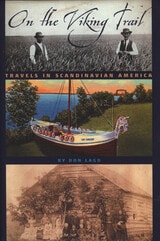
On the Viking Trail
Travels in Scandinavian AmericaDon Lago
University of Iowa Press, 2004
When his father developed Alzheimer’s disease, Don Lago realized that the stories and traditions of his Swedish ancestors would be lost along with the rest of his father’s memories. Haunted by this inevitable tragedy, Lago set out to fight back against forgetting by researching and reclaiming his long-lost Scandinavian roots.
Beginning his quest with a visit to his ancestral home of Gränna, Sweden, Lago explores all facets of Scandinavian America—Swedish, Danish, Finnish, Norwegian, and Icelandic—along the way. He encounters Icelanders living in the Utah desert, a Titanic victim buried beneath a gigantic Swedish coffee pot in Iowa, an Arkansas town named after the famous Swedish opera singer Jenny Lind, a real-life Legoland in southern California, and other unique remnants of America’s Scandinavian past. Visits to Sigurd Olson’s legendary cabin on the banks of Burntside Lake in the Boundary Waters of Minnesota and Carl Sandburg’s birthplace in Galesburg, Illinois, further provide Lago with an acute sense of the Scandinavian values that so greatly influenced, and continue to influence, American society.
More than just a travel memoir, On the Viking Trail places Scandinavian immigrants and their history within the wider sweep of American culture. Lago’s perceptive eye and amusing tales remind readers of all ethnic backgrounds that to truly appreciate America one must never forget its immigrant past.
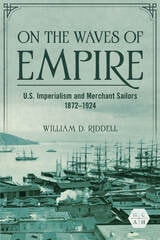
On the Waves of Empire
U.S. Imperialism and Merchant Sailors, 1872-1924William D. Riddell
University of Illinois Press, 2023
Sophisticated and innovative, On the Waves of Empire reveals how maritime labor and shipping capital stitched together, tore apart, and re-stitched the seams of empire.
On the Way to Heidegger’s Contributions to Philosophy
Parvis Emad
University of Wisconsin Press, 2007
On the Way to Theory
Lawrence Grossberg
Duke University Press, 2024
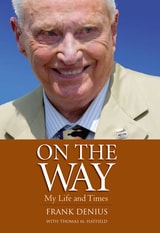
On the Way
My Life and TimesBy Frank Denius
University of Texas Press, 2016
Frank Denius was not yet twenty-one when he fought his way across Europe and was awarded four Silver Stars, a Presidential Unit Citation, and two Purple Hearts. On the Way describes Denius’s formative experiences during World War II in gripping detail and will cause any reader to wonder how he or she might have held up under similar pressure. The powerful opening chapters are followed by a detailed account of Denius’s life and career after the war, assembled into a first-person memoir from conversations between Denius and Thomas Hatfield, and published by the Briscoe Center for American History at the University of Texas at Austin.
Discharged from the army in October 1945, Denius enrolled at the University of Texas within a week. He is a lifelong supporter of the university: as part of the Texas Exes, as a donor to numerous academic programs, and as a fan of Longhorn football. Former UT football coach Mack Brown liked to say, “Frank has been to more practices than I have.”
Denius graduated from the University of Texas School of Law and joined one of Austin’s leading law firms in the late 1940s. Denius recounts how Texas operated in Lyndon Johnson’s prime, observes power plays in the Texas energy industry, and describes his role in building a regional university into a global leader.
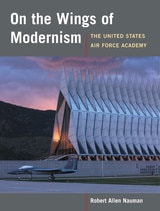
On the Wings of Modernism
The United States Air Force AcademyRobert Allen Nauman
University of Illinois Press, 2003
The United States Air Force Academy stands as one of the most extensive architectural projects of the cold war era. Key to a full understanding of American modernism, the project was also a volatile battleground involving competing ideas about aesthetics and politics. Arguing that the academy's production was squarely grounded in bureaucratic and political processes, Robert Allen Nauman demonstrates that selection of both the site and the design firm was the result of political maneuverings involving U.S. military leadership.
In the academy’s iconic design, myths and metaphors of flight and the American West were interwoven with those of modernism, both to justify the plan and to free it from any lingering socialist or European associations. Skidmore, Owings, and Merrill’s first public exhibition of plans and models for the project was designed by the former Bauhaus master Herbert Bayer, and it incorporated photographs of the Colorado Springs site by Ansel Adams and William Garnett. Using previously unexplored resources of the U.S. Air Force Academy, SOM, and the Air Force Academy Construction Agency, Nauman uncovered materials such as negatives of Adams’s original photographs of the sites. He also conducted extensive interviews with SOM’s project director for the academy, Walter Netsch, in tracing the complete history of the academy's construction, from its earliest conception to eventual completion.