Results by title
18284 books match the query 'United States' and 384 start with o
Organizing Locally
How the New Decentralists Improve Education, Health Care, and TradeBruce Fuller
University of Chicago Press, 2015
Fuller first untangles the economic and cultural currents that have eroded the efficacy of—and our trust in—large institutions over the past half century. From there we meet intrepid leaders who have been doing things differently. Traveling from a charter school in San Francisco to a veterans service network in Iowa, from a Pennsylvania health-care firm to the Manhattan branch of a Swedish bank, he explores how creative managers have turned local staff loose to craft inventive practices, untethered from central rules and plain-vanilla routines. By holding their successes and failures up to the same analytical light, he vividly reveals the key cornerstones of social organization on which motivating and effective decentralization depends. Ultimately, he brings order and evidence to the often strident debates about who has the power—and on what scale—to structure how we work and live locally.
Written for managers, policy makers, and reform activists, Organizing Locally details the profound decentering of work and life inside firms, unfolding across postindustrial societies. Its fresh theoretical framework explains resurging faith in decentralized organizations and the ingredients that deliver vibrant meaning and efficacy for residents inside. Ultimately, it is a synthesizing study, a courageous and radical new way of conceiving of American vitality, creativity, and ambition.
Organizing Professionals
Academic Employees Negotiating a New AcademyGary Rhoades
Rutgers University Press, 2025
Organizing Women
Home, Work, and the Institutional Infrastructure of Print in Twentieth-Century AmericaChristine Pawley
University of Massachusetts Press, 2022
In the first decades of the twentieth century, print-centered organizations spread rapidly across the United States, providing more women than ever before with opportunities to participate in public life. While most organizations at the time were run by and for white men, women—both Black and white—were able to reshape their lives and their social worlds through their participation in these institutions.
Organizing Women traces the histories of middle-class women—rural and urban, white and Black, married and unmarried—who used public and private institutions of print to tell their stories, expand their horizons, and further their ambitions. Drawing from a diverse range of examples, Christine Pawley introduces readers to women who ran branch libraries and library schools in Chicago and Madison, built radio empires from their midwestern farms, formed reading clubs, and published newsletters. In the process, we learn about the organizations themselves, from libraries and universities to the USDA extension service and the YWCA, and the ways in which women confronted gender discrimination and racial segregation in the course of their work.
Organizing Workers in the Shadow of Slavery
Global Inequality, Racial Boundaries, and the Rise of Unions in American and British Capitalism, 1870–1929Rudi Batzell
University of Chicago Press, 2025
During the rise of the labor movement in the late nineteenth century, why were American workers unable to organize inclusive trade unions like those formed by their counterparts in the United Kingdom? Comparing American and British capitalism in the port cities of Baltimore and Liverpool and the steel cities of Pittsburgh and Sheffield, Rudi Batzell reveals that the answer lies in the legacies of slavery and entrenched structures of racial inequality. Strikebreaking succeeded more often in the United States because landless Black Americans were, out of economic desperation, more likely to become scabs and fracture the class solidarity of any union movement. Batzell shows, in short, how racism was and is deeply connected to class, migration, and capitalism in a global economy marked by slavery and empire. In emphasizing the geography of economic inequality, this book offers new clarity on the late-nineteenth-century successes and failures of working-class formation. More broadly, Organizing Workers in the Shadow of Slavery makes it clear that the pursuit of justice today will require sustained economic reparations for slavery and colonialism.

Organizing for Equality
The Evolution of Women's and Racial-Ethnic Organizations in America, 1955-1985Minkoff, Debra C
Rutgers University Press, 1995
Women and racial-ethnic minorities have had long histories of mobilizing for equality in U.S. society, but recent decades have witnessed an unprecedented expansion in the number and visibility of voluntary and activist organizations committed to challenging gender and racial-ethnic discrimination. What conditions have encouraged this growth? Going beyond more familiar accounts of social movement development, Debra Minkoff uses multivariate techniques to demonstrate that there is an ecology of organizational evolution that has shaped the formation and survival of national women's, African-American, Asian American, and Latino social and political organizations. Changes in the environment for action during the 1960s promoted the creation of a niche for women's and minority organizational activity, and this sector continued to expand even as the climate for social action became increasingly conservative during the 1970s and 1980s. Drawing on recent advances in both social movement and organizational theory and research, Minkoff offers an organizational analysis of the evolution of the women's and racial-ethnic social change sector since the mid-1950s. She provides an original synthesis of social movement and organizational theory, and unique analysis of the development of these women's and minority organizations from the civil rights era to the present.
Organizing for Foreign Policy Crises
Presidents, Advisers, and the Management of Decision MakingPatrick J. Haney
University of Michigan Press, 2002
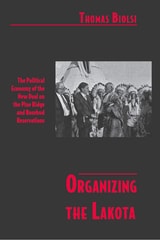
Organizing the Lakota
The Political Economy of the New Deal on the Pine Ridge and Rosebud ReservationsThomas Biolsi
University of Arizona Press, 1992
Biolsi pays particular attention to the administrative means by which the OIA retained the power to design and implement tribal "self-government" as well as the power to control the flow of critical resources—rations, relief employment, credit—to the reservations. He also shows how this imbalance of power between the tribes and the federal bureaucracy influenced politics on the reservations, and argues that the crisis of authority faced by the Lakota tribal governments among their own would-be constituents—most dramatically demonstrated by the 1973 Wounded Knee occupation—is a direct result of their disempowerment by the United States.
Orgies of Feeling
Melodrama and the Politics of FreedomElisabeth R. Anker
Duke University Press, 2014
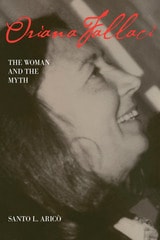
Oriana Fallaci
The Woman and the MythSanto L. Aricò
Southern Illinois University Press, 1998
Internationally acclaimed as a journalist, war correspondent, interviewer, and novelist, Oriana Fallaci’s public persona reached almost mythic proportions. It is a myth Fallaci herself created, according to Santo L. Aricò, who probes the psychological forces that motivated one of the twentieth century’s most famous and successful women writers.
Using his own extensive interviews with the writer, Aricò maps out Fallaci’s journey through life, paying particular attention to her ongoing and painstaking attempts to establish her own mythical status. He first examines her career as a literary journalist, emphasizing the high quality of her writing. From there, he concentrates on how Fallaci’s personal image began to emerge in her writings, as well as the way in which, through her powerful narratives, she catapulted herself into the public eye as her own main character.
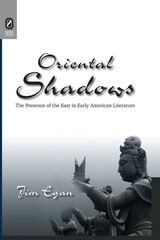
Oriental Shadows
The Presence of the East in Early American LiteratureJim Egan
The Ohio State University Press, 2011
Through the use of several iconic early American authors (Anne Bradstreet, James Kirkpatrick, Benjamin Franklin, and Edgar Allan Poe), Jim Egan’s Oriental Shadows: The Presence of the East in Early American Literature explores the presence of “the East” in American writing.
In bringing to light this largely overlooked archive of images within the American literary canon, Oriental Shadows suggests that the East played a key role in the emergence of a distinctively American literary tradition and, further, that early American identity was born as much from figures of the East as it was from the colonists’ encounters with the frontier.
Orientalism and Modernism
The Legacy of China in Pound and WilliamsZhaoming Qian
Duke University Press, 1995
Consulting rare and unpublished materials, Qian traces Pound’s and Williams’s remarkable dialogues with the great Chinese poets—Qu Yuan, Li Bo, Wang Wei, and Bo Juyi—between 1913 and 1923. His investigation reveals that these exchanges contributed more than topical and thematic ideas to the Americans’ work and suggests that their progressively modernist style is directly linked to a steadily growing contact and affinity for similar Chinese styles. He demonstrates, for example, how such influences as the ethics of pictorial representation, the style of ellipsis, allusion, and juxtaposition, and the Taoist/Zen–Buddhist notion of nonbeing/being made their way into Pound’s pre-Fenollosan Chinese adaptations, Cathay, Lustra, and the Early Cantos, as well as Williams’s Sour Grapes and Spring and All. Developing a new interpretation of important work by Pound and Williams, Orientalism and Modernism fills a significant gap in accounts of American Modernism, which can be seen here for the first time in its truly multicultural character.
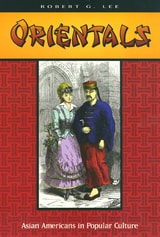
Orientals
Robert Lee
Temple University Press, 1999
The idea of Asians as mysterious strangers who could not be assimilated into the cultural mainstream was percolating to the surface of American popular culture in the mid-nineteenth century, when Chinese immigrant laborers began to arrive in this country in large numbers. Lee shows how the bewildering array of racialized images first proffered by music hall songsters and social commentators have evolved and become generalized to all Asian Americans, coalescing in particular stereotypes. Whether represented as Pollutant, Coolie, Deviant, Yellow Peril, Model Minority, or Gook, the Oriental is portrayed as alien and a threat to the American family -- the nation writ small.
Refusing to balance positive and negative stereotypes, Lee connects these stereotypes to particular historical moments, each marked by shifting class relations and cultural crises. Seen as products of history and racial politics, the images that have prevailed in songs, fiction, films, and nonfiction polemics are contradictory and complex. Lee probes into clashing images of Asians as (for instance) seductively exotic or devious despoilers of (white) racial purity, admirably industrious or an insidious threat to native laborers. When Lee dissects the ridiculous, villainous, or pathetic characters that amused or alarmed the American public, he finds nothing generated by the real Asian American experience; whether they come from the Gold Rush camps or Hollywood films or the cover of Newsweek, these inhuman images are manufactured to play out America's racial myths.
Orientals comes to grips with the ways that racial stereotypes come into being and serve the purposes of the dominant culture.
Orientations
Mapping Studies in the Asian DiasporaKandice Chuh and Karen Shimakawa, eds.
Duke University Press, 2001
With its recurrent themes of transnationalism, globalization, and postcoloniality, Orientations considers various embodiments of the Asian diaspora, including a rumination on minority discourses and performance studies, and a historical look at the journal Amerasia. Exploring the translation of knowledge from one community to another, other contributions consider such issues as Filipino immigrants’ strategies for enacting Asian American subjectivity and the link between area studies and the journal Subaltern Studies. In a section that focuses on how disciplines—or borders—form, one essay discusses “orientalist melancholy,” while another focuses on the construction of the Asian American persona during the Cold War. Other topics in the volume include the role Asian immigrants play in U.S. racial politics, Japanese American identity in postwar Japan, Asian American theater, and the effects of Asian and Asian American studies on constructions of American identity.
Contributors. Dipesh Chakrabarty, Kuan-Hsing Chen, Rey Chow, Kandice Chuh, Sharon Hom, Yoshikuni Igarashi, Dorinne Kondo, Russell Leong, George Lipsitz, Lisa Lowe, Martin F. Manalansan IV, David Palumbo-Liu, R. Radhakrishnan, Karen Shimakawa, Sau-ling C. Wong
Original Copy
Ekphrasis, Gender, and the National Imagination in Nineteenth-Century American LiteratureChrista Holm Vogelius
University of Massachusetts Press, 2025
When critics of poet Phillis Wheatley, the first African American to publish a collection of poetry, dismiss her work as derivative, they fail to see her writing as part of a new creative pantheon, sitting alongside other works that, like the popular copybooks in antebellum America, are structured as a conversation between artistic allies. Different kinds of copying in this period were distinctly feminized practices, such as artistic copying, pedagogical recitation, and literary imitation. Ekphrasis, the literary description of a work of visual art, reveals a particularly interesting form of copying, as the artwork in question becomes a kind of mediated space between author and reader; this practice, then, becomes the emblematic form of literature as collective production.
Original Copy frames ekphrasis and other forms of literary and visual copy-work as key concepts for understanding the discussions of nationalism, originality, and gender that dominated US literary circles during the first half of the nineteenth century. Christa Holm Vogelius focuses on four major writers of the period—Phillis Wheatley, Margaret Fuller, Sophia Hawthorne, and Henry Longfellow—to offer a narrative of a self-consciously feminine antebellum literary culture that was equally invested in literary nationality and convention. The explicitly feminized forms of the copy between and within media, she argues, became a productive means by which writers across a variety of genres interrogated the ill-defined but ubiquitous idea of an “original” American literature. Original Copy bridges three bodies of scholarship that have remained largely distinct—studies of literary nationalism and transnationalism, scholarship on gender in nineteenth century literary culture, and aesthetic and media theory—to argue for the significance of both imitation and intimate author-reader relations to the development of an American literature.
Origins and Destinations
The Making of the Second GenerationRenee Luthra
Russell Sage Foundation, 2018
Using surveys of second generation immigrant adults in New York and Los Angeles, Origins and Destinations explains why second generation experiences differ across national origin groups and why immigrant offspring with the same national background often follow different trajectories. Inter-group disparities stem from contexts of both emigration and immigration. Origin countries differ in value orientations: immigrant parents transmit lessons learned in varying contexts of emigration to children raised in the U.S. A system of migration control sifts immigrants by legal status, generating a context of immigration that favors some groups over others. Both contexts matter: schooling is higher among immigrant children from more secular societies (South Korea) than among those from more religious countries (the Philippines). When immigrant groups enter the U.S. migration system through a welcoming door, as opposed to one that makes authorized status difficult to achieve, education propels immigrant children to better jobs.
Diversity is also evident among immigrant offspring whose parents stem from the same place. Immigrant children grow up with homeland connections, which can both hurt and harm: immigrant offspring get less schooling when a parent lives abroad, but more schooling if parents in the U.S. send money to relatives living abroad. Though all immigrants enter the U.S. as non-citizens, some instantly enjoy legal status, while others spend years in the shadows. Children born abroad, but raised in the U.S. are all everyday Americans, but only some have become de jure Americans, a difference yielding across-the-board positive effects, even among those who started out in the same country.
Disentangling the sources of diversity among today’s population of immigrant offspring, Origins and Destinations provides a compelling new framework for understanding the second generation that is transforming America.

Origins of the National Forests
Harold K. Steen, ed.
Duke University Press, 1992
The national forests are a major source of wood, water, minerals, forage, animal life and habitat, and wilderness. Yet questions of who controls and who benefits from the resources have posed problems and conflicts from the origins of the Forest Service to the present. Based on a 1991 Forest History Society conference, the essays collected here discuss a range of important topics surrounding our national forests, including the relationship between the federal and state systems that regulate the forests; the privately owned lands within the forests that are governed by federal statutes, state laws, and county ordinances; the ill-defined rights of those who lived on the land long before it was a national forest and were forced off the land; and the effect of early policymaking decisions made within the framework of the emerging Conservation Movement.
Contributors. Ron Arnold, Pamela A. Conners, Mary S. Culpin, Stanley Dempsey, Peter Gillis, Donn E. Headley, Robert L. Hendricks, Stephen Larrabee, Patricia Nelson Limerick, Dennis L. Lynch, Michael McCarthy, Char Miller, Joseph A. Miller, James Muhn, Kevin Palmer, Donald Pisani, John F. Reiger, William Rowley, Michael Ryan, William E. Shands, Harold K. Steen, Richard White, Gerald W. Williams
Origins of the TVA
The Muscle Shoals Controversy, 1920-1932Preston J. Hubbard
University of Alabama Press, 1961
How a North Alabama river fueled a national showdown over power, democracy, and the New Deal
Origins of the TVA: The Muscle Shoals Controversy, 1920–1932 is the definitive history of the bitter, decade-long struggle that gave rise to the Tennessee Valley Authority, one of the most consequential experiments in American public policy. Centered on Muscle Shoals, Alabama, this book traces how wartime investments in nitrates and hydropower became the focal point for national debates over public versus private power, regional planning, agricultural reform, and the proper role of the federal government.
In an era grappling with industrial transformation and sectional inequality, the story of Muscle Shoals illuminates why the TVA emerged as a landmark solution with global influence. Drawing on an extraordinary range of sources—more than twenty-five congressional hearings, the Congressional Record, private manuscripts, National Archives collections, and contemporary journalism—historian Preston J. Hubbard delivers a model of scholarly rigor and balance. Originally published in 1961 and still unmatched in scope, the book is widely praised for its restraint, clarity, and meticulous reconstruction of complex political, economic, and technological issues.
Hubbard demonstrates how a small group of lawmakers led by Senator George W. Norris ultimately shaped a durable vision of public power and regional development. This book will reward historians, political scientists, policy professionals, and students of Southern history, as well as readers interested in the origins of the New Deal, environmental policy, and the enduring debate over public resources and private enterprise.
Origins of the War with Mexico
The Polk-Stockton IntrigueBy Glenn W. Price
University of Texas Press, 1967
In the spring of 1846 James K. Polk announced that the Mexican Army had invaded United States territory and had “shed American blood upon the American soil.” This political rhetoric, as Glenn W. Price establishes in Origins of the War with Mexico: The Polk-Stockton Intrigue, is part of the myth of American innocence. It represents the “internal contradiction between professed values and patterns of action,” perpetuated by American historical writing that emphasizes national consequences of the acquisition of foreign territory and minimizes both its international significance and the importance of the diplomatic and military methods used.
A conflict with Mexico, leading to territorial expansion of the United States, was not unwanted. California was Polk’s prime objective from the beginning of his administration, and this Mexican province was to be acquired by conquest in a war initiated on the Texas-Mexican border. To this end Polk sent several agents to Texas, but the man at the center of the war intrigue was Commodore Robert F. Stockton, independently wealthy, prominent in politics, and the head of great business enterprises.
Sufficient evidence exists to substantiate in every important particular the steps in Polk’s path of intrigue: his attempts to bribe Mexican officials; his efforts to encourage revolutionary forces in the Mexican provinces; his use of the threat of force to frighten Mexico into selling California; his attempt to initiate a war by proxy through the government of Texas and Anson Jones.
If Polk was unwilling to assume responsibility for aggressive war, Stockton was not; he arrived in Galveston with a squadron of naval vessels in May of 1845, prepared to finance an army of three thousand men from his personal funds to avoid the overt involvement of the government of the United States. But, says Price, for all the internationally dangerous implications of such a maneuver, the two men who played the chief roles in the war intrigue of 1845 are representative in their written and spoken expression of faith in American righteousness of action and in the American tradition of the divine mission.
Based on extensive research into the written and spoken words of the people who were involved, directly and indirectly, in the events, this analysis (which will be considered revisionist) of the origins of the War with Mexico is the result of the kind of objective approach to national history for which the author makes a plea in his preface and conclusion and in his interpretive comments throughout the work. The historian, Price believes, “has the extraordinary advantage of being able to examine mankind from that distance and elevation and detachment which so often reveals, as it is designed to reveal, the gulf between pretension and performance.”
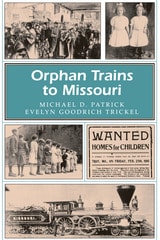
Orphan Trains to Missouri
Michael D. Patrick & Evelyn Goodrich Trickel
University of Missouri Press, 1997
As an "orphan train" crossed the country, it left part of its cargo at each stop, a few children in one small town and a few in another. Even though farmers needed many hands for labor, most of the small farm communities could not or would not take all of the children on the train. As the train moved to its next stop, those children not taken feared no one would ever want them.
Early immigration laws encouraged the poor of Europe to find new hope with new lives in the United States. But sometimes the immigrants exchanged a bad situation in their native country for an even worse one on the streets of New York and other industrial cities. As a result, the streets were filled with crowds of abandoned children that the police called "street arabs." Many New York citizens blamed the street arabs for crime and violence in the city and wanted them placed in orphan homes or prisons.
In 1853 a man by the name of Charles Loring Brace, along with other well-to-do men in New York City, founded the Children's Aid Society. The society planned to give food, lodging, and clothing to homeless children and provide educational and trade opportunities for them. But the number of children needing help was so large that the Children's Aid Society was unable to care for them, and Brace developed a plan to send many of the children to the rural Midwest by train. He was convinced that the children of the streets would find many benefits in rural America. In 1854 he persuaded the board of the society to send the first trainload of orphans west. With this, the orphan trains were born.
Cheap fares, the central location of the state, and numerous small farming towns along the railroad tracks made Missouri the perfect hub for the orphan trains, even though many areas of the state were still largely unsettled. Researchers have estimated that from 150,000 to 400,000 children were sent out on orphan trains, with perhaps as many as 100,000 being placed in Missouri.
Orphan Trains to Missouri documents the history of the children on those Orphan Trains--their struggles, their successes, and their failures. Touching stories of volunteers who oversaw the placement of the orphans as well as stories of the orphans themselves make this a rich record of American and midwestern history.
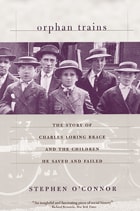
Orphan Trains
The Story of Charles Loring Brace and the Children He Saved and FailedStephen O'Connor
University of Chicago Press, 2004
A powerful blend of history, biography, and adventure, Orphans Trains remains the definitive work on this little-known episode in American history.

Orphan/Agent
A Korean Adoptee Life in Cold War AmericaElizabeth Lawrence
Lever Press, 2027
Roger Paul Clow, an orphaned refugee of the Korean War, was sent to America as a child in 1953. Seventy years later, his historian daughter grapples with the meaning of her father’s life while grieving his death.
Orphan/Agent is a personal narrative that doubles as an accessible introduction to key issues in transpacific history and Asian American studies. As the book follows Roger from a childhood in wartime Korea, to student years in the continental US, to a career in Hawai‘i, it reckons with the lasting consequences of war and challenges mythic narratives of the American Dream, the model minority, and American exceptionalism.
Blending family stories and historical analysis, Orphan/Agent models historical thinking for students. Readers may well be inspired to revisit their own family stories, with new questions, respect for their sources, and love.
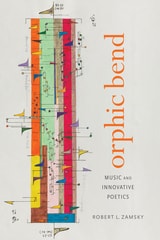
Orphic Bend
Music and Innovative PoeticsRobert L. Zamsky
University of Alabama Press, 2021
WINNER OF THE ELIZABETH AGEE PRIZE IN AMERICAN LITERATURE
Exploring how music reshapes the possibilities of poetry.
Orphic Bend: Music and Innovative Poetics explores the impact of music on recent pioneering literary practices in the United States. Adopting the myth of Orpheus as its framework, Robert L. Zamsky argues that works by Charles Bernstein, Robert Creeley, John Taggart, Tracie Morris, and Nathaniel Mackey restage ancient debates over the relationship between poetry and music even as they develop work that often sharply diverges from traditional literary forms. Opening each chapter with a consideration of the orphic roots of lyric, Zamsky integrates contemporary debates over the prospects and limitations of humanism, the meaningfulness of gesture and performance, and the nature of knowledge with the poetics of the writers under consideration, grounding his analysis in close readings of their work.
The myth of Orpheus is used as a lens throughout the book, its different facets illuminating sometimes dramatically different aspects of the shared framework of poetry and music. In the case of Bernstein, for instance, Zamsky highlights Ezra Pound’s meditations on the relationship between poetry and music (the ground upon which Pound seeks to recapture the lost possibilities of the Renaissance) and Bernstein’s incisive critique of Pound. For her part, Morris emphasizes the performative power of spoken language, foregrounding the fact that all spoken language bears cultural, communal, and personal marks of the speaker, improving an ensemble self even within the most elemental features of language. Meanwhile, in Mackey’s work, the orphic voice of the poet powerfully reaches toward an order of knowledge in which poetry and music are nearly indecipherable from one another. In this sense, music and the musicality of poetic language are the gateways for Mackey’s Gnosticism, the mechanisms of initiation into a realm, not of secrets to be learned, but of visionary knowing that continuously unfolds.
The text explores a range of musical influences on the writers under consideration, from opera to different iterations of jazz, and underscores the variety of ways in which music informs their work. Many of these writers effectively present a theory of music in their invocations of it as an inspiration for, or as an analog to, poetic practice. Zamsky’s focus on poetry and music echoes important interdisciplinary studies on literary modernism, a period for which the importance of music to literary practice is well established and extends that discussion to the contemporary context. In doing so, Orphic Bend provides an important opportunity to consider both the specific legacy of modernism, and to situate contemporary writers in broader historical contexts.
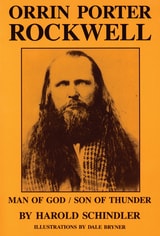
Orrin Porter Rockwell
Man of God Son of ThunderHarold Schindler
University of Utah Press, 1983
The legend of the Destroying Angel of Mormondom was well established by the time of his death, of natural causes, in 1878. Travelers sang ballads about him as they gathered around their campfires at night. Mothers used his name to frighten children into obedience. He was accused of literally hundreds of murders, all in the name of the Mormon Church.
Yet behind all the myth was a man, a human being. Orrin Porter Rockwell believed in his prophet, Joseph Smith. He spent most of a year chained in an Independence dungeon for his belief, then walked across Missouri to Nauvoo, stumbling into Joseph’s house on Christmas Day. Joseph said to him then, “Cut not thy hair and no bullet or blade can harm thee,” and the legend was born.
Rockwell continued to serve the leaders of his church—as hunter, guide, messenger, scout, guerilla, emissary to the Indians, and lawman. He traveled thousands of miles, raised three families, accumulated land and wealth—and favorably impressed almost everyone who met him. But although he walked with presidents and generals, scholars and scoundrels, in a life lived at the center of many of the great events of the American frontier, he has remained an enigma, a source of continuing controversy.
Harold Schindler’s remarkable investigative skills led him into literally thousands of unlikely places in his search for the truth about Rockwell. Dale L. Morgan, one of the west’s foremost historians, called the first edition “…an impressive job of research, one of the most impressive in recent memory, in the Mormon field. Mr. Schindler has shown great energy and sagacity in dealing with a difficult, highly controversial subject; and he has also made maximum use of the latest scholarship and newly available archival resources.”
But the author was not satisfied until he had probed even more deeply, and this revised and enlarged second edition contains greatly expanded documentation as well as textual additions that flesh out the characters and events of this classic drama of early America.
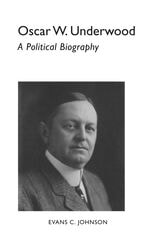
Oscar W. Underwood
A Political BiographyEvans C. Johnson
University of Alabama Press, 2006
Although Oscar W. Underwood was considered a titan of his age, few American political figures have suffered such neglect as he. Except for his candidacy for the Democratic nomination in 1924, his political career is largely forgotten even in Alabama. The one place in which Underwood is well remembered is in the folklore of Congress, where he is widely regarded as a great party leader who had mastered the rules perhaps as thoroughly as any member of Congress. This mastery, together with steady work, personal magnetism, and a willingness to compromise, made him effective as chairman of the Ways and Means Committee in formulating a majority program after the Democrats seized control of the House in 1910. Pat Harrison, Underwood's lieutenant as minority leader, referred to Underwood as the "greatest natural parliamentarian, the greatest leader of a law-making body that I ever saw."
--from the Preface to Oscar W. Underwood: A Political Biography
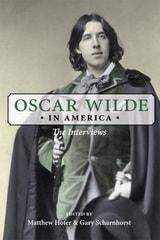
Oscar Wilde in America
The InterviewsEdited by Matthew Hofer and Gary Scharnhorst
University of Illinois Press, 2013
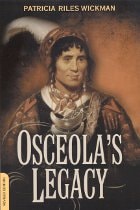
Osceola's Legacy
Patricia Riles Wickman
University of Alabama Press, 2006
A bestselling, re-evaluation of a major Native American resistance leader. Named an Outstanding Book by the Gustavus Myers Center for the Study of Human Rights.
Born in Alabama to a Muscogee/Creek Indian mother and an English father, Osceola, born Billy Powell, came to prominence in the 1830s for resisting the U. S. government's sweep into Florida. He protested the government's Florida Indian removal, killed a pro-emigration Indian leader and then made war on the US government.
Osceola's Legacy draws on a wealth of sources, including letters, diaries, and artifacts to bring this fascinating figure and the central role he played in the Second Seminole War into vivid focus. Of particular interest is a chapter on the forensic report on Osceola's grave as well as descriptions and the illustrations of his personal property at the time of his death.
Osceola's Legacy is significant for its genealogy and archaeological study of this Native American and his interaction with the federal government during the 1800s. The catalog of photographs of Osceola portraits and his personal possessions makes this a worthwhile reference book as well.
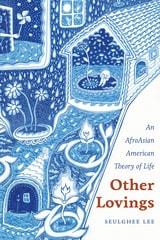
Other Lovings
An AfroAsian American Theory of LifeSeulghee Lee
The Ohio State University Press, 2025
In Other Lovings, Seulghee Lee traces the presence and plenitude of love embedded in Black and Asian American literatures and cultures to reveal their irreducible power to cohere minoritarian social life. Bringing together Black studies, Asian American studies, affect theory, critical theory, and queer of color critique, Lee examines the bonds of love in works by Amiri Baraka, Audre Lorde, David Henry Hwang, Gayl Jones, Fred Moten, Adrian Tomine, and Charles Yu. He attends to the ontological force of love in popular culture, investigating Asian American hip-hop and sport through readings of G Yamazawa, Year of the Ox, and Jeremy Lin, as well as in Black public culture through bell hooks, Martin Luther King Jr., and Cornel West.
By assessing love’s positive function in these works, Lee argues against critical regimes, such as Afropessimism and racial melancholia, that center negativity. In revealing what Black and Asian American traditions share in their positive configurations of being and collectivity, and in their responses to the overarching logic of white supremacy, Other Lovings suggests possibilities for thinking beyond sociological opposition and historical difference and toward political coalition and cultural affinity. Ultimately, Other Lovings argues for a counter-ontology of love—its felt presence, its relational possibilities, and its lived practices.
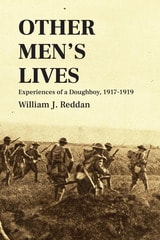
Other Men's Lives
Experiences of a Doughboy, 1917–1919William J. Reddan
Westholme Publishing, 2017
“Who can explain the feelings or thoughts of a soldier during the last few minutes before a battle? He fixes his bayonet, sees that his rifle is working properly, loads it, turns the safety lock, doing a dozen things, automatically from force of training. Just a faint trace of nervousness. . . . A few of us were thinking of a wife and children hoping if it was our turn to ‘Go West,’ that the folks back home would not feel too badly.”—from Other Men’s Lives
Receiving orders in March 1917 to report for active service in the European war, Capt. William J. Reddan and his New Jersey National Guard unit joined the 29th Infantry Division of the U.S. Army. Following training for “Over There,” which included maneuvering under live machine gun and grenade fire and constant bayonet drills, Reddan assumed command of Company B, 114th Infantry—two hundred officers and men. Arriving in France in June 1918, Reddan and his company entered the frontline trenches along the Alsace front in August. Fighting side by side with the French, the 114th conducted patrols in “no man’s land,” repulsed attacks, and endured artillery and chemical barrages. Toward the end of September, the regiment was moved by truck to a new sector: the Argonne Forest. Here, Reddan and his company would be part of the Meuse-Argonne offensive, the largest in the history of the U.S. Army. This final Allied assault would last until the Armistice, November 11, 1918, and claim the most American lives of the war. On October 12, Reddan and the rest of the 114th Infantry were ordered to take a German position that was supposed to offer little resistance; instead, Reddan watched in horror as his company was destroyed: of his two hundred officers and men, only thirteen survived the ordeal. Wounded by both shrapnel and gas, Reddan was evacuated to a field hospital and did not return to his unit until after peace was declared.
Written in 1936, Other Men’s Lives: Experiences of a Doughboy, 1917–1919 recounts the complete story of Reddan’s company in the World War, including the true story of what happened in that tragic October battle as well as the political aftermath that sought to exonerate the upper command who had bungled the operation.
Other People's Colleges
The Origins of American Higher Education ReformEthan W. Ris
University of Chicago Press, 2022
For well over one hundred years, people have been attempting to make American colleges and universities more efficient and more accountable. Indeed, Ethan Ris argues in Other People’s Colleges, the reform impulse is baked into American higher education, the result of generations of elite reformers who have called for sweeping changes in the sector and raised existential questions about its sustainability. When that reform is beneficial, offering major rewards for minor changes, colleges and universities know how to assimilate it. When it is hostile, attacking autonomy or values, they know how to resist it. The result is a sector that has learned to accept top-down reform as part of its existence.
In the early twentieth century, the “academic engineers,” a cadre of elite, external reformers from foundations, businesses, and government, worked to reshape and reorganize the vast base of the higher education pyramid. Their reform efforts were largely directed at the lower tiers of higher education, but those efforts fell short, despite the wealth and power of their backers, leaving a legacy of successful resistance that affects every college and university in the United States. Today, another coalition of business leaders, philanthropists, and politicians is again demanding efficiency, accountability, and utility from American higher education. But, as Ris argues, top-down design is not destiny. Drawing on extensive and original archival research, Other People’s Colleges offers an account of higher education that sheds light on today’s reform agenda.

Other Sisterhoods
LITERARY THEORY AND U.S. WOMEN OF COLOREdited by Sandra Kumamoto Stanley
University of Illinois Press, 1998
The fifteen contributors to Other Sisterhoods: Literary Theory and
U.S. Women of Color examine the ways that women writers of color have
contributed to the discourse of literary and cultural theory. They focus
on the impact of key issues, such as social construction and identity
politics, on the works of women writers of color, as well as on the ways
these women deal with differences relating to gender, class, race/ethnicity,
and sexuality. The book also explores the ways women writers of color
have created their own ethnopoetics within the arena of literary and cultural
theory, helping to redefine the nature of theory itself.
"A sophisticated resource that will do much to carry us through
to the next century. Great work!" -- Alvina E. Quintana, author of
Home Girls: Chicana Literary Voices
CONTRIBUTORS:Sandra Kumamoto Stanley, AnaLouise Keating, Dionne
Espinoza, Kimberly N. Brown, Marilyn Edelstein, Tomo Hattori, Robin Riley
Fast, King-Kok Cheung, Timothy Libretti, Renae Moore Bredin, Jennifer
Browdy de Hernandez, Kimberly M. Blaeser, Kathryn Bond Stockton, Eun Kyung
Min, Cecilia Rodriguez Milanes
Others Had It Worse
Sour Dock, Moonshine, and Hard Times in Davis County, IowaVetra Melrose Padget Covert and Chris D. Baker
University of Iowa Press, 2013
Our America
Nativism, Modernism, and PluralismWalter Benn Michaels
Duke University Press, 1997
“We have a great desire to be supremely American,” Calvin Coolidge wrote in 1924. That desire, Michaels tells us, is at the very heart of American modernism, giving form and substance to a cultural movement that would in turn redefine America’s cultural and collective identity—ultimately along racial lines. A provocative reinterpretation of American modernism, Our America also offers a new way of understanding current debates over the meaning of race, identity, multiculturalism, and pluralism.
Michaels contends that the aesthetic movement of modernism and the social movement of nativism came together in the 1920s in their commitment to resolve the meaning of identity—linguistic, national, cultural, and racial. Just as the Johnson Immigration Act of 1924, which excluded aliens, and the Indian Citizenship Act of the same year, which honored the truly native, reconceptualized national identity, so the major texts of American writers such as Cather, Faulkner, Hurston, and Williams reinvented identity as an object of pathos—something that can be lost or found, defended or betrayed. Our America is both a history and a critique of this invention, tracing its development from the white supremacism of the Progressive period through the cultural pluralism of the Twenties. Michaels’s sustained rereading of the texts of the period—the canonical, the popular, and the less familiar—exposes recurring concerns such as the reconception of the image of the Indian as a symbol of racial purity and national origins, the relation between World War I and race, contradictory appeals to the family as a model for the nation, and anxieties about reproduction that subliminally tie whiteness and national identity to incest, sterility, and impotence.
Our Americas
Political and Cultural Imaginings, Volume 2004Sandhya Shukla and Heidi Tinsman, eds.
Duke University Press, 0
This special issue of Radical History Review takes as its inspiration Cuban writer and revolutionary José Martí’s famous 1891 essay “Our America.” Focusing on Martí’s appropriation of the term “America”—used to refer to a transnational, regional project of solidarity in Latin America and to suggest a new epistemology that challenged the ideologies underpinning U.S. imperialism—Our Americas: Political and Cultural Imaginings investigates the highly contested concept of “the Americas” as it has been defined and deployed in differing strategic and politically informed ways across history. The issue is dedicated to probing the transnational political and social possibilities that emerge when the discursive boundaries established by fields such as “Latin American studies” and “American studies”—as well as the geopolitical boundaries drawn during the colonial era—are expanded or transgressed.
Drawing on history, cultural anthropology, literary criticism, and memoirs, the works in this collection, gathered from contributors from an array of geographic locales, seek to integrate “Latin America,” “North America,” “the Caribbean,” and other regions. Striving to move beyond a simple joining of “Latin America” and the United States, the transnational concept of “the Americas” is explored and complicated through essays that examine the contrasting visions of Latin American independence embodied in the writings of revolutionaries from different nations; discuss the ramifications of a political treaty that institutionalized a separation between Mexico and the United States; deconstruct the exclusionary discourses of U.S. nationalism; and expose the ways in which institutionalized racism and homophobia are roadblocks to social and political solidarity in Latin America. In discussion forums, contributors plumb the history and current relevance of the concept of “Latin America” for intellectual, social, and political work and address the unique challenges facing those who seek to teach “the Americas.”
Contributors. Arturo Arias, John Beck, John D. Blanco, Nestor Garcia Canclini, Patricio Del Real, Ian Christopher Fletcher, Paul Giles, Salah D. Hassan, Martin Hopenhayn, Aisha Khan, R. J. Lambrose, Ian Lekus, Kate Masur, Enrique C. Ochoa, Diana Paton, Rossana Reguillo, Gemma Robinson, Aimee Carillo Rowe, Maria Josefina Saldana-Portillo, Sandhya Shukla, Heidi Tinsman, Carlos E. Bojorquez Urzaiz
Our Blood
The Social Experience of HeritasMichael M. Bell, Loka Ashwood and Jay Orne
University of Chicago Press, 2026
From whom do I come? Our Blood describes the central importance of our sense not just of our heritage, but our embodied heritage: that our past is in our bodies and runs in our blood, and that our embodied past is central to our futures. Deeply felt heritas, as Michael M. Bell, Loka Ashwood, and Jay Orne call it, can be a source of great love and kindness for one another. But it can also be a beautiful horror, the source of some of our greatest hate and meanness towards one another. We think of our embodied heritage as natural and historical facts, beyond our choice, and therefore free of manipulation for social gain. We think of it as spirited presences in our bodies that we did not choose. We think of its origins as external to us, whether we are talking about family, class, caste, places, things, ethnoraciality, or our professions. We think of it as legitimate and rightful, therefore. But we do choose. We do select. Bell, Ashwood, and Orne argue that greater awareness of heritas’s social origins and social selectivity can help us cultivate a wider sense of mutual care and ease the divisiveness of our time. Ultimately, Our Blood asks us all to consider heritas, and in doing so, to perhaps even reconsider our very selves.
Our Charge to Keep
Writing Center and Writing Program Administration at Historically Black Colleges and UniversitiesWonderful Faison
Utah State University Press, 2026
The first book to explore writing center (WC) and writing program (WP) administration in HBCUs, Our Charge to Keep nuances ideas of ethical tutoring, explores Black college students’ beliefs about using Black Language in academic writing, provides new theories about tutoring, and gives insights into infrastructure and challenges facing WC and WP administrators in HBCU settings.
Many writing center directors have taken up the challenge to interrogate the impact of systemic racism on writing center theory, research, pedagogy, praxes, and daily operations, but the focus has largely been on predominantly white institutions (PWIs). As a result, writing center theory and research has unintentionally excluded the practices of everyday HBCU writing centers—their pedagogies, praxes, theories, and research. This edited volume rectifies this marginality by centering the epistemologies, practices, and wisdom of HBCU writing administrators, theorists, and practitioners. Chapters examine antiracist pedagogy, first-year writing challenges, the role of the larger HBCU community, and more.
Our Charge to Keep is a collection of writings that ultimately demystifies the administration of HBCU writing centers and inspires critical curiosity about them. Dr. Wonderful and Kendra Mitchell frame and showcase the resilience of HBCU writing center directors in combating the residual impact of systemic oppression and point the way forward for PWIs to shift toward new HBCU-centered perspectives on how to institute true antiracist policies and initiatives.
Our Children, Their Children
Confronting Racial and Ethnic Differences in American Juvenile JusticeEdited by Darnell F. Hawkins and Kimberly Kempf-Leonard
University of Chicago Press, 2005
Our Children, Their Children provides a state-of-the-science examination of racial and ethnic disparities in the American juvenile justice system. Here, contributors document the precise magnitude of these disparities, seek to determine their causes, and propose potential solutions. In addition to race and ethnicity, contributors also look at the effects on juvenile justice of suburban sprawl, the impact of family and neighborhood, bias in postarrest decisions, and mental health issues. Assessing the implications of these differences for public policy initiatives and legal reforms, this volume is the first critical summary of what is known and unknown in this important area of social research.
Our Common Bonds
Using What Americans Share to Help Bridge the Partisan DivideMatthew Levendusky
University of Chicago Press, 2023
One of the defining features of twenty-first-century American politics is the rise of affective polarization: Americans increasingly not only disagree with those from the other party but distrust and dislike them as well. This has toxic downstream consequences for both politics and social relationships. Is there any solution?
Our Common Bonds shows that—although there is no silver bullet that will eradicate partisan animosity—there are concrete interventions that can reduce it. Matthew Levendusky argues that partisan animosity stems in part from partisans’ misperceptions of one another. Democrats and Republicans think they have nothing in common, but this is not true. Drawing on survey and experimental evidence, the book shows that it is possible to help partisans reframe the lens through which they evaluate the out-party by priming commonalities—specifically, shared identities outside of politics, cross-party friendships, and common issue positions and values identified through civil cross-party dialogue. Doing so lessons partisan animosity, and it can even reduce ideological polarization. The book discusses what these findings mean for real-world efforts to bridge the partisan divide.
Our Common Country
Mutual Good Will in AmericaWarren G. Harding, Edited by Warren G. Harding, III, & Intro by Robert H. Ferrell
University of Missouri Press, 2003
Our Deep Gossip
Conversations with Gay Writers on Poetry and DesireChristopher Hennessy; Foreword by Christopher Bram
University of Wisconsin Press, 2013

Our Enduring Values Revisited
Librarianship in an Ever-Changing WorldMichael Gorman
American Library Association, 2015
Our Enduring Values
Librarianship in the 21st CenturyMichael Gorman
American Library Association, 2000
Our Energy Future
Lincoln Davies
University of Utah Press, 2025
In Our Energy Future, Lincoln Davies shines a bright light on the challenges the transition presents, including energy equity, political partisanship, the need for holistic solutions, and adaptability in the face of change. Our Energy Future makes the case for why the United States’ current transition to clean energy provides our world with something we so desperately need today: hope.

Our First Family’s Home
The Ohio Governor’s Residence and Heritage GardenMary Alice Mairose
Ohio University Press, 2008
This richly illustrated volume tells the story of thehome that has served as Ohio’s executive residence since 1957, and of the nine governors and their families who have lived in the house. Our First Family’s Home offers the first complete history of the residence and garden that represent Ohio to visiting dignitaries and the citizens of the state alike. Once in a state of decline, the house has been lovingly restored and improved by itsresidents. Development of the Ohio Heritage Garden has increased the educational potential of the house and has sparked an interest in the preservation of native plant species. Looking toward the future, the Residence is also taking the lead in promoting environmental issues such as solar powerand green energy.
Photographs by award-winning environmental photographer Ian Adams and botanical art by Dianne McElwain showcase the beauty of the home’s architecture and the myriad of native plants that grace the three acres on which the Residence stands. Dianne McElwain is a member of the American Society of Botanical Artists in New York. Her botanical paintings have won numerous awards and are found in prestigious collections throughout the United States.
Essays highlight the Jacobethan Revival architecture and the history of the home. The remaining pieces cover the garden and include an intimate tour of the Heritage Garden, which was inspired by Ohio’s diverse landscape. Finally, former Governor Ted Strickland and First Lady Frances Strickland discuss the increasing focus on green energy at the Governor’s Residence and First Lady Emerita Hope Taft explains how native plants can help sustain the environment.
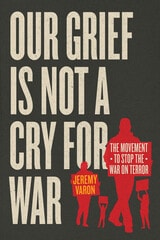
Our Grief Is Not a Cry for War
The Movement to Stop the War on TerrorJeremy Varon
University of Chicago Press, 2025
Just after 9/11, President George W. Bush climbed the rubble where the World Trade Center had stood. Surrounded by shouts of anger, he said, “The people who knocked these buildings down will hear all of us soon!” With these words, Bush ushered in the War on Terror. Quickly, a global protest movement mobilized against it, reshaping the political, moral, and media landscape.
Jeremy Varon’s Our Grief Is Not a Cry for War is the definitive history of that movement. Millions of Americans participated in thousands of acts of protest, from demonstrations to civil disobedience to peace encampments in Iraq. On February 15, 2003, up to 30 million people worldwide took to the streets in the largest protest in human history. But this enormous outcry was not enough to stop the US invasion of Iraq. Varon explores the limits to the movement’s power but also shows how it worked to make opposition to the Iraq War a part of public debate, hastening its end and limiting the broader War on Terror. In the book, you’ll meet the families of the 9/11 victims, Iraq War veterans, and Gold Star families who spoke out against war.
Written with a lively and revelatory voice, Our Grief Is Not a Cry for War illuminates the passion of the peace movement, the mark it made, and the enduring legacies of the War on Terror.
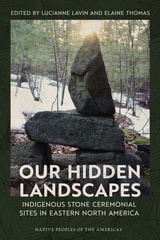
Our Hidden Landscapes
Indigenous Stone Ceremonial Sites in Eastern North AmericaLucianne Lavin
University of Arizona Press, 2023
This volume introduces readers to eastern North America’s Indigenous ceremonial stone landscapes (CSLs)—sacred sites whose principal identifying characteristics are built stone structures that cluster within specific physical landscapes. Our Hidden Landscapes presents these often unrecognized sites as significant cultural landscapes in need of protection and preservation.
In this book, Native American authors provide perspectives on the cultural meaning and significance of CSLs and their characteristics, while professional archaeologists and anthropologists provide a variety of approaches for better understanding, protecting, and preserving them. The chapters present overwhelming evidence in the form of oral tradition, historic documentation, ethnographies, and archaeological research that these important sites created and used by Indigenous peoples are deserving of protection.
This work enables archaeologists, historians, conservationists, foresters, and members of the general public to recognize these important ritual sites.
Contributors
Nohham Rolf Cachat-Schilling
Robert DeFosses
James Gage
Mary Gage
Doug Harris
Julia A. King
Lucianne Lavin
Johannes (Jannie) H. N. Loubser
Frederick W. Martin
Norman Muller
Charity Moore Norton
Paul A. Robinson
Laurie W. Rush
Scott M. Strickland
Elaine Thomas
Kathleen Patricia Thrane
Matthew Victor Weiss
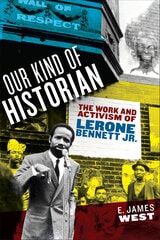
Our Kind of Historian
The Work and Activism of Lerone Bennett Jr.E. James West
University of Massachusetts Press, 2022
Journalist, activist, popular historian, and public intellectual, Lerone Bennett Jr. left an indelible mark on twentieth-century American history and culture. Rooted in his role as senior editor of Ebony magazine, but stretching far beyond the boundaries of the Johnson Publishing headquarters in Chicago, Bennett’s work and activism positioned him as a prominent advocate for Black America and a scholar whose writing reached an unparalleled number of African American readers.
This critical biography—the first in-depth study of Bennett’s life—travels with him from his childhood experiences in Jim Crow Mississippi and his time at Morehouse College in Atlanta to his later participation in a dizzying range of Black intellectual and activist endeavors. Drawing extensively on Bennett’s previously inaccessible archival collections at Emory University and Chicago State, as well as interviews with close relatives, colleagues, and confidantes, Our Kind of Historian celebrates his enormous influence within and unique connection to African American communities across more than half a century of struggle.
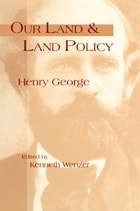
Our Land & Land Policy
Speeches Lectures, and Miscellaneous WritingsKenneth C. Wenzer
Michigan State University Press, 1999
Even before the publication of Progress and Poverty in 1879, San Francisco political economist and publisher Henry George (1839-1897) had written extensively about what he considered to be the causes for worldwide economic inequity—land monopolization and speculation by wealthy entrepreneurs and corrupt politicians. But his attacks on these evils were coupled with a plan for a possible brighter future, for a world in which disparities between people of different classes could be adjusted. By the time he died in 1897, his assessments of liberal 19th-century economic theory were critically acclaimed in Europe and the United States.
Michigan State University Press's new edition of Our Land and Land Policy includes the texts of speeches George delivered and essays he published during three decades of political activism. These pieces were chosen originally in 1901 by George's son, Henry George, Jr., to portray the expansiveness and depth of his father's philosophy and the sincerity with which the elder George struggled throughout his life for social justice.
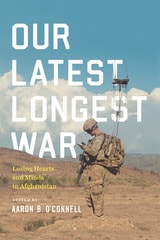
Our Latest Longest War
Losing Hearts and Minds in AfghanistanEdited by Aaron B. O'Connell
University of Chicago Press, 2017
America’s goals in Afghanistan were lofty to begin with: dismantle al Qaeda, remove the Taliban from power, remake the country into a democracy. But not only did the mission come completely unmoored from reality, the United States wasted billions of dollars, and thousands of lives were lost. Our Latest Longest War is a chronicle of how, why, and in what ways the war in Afghanistan failed. Edited by historian and Marine lieutenant colonel Aaron B. O’Connell, the essays collected here represent nine different perspectives on the war—all from veterans of the conflict, both American and Afghan. Together, they paint a picture of a war in which problems of culture and an unbridgeable rural-urban divide derailed nearly every field of endeavor. The authors also draw troubling parallels to the Vietnam War, arguing that deep-running ideological currents in American life explain why the US government has repeatedly used armed nation-building to try to transform failing states into modern, liberal democracies. In Afghanistan, as in Vietnam, this created a dramatic mismatch of means and ends that neither money, technology, nor the force of arms could overcome.
The war in Afghanistan has been the longest in US history, and in many ways, the most confounding. Few who fought in it think it has been worthwhile. These are difficult topics for any American or Afghan to consider, especially those who lost friends or family in it. This sobering history—written by the very people who have been fighting the war—is impossible to ignore.
Our Movie Heritage
Tom McGreevey and Joanne L Yeck
Rutgers University Press, 1997
Our Movie Heritage should be read by anyone interested in motion picture history. Without film preservation, there can be no valid film history. Documents, autobiographies, oral histories, and secondary sources are of importance, but viewing the actual films preserved or restored to a state comparable to the way they were originally viewed is of inestimable importance.Rudy Behlmer, film historian and author of Memo from David O. Selznick
Our Movie Heritage is an enticing, up to the minute account of the complex National Film preservation effort, and should be read by anyone interested in our rich cinematic heritage.Mary Lea Bandy, chief curator, The Museum of Modern Art
Imagine an America without any images of itself no Judy Garland in the Wizard of Oz, no Orson Welles in Citizen Kane, and no Bogart and Bergman in Casablanca. Movies are an extraordinary personal and collective history of the American people. Unfortunately, over 90 percent of America's silent films are already lost to us, and more than half of the American feature films made before 1950 no longer exist. Whether it is a piece of cellulose nitrate exposed in 1910 or a strip of Eastman Color acetate stock produced in the 1970s all film self-destructs. Rapidly.
Our Movie Heritage is a highly readable and informative view of the world of film preservation, showing the work being done to save our national treasure trove of film history. Full of tales of discovery and rescue, the book is an urgent plea for preservation. Our Movie Heritage describes the race against time currently under way both in the public and private sectors in order to salvage what is left in vaults, theaters, and private collections. The book explains the basics of film preservation, covering the who, what, when, where, and how of the field, with top archivists and film restoration experts expressing their concerns and hopes for the future of movies. This beautifully produced book, with over one hundred pictures of top stars, directors, and film people, is itself a treasure that showcases the importance of this legacy.
Our Musicals, Ourselves
A Social History of the American Musical TheatreJohn Bush Jones
Brandeis University Press, 2004