Results by title
471 books match the query 'Aesthetics' and 23 start with p
Paradise and Method
Poetry and PraxisBruce Andrews
Northwestern University Press, 1996
Addressing poetics from a poet's perspective, Andrews focuses on the ways in which meaning is produced and challenged. His essays aim "to map out opportunities for making sense (or making noise)--both in reading and writing contemporary literature. At the center has been a desire to explore language, as up close as possible, as a material and social medium for restagings of meaning and power." Andrews analyzes poetics and the production of meaning; alternative traditions and canons; and innovative contemporary poetry, particularly its break with many of the premises and constraints of even the most forward-looking modernisms.
Passamaquoddy Ceremonial Songs
Aesthetics and SurvivalAnn Morrison Spinney
University of Massachusetts Press, 2010
Philosophies of Art and Beauty
Selected Readings in Aesthetics from Plato to HeideggerAlbert Hofstadter and Richard Kuhns
University of Chicago Press, 1964
This anthology of primary texts gathers an incredibly large number of the most important philosophical writings on art and aesthetics from the ancient Greeks to contemporary thought. Albert Hofstadter and Richard Kuhns present English-language translations of works of
- Plato
- Aristotle
- Plotinus
- Augustine
- Marsilio Ficino
- Earl of Shaftesbury
- Kant
- Schelling
- Hegel
- Schopenhauer
- Nietzsche
- Benedetto Croce
- John Dewey
- Heidegger

Philosophy Looks At The Arts
Joseph Margolis
Temple University Press, 1987
Philosophy by Other Means
The Arts in Philosophy and Philosophy in the ArtsRobert B. Pippin
University of Chicago Press, 2021
The arts hold a range of values and ambitions, offering beauty, playfulness, and craftsmanship while deepening our mythologies and enriching the human experience. Some works take on philosophical ambitions, contributing to philosophy in ways that transcend the discipline’s traditional analytic and discursive forms. Pippin’s claim is twofold: criticism properly understood often requires a form of philosophical reflection, and philosophy is impoverished if it is not informed by critical attention to aesthetic objects. In the first part of the book, he examines how philosophers like Kant, Hegel, and Adorno have considered the relationship between art and philosophy. The second part of the book offers an exploration of how individual artworks might be considered forms of philosophical reflection. Pippin demonstrates the importance of practicing philosophical criticism and shows how the arts can provide key insights that are out of reach for philosophy, at least as traditionally understood.
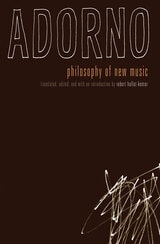
Philosophy of New Music
Theodor W. Adorno
University of Minnesota Press, 2019
An indispensable key to Adorno’s influential oeuvre—now in paperback
In 1949, Theodor W. Adorno’s Philosophy of New Music was published, coinciding with the prominent philosopher’s return to a devastated Europe after his exile in the United States. Intensely polemical from its first publication, every aspect of this work was met with extreme reactions, from stark dismissal to outrage. Even Arnold Schoenberg reviled it.
Despite the controversy, Philosophy of New Music became highly regarded and widely read among musicians, scholars, and social philosophers. Marking a major turning point in his musicological philosophy, Adorno located a critique of musical reproduction as internal to composition, rather than a matter of musical performance. Consisting of two distinct essays, “Schoenberg and Progress” and “Stravinsky and Reaction,” Philosophy of New Music poses the musical extremes in which Adorno perceived the struggle for the cultural future of Europe: between human emancipation and barbarism, between the compositional techniques and achievements of Schoenberg and Stravinsky.
In this translation, which is accompanied by an extensive introduction by distinguished translator Robert Hullot-Kentor, Philosophy of New Music emerges as an essential guide to the whole of Adorno's oeuvre.
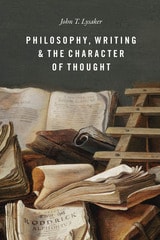
Philosophy, Writing, and the Character of Thought
John T. Lysaker
University of Chicago Press, 2018
Philosophy’s relation to the act of writing is John T. Lysaker’s main concern in Philosophy, Writing, and the Character of Thought. Whether in Plato, Montaigne, Nietzsche, Wittgenstein, or Derrida, philosophy has come in many forms, and those forms—the concrete shape philosophizing takes in writing—matter. Much more than mere adornment, the style in which a given philosopher writes is often of crucial importance to the point he or she is making, part and parcel of the philosophy itself.
Considering how writing influences philosophy, Lysaker explores genres like aphorism, dialogue, and essay, as well as logical-rhetorical operations like the example, irony, and quotation. At the same time, he shows us the effects of these rhetorical devices through his own literary experimentation. In dialogue with such authors as Benjamin, Cavell, Emerson, and Lukács, he aims to revitalize philosophical writing, arguing that philosophy cannot fulfill its intellectual and cultural promise if it keeps to professional articles and academic prose. Instead, philosophy must embrace writing as an essential, creative activity, and deliberately reform how it approaches its subject matter, readership, and the evolving social practices of reading and reflection.
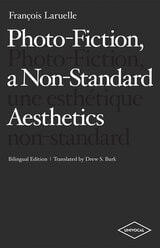
Photo-Fiction, a Non-Standard Aesthetics
François Laruelle
University of Minnesota Press, 2012
Twenty years after cultivating a new orientation for aesthetics via the concept of non-photography, François Laruelle returns, having further developed his notion of a non-standard aesthetics. Published for the first time in a bilingual edition, Photo-Fiction, a Non-Standard Aesthetics expounds on Laruelle’s current explorations into a photographic thinking as an alternative to the worn-out notions of aesthetics based on an assumed domination of philosophy over art. He proposes a new philosophical photo-fictional apparatus, or philo-fiction, that strives for a discursive mimesis of the photographic apparatus and the flash of the Real entailed in its process of image making. “A bit like if an artisan, to use a Socratic example, instead of making a camera based off of diagrams found in manuals, on the contrary had as his or her project the designing of a completely new apparatus of philo-fiction, thus capable of producing not simply photos, but photo-fictions.” One must enter into a space for seeing the vectorial and the imaginary number. Laruelle’s philo-fictions become not art installations, but “theoretical installations” calling for the consideration of the possibility of a non-standard aesthetics being of an equal or superior power to art and philosophy, an aesthetics in-the-last-instance that is itself an inventive and creative act of the most contemporary kind.
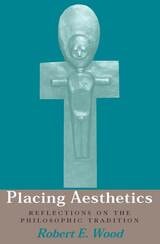
Placing Aesthetics
Reflections on the Philosophic TraditionRobert E. Wood
Ohio University Press, 2000
Examining select high points in the speculative tradition from Plato and Aristotle through the Middle Ages and German tradition to Dewey and Heidegger, Placing Aesthetics seeks to locate the aesthetic concern within the larger framework of each thinker’s philosophy.
In Professor Robert Wood’s study, aesthetics is not peripheral but rather central to the speculative tradition and to human existence as such. In Dewey’s terms, aesthetics is “experience in its integrity.” Its personal ground is in “the heart,” which is the dispositional ground formed by genetic, cultural , and personal historical factors by which we are spontaneously moved and, in turn, are inclined to move, both practically and theoretically, in certain directions.
Prepared for use by the student as well as the philosopher, Placing Aesthetics aims to recover the fullness of humanness within a sense of the fullness of encompassing Being. It attempts to overcome the splitting of thought, even in philosophy, into exclusive specializations and the fracturing of life itself into theoretical, practical, and emotive dimensions.
Plato's Symposium
A Translation by Seth Benardete with Commentaries by Allan Bloom and Seth BenardetePlato
University of Chicago Press, 2001
Plotinus on Beauty (Enneads 1.6 and 5.8.1–2)
The Greek Text with NotesAndrew Smith
SBL Press, 2019
A Greek edition of Plotinus's philosophical works with notes for students of Classical Greek
Plotinus, the father of Neoplatonism, composed the treatise On Beauty (Ennead 1.6) as the first of a series of philosophical essays devoted to interpreting and elucidating Platonic ideas. This treatise is one of the most accessible and influential of Plotinus's works, and it provides a stimulating entrée into the many facets of his philosophical activity. In this volume Andrew Smith first introduces readers to the Greek of Plotinus and to his philosophy in general, then provides the Greek text of and English notes on Plotinus's systematic argument and engaging exhortation to foster the inner self. The volume ends with the text of and notes on Plotinus's complementary statements in On Intelligible Beauty (Ennead 5.8.1–2).
Features:
- An overview of Plotinus's life
- Background discussion of Plotinus's thought and outline of his philosophical system
- Analysis of the relationship of Plotinus's thought to Plato’s
Poetry as a Way of Life
Aesthetics and Askesis in the German Eighteenth CenturyGabriel Trop
Northwestern University Press, 2014
What would it mean to make a work of art the focal point of one’s life practice? Poetry as a Way of Life goes back to the origins of aesthetics as a philosophical discipline in the early eighteenth century in order to uncover an understanding of the work of art as an exercise of the self. Engaging in close readings of works by both canonical and less well-known eighteenth-century German poets such as Friedrich Holderlin, Novalis, Friedrich von Hagedorn, and Johann Wilhelm Ludwig Gleim, Gabriel Trop illustrates the ways in which these authors tap into the potential of poetic form to redefine the limits of human perception and generate alternative ways of being in the world.
Poetry in a World of Things
Aesthetics and Empiricism in Renaissance EkphrasisRachel Eisendrath
University of Chicago Press, 2018
In Poetry in a World of Things, Rachel Eisendrath explores how poetry responded to this new detachment by becoming a repository for a more complex experience of the world. The book focuses on ekphrasis, the elaborate literary description of a thing, as a mode of resistance to this new empirical objectivity. Poets like Petrarch, Spenser, Marlowe, and Shakespeare crafted highly artful descriptions that recovered the threatened subjective experience of the material world. In so doing, these poets reflected on the emergence of objectivity itself as a process that was often darker and more painful than otherwise acknowledged. This highly original book reclaims subjectivity as a decidedly poetic and human way of experiencing the material world and, at the same time, makes a case for understanding art objects as fundamentally unlike any other kind of objects.
Poetry, Beauty, and Contemplation
The Complete Aesthetics of Jacques MaritainJohn G. Trapani Jr.
Catholic University of America Press, 2011
Political Aesthetics in the Era of Shakespeare
Edited by Christopher Pye
Northwestern University Press, 2020
Taking up this expansive conception of aesthetics, Political Aesthetics in the Era of Shakespeare suggests that the political stakes of the literary work—and Shakespeare’s work in particular—extend from the most intimate dimensions of affective response to the problem of the grounds of political society. The approaches to aesthetic thought included in this volume explore the intersections between the literary work and the full range of concerns animating the field today: political philosophy, affect theory, and ecocritical analysis of environs and habitus.
Post-Digital Rhetoric and the New Aesthetic
Justin Hodgson
The Ohio State University Press, 2019
Post-Digital Rhetoric and the New Aesthetic takes stock of these reconfigurations and their implications for rhetorical studies by taking up the New Aesthetic—a movement introduced by artist/digital futurist James Bridle that was meant to capture something of a digital way of seeing by identifying aesthetic values that could not exist without computational and digital technologies. Bringing together work in rhetoric, art, and digital media studies, Hodgson treats the New Aesthetic as a rhetorical ecology rather than simply an aesthetic movement, allowing him to provide operative guides for the knowing, doing, and making of rhetoric in a post-digital culture.

Postmodern Sophistications
Philosophy, Architecture, and TraditionDavid Kolb
University of Chicago Press, 1990
Postpolitics and the Aesthetic Imagination
Juan Meneses
University of Minnesota Press, 2025
Igniting political power through the lens of art and the imagination
Postpolitics and the Aesthetic Imagination investigates the erosion of meaningful political action in today’s world. Gathering writings from an array of scholars, editor Juan Meneses asks: can an aesthetic theory of postpolitics help us understand and counteract the most insidious processes of depoliticization?
The contributors to this volume explore how the aesthetic imagination can play a crucial role in reenvisioning key political elements, including governance, agency, rights, and responsibility. With a survey of various artistic mediums—film, dance, music, literature, and digital media—the essays illustrate how the aesthetic can reveal ways to breathe new life into the work of emancipatory politics. Reclaiming the arts and humanities as vital to political life, the contributors revisit but also move beyond the social sciences’ central focus on neoliberalism and public administration to address other topics such as tech-capitalism, race, environmental violence, and patriarchy.
Postpolitics and the Aesthetic Imagination argues for a conscious deployment of aesthetics to resist political anesthesia and promote a more just society, underscoring the role of the imagination in political engagement and change.
Contributors: Jacquelyn Arcy, U of Wisconsin–Parkside; Christopher Breu, Illinois State U; Stephen Charbonneau, Florida Atlantic U; Eric Lemmon, Webster U; Robert P. Marzec, Purdue U; Allison Page, Rutgers U–Camden; Matthew Scully, U of Lausanne; Erik Swyngedouw, U of Manchester; Sherryl Vint, U of California, Riverside.
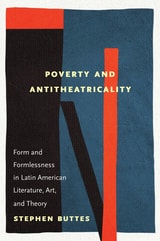
Poverty and Antitheatricality
Form and Formlessness in Latin American Literature, Art, and TheoryStephen Buttes
Rutgers University Press, 2025
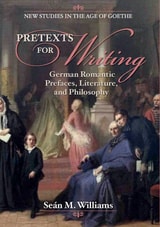
Pretexts for Writing
German Romantic Prefaces, Literature, and PhilosophyWilliams, Seán M
Bucknell University Press, 2019
Published by Bucknell University Press. Distributed worldwide by Rutgers University Press.
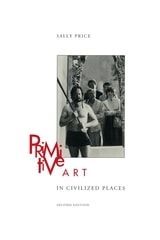
Primitive Art in Civilized Places
Second EditionSally Price
University of Chicago Press, 2002
"[Price] presents a literary collage of the Western attitude to other cultures, and in particular to the visual art of the Third and Fourth Worlds. . . . Her book is not about works of 'primitive art' as such, but about the Western construction 'Primitive Art.' It is a critique of Western ignorance and arrogance: ignorance about other cultures and arrogance towards them."—Jeremy Coote, Times Literary Supplement
"The book is infuriating, entertaining, and inspirational, leaving one feeling less able than before to pass judgment on 'known' genres of art, but feeling more confident for that."—Joel Smith, San Francisco Review of Books
"[A] witty, but scholarly, indictment of the whole primitive-art business, from cargo to curator. And because she employs sarcasm as well as pedagogy, Price's book will probably forever deprive the reader of the warm fuzzies he usually gets standing before the display cases at the local ethnographic museum."—Newsweek
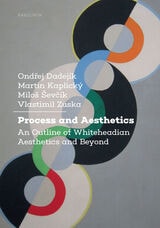
Process and Aesthetics
An Outline of Whiteheadian Aesthetics and BeyondOndrej Dadejík, Martin Kaplický, Miloš Ševcík, and Vlastimil Zuska
Karolinum Press, 2021
Though philosopher Alfred North Whitehead did not dedicate any books or articles specifically to aesthetics, aesthetic motifs nonetheless permeate his entire body of work. Despite this, aestheticians have devoted little attention to Whitehead. In this book, four scholars of aesthetics provide another angle from which Whiteheadian aesthetics might be reconstructed. Paying special attention to the notion of aesthetic experience, the authors analyze abstraction versus concreteness, immediacy versus mediation, and aesthetic contextualism versus aesthetic isolationism. The concepts of creativity and rhythm are crucial to their interpretation of Whiteheadian aesthetics. Using these concepts, the book interprets the motif of the processes by which experience is harmonized, the sensation of the quality of the whole, and directedness towards novelty.
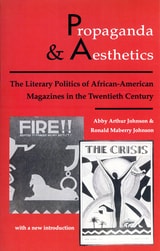
Propaganda and Aesthetics
The Literary Politics of Afro-American Magazines in the Twentieth CenturyAbby Arthur Johnson
University of Massachusetts Press, 1979
Little work has been done on individual Afro-American periodicals and nothing, up to this point, has been published on twentieth-century black journals as a group. Studies of magazines in general are relatively rare, with only The Little Magazine, by Frederick Hoffman, Charles Allen, and Carolyn P. Ulrich, attempting a survey of small journals in this century. This book fills a considerable gap in literary history by detailing the development of Afro-American magazines in this century.