Results by title
354 books match the query 'Authors, American' and 10 start with p
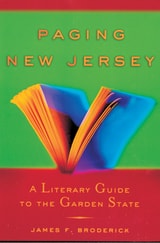
Paging New Jersey
A Literary Guide to the Garden StateBroderick, James F
Rutgers University Press, 2003
For 300 years, New Jersey writers, books, and historical events have helped shape the cultural landscape of the nation, and yet the state is rarely credited for its numerous contributions to American letters and folklore. Paging New Jersey is just the book for those interested in uncovering a treasure trove of information about the Garden State’s key role in the creation of U.S. literary and popular culture. New Jersey writers from Stephen Crane to Toni Morrison are included as well as longtime Camden resident Walt Whitman and Newark native Philip Roth.
James F. Broderick’s unique look at the state’s literary and cultural history answers intriguing Jersey-related questions such as: how author Peter Benchley got the idea for Jaws; where Aaron Burr shot Alexander Hamilton; why the Hindenberg exploded over Lakehurst in 1937; and where to find help in locating Captain Kidd’s buried treasure along the Jersey Shore. Most people know that television’s fictional Tony Soprano lives in New Jersey, but what about the state’s other mobsters— The real “goombahs?” Who are they and what have these particular Jersey devils written?
Full of commentary, biographical information, and history—along with suggested reading lists— Paging New Jersey is a crash course in Jerseyana. For those who live in the state, expatriots, and yes, even those who think all New Jersey has to offer is the Turnpike, Broderick’s engaging yet learned book provides an entertaining look at the Garden State’s rich cultural heritage.

Passion and Craft
CONVERSATIONS WITH NOTABLE WRITERSEdited by Bonnie Lyons and Bill Oliver
University of Illinois Press, 1998
Craft go beyond the merely autobiographical, revealing that, despite
their differences, they share passionate devotion and discipline for their
craft.
Included are Richard Ford, winner in 1995 of both the Pulitzer Prize
and the PEN/Faulkner Award; Gina Berriault, 1997 winner of the National
Book Critics Circle Award; Bobbie Ann Mason; T. Coraghessan Boyle; Rick
Bass; Leonard Michaels; Christopher Tilghman; Thom Jones; Julia Alvarez;
Andre Dubus; Jayne Anne Phillips; and Tobias Wolff.
Their comments will interest readers devoted to their novels and stories,
other writers, and aspiring writers.
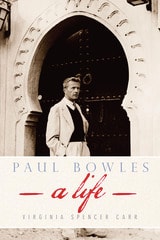
Paul Bowles
A LifeVirginia Spencer Carr
Northwestern University Press, 2008
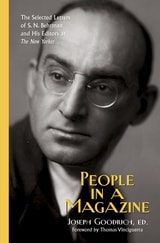
People in a Magazine
The Selected Letters of S. N. Behrman and His Editors at "The New Yorker"Joseph Goodrich
University of Massachusetts Press, 2018
Playwright, biographer, screenwriter, and critic S. N. Behrman (1893–1973) characterized the years he spent writing for The New Yorker as a time defined by “feverish contact with great theatre stars, rich people and social people at posh hotels, at parties, in mansions and great estates.” While he hobnobbed with the likes of Mary McCarthy, Elia Kazan, and Greta Garbo and was one of Broadway's leading luminaries, Behrman would later admit that the friendships he built with the magazine's legendary editors Harold Ross, William Shawn, and Katharine S. White were the “one unalloyed felicity” of his life.
People in a Magazine collects Behrman's correspondence with his editors along with telegrams, interoffice memos, and editorial notes drawn from the magazine's archives—offering an unparalleled view of mid-twentieth-century literary life and the formative years of The New Yorker, from the time of Behrman's first contributions to the magazine in 1929 until his death.
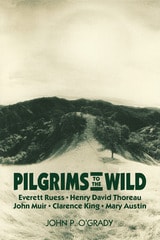
Pilgrims To The Wild
John P O'Grady
University of Utah Press, 1993
Pilgrims to the Wild is a survey of American writers who have responded to their encounters with the natural world. Ranging in its treatment from Thoreau’s important but neglected essay, 'Walking,' to the exuberant letters of the young artist Everett Ruess (who disappeared in the Escalante canyonlands), this is a broadly based exploration that brings to bear Eastern and Western classical philosophy, as well as contemporary critical theory, on a distinctive tradition of American Writing—those works concerned with the human relationship to the nonhuman world.
In addition to offering a fresh interpretation of classic authors such a Thoreau and Muir, this book introduces readers to the less widely known but equally fascinating writers Clarence King and Mary Austin.
Pillars of Salt, Monuments of Grace
New England Crime Literature and the Origins of American Popular Culture, 1674-1860Daniel A. Cohen
University of Massachusetts Press, 2006
Place Envy
Essays in Search of OrientationMichael Lowenthal
The Ohio State University Press, 2026
Growing up in places where his family had no past, and met mostly by silence from his Holocaust-refugee grandparents, Michael Lowenthal longed to be from somewhere. Then he realized he was gay and felt displaced from his own displaced family. Place Envy—his first book of essays after five acclaimed books of fiction—chronicles his quest for orientation in the world: as an agnostic Jew, as a queer traveler and lover, and as a writer who can tell or twist the truth. Yearning for a queer lineage, he obsesses about an uncle who perished at Bergen-Belsen but then finds, in his grandmother’s German hometown, a more surprising legacy. He lives with a Pennsylvania Amish family; accompanies blind gay men on a Mexican cruise; plays jazz with Sun Ra, the Afrofuturist who claimed to hail from Saturn; and pursues a clarifying love affair in Brazil. Collectively, these essays recount Lowenthal’s many journeys of dislocation and relocation: to foreign countries and subcultures and to the riskiest shores of family and self.
Placing Papers
The American Literary Archives MarketAmy Hildreth Chen
University of Massachusetts Press, 2020
The market for contemporary authors' archives began when research libraries needed to cheaply provide primary sources for the swelling number of students and faculty following World War II. Demand soon grew, and while writers and their families found new opportunities to make money, so too did book dealers and literary agents with the foresight to pivot their businesses to serve living authors. Public interest surrounding celebrity writers had exploded by the late twentieth century, and as Placing Papers illustrates, even the best funded institutions were forced to contend with the facts that acquiring contemporary literary archives had become cost prohibitive and increasingly competitive.
Poe in His Own Time
A Biographical Chronicle of His Life, Drawn from Recollections, Interviews, and Memoirs by Family, Friends, and AssociatesBenjamin F. Fisher
University of Iowa Press, 2010
An image of Edgar Allan Poe (1809–1849) as a man of gloom and mystery continues to hold great popular appeal. Long recognized as one of the greats of American literature, he elicited either highly commendatory or absolutely hostile reactions from many who knew him, from others who claimed to comprehend him as person or as writer, and from still others who circulated as fact opinions intuited from his writings. Whether promoting him as angel or demon, “a man of great and original genius” or “extraordinarily wicked,” the viewpoints in this dramatic collection of primary materials provide vigorous testimony to support the contradictory images of the man and the writer that have prevailed for a century and a half.
Noted Poe scholar Benjamin Fisher includes a comprehensive introduction and a detailed chronology of Poe’s sadly short life; each entry is introduced by a short headnote that places the selection in historical and cultural context, and explanatory notes provide information about people and places. From John Allan’s letter to Secretary of War John Eaton about Poe’s West Point life to John Frankenstein’s hostile verse casting him as an alcoholic, from Rufus Griswold’s first and second posthumous vilifications to James Russell Lowell’s more sensible outline of his life and career, from scornful to commendable reviews to scathing attacks on his morals to recognition of his comic achievements, Fisher has gathered a lively array of materials that read like the most far-fetched of gothic tales.
Poe himself was creative when he supplied information to others about his life and literary career, and the speculative content of many of the portrayals presented in this collection read as if their authors had set out to be equally creative. The sixty-nine recollections gathered in Poe in His Own Time form a dramatic, real-time biographical narrative designed to provide a multitude of perspectives on the famous author, sometimes in conflict with each other and sometimes in agreement but always arresting.
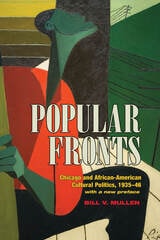
Popular Fronts
Chicago and African-American Cultural Politics, 1935-46Bill V. Mullen
University of Illinois Press, 2015
With a new preface Bill V. Mullen updates his dynamic reappraisal of a critical moment in American cultural history. Mullen's study includes reassessments of the politics of Richard Wright's critical reputation and a provocative reading of class struggle in Gwendolyn Brooks' A Street in Bronzeville. He also takes an in-depth look at the institutions that comprised Chicago's black popular front: the Chicago Defender, the period's leading black newspaper; Negro Story, the first magazine devoted to publishing short stories by and about African Americans; and the WPA-sponsored South Side Community Art Center.