475 books match the query 'Catholic' and 30 start with p
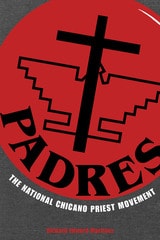
cover of PADRES: The National Chicano Priest Movement

PADRES

The National Chicano Priest Movement

By Richard Edward Martínez

University of Texas Press, 2005

From the 1848 Treaty of Guadalupe Hidalgo to the 1960s, Mexican American Catholics experienced racism and discrimination within the U.S. Catholic church, as white priests and bishops maintained a racial divide in all areas of the church's ministry. To oppose this religious apartheid and challenge the church to minister fairly to all of its faithful, a group of Chicano priests formed PADRES (Padres Asociados para Derechos Religiosos, Educativos y Sociales, or Priests Associated for Religious, Educational, and Social Rights) in 1969. Over the next twenty years of its existence, PADRES became a powerful force for change within the Catholic church and for social justice within American society.

This book offers the first history of the founding, activism, victories, and defeats of PADRES. At the heart of the book are oral history interviews with the founders of PADRES, who describe how their ministries in poor Mexican American parishes, as well as their own experiences of racism and discrimination within and outside the church, galvanized them into starting and sustaining the movement. Richard Martínez traces the ways in which PADRES was inspired by the Chicano movement and other civil rights struggles of the 1960s and also probes its linkages with liberation theology in Latin America. He uses a combination of social movement theory and organizational theory to explain why the group emerged, flourished, and eventually disbanded in 1989.
[more]
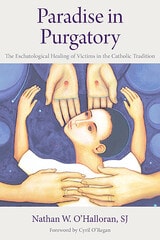
cover of Paradise in Purgatory: The Eschatological Healing of Victims in the Catholic Tradition

Paradise in Purgatory

The Eschatological Healing of Victims in the Catholic Tradition

Nathan W. O'Halloran

Catholic University of America Press, 2024
The claim of this book is that it is a precondition for Heaven that victims experience an eschatological healing of their other-inflicted wounds. Nathan O’Halloran, SJ, argues that the best theological space in which to locate this eschatological healing is in what he terms Paradise-in-Purgatory. The doctrine of Purgatory developed as a postmortem theological category for addressing sins committed after baptism and for which adequate penance has not been completed before death. In its full doctrinal articulations at Lyons II, Florence, and Trent, Purgatory is a doctrine concerned with personal, self-inflicted sin. Victims, on the other hand, require healing from other-inflicted sin rather than self-inflicted sin. For this reason, a certain expansion of this Catholic doctrine is required to make theological space for victims. O’Halloran argues that he has found that theological space within the Church’s ample tradition. The wellspring from which the doctrine of Purgatory emerged contains a richer content than has been represented thus far by conciliar definitions. Paradise in Purgatory maintains that the soteriological logic out of which Purgatory developed can be extended also to the postmortem healing of victims, and the soteriological logic of the New Testament supports this conclusion. Using as fundamental touchstones the wiping away of victims’ tears in the Book of Revelation, and the healing of Dinocrates through the prayers of his sister Perpetua in the Passion of Perpetua and Felicity, O’Halloran argues that victims must have an opportunity to experience full postmortem salvation from other-inflicted sin. The volume concludes that Purgatory can be theologically expanded to include a Paradise-in-Purgatory, i.e., a process that heals the other-inflicted wounds of sin which victims carry with them through death. The wounds of victims cannot be eschatologically discarded but must be subjected to the healing salvation which Christ came to offer.
[more]
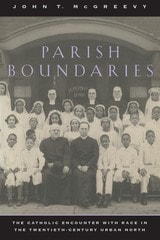
cover of Parish Boundaries: The Catholic Encounter with Race in the Twentieth-Century Urban North

Parish Boundaries

The Catholic Encounter with Race in the Twentieth-Century Urban North

John T. McGreevy

University of Chicago Press, 1996

Parish Boundaries chronicles the history of Catholic parishes in major cities such as Boston, Chicago, Detroit, New York, and Philadelphia, melding their unique place in the urban landscape to the course of twentieth century American race relations. In vivid portraits of parish life, John McGreevy examines the contacts and conflicts between Euro-American Catholics and their African-American neighbors. By tracing the transformation of a church, its people, and the nation, McGreevy illuminates the enormous impact of religious culture on modern American society.

"Parish Boundaries can take its place in the front ranks of the literature of urban race relations."—Jonathan Dorfman, Washington Post Book Review

"A prodigiously researched, gracefully written book distinguished especially by its seamless treatment of social and intellectual history."—Robert Orsi, American Historical Review

"Parish Boundaries will fascinate historians and anyone interested in the historic connection between parish and race."—Ed Marciniak, Chicago Tribune

"The history that remains to be written will rest on the firm foundation of Mr. McGreevy's remarkable book."—Richard Wightman Fox, New York Times Book Review

[more]
cover of Passion of Israel: Jacques Maritain, Catholic Conscience, and the Holocaust

Passion of Israel

Jacques Maritain, Catholic Conscience, and the Holocaust

Richard Francis Crane

University of Scranton Press, 2010

In his lifetime, French philosopher Jacques Maritain (1882–1973) achieved a reputation as both a leading Catholic intellectual and as an outspoken critic of antisemitism. Here historian Richard Francis Crane traces the development of Maritain’s opposition toward antisemitism and analyzes the Catholic appreciation of Judaism that animated his stance. Crane probes the writings and teachings of Maritain—from before, during, and after the Holocaust—and illuminates how his ideas altered Christian perceptions of Jews and Judaism during his lifetime and continue to do so today.
[more]
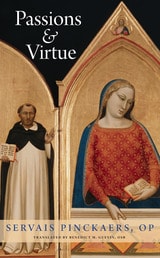
cover of Passions and Virtue

Passions and Virtue

Servais Pinckaers

Catholic University of America Press, 2015
This book, the last that noted moral theologian Servais Pinckaers, OP, wrote before his death, was conceived as a follow-up to his previous work Plaidoyer pour la vertu (An Appeal for Virtue) (2007) Pinckaers' aim in Passions and Virtue was to show the positive and essential role that our emotions play in the life of virtue. His purpose is part of a larger project of renewing moral theology, a theology too often experienced as an ethics of obligation rather than as a practical guide to living virtuously. To this end, Pinckaers sketches a positive psychology of the passions as found in the biblical tradition, in the writings of the Fathers of the Church, in pagan authors and, especially, in the writings of Saint Thomas Aquinas.
[more]
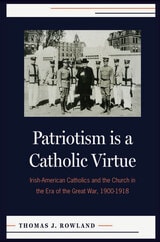
cover of Patriotism is a Catholic Virtue: Irish-American Catholics, The American Church and the Coming of the Great War

Patriotism is a Catholic Virtue

Irish-American Catholics, The American Church and the Coming of the Great War

Thomas J. Rowland

Catholic University of America Press, 2023
Most of the literature concerning the momentous challenges facing Irish American Catholics in the first two decades of the twentieth century pay but scant attention to the role played in addressing them by the American Church. Among the myriad political, social, cultural and economic issues confronting Irish American Catholics none stand out as prominently as the unabated burden of combatting scurrilous attacks upon them by nativist forces, the task of proving themselves as loyal American citizens, and navigating the perilous waves in advancing the course of directing Irish American nationalism and the cause of Ireland’s freedom. Patriotism is a Catholic Virtue ferrets out the impact the institutional Church played in affecting the course of action Irish American Catholics took regarding these three crucial missions. Whereas the task of confronting the assaults of nativism, seemingly the natural task for the institutional Church, this study provides extensive evidence of the relentless defense of Catholic virtue conducted by diocesan newspapers. Similarly, the mission of promoting Catholics as loyal American citizens was largely left in the hands of the American hierarchy, its clergy, newspapers and Catholic societies and affiliates. Lastly, this book provides evidence that the Church may well have played the decisive role in guiding its Irish American faithful along paths that, while conservatively promoting Irish nationalism, did not jeopardize an “American First” policy for Catholics. All of this was accomplished in the crucible of an emerging worldwide war.
[more]
cover of Paul in the Summa Theologiae

Paul in the Summa Theologiae

Matthew Levering

Catholic University of America Press, 2014
Aquinas's commentaries on St. Paul are well known and have received significant attention in the past few years. It is widely known, too, that Aquinas quotes Paul often in the Summa theologiae. This aspect of the Summa, however, has not been studied in detail. This book seeks to fill that lacuna in scholarship.
[more]
cover of Peace in the Thought of Thomas Aquinas: Philosophy, Theology, and Ethics

Peace in the Thought of Thomas Aquinas

Philosophy, Theology, and Ethics

John M. Meinert

Catholic University of America Press, 2024
What does Aquinas have to teach us on the topic of peace? Looking over the scholarly literature, one would think very little. Most Thomists ignore Aquinas’s thought on peace. Most peace researchers summarily dismiss Aquinas. Peace in the Thought of Thomas Aquinas challenges both these trends and offers the first book length study of peace in Aquinas’s thought. John Meinert outlines Aquinas's historical predecessors, then provides an exposition and interpretation of the full scope of Aquinas's thought on peace: metaphysics, Trinitarian theology, Christology, Pneumatology, ecclesiology, natural theology, ethics, and sacramental theology. What emerges from this extended study is a new vision of Aquinas’s work. Peace in the Thought of Thomas Aquinas establishes Aquinas as an indispensable dialogue partner for anyone thinking rigorously about the theology, philosophy, and ethics of peace. As Aquinas himself says, “observe peace and you will come to salvation.”
[more]
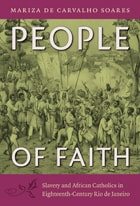
cover of People of Faith: Slavery and African Catholics in Eighteenth-Century Rio de Janeiro

People of Faith

Slavery and African Catholics in Eighteenth-Century Rio de Janeiro

Mariza de Carvalho Soares

Duke University Press, 2011
In People of Faith, Mariza de Carvalho Soares reconstructs the everyday lives of Mina slaves transported in the eighteenth century to Rio de Janeiro from the western coast of Africa, particularly from modern-day Benin. She describes a Catholic lay brotherhood formed by the enslaved Mina congregants of a Rio church, and she situates the brotherhood in a panoramic setting encompassing the historical development of the Atlantic slave trade in West Africa and the ethnic composition of Mina slaves in eighteenth-century Rio. Although Africans from the Mina Coast constituted no more than ten percent of the slave population of Rio, they were a strong presence in urban life at the time. Soares analyzes the role that Catholicism, and particularly lay brotherhoods, played in Africans’ construction of identities under slavery in colonial Brazil. As in the rest of the Portuguese empire, black lay brotherhoods in Rio engaged in expressions of imperial pomp through elaborate festivals, processions, and funerals; the election of kings and queens; and the organization of royal courts. Drawing mainly on ecclesiastical documents, Soares reveals the value of church records for historical research.
[more]
cover of Perfecting Human Actions: St. Thomas Aquinas on Human Participation in Eternal Law

Perfecting Human Actions

St. Thomas Aquinas on Human Participation in Eternal Law

John Rziha

Catholic University of America Press, 2009
During the last few centuries, a practical dichotomy between God and humans has developed within moral theory. As a result, moral theory tends to focus only on humans where human autonomy is foundational or only on God where divine commands capriciously rule. However, the moral theology of Thomas Aquinas overcomes this dichotomy. For Thomas, humans reach their perfection by participating in God's wisdom and love. Perfecting Human Actions explores the ways humans participate in eternal law--God's wisdom that guides and moves all things to their proper action. The book begins with a thoughtful examination of the philosophic recovery of the notion of participation in Thomistic metaphysics. It then explains Thomas's theological understanding of the notion of participation to show how humans are related to God. It is discovered that when performing human actions, humans participate in the eternal law in two ways: as moved and governed by it, and cognitively. In reference to participation as moved and governed, humans are directed by God to their proper end of eternal happiness. This mode of participation can be increased by perfecting the natural inclinations through virtue, grace, and the gifts of the Holy Spirit. In reference to cognitive participation, humans as rational creatures can know their proper end and how to attain it. Through this knowledge of moral truths, the intellect participates in the eternal law. Cognitive participation is perfected by the intellectual virtues (especially faith) and the gifts of the Holy Spirit (especially wisdom). The book concludes by showing how the notion of human participation in the eternal law is a much better foundation for moral theory than the contemporary notion of autonomy.
[more]
cover of Peter Comestor's Lectures on the Glossed Gospel of John: A Study with a Critical Edition and Translation

Peter Comestor's Lectures on the Glossed Gospel of John

A Study with a Critical Edition and Translation

Peter Comestor

Catholic University of America Press, 2023

This monograph encompasses the first critical edition, translation, and historical study of a series of lectures from the cathedral school of Notre-Dame, Peter Comestor’s Glosses on the Glossed Gospel of John. Delivered in Paris in the mid-1150s, Comestor’s expansive lecture course on the Glossa ordinaria on the Gospel of John has survived in no fewer than seventeen manuscript witnesses, being preserved in the form of continuous transcripts taken in shorthand by a student-reporter (reportationes). The editor has selected the fifteen best witnesses to produce a critical edition and translation of the first chapter of Comestor’s lectures on the Gospel of John. In addition to the text of the original lectures, the edition includes appendices containing accretions to the lecture materials added by Comestor and his students, as well as the corresponding text of the Glossa ordinaria from which Comestor lectured. The Latin text and translation of Peter Comestor’s lectures are preceded by a wide-ranging critical study of the historical and intellectual context of Peter Comestor’s biblical teaching. This study begins with an outline of Comestor’s scholastic career and known works, with a detailed introduction to his Gospel lectures and the relevant historiography. Subsequently, a survey is made of the intellectual landscape of Comestor’s lectures: namely, the tradition of biblical teaching originating at the School of Laon, preserved in the Glossa ordinaria, and developed in the classroom by Peter Lombard and a succession of Parisian masters, notably Comestor himself. The following section examines the portion of the lectures presented in this book, encompassing an overview of its contents and structure, a description of Comestor’s teaching method and scholastic setting, a study of the text’s sources, and a consideration of Comestor’s participation and reception in the scholastic tradition. The final chapters contain a careful description of the manuscripts and editorial principles adopted in the Latin edition and translation.
[more]
cover of Peter Comestor's Lectures on the Gospel of Luke and its Glosses

Peter Comestor's Lectures on the Gospel of Luke and its Glosses

Peter Comestor

Catholic University of America Press, 0

Through a partial critical edition and study of Peter Comestor’s lectures, this volume recontextualizes the biblical exegesis of the twelfth-century Latin cathedral schools within the frameworks of the study of ars grammatica, underscoring the importance of the master-disciple relationship in forming medieval exegetical schools of thought. This study critically examines the Latin biblical lectures of Peter Comestor, a twelfth-century scholar based in Paris, focusing on his commentary on the Gospel of Luke and its glossing tradition. The study positions Comestor’s lectures among Latin biblical commentaries produced in the cathedral schools of Laon and Paris, a vital intellectual movement shaped by well-known figures such as Anselm of Laon and Peter Lombard, and which provided the foundations for the University of Paris. Recent scholarship has sought to bridge the gap between biblical commentaries and systematic theological treatises by highlighting the shared didactic methodologies between the medieval study of the liberal arts and sacred scripture. This study of Comestor’s Luke lectures expands these efforts, underscoring the role of classical philology and liberal arts pedagogy in shaping medieval theological thought. The volume highlights how the cathedral school scholars of northern France approached Christian theology as a work of textual criticism, exploring a wide range of subjects—from geometry to canon law—through biblical interpretation. By tracing these intellectual traditions, the study uncovers the pedagogical practices that informed the understanding of Christian biblical exegesis in the Latin Middle Ages, particularly in the period leading up to the establishment of Europe’s first universities and theology faculties.
[more]
cover of Peter Lombard and the Biblical Gloss: Textual Fluidity in Mid-Twelfth-Century Paris

Peter Lombard and the Biblical Gloss

Textual Fluidity in Mid-Twelfth-Century Paris

Mark Clark

Catholic University of America Press, 2026
This monograph presents altogether new and substantial evidence showing that the view of the development of Scholasticism and Scholastic thought going back three centuries at least is mistaken. Peter Lombard's Sentences and his career did not mark and mirror a transition from the traditional biblical theology to the newer systematic theology, as so long supposed. Rather, the traditional genres of medieval theology served as the indispensable foundation for the development of new forms for teaching Christian doctrine to clerics, forms organized systematically. The Bible was not displaced or abandoned in favor of various summas but was rather integrated into a medieval theology that looks surprisingly like the ideal of the Second Vatican Council. Dei Verbum, the dogmatic constitution that deals with the place of Sacred Scripture, doesn't mention the Schoolmen, because longstanding historiography on Scholastic thought in the High Middle Ages misled popes and prelates into supposing the medieval theology had abandoned the Bible in favor of cold, logical, systematic treatises. In fact, however, Peter Lombard, Bonaventure, Thomas Aquinas and many others could themselves have authored Dei Verbum, which reads like the prologues and primers that the masters teaching theology to clerics in the High Middle Ages wrote themselves.
[more]
cover of Pickin’ Cotton on the Way to Church: The Life and Work of Father Boniface Hardin, OSB

Pickin’ Cotton on the Way to Church

The Life and Work of Father Boniface Hardin, OSB

Nancy Van Note Chism

Indiana Historical Society Press, 2019
Pickin’ Cotton on the Way to Church highlights the life of Father Boniface Hardin, a Benedictine monk. James Dwight Randolph (Randy) Hardin was born on November 18, 1933, in Bardstown, Kentucky, educated in Catholic schools in Kentucky, and thirteen years old when he asked to become a priest. Excluded from the seminaries in Kentucky because of his race, he enrolled in Saint Meinrad Seminary in Spencer County, Indiana, which had just started accepting black students. After six years of study he took his vows as monk and was given the name Boniface. He was ordained a priest in 1959 and attained a graduate degree in 1963. In 1965 Father Hardin accepted the position of associate pastor at Holy Angels Catholic Church, a predominately black parish in Indianapolis. Father Hardin was a social activist who spoke out against poverty, segregation, police brutality, and fought against the construction of an interstate highway that would adversely affect the black community. Such actions were considered inappropriate for a priest and the Archbishop of Indianapolis removed him from his position at Holy Angels. Although reinstated due to public outcries, Father Hardin soon left Holy Angels, and, along with Sister Jane Shilling, opened the Martin Center, where they could advocate full time for the poor and disenfranchised through a series of programs and services. Realizing the correlation between education and career advancement, Father Boniface and Sister Jane founded Martin University, the only predominately African American institution of higher learning in Indiana. The university continues to play a unique role in the community, with a special focus on educational opportunities to those who have been too often discounted, discouraged, and disregarded by society. Although Father Hardin was widely known in Indiana during his lifetime, accumulating many awards and honors, it is important to document his life and work for posterity. It is hoped that this volume will provide an overview of his story and lay the foundation for other scholarly efforts.
[more]
cover of Pictures, Quotations, and Distinctions: Fourteen Essays in Phenomenology

Pictures, Quotations, and Distinctions

Fourteen Essays in Phenomenology

Robert Sokolowski

Catholic University of America Press, 2022

One of the major contributions of Husserl’s phenomenology has been to show that things present themselves to us in strikingly different ways. There are various kinds of presentations and something like logical structures in them that allow the truth of things to appear. Being pictured is different from being named, and also different from being distinguished from something else. The fourteen essays in this volume provide concrete and colorful examples of strategic forms of presentation, and they also shed light on us as persons who exercise our intelligence when we let things appear in these various ways. Even our moral conduct takes place because something appears to us as to be done or to be avoided in a situation that calls for action. When we quote what someone has said, for example, we express things as they have been expressed by someone else, and we invoke the authority of that other speaker. In measurement, we either bring external units, such as inches or yards, to determine the “how much” of things; or we engage in “internal measurement” and use one part of the object to determine the size of the whole. In moral action, the deep core of what we do involves either benevolence or malevolence, and in such conduct we shape or confirm ourselves as good or bad. Even the timing of things, the measurement of their motions and the determination of their before and after, in both clock and calendar time, cannot take place without the involvement of the person’s own interwoven perceptions, remembrances, and anticipations, all held together by the underlying flow of personal as well as worldly temporality. The essays in this book are an attempt to blend the philosophical approaches of Aristotle and Husserl, the classical and the modern, to help us appreciate what Aristotle called “being as the true,” and to show how the human person is involved in this enterprise.
[more]
cover of Piercing the Clouds: Lectio Divina and the Preparation for Ministry

Piercing the Clouds

Lectio Divina and the Preparation for Ministry

Kevin Zilverberg

Saint Paul Seminary Press, 2021
This book’s six essays pertain to the “piercing of the clouds,” or the experience of heavenly mysteries, which characterizes lectio divina practiced well. Moreover, these peer-reviewed essays give special attention to the practice of lectio divina during preparation for ministry, especially the ministry of Catholic priests. That being said, any current or prospective Bible-reader may profit from this book; most of its content applies to Catholic seminarians and literate Christians alike. Here follow brief descriptions of each chapter. Laurence Kriegshauser, OSB, begins the book with a chapter on the Western monastic tradition of lectio divina and seminary formation, including an historical survey of lectio divina, a description of its characteristics, and reflections on its practice in seminaries. Michael Magee reflects upon the implications of exegetical method for lectio divina, with a comparison and critique of three commentaries’ treatments of John 6. Konrad Schaefer, OSB, advocates for fostering growth and formation through lectio divina, beginning his chapter with a description of its theological underpinnings and then taking up some practical considerations for students. Marcin Kowalski focuses on meditatio of lectio divina following upon exegesis-informed lectio, with an examination of Romans 7:7–25 as a test case. Daniel Keating examines oratio and contemplatio (and actio) of lectio divina, giving attention to theologians from twelfth-century Carthusian Prior Guigo II to Pope Benedict XVI. Anthony Giambrone, OP, contributes the final essay, on searching the Scriptures and the mystery of preaching. For him, exquisitio (intellectual engagement) leads to supplicatio (prayerful supplication), which culminates in praedicatio (preaching).
[more]
cover of Piers Plowan: The A Version, Revised Edition

Piers Plowan

The A Version, Revised Edition

William Langland

Catholic University of America Press, 2023
Passionate about trying to create social justice in a time of crisis after the Black Plague, William Langland spent his entire life working on Piers Plowman, an epic study of the human quest for truth, justice, and community. The "A Version," the first and shortest of the three versions he crafted, is wonderfully relatable and completely teachable to a modern student audience. Piers Plowman is becoming ever more relevant to students and scholars in English studies. Perhaps because the poem involves culture, religion, community, and work and engages explicitly with the histories of government and popular revolt, this allegorical tale of a wandering Christian named "Will," searching for truth with the aid of a humble plowman named Piers, has found new critical and pedagogic life in the last 20 years. Currently there are no translations of the A-version of Piers Plowman in print, so readers, scholars and teachers have been longing for an affordable, student-centered translation. The apparatus includes a 30-page historical and critical introduction, footnotes, a bibliography, a note on translation theory and practice, and samplings of the original text in Middle English, with a guide to pronunciation of that language. Piers Plowman is an extraordinary important document about the issues dramatically relevant to this day. It confronts poverty and inequity in 14th-century England and explores the need for virtue and social justice, encouraging its readers to create equality with open access for people of all classes and abilities. Though a Christian poem, Piers addresses issues of inclusivity, social responsibility and communal duty, as the poem’s protagonist wanders about the world, facing injustice and persecution as he looks for truth and salvation. Michael Calabrese, author of An Introduction to Piers Plowman and director of the Chaucer Studio’s Middle English recording of the poem, brings Piers Plowman to life for 21st-century students and for all readers interested in the history of society, virtue, faith and salvation.
[more]
cover of Poetry and Politics in the Play Sir Thomas More

Poetry and Politics in the Play Sir Thomas More

L. Joseph Hebert

Catholic University of America Press, 2026
If ever a play had something to say about the art of statesmanship, that play is Sir Thomas More. Its origins and authorship shrouded in mystery, the manuscript was likely written and revised between 1593 and 1604. This carefully crafted and dramatically compelling work pays tribute to a man eminent in philosophy and literature as well as politics, whose brilliant career and violent death revolved around controversies relevant to the turbulent transformations of the Tudor age, and to the subsequent development of modern government and society. Known then and now as "a man for all seasons," More was an accomplished poet, rhetorician, lawyer, diplomat, member of parliament and speaker of the House of Commons, a legal and political advisor to the city of London and King Henry VIII, and finally Chancellor of England. Having established a reputation for moral integrity, fervent piety, and vigorous opposition to both corruption and misguided attempts at reform, More saw his public career come to an abrupt end when he refused to recognize Henry as head of the English Church. In the generations that followed his trial and execution for "high treason," More was hailed by many as a man of wisdom, courage, and good faith-indeed, as "a blessed and happy martyr,"-even as the regime whose foundations he opposed continued to insist upon his error, guilt, and folly. Under the watchful eye of an Elizabethan censor, Sir Thomas More explores questions of profound philosophic and historic significance-questions that remained politically explosive at the time, and that continue to divide authors and audiences today. This book is the first to offer a comprehensive reading of the political and philosophical currents informing the play, including scene by scene summaries of the drama and clarifying synopses of sources referenced in the commentary.
[more]
cover of Pope Francis and the Search for God in America: The Significance of His Early Visits to the Americas

Pope Francis and the Search for God in America

The Significance of His Early Visits to the Americas

Maria Clara Bingemer

Catholic University of America Press, 2021
In Tutti Fratelli, Pope Francis has called again for a “culture of encounter,” But how should his theology, pastoral practice, and social message be understood and applied in the Church of the Americas, a single but complex reality that extends from South to North? This volume offers analyses from experts looking back to the Argentine pontiff’s first fateful encuentros in the Americas as a help for understanding the present reality of the Church in the Western Hemisphere. The group includes theologians, historians, and political scientists, and the unique contribution of the volume lies in the panoramic perspective offered by the book as a whole. The initial essays set the stage for the volume as a whole, offering rich insight into Argentine and Latin American history, the world from which the Pope came and to which he returned in 2015, as well as surveying the impact of the Latin American “theology of the people” on the Pope’s visit to the U.S. Additional essays address theological, historical, and pastoral engagements that cut across several of the visits. The final group of essays is dedicated to the visits themselves and is arranged in the order that they occurred. Pope Francis and the Search for God in América is offered to all the members of the Church in América, South and North, old and young, with the hope that it will spur even more thought, reflection, prayer, and service.
[more]
cover of Pope John Paul II Speaks on Women

Pope John Paul II Speaks on Women

Brooke Williams Deely

Catholic University of America Press, 2014
In Pope John Paul II Speaks on Women, Brooke Williams Deely presents a comprehensive record of John Paul II's reflections. This collection brings to the forefront the full context and content of his original contributions. Since John Paul II encouraged women and men to expand what he has adumbrated, this book facilitates ongoing dialogue. The principle of the organization of the volume is chronological, compiling John Paul II's teachings on the subject of women arranged by date over the entire term of his Papacy. Since this influential Pope addressed the situation of women from the beginning of his pontificate, this overview of his writings and his spoken addresses best showcases the development and historical context of his thought.
[more]
cover of Preaching to Latinos: Welcoming the Hispanic Moment in the U.S. Church

Preaching to Latinos

Welcoming the Hispanic Moment in the U.S. Church

Michael Kueber

Catholic University of America Press, 2022
There is a wide and growing gap in the Catholic Church in the United States between the clergy, who are mostly of European descent, and the large percentages of Catholics who identify as Latinos. While the US Church has made a concerted effort to build Hispanic ministries, many clergy and lay ministers are still ill-equipped to understand the cultural background of their parishioners, especially the large numbers who are foreign born. Because of this disconnect, the Church risks missing "the Hispanic Moment" in the US Church, in which the faith and traditions of these newest waves of US immigration could not just exist in parallel to English-language congregations, but enrich and enliven the faith of the whole community while passing on the faith to subsequent generations. Learning Spanish--while helpful--is not enough. There are intercultural competencies that can only be developed through practice, but it also helps already-busy clergy to have a concise guide. In addition to knowing the scholarly literature on cross-cultural preaching and Hispanic culture, Father Michael Kueber has twenty years of experience serving first generation Hispanic immigrants and their second generation children. In Preaching to Latinos, Kueber provides the readers with best practices for preaching to and leading their churches. As a member of an ecumenical community, he is able to speak to members of all Christian denominations.
[more]
cover of Pressed by a Double Loyalty: Hungarian Attendance at the Second Vatican Council, 1959-1965

Pressed by a Double Loyalty

Hungarian Attendance at the Second Vatican Council, 1959-1965

András Fejérdy

Central European University Press, 2017
The Second Vatican Council is the single most influential event in the 20th century history of the Catholic Church. The book analyzes the relationship between the Council and the "Ostpolitik" of the Vatican through the history of the Hungarian presence at Vatican II. Pope John XXIII, elected in 1958, was a catalyst. The pope thought that his most urgent task was to renew contacts with the Church behind the iron curtain. Hungarian participation at the Council was also made possible by the new, pragmatic model in Hungarian church politics. After the crushing of the 1956 Revolution, churches in Hungary thought that the regime would last and were willing to compromise. Vatican II – in the perspective of Hungary – was not primarily an ecclesial event, but it remained closely joined to the negotiations between the Holy See and the Kádár regime: during the Council Hungary became the experimental laboratory of the Vatican's new eastern policy. Was it a Vatican decision or a Soviet instruction? Fejérdy suggests that it was a decision of the Holy See.
[more]
cover of Priests: A Calling in Crisis

Priests

A Calling in Crisis

Andrew M. Greeley

University of Chicago Press, 2004

For several years now, the Roman Catholic Church and the institution of the priesthood itself have been at the center of a firestorm of controversy. While many of the criticisms lodged against the recent actions of the Church—and a small number of its priests—are justified, the majority of these criticisms are not. Hyperbolic and misleading coverage of recent scandals has created a public image of American priests that bears little relation to reality, and Andrew Greeley's Priests skewers this image with a systematic inside look at American priests today.

No stranger to controversy himself, Greeley here challenges those analysts and the media who parrot them in placing the blame for recent Church scandals on the mandate of celibacy or a clerical culture that supports homosexuality. Drawing upon reliable national survey samples of priests, Greeley demolishes current stereotypes about the percentage of homosexual priests, the level of personal and professional happiness among priests, the role of celibacy in their lives, and many other issues. His findings are more than surprising: they reveal, among other things, that priests report higher levels of personal and professional satisfaction than doctors, lawyers, or faculty members; that they would overwhelmingly choose to become priests again; and that younger priests are far more conservative than their older brethren.

While the picture Greeley paints should radically reorient the public perception of priests, he does not hesitate to criticize the Church's significant shortcomings. Most priests, for example, do not think the sexual abuse problems are serious, and they do not think that poor preaching or liturgy is a problem, though the laity give them very low marks on their ministerial skills. Priests do not listen to the laity, bishops do not listen to priests, and the Vatican does not listen to any of them. With Greeley's statistical evidence and provocative recommendations for change—including a national "Priest Corps" that would offer young men a limited term of service in the Church—Priests offers a new vision for American Catholics, one based on real problems and solutions rather than on images of a depraved, immature, and frustrated priesthood.
[more]
cover of Principles of Catholic Theology, Book 1: On the Nature of Theology

Principles of Catholic Theology, Book 1

On the Nature of Theology

Thomas Joseph White, OP

Catholic University of America Press, 2023
Catholic theology has to face a certain number of fundamental questions: what is the nature and content of Christian revelation, what are the sources of revelation, how are the mysteries of the faith to be understood in relation of one to another, and how do the truths of the Catholic faith relate to the acquisitions of natural reason. In the contemporary context, Catholic theology is marked by a diversity of approaches, many of which are seemingly incompatible or estranged from one another. How might we think about the unity of Catholic theology over and above the diversity of forms? What role, if any, can Aquinas play as a common doctor in facilitating exchanges between theological traditions in the Church? Principles of Catholic Theology seeks to address directly the nature of Catholic theology and the challenge of its contemporary articulation with an eye towards its articulation in its Thomistic key. This book is also the first of a series of collections of essays by Thomas Joseph White, OP, extending over a range of fundamental topics in Catholic dogmatic theology.
[more]
cover of Principles of Catholic Theology, Book 2: On the Rational Credibility of Christianity

Principles of Catholic Theology, Book 2

On the Rational Credibility of Christianity

Thomas Joseph White, OP

Catholic University of America Press, 2023
Can a philosopher defend the rational warrant for belief in Christianity? Is it reasonable to be religious? Is it philosophically responsible to be a Christian who believes in the mystery of the Trinity? Principles of Catholic Theology explores these questions in a systematic way by considering questions of ultimate explanation. Why not hold that modern atheistic naturalism provides the best explanation of reality? Or, if there is a transcendent first principle that explains all of reality, is it impersonal rather than personal? Contrastingly, if monotheism constitutes the best explanation for created being, how can we reasonably believe in any particular revelation concerning God? What are the criteria for rational belief in revelation? Thomas Joseph White, OP, considers these questions by exploring a series of topics: the transcendentals (existence, oneness, truth, goodness, beauty); rational argument for the existence of God; the immateriality and subsistence after death of the personal soul of the human being; the historical and conceptual coherence of Trinitarian doctrine; and the reasonableness of the natural desire to see God. The aim of Principles of Catholic Theology, Book 2 is to place contemporary natural reason in profound dialogue with the Catholic faith and to think about ways that we can consent to the profound mystery of the Holy Trinity that are in robust concord with the knowledge obtained from philosophical, scientific, and historical sources.
[more]
cover of Principles of Catholic Theology, Book 3: On God, Trinity, Creation, and Christ

Principles of Catholic Theology, Book 3

On God, Trinity, Creation, and Christ

Thomas Joseph White

Catholic University of America Press, 2024
What if anything can human beings know about God, either by way of philosophical reasoning or by divine revelation? How does the mystery of the Incarnation illuminate our understanding of the nature and mystery of God and the nature and destiny of the human person? The essays in this book explore topics pertaining to the nature of God, apophatic theology, divine simplicity and the holy Trinity, divine beauty, and the beauty of creation. The book also contains a series of speculative considerations of Christology: Why did God become human? How ought we understand the two natures of Christ and the topic of the communication of idioms (attribution of both divine and human properties to one person)? There is also a sustained treatment of Jesus' human knowledge and voluntary freedom. Did Jesus understand his own lordship and his unity with the Father and the Holy Spirit, and if so, how? Did Christ's human will always accord with the divine will, and what significance does this idea have for our understanding of the redemption affected by Christ for the whole human race? Through these explorations, principles drawn from Thomas Aquinas and from Thomistic tradition are taken into account as key resources for the adjudication of contemporary theological challenges. Principles of Catholic Theology, Book 3 is a continuation of Fr. Thomas Joseph White's collection of essays, extending over a range of fundamental topics in Catholic dogmatic theology.
[more]
cover of Principles of Catholic Theology, Book 4: On the Church, Mary, Nature and Grace

Principles of Catholic Theology, Book 4

On the Church, Mary, Nature and Grace

Thomas Joseph White

Catholic University of America Press, 2023
In the Nicene Creed Christians profess belief in the Church, "one, holy, catholic, and apostolic." The Church is also called the mystical body of Christ and the bride of Christ. What is the Church and how can we understand her mystery in light of the mystery of Christ? Principles of Catholic Theology, Book 4 explores Catholic ecclesiology and the theology of the Virgin Mary, as an exemplar of the Church's life. It also considers the people of Israel in light of the Church and Christ. The second half of the book considers human nature in light of the grace of Christ, and ecclesial humanity, so as to consider thematic and universal relations of grace to human nature. Major controversies are addressed such as the natural desire to see God and the Thomistic understanding of election and predestination. Effectively this volume seeks to receive and interpret the teaching of the Second Vatican Council Constitution on the Church, Lumen Gentium, within the Thomistic theological tradition and in light of that tradition. Principles of Catholic Theology, Book 4 is a continuation of Fr. Thomas Joseph White's collection of essays, extending over a range of fundamental topics in Catholic dogmatic theology.
[more]
cover of Principles of Catholic Theology, Book 5: No One is More Human Than God: On the Trinitarian Presence of God in the World

Principles of Catholic Theology, Book 5

No One is More Human Than God: On the Trinitarian Presence of God in the World

Thomas Joseph White

Catholic University of America Press, 2026
This work explores a Christian understanding of God’s presence in the world. As the Creator of all that exists, the Creator-Trinity is mysteriously present to all things, and truly but imperfectly knowable as such. In addition to this creative presence, however, there is also the manifestation of God’s presence as a gift of grace. By supernatural faith, the trinitarian life of God is made known to us as an object of the Christian mystical life. This life is centered especially upon God’s unique presence by way of Incarnation, human life, death, and resurrection, in the person of Jesus of Nazareth. This work ex­plores these notions in comparison with other religious traditions, in a Cath­olic as well as ecumenical perspective. Original considerations are offered re­garding the nature of scriptural inspiration, the Church as the mystical body of Christ, and the sacraments as instrumental expressions of the Incarnation, all with a view to the notion of mystical experience, and union with God. Principles of Catholic Theology, Book 5 is a continuation of Fr. Thomas Joseph White’s collection of essays, extending over a range of fundamental topics in Catholic dogmatic theology.
[more]
cover of Proclaiming Jesus Christ: Catholic and Evangelical Perspectives on Evangelization

Proclaiming Jesus Christ

Catholic and Evangelical Perspectives on Evangelization

Steven Hoskins

Saint Paul Seminary Press, 2026
[more]
cover of Putting on Christ: Augustine's Early Theology of Salvation and the Sacraments

Putting on Christ

Augustine's Early Theology of Salvation and the Sacraments

Ty Paul Monroe

Catholic University of America Press, 2022

Putting on Christ aims to situate Augustine’s early soteriology and sacramental theology within the context of his personal history and intellectual development. Beginning with an extended analysis of the theology of salvation and sacramental efficacy contained within Augustine’s Confessions (ca. 400), the study then traces the maturation of his views on these matters, beginning with his earliest extant works, the Cassicacum dialogues (ca. 386). The journey entails treating Augustine’s earliest discussions of Christ’s person and his saving work, as well as the believer’s subjective experience of conversion and salvation. As Augustine’s corpus shifts from philosophical dialogues to explicitly apologetic and scriptural-exegetical works, so too does his soteriological lexicon expand to include concepts and terms that will later become his stock-in-trade, such as the virtue of humilitas. And as his roles in the North African Church come to include participation in the presbyterate and the episcopacy, so too does his engagement expand to a wider set of polemical contexts, both anti-Manichaean and anti-Donatist. Putting on Christ tracks these and many other aspects of Augustine’s maturing thought, showing where lines of both continuity and development lie and aiming to uncover their reasons. In doing so, it reveals Augustine to be a thinker and a teacher who continued to hone his understanding of salvation, the very heartbeat of Christian life and thought, as well as its relation to various other aspects of the Christian theological worldview, from Christology and anthropology to sacramental theology and ecclesiology.
[more]