Results by title
143 books match the query 'Class' and 7 start with p

Parenting Empires
Class, Whiteness, and the Moral Economy of Privilege in Latin AmericaAna Yolanda Ramos-Zayas
Duke University Press, 2020
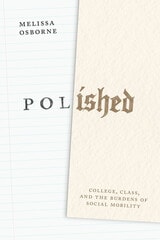
Polished
College, Class, and the Burdens of Social MobilityMelissa Osborne
University of Chicago Press, 2024
While college initiates a major transition in all students’ lives, low-income and first-generation students attending elite schools are often entering entirely new worlds. Amid the financial and academic challenges of adapting to college, their emotional lives, too, undergo a transformation. Surrounded by peers from different classes and cultural backgrounds, they are faced with an impossible choice: turn away from their former lives to blend in or stay true to themselves and remain on the outside.
An ethnography that draws on in-depth interviews with one hundred and fifty first-generation and low-income students across eighteen elite institutions, Polished uncovers the hidden consequences of the promise of social mobility in today’s educational landscape. Sociologist Melissa Osborne reveals how the very support designed to propel first-generation students forward can unexpectedly reshape their identities, often putting them at odds with their peers and families. Without direct institutional support, this emotional journey can lead to alienation, mental health challenges, poor academic outcomes, and difficult choices between upward mobility or maintaining authenticity and community. Whether you're an educator, advocate, or student, Polished provides a powerful perspective on the uncharted challenges of social mobility and personal identity during college.
Polished
College, Class, and the Burdens of Social MobilityMelissa Osborne
University of Chicago Press, 2024
An illuminating look at the emotional costs of mobility faced by first-generation and low-income college students.
While college initiates a major transition in all students’ lives, low-income and first-generation students attending elite schools are often entering entirely new worlds. Amid the financial and academic challenges of adapting to college, their emotional lives, too, undergo a transformation. Surrounded by peers from different classes and cultural backgrounds, they are faced with an impossible choice: turn away from their former lives to blend in or stay true to themselves and remain on the outside.
An ethnography that draws on in-depth interviews with one hundred and fifty first-generation and low-income students across eighteen elite institutions, Polished uncovers the hidden consequences of the promise of social mobility in today’s educational landscape. Sociologist Melissa Osborne reveals how the very support designed to propel first-generation students forward can unexpectedly reshape their identities, often putting them at odds with their peers and families. Without direct institutional support, this emotional journey can lead to alienation, mental health challenges, poor academic outcomes, and difficult choices between upward mobility or maintaining authenticity and community. Whether you're an educator, advocate, or student, Polished provides a powerful perspective on the uncharted challenges of social mobility and personal identity during college.
Producing Power
Ethnicity, Gender, and Class in a Caribbean WorkplaceKevin A. Yelvington
Temple University Press, 1995
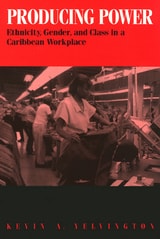
In a small, locally owned Trinidadian factory that produces household goods, 80 percent of the line workers are women, almost all black or East Indian. The supervisors are all men, either white or East Indian. Kevin Yelvington worked for a year in this factory to study how ethnicity and gender are integral elements of the class structure, a social and economic structure that permeates all relations between men and women in the factory. These primary divisions determine the way the production process is ordered and labor divided.
Unlike women in other industries in "underdeveloped" parts of the world who are recruited by foreign firms, Caribbean women have always contributed to the local economy. Within this historical context, Yelvington outlines the development of the state, and addresses exploitation and domination in the labor process. Yelvington also documents the sexually charged interactions between workers and managers and explores how both use flirting and innuendo to their advantage. Weddings and other social events outside the factory provide insightful details about how the creation of social identities carries over to all aspects of the local culture.

Protecting Home
Class, Race, and Masculinity in Boys' BaseballGrasmuck, Sherri
Rutgers University Press, 2005
What can neighborhood baseball tell us about class and gender cultures, urban change, and the ways that communities value public space? Through a close exploration of a boys’ baseball league in a gentrifying neighborhood of Philadelphia, sociologist Sherri Grasmuck reveals the accommodations and tensions that characterize multicultural encounters in contemporary American public life. Based on years of ethnographic observation and interviews with children, parents, and coaches, Protecting Home offers an analysis of the factors that account for racial accommodation in a space that was previously known for racial conflict and exclusion. Grasmuck argues that the institutional arrangements and social characteristics of children’s baseball create a cooperative environment for the negotiation of social, cultural, and class differences.
Chapters explore coaching styles, parental involvement, institutional politics, parent-child relations, and children’s experiences. Grasmuck identifies differences in the ways that the mostly white, working-class “old-timers” and the racially diverse, professional newcomers relate to the neighborhood. These distinctions reflect a competing sense of cultural values related to individual responsibility toward public space, group solidarity, appropriate masculine identities, and how best to promote children’s interests—a contrast between “hierarchical communalism” and “child-centered individualism.”
Through an innovative combination of narrative approaches, this book succeeds both in capturing the immediacy of boys’ interaction at the playing field and in contributing to sophisticated theoretical debates in urban studies, the sociology of childhood, and masculinity studies.

Public and Private
Gender, Class, and the British Novel (1764-1878)Patricia McKee
University of Minnesota Press, 1997
Public and Private was first published in 1997. Minnesota Archive Editions uses digital technology to make long-unavailable books once again accessible, and are published unaltered from the original University of Minnesota Press editions.
This groundbreaking work examines the emergent and fluctuating relationship between the public and private social spheres of the late eighteenth and nineteenth centuries. By assessing novels such as Mary Shelley's Frankenstein and Jane Austen's Emma through the lens of the social theories of Jürgen Habermas and Michel Foucault, Patricia McKee presents a fresh and highly original contribution to literary studies.
McKee explores the themes of production and consumption as they relate to gender and class throughout the works of many of the most influential novels of the age including Tobias Smollett's Humphry Clinker, Horace Walpole's The Castle of Otranto, Emma, Frankenstein, Anthony Trollope's Barchester Towers, Charles Dickens's Little Dorrit and The Old Curiosity Shop, Mrs. Henry Wood's East Lynne, and Thomas Hardy's The Return of the Native.
McKee analyzes portrayals of a society in which abstract idealism belonged to knowledgeable, productive men and the realm of ignorance was left to emotional, consuming women and the uneducated. She traces the various ways British literature of the eighteenth and nineteenth centuries worked to reform this social experience. Topics include Dickens's attack on the bureaucratic use of knowledge to maintain the status quo; the function of antiprogressive depictions of knowledge in Trollope, Shelley, and Hardy; and Austen's characterization of the protagonist Emma as an exception in a society that denied women's productive use of knowledge.
Offering a sharp challenge to theorists who have charted a linear division of public and private experience, McKee highlights the unexpected configurations of the emergence of the public and private spheres and the effect of knowledge distribution across class and gender lines.
Patricia McKee is professor of English at Dartmouth College. She is the author of Heroic Commitment in Richardson, Eliot, and James (1986).
Putting Inequality in Context
Class, Public Opinion, and Representation in the United StatesChristopher Ellis
University of Michigan Press, 2017
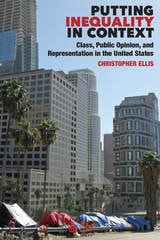
Christopher Ellis argues citizens’—and legislators’—views of class politics are driven by lived experience in particular communities. While some experience is formally political, on an informal basis citizens learn a great deal about their position in the broader socioeconomic spectrum and the social norms governing how class intersects with day-to-day life. These factors are important for policymakers, since most legislators do not represent “the public” at large, but specific constituencies.
Focusing on U.S. congressional districts as the contextual unit of interest, Ellis argues individuals’ political behavior cannot be separated from their environment, and shows how income’s role in political processes is affected by the contexts in which citizens and legislators interact. Political inequality exists in the aggregate, but it does not exist everywhere. It is, rather, a function of specific arrangements that depress the political influence of the poor. Identifying and understanding these factors is a crucial step in thinking about what reforms might be especially helpful in enhancing equality of political voice.