Results by title
90 books match the query 'Constitutional history' and 5 start with p
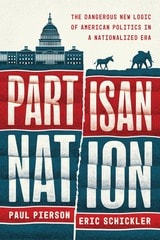
Partisan Nation
The Dangerous New Logic of American Politics in a Nationalized EraPaul Pierson and Eric Schickler
University of Chicago Press, 2024
A provocative exploration of how America’s democratic crisis is rooted in a dangerous mismatch between our Constitution and today’s nationalized, partisan politics.
The ground beneath American political institutions has moved, with national politics subsuming and transforming the local. As a result, American democracy is in trouble.
In this paradigm-shifting book, political scientists Paul Pierson and Eric Schickler bring a sharp new perspective to today’s challenges. Attentive to the different coalitions, interests, and incentives that define the Democratic and Republican parties, they show how contemporary polarization emerged in a rapidly nationalizing country and how it differs from polarization in past eras. In earlier periods, three key features of the political landscape—state parties, interest groups, and media—varied locally and reinforced the nation’s stark regional diversity. But this began to change in the 1960s as the two parties assumed clearer ideological identities and the power of the national government expanded, raising the stakes of conflict. Together with technological and economic change, these developments have reconfigured state parties, interest groups, and media in self-reinforcing ways. The result is that today’s polarization is self-perpetuating—and intensifying.
Partisan Nation offers a powerful caution. As a result of this polarization, America’s political system is distinctly and acutely vulnerable to an authoritarian movement emerging in the contemporary Republican Party, which has both the motive and the means to exploit America’s unusual Constitutional design. Combining the precision and acuity characteristic of their earlier work, Pierson and Schickler explain what these developments mean for American governance and democracy.

Politics and the Constitution in the History of the United States, Volume 3
The Political Background of the Federal ConventionWilliam W. Crosskey and William Jeffrey
University of Chicago Press, 1980

Politics as Development
The Emergence of Political Parties in Nineteenth-Century SerbiaGale Stokes
Duke University Press, 1990
Popular Sovereignty and the Crisis of German Constitutional Law
The Theory and Practice of Weimar ConstitutionalismPeter C. Caldwell
Duke University Press, 1997
Caldwell makes accessible the rich literature in German constitutional thought of the Weimar period, most of which has been unavailable in English until now. On the liberal left, Hugo Preuss and Hans Kelsen defended a concept of democracy that made the constitution sovereign and, in a way, created the "Volk" through constitutional procedure. On the right, Carl Schmitt argued for a substantial notion of the "Volk" that could overrule constitutional procedure in a state of emergency. Rudolf Smend and Heinrich Triepel located in the constitution a set of inviolable values of the political community, while Hermann Heller saw in it a guarantee of substantial social equality. Drawing on the work of these major players from the 1920s, Caldwell reveals the various facets of the impassioned constitutional struggles that permeated German legal and political culture during the Weimar Republic.
Private Property and the Limits of American Constitutionalism
The Madisonian Framework and Its LegacyJennifer Nedelsky
University of Chicago Press, 1990