Results by title
628 books match the query 'Democracy' and 41 start with p

POWER OF THE PEOPLE
Congressional Competition, Public Attention, and Voter RetributionSean M. Theriault
The Ohio State University Press, 2005

Palestinians in Israel
Segregation, Discrimination and DemocracyBen White
Pluto Press, 2012
Palestinians in Israel considers a key issue ignored by the official 'peace process' and most mainstream commentators: that of the growing Palestinian minority within Israel itself.
What the Israeli right-wing calls 'the demographic problem' Ben White identifies as 'the democratic problem' which goes to the heart of the conflict. Israel defines itself not as a state of its citizens, but as a Jewish state, despite the substantial and increasing Palestinian population. White demonstrates how the consistent emphasis on privileging one ethno-religious group over another cannot be seen as compatible with democratic values and that, unless addressed, will undermine any attempts to find a lasting peace.
Individual case studies are used to complement this deeply informed study into the great, unspoken contradiction of Israeli democracy. It is a pioneering contribution which will spark debate amongst all those concerned with a resolution to the Israel/Palestine conflict.
Pandemic Power
The Covid Response and the Erosion of Democracy - A Liberal CritiqueMuriel Blaive
Central European University Press, 2025
Partisan Gerrymandering and the Construction of American Democracy
Erik J. Engstrom
University of Michigan Press, 2016
Erik J. Engstrom offers a historical perspective on the effects of gerrymandering on elections and party control of the U.S. national legislature. Aside from the requirements that districts be continuous and, after 1842, that each select only one representative, there were few restrictions on congressional districting. Unrestrained, state legislators drew and redrew districts to suit their own partisan agendas. With the rise of the “one-person, one-vote” doctrine and the implementation of the Voting Rights Act of 1965, however, redistricting became subject to court oversight.
Engstrom evaluates the abundant cross-sectional and temporal variation in redistricting plans and their electoral results from all the states, from 1789 through the 1960s, to identify the causes and consequences of partisan redistricting. His analysis reveals that districting practices across states and over time systematically affected the competitiveness of congressional elections, shaped the partisan composition of congressional delegations, and, on occasion, determined party control of the House of Representatives.
Partisan Hostility and American Democracy
Explaining Political Divisions and When They MatterJames N. Druckman, Samara Klar, Yanna Krupnikov, Matthew Levendusky, and John Barry Ryan
University of Chicago Press, 2024
An unflinching examination of the effects and boundaries of partisan animosity.
For generations, experts argued that American politics needed cohesive parties to function effectively. Now many fear that strong partisan views, particularly hostility to the opposing party, are damaging democracy. Is partisanship as dangerous as we fear it is?
To provide an answer, this book offers a nuanced evaluation of when and how partisan animosity matters in today’s highly charged, dynamic political environment, drawing on panel data from some of the most tumultuous years in recent American history, 2019 through 2021. The authors show that partisanship powerfully shapes political behaviors, but its effects are conditional, not constant. Instead, it is most powerful when politicians send clear signals and when an issue is unlikely to bring direct personal consequences. In the absence of these conditions, other factors often dominate decision-making.
The authors argue that while partisan hostility has degraded US politics—for example, politicizing previously non-political issues and undermining compromise—it is not in itself an existential threat. As their research shows, the future of American democracy depends on how politicians, more than ordinary voters, behave.
Partisan Nation
The Dangerous New Logic of American Politics in a Nationalized EraPaul Pierson and Eric Schickler
University of Chicago Press, 2024
A provocative exploration of how America’s democratic crisis is rooted in a dangerous mismatch between our Constitution and today’s nationalized, partisan politics.
The ground beneath American political institutions has moved, with national politics subsuming and transforming the local. As a result, American democracy is in trouble.
In this paradigm-shifting book, political scientists Paul Pierson and Eric Schickler bring a sharp new perspective to today’s challenges. Attentive to the different coalitions, interests, and incentives that define the Democratic and Republican parties, they show how contemporary polarization emerged in a rapidly nationalizing country and how it differs from polarization in past eras. In earlier periods, three key features of the political landscape—state parties, interest groups, and media—varied locally and reinforced the nation’s stark regional diversity. But this began to change in the 1960s as the two parties assumed clearer ideological identities and the power of the national government expanded, raising the stakes of conflict. Together with technological and economic change, these developments have reconfigured state parties, interest groups, and media in self-reinforcing ways. The result is that today’s polarization is self-perpetuating—and intensifying.
Partisan Nation offers a powerful caution. As a result of this polarization, America’s political system is distinctly and acutely vulnerable to an authoritarian movement emerging in the contemporary Republican Party, which has both the motive and the means to exploit America’s unusual Constitutional design. Combining the precision and acuity characteristic of their earlier work, Pierson and Schickler explain what these developments mean for American governance and democracy.
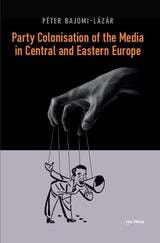
Party Colonisation of the Media in Central and Eastern Europe
Péter Bajomi-Lázár
Central European University Press, 2014
Party Competition and Responsible Party Government
A Theory of Spatial Competition Based Upon Insights from Behavioral Voting ResearchJames Adams
University of Michigan Press, 2001
Party Mandates and Democracy
Making, Breaking, and Keeping Election Pledges in Twelve CountriesElin Naurin, Terry J. Royed, and Robert Thomson, Editors
University of Michigan Press, 2019
The fulfillment of parties’ election pledges is an essential part of the democratic process. This book is the first major, genuinely comparative study of promises across a broad range of countries and elections, including the United States, Canada, nine Western European countries, and Bulgaria. The book thus adds to the body of literature on the variety of outcomes stemming from alternative democratic institutions.
Passions and Constraint
On the Theory of Liberal DemocracyStephen Holmes
University of Chicago Press, 1995
According to Holmes, three elements of classical liberal theory are commonly used to attack contemporary liberalism as antagonistic to genuine democracy and the welfare state: constitutional constraints on majority rule, the identification of individual freedom with an absence of government involvement, and a strong emphasis on the principle of self-interest. Through insightful essays on Hobbes's analysis of the English Civil War in Behemoth, Bodin's writings on the benefits of limited government, and Mill's views on science and politics, Holmes shows that these basic principles provide, to the contrary, a necessary foundation for the development of democratic, regulatory, and redistributionist politics in the modern era.
Holmes argues that the aspirations of liberal democracy—including individual liberty, the equal dignity of citizens, and a tolerance for diversity—are best understood in relation to two central themes of classical liberal theory: the psychological motivations of individuals and the necessary constraint on individual passions provided by institutions. Paradoxically, Holmes argues that such institutional restraints serve to enable, rather than limit, effective democracy.
In explorations of subjects ranging from self-interest to majoritarianism to "gag rules," Holmes shows that limited government can be more powerful than unlimited government—indeed, that liberalism is one of the most effective philosophies of state building ever contrived. By restricting the arbitrary powers of government officials, Holmes states, a liberal constitution can increase the state's capacity to focus on specific problems and mobilize collective resources for common purposes.
Passions and Constraint is an assessment of what that tradition has meant and what it can mean today.
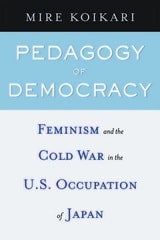
Pedagogy of Democracy
Feminism and the Cold War in the U.S. Occupation of JapanMire Koikari
Temple University Press, 2009
Pedagogy of Democracy re-interprets the U.S. occupation of Japan from 1945 to 1952 as a problematic instance of Cold War feminist mobilization rather than a successful democratization of Japanese women as previously argued. By combining three fields of research—occupation, Cold War, and postcolonial feminist studies—and examining occupation records and other archival sources, Koikari argues that postwar gender reform was one of the Cold War containment strategies that undermined rather than promoted women’s political and economic rights.
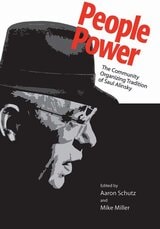
People Power
The Community Organizing Tradition of Saul AlinskyAaron Schutz
Vanderbilt University Press, 2015
--Fred Ross, Cesar Chavez, Dolores Huerta, and the Community Service Organization and National Farm Workers Association
--Nicholas von Hoffman and the Woodlawn Organization
--Tom Gaudette and the Northwest Community Organization
--Ed Chambers, Richard Harmon, and the Industrial Areas Foundation
--Shel Trapp, Gale Cincotta, and National People's Action
--Heather Booth, Midwest Academy, and Citizen Action
--Wade Rathke and ACORN
Weaving classic texts with interviews and their own context-setting commentaries, the editors of People Power provide the first comprehensive history of Alinsky-based organizing in the tumultuous period from 1955 to 1980, when the key organizing groups in the United States took form. Many of these selections--previously available only on untranscribed audiotapes or in difficult-to-read mimeograph or Xerox formats--appear in print here for the first time.

Perfect Wave
More Essays on Art and DemocracyDave Hickey
University of Chicago Press, 2017
When Dave Hickey was twelve, he rode the surfer’s dream: the perfect wave. And, like so many things in life we long for, it didn’t quite turn out—he shot the pier and dashed himself against the rocks of Sunset Cliffs in Ocean Beach, which nearly killed him.
Hickey went on to develop a career as one of America’s foremost critical iconoclasts, a trusted no-nonsense voice commenting on the worlds of art and culture. Perfect Wave brings together essays on a wide range of subjects from throughout Hickey’s career, displaying his breadth of interest and powerful insight into what makes art work, or not, and why we care. With Hickey as our guide, we travel to Disneyland and Vegas, London and Venice. We discover the genius of Karen Carpenter and Waylon Jennings, learn why Robert Mitchum matters more than Jimmy Stewart, and see how the stillness of Antonioni speaks to us today. Never slow to judge—or to surprise us in doing so—Hickey relates his wincing disappointment in the later career of his early hero Susan Sontag and shows us the appeal to our commonality that we’ve been missing in Norman Rockwell.
Bookended by previously unpublished personal essays that offer a new glimpse into Hickey’s own life—including the aforementioned conclusion to his surfing career—Perfect Wave is a welcome addition to the Hickey canon.
Philanthropy in Democratic Societies
History, Institutions, ValuesEdited by Rob Reich, Chiara Cordelli, and Lucy Bernholz
University of Chicago Press, 2016
The contributors balance empirical and normative approaches, exploring both the roles philanthropy has actually played in societies and the roles it should play. They ask a multitude of questions: When is philanthropy good or bad for democracy? How does, and should, philanthropic power interact with expectations of equal citizenship and democratic political voice? What makes the exercise of philanthropic power legitimate? What forms of private activity in the public interest should democracy promote, and what forms should it resist? Examining these and many other topics, the contributors offer a vital assessment of philanthropy at a time when its power to affect public outcomes has never been greater.
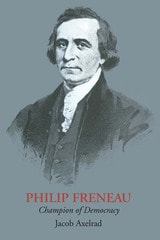
Philip Freneau
Champion of DemocracyBy Jacob Axelrad
University of Texas Press, 1967
Philip Freneau was a poet, editor, and mariner. A graduate of Princeton, he was the roommate of James Madison and a classmate of Hugh Henry Brackenridge and Aaron Burr. When the colonies rebelled against England, he supported his newly born nation as a privateer, spending some time in a British prison as a result. He also served, more effectively, as “the poet of the Revolution.” Later he became the journalistic voice of the democrats.
Ardently devoted to liberty, he believed himself to be a defender of the common man, for whom he fought selflessly and often vitriolicly throughout his life. In newspapers such as The Freeman’s Journal, The New York Daily Advertiser, The National Gazette, The Jersey Chronicle, and The Time-Piece, he published articles, letters, and poems, instructing the citizens of the new Republic about their rights, and attacking those who, he believed, were infringing on those rights. In the midst of the controversy in which he was so often involved, he also found time to write a small body of poetry whose sensitivity and beauty mark him as the poetic equal of his European contemporaries, and, in fact, as a precursor of the new Romantic movement
In Philip Freneau: Champion of Democracy Jacob Axelrad provides a detailed biography of this pensman of the Revolution and early Republic. He gives a sympathetic, imaginative, perceptive, yet objective interpretation of Freneau and his place in history, and at the same time he presents a delightfully readable and clear picture of the period during which the poet lived.
These pages not only re-create the battles between Whig and Tory, federalist and democrat, but they also are alive with the activities and philosophies of the men who made American history. James Madison, Thomas Jefferson, Alexander Hamilton, George Washington, John Adams, James Monroe go about the business of creating and shaping a new country, and as they do, they move into and out of the life of the poet of Monmouth, influencing him in a variety of ways.
Above all, Axelrad brings to life for the reader the man Freneau: simple, direct, often uncritical in his devotion to the cause he believed in; courageous in sustaining his stand against strong opposition; disillusioned and pessimistic about human nature, yet boldly optimistic about the future of humanity and of his country. And always behind the furor the reader is aware of the man struggling to provide a living for himself and his family, and never quite succeeding.
Pierre Bourdieu
A Critical IntroductionJeremy F. Lane
Pluto Press, 2000
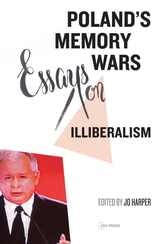
Poland's Memory Wars
Essays on IlliberalismJo Harper
Central European University Press, 2018
This volume of essays and interviews by Polish, British, and American academics and journalists provides an overview of current Polish politics for both informed and non-specialist readers. The essays consider why and how PiS, Law and Justice, the party of Jarosław Kaczynski, returned to power, and the why and how of its policies while in power. They help to make sense of how “history” plays a key role in Polish public life and politics.
The descriptions of PiS in Western media tend to rework old stereotypes about Eastern Europe that had lain dormant for some time. The book addresses the underlying question whether PiS was simply successful in understanding its electorate, and just helped Poland to revert to its normal state. This new Normal seems quite similar to the old one: insular, conservative, xenophobic, and statist.
The book looks at the current struggle between one ‘Poland’ and another; between a Western-looking Poland and an inward-looking Poland, the former more interested in opening to the world, competing in open markets, and working within the EU, and the latter more concerned with holding onto tradition.
The question of illiberalism has gone from an ‘Eastern’ problem (Russia, Turkey, Hungary, etc.) to a global one (Brexit and the U.S. elections). This makes the very specific analysis of Poland’s illiberalism applicable on a broader scale.
Polarization and Democracy in Latin America
Legacies of the Left TurnSantiago Anria and Kenneth M. Roberts
University of Chicago Press, 2026
An insightful examination of Latin America’s contemporary democratic landscape and how it is marked by patterns of polarization and volatility.
Although Latin American democracies have shown considerable resilience, today they face new forms of political polarization and instability. These challenges are closely connected to the legacies of the region’s “left turn,” which sought to transform entrenched inequalities and social hierarchies in the early twenty-first century. Unprecedented in its scope and duration, the left turn reflected an underlying realignment of political contestation in a highly unequal region. Yet despite notable achievements in addressing social needs, leftist parties struggled to deepen democracy by empowering popular majorities, and they faced powerful elite backlashes.
Through a comparative analysis of seven South American countries, Santiago Anria and Kenneth M. Roberts trace the different origins and trajectories in power of the populist and social democratic currents that emerged within the left turn. Anria and Roberts argue that today’s democratic orders face intensifying polarization and institutional fragility, even where social democratic parties made explicit efforts to build broad coalitions and temper political conflict. They show how activist networks and social movements on the left and the right triggered latent political conflicts and are now reshaping democratic competition and the terms of social inclusion in South American politics.
Political Matter
Technoscience, Democracy, and Public LifeBruce Braun
University of Minnesota Press, 2010
Exploring the frictions that come from linking the work of scholars in science and technology studies and political theory, these essays spark new ways of understanding the matter of politics.
Contributors: Andrew Barry, U of Oxford; Jane Bennett, Johns Hopkins U; Stephen J. Collier, New School; William E. Connolly, Johns Hopkins U; Rosalyn Diprose, U of New South Wales; Lisa Disch, U of Michigan; Gay Hawkins, U of New South Wales; Andrew Lakoff, UC San Diego; Noortje Marres, U of London; Isabelle Stengers, U Libre de Bruxelles; Nigel Thrift, U of Warwick.
Political Tolerance and American Democracy
John L. Sullivan, James Piereson, and George E. Marcus
University of Chicago Press, 1982
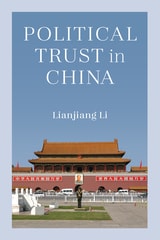
Political Trust in China
Lianjiang Li
University of Michigan Press, 2025

Politics for People
Finding a Responsible Public VoiceDavid Mathews
University of Illinois Press, 1999
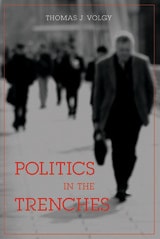
Politics in the Trenches
Citizens, Politicians, and the Fate of DemocracyThomas J. Volgy
University of Arizona Press, 2001
Now ask Tom Volgy. This former mayor of a major western city, who is also a political scientist, contends that most elected officials are the very opposite of what the public thinks: honest, hardworking people whose real work goes unnoticed by most of their constituents and the media.
Volgy has interviewed more than 300 elected officials—mayors, city council members, legislators—from all over the United States to offer a decidedly contrarian view of politics. He explores the lives and working conditions of elected officials at the local level— the area of democracy closest to the public— to show that officeholders are for the most part average citizens, not the slick lawyers or political pros we usually imagine them to be. Most are motivated by a sense of civic duty, and they often work for token salaries, yet once elected they give up their personal lives and fall prey to every conceivable brickbat of public and media outrage.
In Politics in the Trenches, Volgy shows what really happens behind the scenes of government. He contrasts perception with reality regarding the rewards and perks of office. He examines the process of experimentation in the political laboratory and shows how the news media distort it. He provides a case study of homelessness to illustrate the system's constraints and limitations. And he offers a chapter on a typical week in office that will be an eye-opener for most readers.
Although admittedly there are many flaws in the democratic political process, observes Volgy, all are correctable as long as citizens believe in the essential worth of the system itself. His book offers a fresh perspective on democratic governance and tackles tough issues such as campaign finance reform, urging citizens to understand the process before they condemn its players out of hand. More than that, this is a call to action, warning us that we could lose true democracy if we don't get involved.
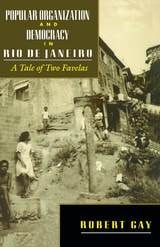
Popular Organization and Democracy in Rio De Janeiro
A Tale of Two FavelasRobert Gay
Temple University Press, 1993
Populism, Education, and Teaching the Manners of Democracy
Robert V Bullough Jr.
Rutgers University Press, 2027
In an era of intense polarization, misinformation, and challenges to democratic norms, American citizens have become disenchanted with democracy and instead embraced populism and grievance. In Populism, Education, and Teaching the Manners of Democracy Robert V. Bullough Jr. offers readers a range of concepts useful for re-imagining the practice of democratic citizenship, both in the classroom as well as for themselves as citizens. Structured around five democratic manners that Bullough argues teachers, students, and citizens should cultivate, hospitality, attuned listening, voice, reflectivity, and evidential discernment, he argues that democracy is a peculiar and demanding way of life that shares with education the goal of human flourishing. By embracing these five manners, we can counter the current grievance culture and instead promote personal and social growth, reorienting education toward democratic living.
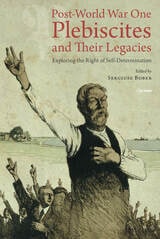
Post-World War One Plebiscites and Their Legacies
Exploring the Right of Self-DeterminationSergiusz Bober
Central European University Press, 2024
Plebiscites, or referendums, are epitomes of direct democracy and the right of self-determination. While direct democracy has always been a key subject in the theory and practice of western liberal democracies, the issue of self-determination has been propelled to the fore by the hegemonistic moves of Russia. By providing a historical analysis of the post-World War One plebiscites, this book deals with enduring, painfully contemporary, and in in any case fundamental, concepts.
The contributors to this edited volume approach the referendums comparatively. After grounding the analysis theoretically, the authors look at detailed aspects of individual cases, with the two plebiscites held in the Danish-German border region of Schleswig in the winter of 1920 as points of departure. They then extend the exploration through the inter-war period and address the effects of border delimitations on everyday life or gender roles in the context of ethnic mobilization. Finally, the book places the post-World War One plebiscites in a long-term perspective. The concluding essays assess, among others, the applicability of plebiscitary solutions to contemporary conflicts, taking into consideration issues of borders, religion, language, identity, and minority rights.
Post-capitalist Futures
Political Economy Beyond Crisis and HopeAdam Fishwick
Pluto Press, 2021
Postmodernism and the Other
New Imperialism of Western CultureZiauddin Sardar
Pluto Press, 1997
Practical Politics
Five Principles for a Community That WorksMichael K. Briand
University of Illinois Press, 1999
Pragmatics of Democracy
A Political Theory of African American Literature Before EmancipationDouglas A. Jones
University of Chicago Press, 2025
Douglas A. Jones’s Pragmatics of Democracy reads African American literature, from its beginnings through the mid-nineteenth century, to theorize how we have come to regard democracy as the most excellent form of political life. Jones notes that the aims of democracy, especially consent of the governed and equality under the law, can seem like tenets of governance that humans desire instinctively. But human nature does not correlate absolutely to politics. Jones argues that political selfhood is formed by “bodily events.” He proposes a typology of such experiences that dispose persons toward democratic subjectivity: ecstasy, impersonality, violence, respectability, and care.
African American literature before Emancipation reveals the democratic features of these categories that conventional political philosophy ignores or obscures. Given their lives as enslaved persons or the descendants of enslaved persons, early black writers crafted narratives about achieving democratic subjectivity that were missing in other Anglo-American canons. Pragmatics of Democracy discusses the works of well-known figures such as Phillis Wheatley, Harriet E. Wilson, and Frederick Douglass as well as those of more neglected writers such as Richard Allen, Peter Paul Simmons, James McCune Smith, and Frank J. Webb.
Pragmatist Politics
Making the Case for Liberal DemocracyJohn McGowan
University of Minnesota Press, 2012
In our current age of cynicism, John McGowan suggests that the time is right to take a fresh look at pragmatism, the philosophy of American democracy. As McGowan shows, pragmatism can be an inspiring alternative to the despair that seems to dominate contemporary American politics. Pragmatist Politics is passionate and convincing, both heartfelt and clear-eyed. It offers an expansive vision of what the United States could be and should be.
From John Dewey and William James, McGowan derives a history of democracy as a way of life, characterized by a distinctive ethos and based on an understanding of politics as potentially effective collective agency. That democratic ideal is wedded to a liberalism that focuses on extending the benefits of democracy and of material prosperity to all. Beyond the intellectual case for liberal democracy, McGowan turns to how James, especially, was attuned to the ways that emotional appeals often trump persuasion through arguments, and he examines the work of Kenneth Burke, among others, to investigate the link between liberal democracy and a comic view of human life. Comedy, McGowan notes, allows consideration of themes of love, forgiveness, and generosity that figure far too infrequently in philosophical accounts of politics.
In McGowan’s work, the combination of pragmatism and comedy takes us on a wide-ranging exploration of what American politics—and by extension American life—could actually be like if it truly reflected American values.
Pre-Election Polling
Sources of Accuracy and ErrorIrving Crespi
Russell Sage Foundation, 1988
Presidents, Populism, and the Crisis of Democracy
William G. Howell and Terry M. Moe
University of Chicago Press, 2020
The most visible cause is Donald Trump, who has used his presidency to attack the nation’s institutions and violate its democratic norms. Yet Trump is but a symptom of causes that run much deeper: social forces like globalization, automation, and immigration that for decades have generated economic harms and cultural anxieties that our government has been wholly ineffective at addressing. Millions of Americans have grown angry and disaffected, and populist appeals have found a receptive audience. These are the drivers of Trump’s dangerous presidency. And after he leaves office, they will still be there for other populists to weaponize.
What can be done to safeguard American democracy? The disruptive forces of modernity cannot be stopped. The solution lies, instead, in having a government that can deal with them—which calls for aggressive new policies, but also for institutional reforms that enhance its capacity for effective action.
The path to progress is filled with political obstacles, including an increasingly populist, anti-government Republican Party. It is hard to be optimistic. But if the challenge is to be met, we need reforms of the presidency itself—reforms that harness the promise of presidential power for effective government, but firmly protect against the fear that it may be put to anti-democratic ends.
Private Virtues, Public Vices
Philanthropy and Democratic EqualityEmma Saunders-Hastings
University of Chicago Press, 2022
Philanthropy plays a huge role in supporting the provision of many public goods in contemporary societies. As a result, decisions that affect public outcomes and people’s diverse interests are often dependent on the preferences and judgments of the rich. Political theorist Emma Saunders-Hastings argues that philanthropy is a deeply political activity. She asks readers to look at how the power wielded by philanthropy impacts democracy and deepens political inequality by enabling the wealthy to exercise outsize influence in public life and by putting in place paternalistic relationships between donors and their intended beneficiaries. If philanthropy is to be made compatible with a democratic society of equals, it must be judged not simply on the benefits it brings but on its wider political consequences. Timely and thought-provoking, Private Virtues, Public Vices will challenge readers’ thoughts on what philanthropy is and how it truly affects us.
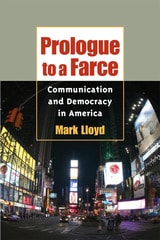
Prologue to a Farce
Communication and Democracy in AmericaMark Lloyd
University of Illinois Press, 2006
Mark Lloyd has crafted a complex and powerful assessment of the relationship between communication and democracy in the United States. In Prologue to a Farce, he argues that citizens’ political capabilities depend on broad public access to media technologies, but that the U.S. communications environment has become unfairly dominated by corporate interests.
Drawing on a wealth of historical sources, Lloyd demonstrates that despite the persistent hope that a new technology (from the telegraph to the Internet) will rise to serve the needs of the republic, none has solved the fundamental problems created by corporate domination. After examining failed alternatives to the strong publicly owned communications model, such as antitrust regulation, the public trustee rules of the Federal Communications Commission, and the underfunded public broadcasting service, Lloyd argues that we must re-create a modern version of the Founder’s communications environment, and offers concrete strategies aimed at empowering citizens.

Prometheus Wired
The Hope for Democracy in the Age of Network TechnologyDarin Barney
University of Chicago Press, 2000
In Prometheus Wired, Darin Barney debunks claims that a networked society will provide the infrastructure for a political revolution and shows that the resources we need for understanding and making sound judgments about this new technology are surprisingly close at hand. By looking to thinkers who grappled with the relationship of society and technology, such as Plato, Aristotle, Marx, and Heidegger, Barney critically examines such assertions about the character of digital networks.
Along the way, Barney offers an eye-opening history of digital networks and then explores a wide range of contemporary issues, such as electronic commerce, telecommuting, privacy, virtual community, digital surveillance, and the possibility of sovereign governance in an age of global networks. Ultimately, Barney argues that instead of placing power back in the hands of the public, a networked economy seems to exacerbate the worst features of industrial capitalism, and, in terms of the surveillance and control it exerts, reduces our political freedom.
Of vital interest to politicians, communicators, and anyone concerned about the future of democracy in the digital age, Prometheus Wired adds a provocative new voice to the debate swirling around "the Net" and the ways in which it will, or will not, change our political lives.
Promissory Notes
On the Literary Conditions of DebtRobin Truth Goodman
Lever Press, 2018
Propaganda and Rhetoric in Democracy
History, Theory, AnalysisEdited by Gae Lyn Henderson and M. J. Braun Foreword by Charles Bazerman
Southern Illinois University Press, 2016
Propaganda and Rhetoric in Democracy offers new perspectives on the history of propaganda, explores how it has evolved during the twentieth and twenty-first centuries, and advances a much more nuanced understanding of what it means to call discourse propaganda.
Public Schools, Private Governance
Education Reform and Democracy in New OrleansJ. Celeste Lay
Temple University Press, 2022
Two months after Hurricane Katrina, Louisiana took control of nearly all the public schools in New Orleans. Today, all of the city’s public schools are charter schools. Although many analyses mark the beginning of education reform in New Orleans with Katrina, in Public Schools, Private Governance, J. Celeste Layargues that the storm merely accelerated the timeline for reforms that had inched along incrementally over the previous decade. Both before and after Katrina, white reformers purposely excluded Black educators, community members, and parents.
Public Schools, Private Governance traces the slow, deliberate dismantling of New Orleans’ public schools, and the processes that have maintained the reforms made in Katrina’s immediate aftermath, showing how Black parents and residents were left without a voice and the officials charged with school governance, most of whom are white, with little accountability. Lay cogently explains how political minorities disrupted systems to create change and keep reforms in place, and the predictable political effects—exclusion, frustration, and resignation—on the part of those most directly affected.
Public Space And Democracy
Marcel Henaff
University of Minnesota Press, 2001
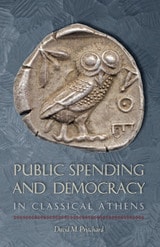
Public Spending and Democracy in Classical Athens
By David M. Pritchard
University of Texas Press, 2015
In his On the Glory of Athens, Plutarch complained that the Athenian people spent more on the production of dramatic festivals and “the misfortunes of Medeas and Electras than they did on maintaining their empire and fighting for their liberty against the Persians.” This view of the Athenians’ misplaced priorities became orthodoxy with the publication of August Böckh’s 1817 book Die Staatshaushaltung der Athener [The Public Economy of Athens], which criticized the classical Athenian dēmos for spending more on festivals than on wars and for levying unjust taxes to pay for their bloated government. But were the Athenians’ priorities really as misplaced as ancient and modern historians believed?
Drawing on lines of evidence not available in Böckh’s time, Public Spending and Democracy in Classical Athens calculates the real costs of religion, politics, and war to settle the long-standing debate about what the ancient Athenians valued most highly. David M. Pritchard explains that, in Athenian democracy, voters had full control over public spending. When they voted for a bill, they always knew its cost and how much they normally spent on such bills. Therefore, the sums they chose to spend on festivals, politics, and the armed forces reflected the order of the priorities that they had set for their state. By calculating these sums, Pritchard convincingly demonstrates that it was not religion or politics but war that was the overriding priority of the Athenian people.