347 books match the query 'Early works to 1800' and 36 start with p
cover of PLOTINUS Ennead I.1: What is the Living Thing? What is Man?: Translation with an Introduction and Commentary

PLOTINUS Ennead I.1

What is the Living Thing? What is Man?: Translation with an Introduction and Commentary

Gerard O'Daly

Parmenides Publishing, 2017


Ennead I.1 is a succinct and concentrated analysis of key themes in Plotinus' psychology and ethics. It focuses on the soul-body relation, discussing various Platonic, Aristotelian, and Stoic views before arguing that there is only a soul-trace in the body (forming with the body a “compound”), while the reasoning soul itself is impassive and flawless. The soul-trace hypothesis is used to account for human emotions, beliefs, and perceptions, and human fallibility in general. Its problematic relation to our rational powers, as well as the question of moral responsibility, are explored. Plotinus develops his original and characteristic concept of the self or “we,” which is so called because it is investigated as something common to all humans (rather than a private individual self), and because it is multiple, referring to the reasoning soul or to the “living thing” composed of soul-trace and body. Plotinus explores the relation between the “we” and consciousness, and also its relation to the higher metaphysical entities, the Good, and Intellect.
 
[more]
cover of PLOTINUS Ennead IV.4.30-45 & IV.5: Problems Concerning the Soul: Translation, with an Introduction and Commentary

PLOTINUS Ennead IV.4.30-45 & IV.5

Problems Concerning the Soul: Translation, with an Introduction and Commentary

Gary M. Gurtler, SJ

Parmenides Publishing, 2015
Ennead IV.4.30–45 and IV.5 retrieves the unity in this last section of Plotinus’ treatise on Problems concerning the Soul. Combining translation with commentary, Gurtler enhances both the accuracy of the translation and the recovery of Plotinus’ often unsuspected originality. This is especially true for IV.5, where previous translations fail to convey the concise nature of his argument against both the Aristotelian and Platonic theories of vision. Plato and Aristotle each claim that vision depends on the light between the eye and the object, but Plotinus presents evidence that this is not the case and develops a novel theory of light as a second activity that moves from source to object directly, even arguing that color is in the light itself rather than merely a quality of the object. This theory of vision, in turn, depends on the nature of sympathy developed especially in IV.4.30–45, where Plotinus shows how action at a distance is both possible and necessary for the proper unity in diversity of the sensible cosmos.
[more]
cover of PLOTINUS Ennead IV.9: On Whether All Souls are One: Translation | Introduction | Commentary

PLOTINUS Ennead IV.9

On Whether All Souls are One: Translation | Introduction | Commentary

Eyjólfur K. Emilsson

Parmenides Publishing, 2026

This short, early treatise undertakes to explain the controversial thesis that all souls—this includes individual human souls and the world-soul—are in some sense just one soul. Plotinus considers a number of objections that can be raised against the thesis. For instance, if the thesis is true, it may seem to follow that that everything that holds for one soul also holds for every other soul. Plotinus seeks to explain that such objections are off the mark, which also shows that the thesis about the unity of soul is not a claim about strict identity of all souls. He then (chapter 5) considers and rejects two materialistic hypotheses about the relationship between individual souls and the world-soul. In the final chapter he presents his own solution: the individual souls and the world-soul are all the soul hypostasis. He likens the relationship between the hypostatic soul and the individual souls with that between a science and the theorems of the science: each theorem potentially contains the whole science and can in a sense be said to be it.
[more]
cover of PLOTINUS Ennead IVI.3-4.29: Problems Concerning the Soul: Translation, with an Introduction and Commentary

PLOTINUS Ennead IVI.3-4.29

Problems Concerning the Soul: Translation, with an Introduction and Commentary

John M. Dillon

Parmenides Publishing, 2015

For Plotinus, the nature and status of the human soul is one of the central problems of philosophy. Ennead IV.3­–4.29 constitutes his most penetrating enquiry into this topic, addressing the issues of the relation of the individual soul to the World Soul, the descent of the soul into body, its relations with that body, problems of personal identity and the nature of memory, sense perception, and the true seat of the emotions —many of which still have a resonance today. 

The treatise is an excellent example of Plotinus’ distinctive method of enquiry: not dogmatic (though he is no sceptic), but worrying away at questions until he has uncovered their complexities to the best of his ability. Such a work requires detailed commentary, such as is provided here, to tease out fully the fascinating convolutions of his thought.
 
[more]
cover of PLOTINUS Ennead VI.4 and VI.5: On the Presence of Being, One and the Same, Everywhere as a Whole: Translation with an Introduction and Commentary

PLOTINUS Ennead VI.4 and VI.5

On the Presence of Being, One and the Same, Everywhere as a Whole: Translation with an Introduction and Commentary

Eyjólfur K. Emilsson

Parmenides Publishing, 2015
Ennead VI.4-5, originally written as a single treatise, contains Plotinus’ most general and sustained exposition of the relationship between the intelligible and the sensible realms, addressing and coalescing two central issues in Platonism: the nature of the soul-body relationship and the nature of participation. Its main question is, How can soul animate bodies without sharing their extension? The treatise seems to have had considerable impact: it is much reflected in Porphyry’s important work, Sententiae, and the doctrine of reception according to the capacity of the recipient, for which this treatise is the main source, resonated in medieval thinkers.   
[more]
cover of PLOTINUS Ennead VI.8: On the Voluntary and on the Free Will of the One: Translation, with an Introduction, and Commentary

PLOTINUS Ennead VI.8

On the Voluntary and on the Free Will of the One: Translation, with an Introduction, and Commentary

Kevin Corrigan

Parmenides Publishing, 2017

Ennead VI.8 gives us access to the living mind of a long dead sage as he tries to answer some of the most fundamental questions we in the modern world continue to ask: are we really free when most of the time we are overwhelmed by compulsions, addictions, and necessities, and how can we know that we are free? Can we trace this freedom through our own agency to the gods, to the Soul, Intellect, and the Good? How do we know that the world is meaningful and not simply the result of chance or randomness?  
Plotinus’ On the Voluntary and on the Free Will of the One is a groundbreaking work that provides a new understanding of the importance and nature of free human agency. It articulates a creative idea of agency and radical freedom by showing how such terms as desire, will, self-dependence, and freedom in the human ethical sphere can be genuinely applied to Intellect and the One while preserving the radical inability of all metaphysical language to express anything about God or gods.
 
[more]
cover of PLOTINUS: Ennead I.6: On Beauty: Translation, with an Introduction and Commentary

PLOTINUS

Ennead I.6: On Beauty: Translation, with an Introduction and Commentary

Andrew Smith

Parmenides Publishing, 2016
"Ennead I.6 is probably the best known and most influential treatise of Plotinus, especially for Renaissance artists and thinkers. Although the title may suggest a work on aesthetics and thus of limited focus, this is far from the case. For it quickly becomes apparent that Plotinus’ main interest is in transcendent beauty, which he identifies with the Good, the goal of all philosophical endeavor in the Platonist’s search to assimilate himself with the divine. 
 
The treatise is at once a philosophical search for the nature of the divine and at the same time an encouragement to the individual to aspire to this goal by taking his start from the beauty which is experienced in this world; for it is an image of transcendent beauty. This upward movement of the treatise reflects throughout the speech of Socrates in Plato’s Symposium in which he recounts the exhortation of the priestess Diotima to ascend from earthly to transcendent beauty, which for Plotinus is identified with the divine."
[more]
cover of PLOTINUS: Ennead II.5: On What Is Potentially and What Actually: Translation with an Introduction and Commentary

PLOTINUS

Ennead II.5: On What Is Potentially and What Actually: Translation with an Introduction and Commentary

Cinzia Arruzza

Parmenides Publishing, 2015
The term dunamis (potentiality) entered into the philosophical vocabulary with Plato, but it was with Aristotle that it acquired, together with energeia (actuality), the strong technical meaning that the two terms have maintained, with variations, throughout subsequent philosophical tradition. 
 
The significance of the notions of actuality and potentiality in Plotinus’ thought can hardly be overstated. Throughout the Enneads, they are crucial to understanding the specific causality of intelligible realities and the relation of participation between intelligible and sensible realms. 
 
In Ennead II.5, Plotinus for the first time provides a systematic clarification of his peculiar use of these terms, through a sustained revision of Aristotle’s own elaboration of the topic and of his terminology. The treatise discusses the different meanings of potentiality and actuality as well as the way each of them applies or does not apply to the sensible realm, to the intelligible realm, and to matter. 
 
While the structure of the text unfolds in a coherent and cohesive manner, Plotinus’ writing in this treatise is dense and at times dry in its technicality. The detailed commentary guides the reader step by step, making an otherwise particularly difficult text accessible.  
[more]
cover of Papyri from Karanis: The Granary C123

Papyri from Karanis

The Granary C123

W. Graham Claytor and Arthur Verhoogt, editors

University of Michigan Press, 2018

Papyri from Karanis: The Granary C123 is the twenty- first volume of University of Michigan papyri and the fourth devoted to texts from the University’s excavations at Karanis. The volume offers a contextualized edition of thirty-seven documents found in  a single structure, a large granary (C123) originally built in the first century CE, in addition to an analysis of the archaeology and history of the structure.

The documents are presented with an introduction, transcription of the original Greek or Latin, translation, commentary, and images. A unique community prayer to the emperor and gods (827) is the volume’s most notable contribution. The other papyri are a mix of private and public documents (petitions, declarations, letters, lists, etc.) that date from between the first century BCE and the fourth century CE. The typological and chronological mix of texts shows that they do not form an undisturbed archive but were rather a dump of wastepaper and other household objects.

Michigan’s excavated papyri are here presented for the first time on the basis of their archaeological find spot rather than being organized according to content. The volume’s introduction provides a possible model for analyzing legacy data from the Karanis excavations stored at the University of Michigan. The book will be of interest to papyrologists, ancient historians, and archaeologists of Greco- Roman Egypt.
[more]
cover of Patience and Salvation in Third Century North Africa: A Christian Latin Reader

Patience and Salvation in Third Century North Africa

A Christian Latin Reader

Sarah Wear

Catholic University of America Press, 2022
Patience and Salvation in Third Century North Africa: A Christian Latin Reader features the entirety of Tertullian’s To Martyrs and The Passion of Perpetua and Felicity, with selections from Cyprian’s On the Good of Patience and a short appendix on Augustine’s Commentary on Psalm 121.6. The Latin text has facing vocabulary and theological, historical, philosophical, and grammatical notes. In the first three centuries, Roman Carthage produced some of the earliest literature composed originally in Latin by Christians. Tertullian’s Ad Martyras (197); Passio Perpetuae et Felicitatis (203), and Cyprian’s De Bono Patientiae (256) all embody the force of this new genre of Latin literature. With this literature, we see a variant of Latin often denoted “Christian Latin.” Christian Latin featured linguistic elements marked by characteristics of biblical Latin, later Latin, as well as vulgarisms. In addition to converging philologically, Tertullian, the author of the Passio, and Cyprian align themselves in topos: they all ask the question of how one can endure torment and anxiety in this world. Patience (patientia), derived from the verb for “to suffer” (patior), is a virtue that allows one to endure troubles, anxieties, and physical pains with the hope of eternal happiness and salvation in heaven. In this Reader, the student will find three different literary perspectives on this theme. The book also draws parallels to the works of Seneca and Cicero on patience and suffering.
[more]
cover of Patron to Painter: Elizabethan Programs for Five Allegorical Paintings

Patron to Painter

Elizabethan Programs for Five Allegorical Paintings

David Evett

Arizona Center for Medieval and Renaissance Studies, 2020
For more than two centuries the group of early modern English manuscripts presented in this volume sat mostly ignored on the shelves of the British Library, known only to the librarians who catalogued them. Six of them, for four different elaborate allegorical paintings, appear in the manuscript catalog of the Sloane Collection as “Instructions to painters.” A seventh, from the Harley collection in the same library, has more recently been added to the group. On art historical, iconographic, and historical grounds the manuscripts add significantly to our knowledge of Elizabethan visual allegory, and reveal a provocative new contribution to the evolution of English political thought. And the development across three of the programs of a warm personal relationship between the patron and the artist opens a unique window into early modern relationships of this kind. Unlike most other surviving artistic programs, this one reveals its author’s personality and interests in a rich and beguiling way, and although as a writer he is no Sidney or Nashe, the naïve yet widely informed enthusiasm with which he addresses his readers has considerable force and charm.
[more]
cover of Pensees

Pensees

Blaise Pascal

Catholic University of America Press, 2021
Blaise Pascal (1623-1662) was a French mathematician, physicist, and religious philosopher, who laid the foundation for the modern theory of probabilities. The Pensées are made up of some 800 fragments, that have proven to be an enduring masterpiece since their initial publication in 1670. This volume is a translation of Philippe Sellier’s edition of Pascal’s Pensées, in addition to two shorter texts, the Exchange with M. de Sacy and The Life of Monsieur Pascal by Pascal’s sister, Gilberte Périer. In addition to a Preface and an Introduction, there is a comprehensive apparatus criticus. The text was originally produced by a team of international Pascal scholars, who translated individual sections and was revised by the General Editor. The introduction situates the Sellier edition in the history of Pascal scholarship and highlights the advance its reordering of the fragments and of the folders or bundles represents, both the translation itself and the notes allow for a deeper reading of the text. It not only gives English readers a version of the authoritative Sellier edition of the collection of reflections known as The Pensées, it also proposes material which help assess the philosopher’s significance and the originality of his thought. On the whole, this translation gives a comprehensive view of the progress of Pascal’s intended Apology of the Christian Religion as well as of other writings on related topics. It also provides today’s readers with a challenging set of arguments, prayer, and quotations from Scripture, and even the record of a mystical experience, known as the Memorial. It highlights all facets of Pascal’s genius, his familiarity with Scripture combined with a talent for controversy, irony mixed with fervor, and altogether the production of an intriguing and challenging writer and thinker.
[more]
cover of Peter Comestor's Lectures on the Glossed Gospel of John: A Study with a Critical Edition and Translation

Peter Comestor's Lectures on the Glossed Gospel of John

A Study with a Critical Edition and Translation

Peter Comestor

Catholic University of America Press, 2023

This monograph encompasses the first critical edition, translation, and historical study of a series of lectures from the cathedral school of Notre-Dame, Peter Comestor’s Glosses on the Glossed Gospel of John. Delivered in Paris in the mid-1150s, Comestor’s expansive lecture course on the Glossa ordinaria on the Gospel of John has survived in no fewer than seventeen manuscript witnesses, being preserved in the form of continuous transcripts taken in shorthand by a student-reporter (reportationes). The editor has selected the fifteen best witnesses to produce a critical edition and translation of the first chapter of Comestor’s lectures on the Gospel of John. In addition to the text of the original lectures, the edition includes appendices containing accretions to the lecture materials added by Comestor and his students, as well as the corresponding text of the Glossa ordinaria from which Comestor lectured. The Latin text and translation of Peter Comestor’s lectures are preceded by a wide-ranging critical study of the historical and intellectual context of Peter Comestor’s biblical teaching. This study begins with an outline of Comestor’s scholastic career and known works, with a detailed introduction to his Gospel lectures and the relevant historiography. Subsequently, a survey is made of the intellectual landscape of Comestor’s lectures: namely, the tradition of biblical teaching originating at the School of Laon, preserved in the Glossa ordinaria, and developed in the classroom by Peter Lombard and a succession of Parisian masters, notably Comestor himself. The following section examines the portion of the lectures presented in this book, encompassing an overview of its contents and structure, a description of Comestor’s teaching method and scholastic setting, a study of the text’s sources, and a consideration of Comestor’s participation and reception in the scholastic tradition. The final chapters contain a careful description of the manuscripts and editorial principles adopted in the Latin edition and translation.
[more]
cover of Peter Fidler: From York Factory to the Rocky Mountains

Peter Fidler

From York Factory to the Rocky Mountains

Barbara Belyea

University Press of Colorado, 2026

In 1792–93 Peter Fidler surveyed the Hudson’s Bay Company’s river and overland routes west from York Factory. He traveled with a fur brigade up the Hayes and Saskatchewan Rivers and then spent the winter months with a Piikani band who hunted buffalo in the Rocky Mountain foothills. Fidler kept precise journals that make it possible to follow the traders’ passage over a lake-strewn landscape and across the plains. The journal texts combine astronomical observations, notation of distances and directions, small sketch maps, and verbal descriptions. Peter Fidler: From York Factory to the Rocky Mountains presents two of Fidler’s survey journals edited and extensively annotated by historian Barbara Belyea from manuscripts in the Hudson’s Bay Company Archives.
 
The two journals—“From York Factory to Buckingham House” and “From Buckingham House to the Rocky Mountains”—detail Fidler’s travels over a period of nine months. They include remarks on fur trade history, organization of the inland brigade, three distinct geographical regions, and the daily life of a Plains nation. Belyea’s introduction and ample notes provide insight into the way geographic, specifically cartographic, information was noted in the journals, with additional information on industry trading techniques, traders’ economic decisions, broad changes in regional social and economic conditions, and interactions with indigenous peoples.
 
Fidler’s journals are an exceptional record of the fur trade’s western expansion and the daily life of a Plains nation at the height of its power and prosperity. With its rich analysis of primary source documents and painstaking reproduction of historical trade routes, Peter Fidler: From York Factory to the Rocky Mountains will be of great value to students and scholars in the fields of fur trade studies, cartography, travel literature, and Canadian history, as well as general readers interested in westward expansion, exploration, commerce, and indigenous-colonial relations.
 
[more]
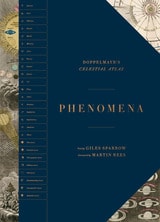
cover of Phenomena: Doppelmayr's Celestial Atlas

Phenomena

Doppelmayr's Celestial Atlas

Giles Sparrow

University of Chicago Press, 2022

Lavishly illustrated volume revealing the intricacies of a 1742 map of the cosmos.
 
The expansive and intricate Atlas Coelestis, created by Johann Doppelmayr in 1742, set out to record everything known about astronomy at the time, covering constellations, planets, moons, comets, and more, all rendered in exquisite detail. Through stunning illustrations, historical notes, and scientific explanations, Phenomena contextualizes Doppelmayr’s atlas and creates a spectacular handbook to the heavens.
 
Phenomena begins by introducing Doppelmayr’s life and work, placing his extraordinary cosmic atlas in the context of discoveries made in the Renaissance and Enlightenment and highlighting the significance of its publication. This oversized book presents thirty beautifully illustrated and richly annotated plates, covering all the fundamentals of astronomy—from the dimensions of the solar system to the phases of the moon and the courses of comets. Each plate is accompanied by expert analysis from astronomer Giles Sparrow, who deftly presents Doppelmayr’s references and cosmological work to a modern audience. Each plate is carefully deconstructed, isolating key stars, planets, orbits, and moons for in-depth exploration. A conclusion reflects on the development of astronomy since the publication of the Atlas and traces the course of the science up to the present day. Following the conclusion is a timeline of key discoveries from ancient times onward along with short biographies of the key players in this history.  
 
[more]
cover of Philo of Alexandria's Exposition on the Tenth Commandment

Philo of Alexandria's Exposition on the Tenth Commandment

Hans Svebakken

SBL Press, 2012
In his comprehensive exposition of the Tenth Commandment (Spec. 4.79–131), Philo considers the prohibition “You shall not desire”: what sort of desire it prohibits (and why) and how the Mosaic dietary laws collectively enforce that prohibition. This volume offers the first complete study of Philo’s exposition, beginning with an overview of its content, context, and place in previous research. In-depth studies of Philo’s concept of desire and his concept of self-control provide background and demonstrate Philo’s fundamental agreement with contemporary Middle-Platonic moral psychology, especially in his theory of emotion (pathos). A new translation of the exposition, with commentary, offers a definitive explanation of Philo’s view of the Tenth Commandment, including precisely the sort of excessive desire it targets and how the dietary laws work as practical exercises for training the soul in self-control.
[more]
cover of Philodemus, On Anger

Philodemus, On Anger

David Armstrong

SBL Press, 2020

The first English translation of On Anger

This latest volume in the Writings from the Greco-Roman World series provides a translation of a newly edited Greek text of Philodemus’s On Anger, now supplemented with the help of multispectral imaging. As our sole evidence for the Epicurean view of what constitutes natural and praiseworthy anger as distinguished from unnatural pleasure in vengeance and cruelty for their own sake, this text is crucial to the study of ancient thought about the emotions. Its critique of contemporary Stoic and Peripatetic theories of anger offers crucial new information for the history of philosophy in the last two centuries BCE. The introduction and commentary also make use of newly revised texts and readings from several other ancient treatises on anger.

Features

  • An apparatus representing work on the text since the papyrus was opened in 1805
  • A full explication of the Epicurean theory of natural anger as an emotion without pleasure
  • One of the Herculaneum papyri that survived the eruption of Vesuvius in 79 CE
[more]
cover of Philodemus, On Death

Philodemus, On Death

W. Benjamin Henry

SBL Press, 2009
On Death, by the Epicurean philosopher Philodemus of Gadara, is among the most significant philosophical treatments of the theme surviving from the Greco-Roman world. The author was an influential figure in first-century B.C.E. Roman society, associated with poets such as Virgil and politicians such as the father-in-law of Julius Caesar. The surviving copies of his treatises were carbonized following the eruption of Vesuvius in 79 C.E. This edition contains the Greek text, newly reconstituted with the help of the infrared imaging technology that has revolutionized the study of Philodemus s works in the twenty-first century, and completely translated into English for the first time. An extensive introduction provides background on Philodemus and his writings, accompanying notes enrich the text, and forty-four pages of photographs illustrate the papyrus manuscript from which the translation is drawn.
[more]
cover of Philodemus, On Property Management

Philodemus, On Property Management

Voula Tsouna

SBL Press, 2013
Philodemus was an important Epicurean philosopher active in southern Italy in the first century B.C.E. His treatise On Property Management, whose surviving part is completely translated here into English for the first time, focuses primarily on the vices or virtues involved in the acquisition and preservation of property and wealth. The extant remains of the work contain the most extensive and thorough treatment of property management found in any Hellenistic author. Philodemus criticizes rival writings by Xenophon and Theophrastus on the subject of oikonomia, or property management, and defends his own Epicurean views on the topic. More systematic and philosophical than rival approaches, the treatise clarifies many moral issues pertaining to the possession and preservation of property and wealth and provides plausible answers to a cluster of moral questions.
[more]
cover of Physics Or Natural Hearing

Physics Or Natural Hearing

Glen Aristotle

St. Augustine's Press, 2005
The William of Moerbeke Translation Series, under the general editorship of Stuart D. Warner, is devoted to publishing translations of important works - ancient, medieval, and modern - regardless of the original language, in every area of scholarly endeavor, including philosophy, political science, theology, literature, history, economics, and law. The aim of the series is to bring the reader as close as possible to the letter and spirit of the original work. Each volume will contain a scholarly introduction and notes. We welcome all inquiries and suggestions. Physics, Or Natural Healing is the first volume of this series.
[more]
cover of Plato's Sophist: Part II of The Being of the Beautiful

Plato's Sophist

Part II of The Being of the Beautiful

Plato

University of Chicago Press, 1986

Theaetetus, the Sophist, and the Statesman are a trilogy of Platonic dialogues that show Socrates formulating his conception of philosophy as he prepares the defense for his trial. Originally published together as The Being of the Beautiful, these translations can be read separately or as a trilogy. Each includes an introduction, extensive notes, and comprehensive commentary that examines the trilogy's motifs and relationships.

"Seth Benardete is one of the very few contemporary classicists who combine the highest philological competence with a subtlety and taste that approximate that of the ancients. At the same time, he as set himself the entirely modern hermeneutical task of uncovering what the ancients preferred to keep veiled, of making explicit what they indicated, and hence...of showing the naked ugliness of artificial beauty."—Stanley Rose, Graduate Faculty Philosophy Journal

Seth Benardete (1930-2001) was professor of classics at New York University. He was the author or translator of many books, most recently The Argument of the Action, Plato's "Laws," and Plato's "Symposium," all published by the University of Chicago Press.
[more]
cover of Plato's Statesman: Part III of The Being of the Beautiful

Plato's Statesman

Part III of The Being of the Beautiful

Plato

University of Chicago Press, 1986

Three classic Platonic dialogues in the most authoritative translation available

Theaetetus is the first of a trilogy of Platonic dialogues that show Socrates formulating his conception of philosophy as he prepares the defense for his trial. This translation is particularly faithful to the original Greek, and it is accompanied by an introduction, extensive notes, and comprehensive commentary that puts the dialogue in context with Plato's thought and its influence over the centuries.

Seth Benardete (1930-2001) was professor of classics at New York University. 
[more]
cover of Plato's Symposium: A Translation by Seth Benardete with Commentaries by Allan Bloom and Seth Benardete

Plato's Symposium

A Translation by Seth Benardete with Commentaries by Allan Bloom and Seth Benardete

Plato

University of Chicago Press, 2001
Plato, Allan Bloom wrote, is "the most erotic of philosophers," and his Symposium is one of the greatest works on the nature of love ever written. This new edition brings together the English translation of the renowned Plato scholar and translator, Seth Benardete, with two illuminating commentaries on it: Benardete's "On Plato's Symposium" and Allan Bloom's provocative essay, "The Ladder of Love." In the Symposium, Plato recounts a drinking party following an evening meal, where the guests include the poet Aristophanes, the drunken Alcibiades, and, of course, the wise Socrates. The revelers give their views on the timeless topics of love and desire, all the while addressing many of the major themes of Platonic philosophy: the relationship of philosophy and poetry, the good, and the beautiful.
[more]
cover of Plato's Theaetetus: Part I of The Being of the Beautiful

Plato's Theaetetus

Part I of The Being of the Beautiful

Plato

University of Chicago Press, 1986

Theaetetus, the Sophist, and the Statesman are a trilogy of Platonic dialogues that show Socrates formulating his conception of philosophy as he prepares the defense for his trial. Originally published together as The Being of the Beautiful, these translations can be read separately or as a trilogy. Each includes an introduction, extensive notes, and comprehensive commentary that examines the trilogy's motifs and relationships.

"Seth Benardete is one of the very few contemporary classicists who combine the highest philological competence with a subtlety and taste that approximate that of the ancients. At the same time, he as set himself the entirely modern hermeneutical task of uncovering what the ancients preferred to keep veiled, of making explicit what they indicated, and hence...of showing the naked ugliness of artificial beauty."—Stanley Rose, Graduate Faculty Philosophy Journal

Seth Benardete (1930-2001) was professor of classics at New York University. He was the author or translator of many books, most recently The Argument of the Action, Plato's "Laws," and Plato's "Symposium," all published by the University of Chicago Press.
[more]
cover of Plotinus ENNEAD IV.8: On the Descent of the Soul into Bodies: Translation, with an Introduction, and Commentary

Plotinus ENNEAD IV.8

On the Descent of the Soul into Bodies: Translation, with an Introduction, and Commentary

Barrie Fleet

Parmenides Publishing, 2012
[more]
cover of Plotinus Ennead I.8: On the Nature and Source of Evil: Translation with an Introduction and Commentary

Plotinus Ennead I.8

On the Nature and Source of Evil: Translation with an Introduction and Commentary

Anne Sheppard

Parmenides Publishing, 2025
Ennead I.8 was written not long before Plotinus’ death in 270 AD, at a time when he was particularly concerned with ethical issues. The treatise’ primary purpose is to argue that evil is not intrinsic to the soul, but since Plotinus always considers ethical issues within a metaphysical framework, it includes an account of the ontological status of matter. Plotinus does his best to preserve a belief in the dependence of all things on a single, supremely good First Principle while admitting that there is evil in the world. He offers a subtle account of the origin of evil in the soul as caused not by either the soul or matter on its own but by the combination of the two. Sheppard shows how Plotinus is responding to ideas found in Plato, Aristotle, the Stoics, and Middle Platonism as well as to the challenge presented by Gnosticism, and argues that the views expressed in I.8 are not inconsistent with what Plotinus has to say about matter and its generation elsewhere. She further considers the criticisms of Plotinus’ views put forward by Proclus and concludes that, despite its weaknesses, Plotinus’ account remains an ingenious attempt to defend monism and the essential goodness of the soul while recognizing the existence of evils.
[more]
cover of Plotinus Ennead II.4: On Matter: Translation with an Introduction and Commentary

Plotinus Ennead II.4

On Matter: Translation with an Introduction and Commentary

A.A. Long

Parmenides Publishing, 2022

In Ennead II.4 Plotinus investigates the question of what underlies the forms that constitute the contents of our minds and senses. Aristotle had called this substrate “matter,” and Stoic philosophers followed suit. With a critical review of their notions, and reference to Plato’s so-called Receptacle, Plotinus develops an account of matter that makes it a supremely negative entity. How he describes the indescribable, and how he justifies incorporeal matter’s indispensability to bodies, are highlights of this tenaciously argued essay.
 
A. A. Long translates and interprets Plotinus’ treatise on the matter that underlies all physical and intelligible beings. With a wide-ranging introduction and probing analysis of details, he explains the intricate structure of the text. The book will appeal to everyone interested in the history of Platonism and ancient Greek theories of the world’s ultimate principles.
[more]
cover of Plotinus Ennead III.4: On Our Allotted Guardian Spirit: Translation with an Introduction and Commentary

Plotinus Ennead III.4

On Our Allotted Guardian Spirit: Translation with an Introduction and Commentary

Wiebke-Marie Stock

Parmenides Publishing, 2020

On Our Allotted Guardian Spirit is a lively and at times perplexing text combining general reflections on the nature of the soul with a discussion of the phenomenon of a personal guardian spirit. Plotinus wants to interpret Plato, and aims to integrate Plato's various statements about daimones into one comprehensive theory. This leads to some views that are, if not exotic, then at least strange on first encounter. However, a closer reading reveals that Plotinus is not interested in demonology per se. Instead, the central concern of the treatise are ideas about the soul, the self, and self-consciousness. Plotinus' explorations produce a theory of the mind as the agent and activity responsible for a person’s ethical choices and conduct of life. The demon emerges as a philosophical tool passed down from Plato, but adapted and rationalized to try to explain motivation to action, the impulse toward the ethical life, and even the various differences in human ethical and psychological constitution. This innovative theory is a response to a strong and ongoing current of thought in the philosophical tradition.

The introduction offers an overview of ancient demonologies, starting with Homer and the Presocratics, and is followed by an in-depth examination of Plato, the Stoics, Plotinus, and later Neoplatonic developments. As such the book presents Plotinus’ specific rationalizing response to the idea of a guardian spirit in the context of ancient philosophical demonologies.
[more]
cover of Plotinus Ennead V.8: On Intelligible Beauty: Translation with an Introduction and Commentary

Plotinus Ennead V.8

On Intelligible Beauty: Translation with an Introduction and Commentary

Andrew Smith

Parmenides Publishing, 2017
Plotinus’ Ennead V.8, originally part of a single work (with III.8, V.5, and II.9), provides the foundation for a positive view of the universe as an image of divine beauty against the Gnostic rejection of the world. Although it emphasizes the cosmic dimension of beauty, it is, as are most treatises of Plotinus, concerned with the individual soul. The notion that the artist has within him an idea of beauty that derives directly from the intelligible world in fact coincides with his theory that each one of us has access to Intellect through his or her own intellect. It is the exploitation of this theme that forms the central dynamic of the treatise, with its stress on our ability to "see" and be one with the intelligible world and its beauty.
[more]
cover of Plotinus Ennead VI.9: On the Good or the One: Translation with an Introduction and Commentary

Plotinus Ennead VI.9

On the Good or the One: Translation with an Introduction and Commentary

Stephen R. L. Clark

Parmenides Publishing, 2020
This early treatise is placed by Plotinus’ editor at the very end of the Enneads, as the culmination of his thought, matching Plotinus’ own last recorded instruction, “to bring the god in you back to the god in the all.” It is a cosmological sketch, arguing that the being of anything depends on its being unified by its orientation to its own good, and so also the being of Everything, the All. The One, or the Good, is at once the goal of all things both individually and collectively, and also the transcendent source of all that we experience, mediated through an intelligible order. But it is also, and perhaps more importantly, intended as a guide to the proper education and discipline of our own motives and experience. We are encouraged to put aside immediate sensory data, egoistic prejudice and sensual impulse, first to grasp at least a little of the intelligible order within which we all live, and at last to purge even those last intellectual attachments and experience what cannot be adequately described: the unity of being.
[more]
cover of Plotinus on Beauty (Enneads 1.6 and 5.8.1–2): The Greek Text with Notes

Plotinus on Beauty (Enneads 1.6 and 5.8.1–2)

The Greek Text with Notes

Andrew Smith

SBL Press, 2019

A Greek edition of Plotinus's philosophical works with notes for students of Classical Greek

Plotinus, the father of Neoplatonism, composed the treatise On Beauty (Ennead 1.6) as the first of a series of philosophical essays devoted to interpreting and elucidating Platonic ideas. This treatise is one of the most accessible and influential of Plotinus's works, and it provides a stimulating entrée into the many facets of his philosophical activity. In this volume Andrew Smith first introduces readers to the Greek of Plotinus and to his philosophy in general, then provides the Greek text of and English notes on Plotinus's systematic argument and engaging exhortation to foster the inner self. The volume ends with the text of and notes on Plotinus's complementary statements in On Intelligible Beauty (Ennead 5.8.1–2).

Features:

  • An overview of Plotinus's life
  • Background discussion of Plotinus's thought and outline of his philosophical system
  • Analysis of the relationship of Plotinus's thought to Plato’s
[more]
cover of Popular Errors

Popular Errors

Laurent Joubert

University of Alabama Press, 1989

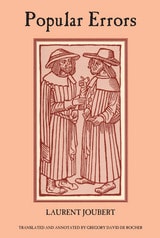
Laurent Joubert was an important figure in the medical world of the French Renaissance. Born in 1529, he became a doctor at age 29 and shortly thereafter was appointed personal physician to Catherine de Medici and later became physician to three French monarchs. Joubert was an educator as well as a physician, and he wrote several works of medical literature, including his most controversial work, Erreurs populaires. While the work focuses on popular misconceptions concerning medicine and physicians in France in the 1500s, it also represents a wealth of information on the social, economic, political, and religious worldviews that framed and thus supported the development and conduct of medical science.
Gregory de Rocher’s skill as a translator brings this highly readable and very funny book to life. Many topics central to Joubert’s thesis in the 1500s remain contemporary themes in the popular and scholarly literature of the 1980s.

[more]
cover of Pregnancy and Birth in Early Modern France: Treatises by Caring Physicians and Surgeons (1581–1625)

Pregnancy and Birth in Early Modern France

Treatises by Caring Physicians and Surgeons (1581–1625)

François Rousset, Jean Liebault, Jacques Guillemeau, Jacques Duval, and Louis de Serres

Iter Press, 2013

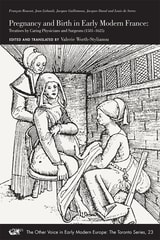
These texts were written in the vernacular for a readership of physicians and surgeons but also of midwives and lay women. So they present important evidence that, contrary to stereotypes, women were the recipients of medical texts written specifically for them. More generally, these texts demonstrate a strong interest in women’s health, indicating that early modern physicians and surgeons had a new interest in the specificity of female anatomy and women’s diseases. The texts selected and translated in this volume allow the reader to access an important group of primary sources on issues related to women’s health, including childbirth and caesarean section, sterility, miscarriage, breastfeeding, etc. The selection of texts is well organized and coherent, the translation is accurate and fluent, and the texts are adequately annotated, so the book will be easily used by scholars and students, including undergraduates. It provides evidence of a new concern and attention for women’s health needs, which, most interestingly, often went hand-in-hand with the rejection of misogynist stereotypes and the challenging of conventional views of female subordination and inferiority.
—Gianna Pomata
Professor of the History of Medicine, Johns Hopkins University
[more]
cover of Prosdocimo de' Beldomandi's Musica Plana and Musica Speculativa

Prosdocimo de' Beldomandi's Musica Plana and Musica Speculativa

Prosdocimo de Beldomandi. Translated by Jan Herlinger.

University of Illinois Press, 2007

Available in English for the first time, Prosdocimo's Tractatus plane musice (1412) and Tractatus musice speculative (1425) are exemplary texts for understanding the high sophistication of music theory in the early fifteenth century. Known for considering music as a science based on demonstrable mathematical principles, Prosdocimo praises Marchetto for his theory of plainchant but criticizes his influential Lucidarium for its heterodox mathematics. In dismissing Marchetto as a “mere performer,” Prosdocimo takes up matters as broad as the nature and definition of music and as precise as counterpoint, tuning, and ecclesiastical modes. The treatises also reveal much about Prosdocimo’s understanding of plainchant; his work with Euclid's Elementa; and his familiarity with the music theory of Boethius, Macrobius, and Johannes de Muris. A foremost authority on Italian music theory of the Middle Ages and early Renaissance, Jan Herlinger consults manuscripts from Bologna, Cremona, and Lucca in preparing these valuable first critical editions.
[more]
cover of Proslogion: including Gaunilo Objections and Anselm's Replies

Proslogion

including Gaunilo Objections and Anselm's Replies

St. Anselm of Canterbury

St. Augustine's Press, 2013

Written for his brother Benedictine monks around 1077, Anselm’s Proslogion is perhaps the best-known partially-read book of the Middle Ages. Many readers are familiar only with Anselm’s well-known argument for God’s existence in Chapters 2–4, which is often called the “ontological argument,” a misleading appellation coined centuries later by Immanuel Kant. In this argument Anselm begins with the thought of “something than which nothing greater is able to be thought,” and subsequently he leads the reader to see that such a reality necessarily exists and cannot be thought not to be. This argument – which is, to be sure, crucial to the work constitutes – but a small portion of the whole. Preceding it is a profound but oft-overlooked opening chapter in which Anselm contemplates his all-too-human condition and disposes the reader to receive aptly his argument for God’s existence in the next three chapters. And following this argument are 20 chapters in which Anselm artfully unfolds the depth and breadth of God’s true existence as that than which nothing greater is able to be thought, showing God to be (among other things) able-to-sense, pity-hearted, just, good, and uncircumscribed. Indeed, if the reader is willing to give himself over to the work as whole, he will be compelled, under Anselm’s deft guidance, to “endeavor to straighten up his mind toward contemplating God,” which is how Anselm describes his own role in the work in his prefatory remarks.

This edition provides a faithful yet readable English rendering of the whole Proslogion, the objections raised to Anselm’s argument by his contemporary Gaunilo, and Anselm’s replies to those objections. (After responding to Gaunilo, Anselm himself requested that these objections and replies be included in subsequent editions of the Proslogion.) This edition also includes an introduction that contextualizes the Proslogion within the monastic, pre-Scholastic age in which it first made its appearance. In addition, by means of notes and commentary, this edition articulates how to contextualize Anselm’s famous argument in the Proslogion as a whole and in light of his replies to Gaunilo, how to appreciate the artistry whereby Anselm knit the Proslogion together into a coherent and concise unity, and how the work may be taught effectively to interested students. These features set this affordable English edition of the Proslogion apart from those currently available, which too often fail to capture accurately the beauty of Anselm’s prose, which often treat the work through the lens of either later Scholasticism or contemporary analytic philosophy of religion, and which take little note of the craftsmanship whereby Anselm constructed this masterfully integrated work that is remembered too often for too few of its 24 chapters.

Matthew Walz has taught in the interdisciplinary program at Thomas Aquinas College in California, and since 2008 he has been a professor in the Philosophy Department of the University of Dallas.
[more]
cover of Protogaea

Protogaea

Gottfried Wilhelm Leibniz

University of Chicago Press, 2008

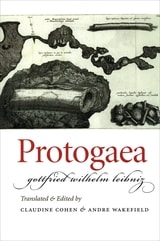
Protogaea, an ambitious account of terrestrial history, was central to the development of the earth sciences in the eighteenth century and provides key philosophical insights into the unity of Gottfried Wilhelm Leibniz’s thought and writings. In the book, Leibniz offers observations about the formation of the earth, the actions of fire and water, the genesis of rocks and minerals, the origins of salts and springs, the formation of fossils, and their identification as the remains of living organisms. Protogaea also includes a series of engraved plates depicting the remains of animals—in particular the famous reconstruction of a “fossil unicorn”—together with a cross section of the cave in which some fossil objects were discovered.

Though the works of Leibniz have been widely translated, Protogaea has languished in its original Latin for centuries. Now Claudine Cohen and Andre Wakefield offer the first English translation of this central text in natural philosophy and natural history. Written between 1691 and 1693, and first published after Leibniz’s death in 1749, Protogaea reemerges in this bilingual edition with an introduction that carefully situates the work within its historical context.
[more]