177 books match the query 'Equality' and 7 start with p
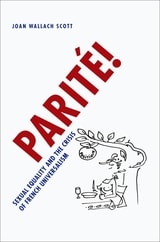
cover of Parité!: Sexual Equality and the Crisis of French Universalism

Parité!

Sexual Equality and the Crisis of French Universalism

Joan Wallach Scott

University of Chicago Press, 2005

France today is in the throes of a crisis about whether to represent social differences within its political system and, if so, how. It is a crisis defined by the rhetoric of a universalism that takes the abstract individual to be the representative not only of citizens but also of the nation. In Parité! Joan Wallach Scott shows how the requirement for abstraction has led to the exclusion of women from French politics. 

During the 1990s, le mouvement pour la parité successfully campaigned for women's inclusion in elective office with an argument that is unprecedented in the annals of feminism. The paritaristes insisted that if the abstract individual were thought of as sexed, then sexual difference would no longer be a relevant consideration in politics. Scott insists that this argument was neither essentialist nor separatist; it was not about women's special qualities or interests. Instead, parité was rigorously universalist—and for that reason was both misunderstood and a source of heated debate.
[more]
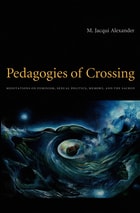
cover of Pedagogies of Crossing: Meditations on Feminism, Sexual Politics, Memory, and the Sacred

Pedagogies of Crossing

Meditations on Feminism, Sexual Politics, Memory, and the Sacred

M. Jacqui Alexander

Duke University Press, 2005

M. Jacqui Alexander is one of the most important theorists of transnational feminism working today. Pedagogies of Crossing brings together essays she has written over the past decade, uniting her incisive critiques, which have had such a profound impact on feminist, queer, and critical race theories, with some of her more recent work. In this landmark interdisciplinary volume, Alexander points to a number of critical imperatives made all the more urgent by contemporary manifestations of neoimperialism and neocolonialism. Among these are the need for North American feminism and queer studies to take up transnational frameworks that foreground questions of colonialism, political economy, and racial formation; for a thorough re-conceptualization of modernity to account for the heteronormative regulatory practices of modern state formations; and for feminists to wrestle with the spiritual dimensions of experience and the meaning of sacred subjectivity.

In these meditations, Alexander deftly unites large, often contradictory, historical processes across time and space. She focuses on the criminalization of queer communities in both the United States and the Caribbean in ways that prompt us to rethink how modernity invents its own traditions; she juxtaposes the political organizing and consciousness of women workers in global factories in Mexico, the Caribbean, and Canada with the pressing need for those in the academic factory to teach for social justice; she reflects on the limits and failures of liberal pluralism; and she presents original and compelling arguments that show how and why transgenerational memory is an indispensable spiritual practice within differently constituted women-of-color communities as it operates as a powerful antidote to oppression. In this multifaceted, visionary book, Alexander maps the terrain of alternative histories and offers new forms of knowledge with which to mold alternative futures.
[more]
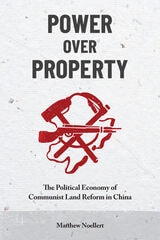
cover of Power over Property: The Political Economy of Communist Land Reform in China

Power over Property

The Political Economy of Communist Land Reform in China

Matthew Noellert

University of Michigan Press, 2020

Following the end of World War II in 1945, the Chinese Communist Party (CCP) spent the next three decades carrying out agrarian reform among nearly one-third of the world’s peasants. This book presents a new perspective on the first step of this reform, when the CCP helped redistribute over 40 million hectares of land to over three hundred million impoverished peasants in the nationwide land reform movement. This land reform, the founding myth of the People’s Republic of China (1949–present) and one of the largest redistributions of wealth and power in history, embodies the idea that an equal distribution of property will lead to social and political equality.
 
Power Over Property argues that in practice, however, the opposite occurred: the redistribution of political power led to a more equal distribution of property. China’s land reform was accomplished not only through the state’s power to define the distribution of resources, but also through village communities prioritizing political entitlements above property rights. Through the systematic analysis of never-before studied micro-level data on practices of land reform in over five hundred villages, Power Over Property demonstrates how land reform primarily involved the removal of former power holders, the mobilization of mass political participation, and the creation of a new social-political hierarchy. Only after accomplishing all of this was it possible to redistribute land. This redistribution, moreover, was determined by political relations to a new structure of power, not just economic relations to the means of production.
 
The experience of China’s land reform complicates our understanding of the relations between economic, social, and political equality. On the one hand, social equality in China was achieved through political, not economic means. On the other hand, the fundamental solution was a more effective hierarchy of fair entitlements, not equal rights. This book ultimately suggests that focusing on economic equality alone may obscure more important social and political dynamics in the development of the modern world.

[more]
cover of Predatory Welfare: Debt, Race, and Cash Transfers

Predatory Welfare

Debt, Race, and Cash Transfers

Erin Torkelson

Duke University Press, 2026
In Predatory Welfare, Erin Torkelson explores how the direct cash transfer program instituted in South Africa revised and reworked post-apartheid racialized and gendered dispossession, despite its promise of ameliorating extreme poverty. Beginning in 2012, she focuses on how poor Black South African women asserted their entitlements to social assistance and responsibilities for familial care against the pressures of expropriation built into the grant payment system. Because the grants did not cover monthly bills, recipients were pushed into predatory loans collateralized by welfare payments. Torkelson finds that the state-sponsored but privately-run program was fundamentally undermined by its reliance on digital financial technologies which encoded wider forces of colonial rule, nationalist politics, and global development. Even when the government assumed control of grant payment in 2018, the neoliberal bent of fiscal policy continued to drive recipients into debt in new ways. Drawing on seven years of ethnographic fieldwork and organization—in grant payment queues, loan offices, grocery stores, Parliament, and the Constitutional Court—Torkelson demonstrates how cash transfers can offer a means to making racial capitalism more acceptable and how recipients can push back to demand reparation.
[more]
cover of Prismatic Metropolis: Inequality in Los Angeles

Prismatic Metropolis

Inequality in Los Angeles

Lawrence D. Bobo

Russell Sage Foundation, 2000
This book cuts through the powerful mythology surrounding Los Angeles to reveal the causes of inequality in a city that has weathered rapid population change, economic restructuring, and fractious ethnic relations. The sources of disadvantage and the means of getting ahead differ greatly among the city's myriad ethnic groups. The demand for unskilled labor is stronger here than in other cities, allowing Los Angeles's large population of immigrant workers with little education to find work in light manufacturing and low-paid service jobs. A less beneficial result of this trend is the increased marginalization of the city's low-skilled black workers, who do not enjoy the extended ethnic networks of many of the new immigrant groups and who must contend with persistent negative racial stereotypes. Patterns of residential segregation are also more diffuse in Los Angeles, with many once-black neighborhoods now split evenly between blacks, Hispanics, Asians, and other minorities. Inequality in Los Angeles cannot be reduced to a simple black-white divide. Nonetheless, in this thoroughly multicultural city, race remains a crucial factor shaping economic fortunes. A Volume in the Multi-City Study of Urban Inequality
[more]
cover of Promissory Notes: On the Literary Conditions of Debt

Promissory Notes

On the Literary Conditions of Debt

Robin Truth Goodman

Lever Press, 2018

There is no doubt that the beginning of the twenty-first century was marked by crises of debt. Less well known is that literature played a historical role in defining and teaching debt to the public. Promissory Notes: On the Literary Conditions of Debt addresses how neoliberal finance has depended upon a historical linking of geopolitical inequality and financial representation that positions the so-called “Third World” as negative value, or debt. Starting with an analysis of Anthony Trollope’s novel, The Eustace Diamonds, Goodman shows how colonized spaces came to inhabit this negative value. Promissory Notes argues that the twentieth-century continues to apply literary innovations in character, subjectivity, temporal and spatial representation to construct debt as the negative creation of value not only in reference to objects, but also houses, credit cards, students, and, in particular, “Third World” geographies, often leading to crisis. Yet, late twentieth century and early twenty-first literary texts, such as Soyinka’s The Road and Ngugi’s Wizard of the Crow, address the negative space of the indebted world also as a critique of the financial take-over of the postcolonial developmental state. Looking to situations like the Puerto Rican debt crisis, Goodman demonstrates how financial discourse is articulated through social inequalities and how literature can both expose and contest the imposition of a morality of debt as a mode of anti-democratic control.
[more]
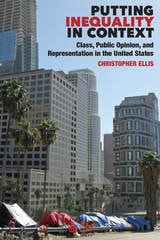
cover of Putting Inequality in Context: Class, Public Opinion, and Representation in the United States

Putting Inequality in Context

Class, Public Opinion, and Representation in the United States

Christopher Ellis

University of Michigan Press, 2017

Rising income inequality is highlighted as one of the largest challenges facing the United States, affecting civic participation and political representation. Although the wealthy often can and do exert more political influence, this is not always the case. To fix political inequality, it is important to understand exactly how class divisions manifest themselves in political outcomes, and what factors serve to enhance, or depress, inequalities in political voice.

Christopher Ellis argues citizens’—and legislators’—views of class politics are driven by lived experience in particular communities. While some experience is formally political, on an informal basis citizens learn a great deal about their position in the broader socioeconomic spectrum and the social norms governing how class intersects with day-to-day life. These factors are important for policymakers, since most legislators do not represent “the public” at large, but specific constituencies.

Focusing on U.S. congressional districts as the contextual unit of interest, Ellis argues individuals’ political behavior cannot be separated from their environment, and shows how income’s role in political processes is affected by the contexts in which citizens and legislators interact. Political inequality exists in the aggregate, but it does not exist everywhere. It is, rather, a function of specific arrangements that depress the political influence of the poor. Identifying and understanding these factors is a crucial step in thinking about what reforms might be especially helpful in enhancing equality of political voice.


[more]