Results by title
377 books match the query 'French' and 16 start with p
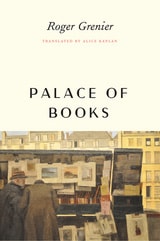
Palace of Books
Roger Grenier
University of Chicago Press, 2014
With Palace of Books, he invites us to explore the domain of literature, its sweeping vistas and hidden recesses. Engaging such fundamental questions as why people feel the need to write, or what is involved in putting one’s self on the page, or how a writer knows she’s written her last sentence, Grenier marshals apposite passages from his favorite writers: Chekhov, Baudelaire, Proust, James, Kafka, Mansfield and many others. Those writers mingle companionably with tales from Grenier’s half-century as an editor and friend to countless legendary figures, including Albert Camus, Romain Gary, Milan Kundera, and Brassai,.
Grenier offers here a series of observations and quotations that feel as spontaneous as good conversation, yet carry the lasting insights of a lifetime of reading and thinking. Palace of Books is rich with pleasures and surprises, the perfect accompaniment to old literary favorites, and the perfect introduction to new ones.
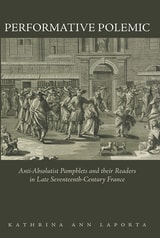
Performative Polemic
Anti-Absolutist Pamphlets and their Readers in Late Seventeenth-Century FranceKathrina Ann LaPorta
University of Delaware Press, 2021
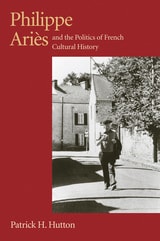
Philippe Aries and the Politics of French Cultural History
Patrick H. Hutton
University of Massachusetts Press, 2004
The author of Centuries of Childhood and other landmark historical works, Philippe Ariès (1914–1984) was a singular figure in French intellectual life. He was both a political reactionary and a path-breaking scholar, a sectarian royalist who supported the Vichy regime and a founder of the new cultural history—popularly known as l'histoire des mentalités—that developed in the decades following World War II. In this book, Patrick H. Hutton explores the relationship between Ariès's life and thought and evaluates his contribution to modern historiography, in France and abroad.
According to Hutton, the originality of Ariès's work and the power of his appeal derived from the way he drew together the two strands of his own intellectual life: his enduring ties to the old cultural order valued by the right-wing Action Française, and a newfound appreciation for the methodology of the leftist Annales school of historians. A demographer by training, he pioneered a new route into the history of private life that eventually won him a wide readership and in late life an appointment to the faculty of the prestigious École des Hautes Études en Sciences Sociales. At the same time, he fashioned himself as a man of letters in the intellectual tradition of the Action Française and became a perspicacious journalist as well as a stimulating writer of autobiographical memoirs. In Hutton's view, this helps explain why, more than any other historian, Philippe Ariès left his personal signature on his scholarship.
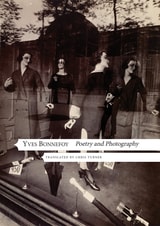
Poetry and Photography
Yves Bonnefoy
Seagull Books, 2017
Bonnefoy's compact essay focuses on one of the disturbing effects of the earliest photographs: their introduction of a notion of non-being—if not, indeed, nothingness—into the world of images. But it also foregrounds a tale which seems to have picked up figuratively on this effect and examined its dangers with a sense of horror: Guy de Maupassant’s extraordinary short story “The Night,” one of the nightmarish works of his last period of conscious creation.

Poets as Readers in Nineteenth-Century France
Critical ReflectionsEdited by Joseph Acquisto, Adrianna M. Paliyenko, and Catherine Witt
University of London Press, 2015
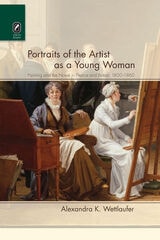
Portraits of the Artist as a Young Woman
Painting and the Novel in France and Britain, 1800–1860Alexandra K. Wettlaufer
The Ohio State University Press, 2011
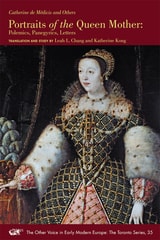
Portraits of the Queen Mother
Polemics, Panegyrics, LettersCatherine de Médicis and Others
Iter Press, 2014
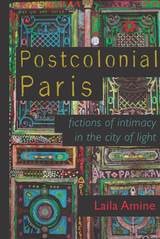
Postcolonial Paris
Fictions of Intimacy in the City of LightLaila Amine
University of Wisconsin Press, 2021
Spanning the decades from the post–World War II era to the present day, Amine demonstrates that the postcolonial other is both peripheral to and intimately entangled with all the ideals so famously evoked by the French capital—romance, modernity, equality, and liberty. In their work, postcolonial writers and artists have juxtaposed these ideals with colonial tropes of intimacy (the interracial couple, the harem, the Arab queer) to expose their hidden violence. Amine highlights the intrusion of race in everyday life in a nation where, officially, it does not exist.
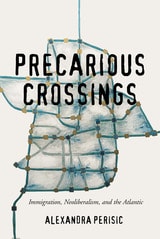
Precarious Crossings
Immigration, Neoliberalism, and the AtlanticAlexandra Perisic
The Ohio State University Press, 2019
Perisic argues that in traveling beyond the postcolonial route that connects former colonizer and former colonized, these authors also shift their focus from cultural difference and national belonging to precarity—a condition characterized by a lack of economic and social stability and protection—as a shared characteristic under global neoliberalization. She demonstrates how contemporary Atlantic narratives reveal the contradictions inherent in neoliberalism as an ideology—thereby showing how they further participate in Atlantic literary and cultural dialogues and push against literary conventions of various genre as they explore the complexities of a globalized Atlantic.
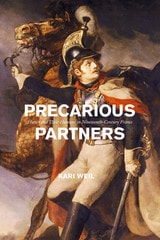
Precarious Partners
Horses and Their Humans in Nineteenth-Century FranceKari Weil
University of Chicago Press, 2020
Weil traces the evolving partnerships established between French citizens and their horses through this era. She considers the newly designed “races” of workhorses who carried men from the battlefield to the hippodrome, lugged heavy loads through the boulevards, or paraded women riders, amazones, in the parks or circus halls—as well as those unfortunate horses who found their fate on a dinner plate. Moving between literature, painting, natural philosophy, popular cartoons, sports manuals, and tracts of public hygiene, Precarious Partners traces the changing social, political, and emotional relations with these charismatic creatures who straddled conceptions of pet and livestock in nineteenth-century France.
Preliminary Discourse to the Encyclopedia of Diderot
Jean Le Rond d'Alembert
University of Chicago Press, 1995
Proust among the Nations
From Dreyfus to the Middle EastJacqueline Rose
University of Chicago Press, 2011
Known for her far-reaching examinations of psychoanalysis, literature, and politics, Jacqueline Rose has in recent years turned her attention to the Israel-Palestine conflict, one of the most enduring and apparently intractable conflicts of our time. In Proust among the Nations, she takes the development of her thought on this crisis a stage further, revealing it as a distinctly Western problem.
Proust in Perspective
VISIONS AND REVISIONSEdited by Armine Kotin Mortimer and Katherine Kolb
University of Illinois Press, 2002
In nineteen original essays, a foreword by Jean–Yves Tadié, and an introduction by editors Armine Kotin Mortimer and Katherine Kolb, this volume guides readers through the dense weave of Proust's fiction and correspondence. The essays take us into the realm of Proustian language–-as quotation, metaphor, and memory–-and into art history and musical ideology, connecting the art of words with the words of art. They explore the interface of history and fiction, the mysteries of the text's evolution, and the dilemmas of its publication. They present the revelations of genetic criticism and the surprises of gender analysis.
Taken together, these essays conjure a multifaceted profile of Proust–-his work, life, character, and influence–-and of new directions in Proust scholarship today. With compelling rigor and infectious enthusiasm, Proust in Perspective conveys the magnitude of Proust's continuing appeal.
Proust's Deadline
Christine M. Cano
University of Illinois Press, 2006
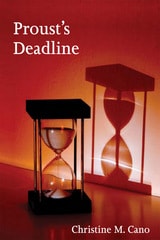
Marcel Proust’s multivolume masterpiece, À la recherche du temps perdu, began to appear in 1913. Over the next fifty years, it gained a reputation as one of the greatest literary works of the twentieth century. But the novel’s classic image as a completed work was later shattered by the discovery of unpublished drafts, and the “war of the Prousts” has kept scholars arguing over its definitive form ever since.
Christine M. Cano’s Proust’s Deadline presents a concise history of the publishing and reception of À la recherche du temps perdu, and sorts out the most important issues that have arisen from the ensuing debates about the text. She ultimately shows how this quintessential “book about time” tells another story about time’s passage: the story of Proust’s mortal confrontation with the temporality of writing, publishing, and reading.
Proust, a Family Affair
Laure Murat
University of Chicago Press, 0
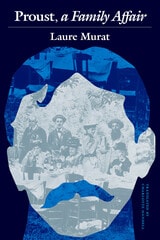
A personal take on Proust’s In Search of Lost Time, written by a woman born into the aristocratic world it describes.
Proust’s In Search of Lost Time is many things: a staggering literary achievement, an evocation of an elite milieu, a complex reckoning with memory. For Laure Murat, it was also a map of the world into which she was born—the world of the French Aristocracy. Descended from French nobility on both sides, Murat saw the châteaux and balls of In Search of Lost Time as the backdrop to her own family story, understood anew through Proust’s eyes.
In this beautiful book, Murat explores both the oppressive constraints of the aristocratic life and the fluidity and linguistic virtuosity of Proust’s astonishing seven-volume novel, which shifts focus from codes of behavior to the experience of living. In Proust, a Family Affair, Murat celebrates the emancipating power of literature and the rewards of paying close attention to a text that may, in turn, provoke a close and loving attendance to the self.
Originally published in French, Proust, a Family Affair has won the Prix Médicis and was shortlisted for France’s most coveted literary award, the Prix Goncourt. This readable, moving translation into English by Charlotte Mandell will appeal to lovers of Proust and to all readers who appreciate personal explorations of literary masterpieces.

Provinces of the Mind
The Modern Novel on Provincial TimeVictoria Baena
University of Chicago Press, 2027
How the provinces, rather than cities or capitals, became the key setting dramatized in—but also transformed by—modern novels in English and French.
To be provincial is to mistake one’s narrow milieu for the world: it is to fall prey to an error of scale. But it is also to feel behind, belated, and excluded from the possibilities of the modern world. In this elegant study of the novel “on provincial time,” Victoria Baena argues that the literary geography of “the provinces” played a key role in forging European narratives of modernity.
In the wake of French revolutionaries’ suppression of older provincial identities and as Britain expanded its imperial reach, the provinces were reinvented on various scales: from countryside to small town, from domestic region to faraway colony. Baena brings together Marxist and feminist spatial theory with a close attention to the politics of narrative form in order to show how the remarkably mobile concept of the provinces developed across social and cultural frameworks from 1800 to 1933. Offering new interpretations of novels of the realist tradition—by Honoré de Balzac, George Eliot, Emily Brontë, George Sand, Thomas Hardy, Marcel Proust, Alain-Fournier, James Joyce, and Claude McKay—she shows how the question of representing the provinces transformed the modern novel.
Provinces of the Mind illuminates some of the more pernicious fictions of provincialism. But it also describes, often movingly, the desire no longer to be provincial, along with the ambivalence and alienation that can entail. Ultimately, the book shows how literary critics can use the provinces to translate questions of literary geography across borders. By interrogating the provincialisms of our own time and place, Baena suggests, critics might make a better case for those worth retaining, as well as a better grasp of those to be left behind.