Results by title
96 books match the query 'Games & Activities' and 9 start with p

Pikachu's Global Adventure
The Rise and Fall of PokemonJoseph Tobin, ed.
Duke University Press, 2004
In analyzing the popularity of Pokémon, this innovative volume addresses core debates about the globalization of popular culture and about children’s consumption of mass-produced culture. Topics explored include the origins of Pokémon in Japan’s valorization of cuteness and traditions of insect collecting and anime; the efforts of Japanese producers and American marketers to localize it for foreign markets by muting its sex, violence, moral ambiguity, and general feeling of Japaneseness; debates about children’s vulnerability versus agency as consumers; and the contentious question of Pokémon’s educational value and place in school. The contributors include teachers as well as scholars from the fields of anthropology, media studies, sociology, and education. Tracking the reception of Pokémon in Japan, the United States, Great Britain, France, and Israel, they emphasize its significance as the first Japanese cultural product to enjoy substantial worldwide success and challenge western dominance in the global production and circulation of cultural goods.
Contributors. Anne Allison, Linda-Renée Bloch, Helen Bromley, Gilles Brougere, David Buckingham, Koichi Iwabuchi, Hirofumi Katsuno, Dafna Lemish, Jeffrey Maret, Julian Sefton-Green, Joseph Tobin, Samuel Tobin, Rebekah Willet, Christine Yano

Play Redux
The Form of Computer GamesDavid Myers
University of Michigan Press, 2010
"Play Redux excels in tying together intellectual traditions that are rooted in literary studies, cognitive science, play studies and several other fields, thereby creating a logical whole. Through this, the book makes service to several academic communities by pointing out their points of contact. This is clearly an important contribution to a growing academic field, and will no doubt become important in many future discussions about digital games and play."
---Frans Mäyrä, University of Tampere, Finland
"David Myers has researched video games longer than anyone else. Play Redux shows him continually relevant, never afraid of courting controversy."
---Jesper Juul, IT University of Copenhagen, Denmark
Play Redux is an ambitious description and critical analysis of the aesthetic pleasures of video game play, drawing on early twentieth-century formalist theory and models of literature. Employing a concept of biological naturalism grounded in cognitive theory, Myers argues for a clear delineation between the aesthetics of play and the aesthetics of texts. In the course of this study, Myers asks a number of interesting questions: What are the mechanics of human play as exhibited in computer games? Can these mechanisms be modeled? What is the evolutionary function of cognitive play, and is it, on the whole, a good thing? Intended as a provocative corrective to the currently ascendant, if not dominant, cultural and ethnographic approach to game studies and play, Play Redux will generate interest among scholars of communications, new media, and film.
David Myers is Reverend Aloysius B. Goodspeed Distinguished Professor at the School of Mass Communication, Loyola University New Orleans.
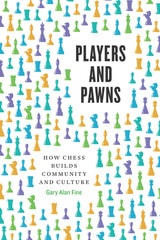
Players and Pawns
How Chess Builds Community and CultureGary Alan Fine
University of Chicago Press, 2015
Full of idiosyncratic characters and dramatic gameplay, Players and Pawns is a celebration of the fascinating world of serious chess.

Playing Hearts
Dan Kois
Duke University Press, 2027

Playing Nature
Ecology in Video GamesAlenda Y. Chang
University of Minnesota Press, 2019
A potent new book examines the overlap between our ecological crisis and video games
Video games may be fun and immersive diversions from daily life, but can they go beyond the realm of entertainment to do something serious—like help us save the planet? As one of the signature issues of the twenty-first century, ecological deterioration is seemingly everywhere, but it is rarely considered via the realm of interactive digital play. In Playing Nature, Alenda Y. Chang offers groundbreaking methods for exploring this vital overlap.
Arguing that games need to be understood as part of a cultural response to the growing ecological crisis, Playing Nature seeds conversations around key environmental science concepts and terms. Chang suggests several ways to rethink existing game taxonomies and theories of agency while revealing surprising fundamental similarities between game play and scientific work.
Gracefully reconciling new media theory with environmental criticism, Playing Nature examines an exciting range of games and related art forms, including historical and contemporary analog and digital games, alternate- and augmented-reality games, museum exhibitions, film, and science fiction. Chang puts her surprising ideas into conversation with leading media studies and environmental humanities scholars like Alexander Galloway, Donna Haraway, and Ursula Heise, ultimately exploring manifold ecological futures—not all of them dystopian.
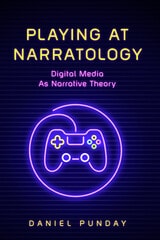
Playing at Narratology
Digital Media as Narrative TheoryDaniel Punday
The Ohio State University Press, 2019
Returning to terms such as narrator, setting, event, character, and world, Playing at Narratology reveals new ways of thinking about these basic narrative concepts—concepts that are not so basic when applied to games and web-based narratives. What are thought of as narrative innovations in these digital forms are a product of technological ability and tied to how we physically interact with a medium, creating new and complicated questions: Is the game designer the implied author or the narrator? Is the space on the screen simply the story’s setting? Playing at Narratology guides us through the evolution of narrative in new media without abandoning the field’s theoretical foundations.
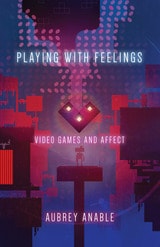
Playing with Feelings
Video Games and AffectAubrey Anable
University of Minnesota Press, 2018
How gaming intersects with systems like history, bodies, and code
Why do we so compulsively play video games? Might it have something to do with how gaming affects our emotions? In Playing with Feelings, scholar Aubrey Anable applies affect theory to game studies, arguing that video games let us “rehearse” feelings, states, and emotions that give new tones and textures to our everyday lives and interactions with digital devices. Rather than thinking about video games as an escape from reality, Anable demonstrates how video games—their narratives, aesthetics, and histories—have been intimately tied to our emotional landscape since the emergence of digital computers.
Looking at a wide variety of video games—including mobile games, indie games, art games, and games that have been traditionally neglected by academia—Anable expands our understanding of the ways in which these games and game studies can participate in feminist and queer interventions in digital media culture. She gives a new account of the touchscreen and intimacy with our mobile devices, asking what it means to touch and be touched by a game. She also examines how games played casually throughout the day create meaningful interludes that give us new ways of relating to work in our lives. And Anable reflects on how games allow us to feel differently about what it means to fail.
Playing with Feelings offers provocative arguments for why video games should be seen as the most significant art form of the twenty-first century and gives the humanities passionate, incisive, and daring arguments for why games matter.
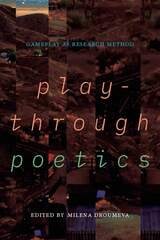
Playthrough Poetics
Gameplay as Research MethodMilena Droumeva
Amherst College Press, 2025
Rigorous scholarship meets cultural practice in this innovative, multi-modal edited collection that includes video essays and offers transcripts of the playthroughs themselves. Readers (and viewers) will come away with a toolkit of models, case studies, and conceptual frameworks for analyzing video games through gameplay. This volume is a fresh return to the joy of play: the poetics of games as contemporary forms of storytelling and interactivity.
With contributions from Ashlee Bird, Brandon Blackburn, Milena Droumeva, Kishonna Gray, Robyn Hope, Ben Scholl, Maria Sommers, Ashlyn Sparrow, Christine Tran, and Aaron Trammell.
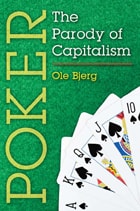
Poker
The Parody of CapitalismOle Bjerg
University of Michigan Press, 2011
Poker is an extraordinary worldwide phenomenon with major social, cultural, and political implications, and Poker: The Parody of Capitalism investigates the game of poker as a cultural expression of significance not unlike art, literature, film, or music. Tracing the history of poker and comparing the evolution of the game to the development of capitalism, Ole Bjerg complicates prevalent notions of “casino capitalism” and correspondingly facile and simplistic comparisons of late capitalism and poker. By employing Slavoj Žižek’s threefold distinction between imaginary-symbolic-real as a philosophical framework to analyze poker and to understand the basic strategies of the game, Bjerg explores the structural characteristics of poker in relation to other games, making a clear distinction between poker and other gambling games of pure chance such as roulette and craps. With its combination of social theory and empirical research, Poker offers an engaging exploration of a cultural trend.
"Poker is a theoretically sophisticated, highly original and innovative treatment of a contemporary social phenomenon, and contributes greatly to our understanding of the nature of contemporary capitalism."
—Charles Livingstone, Monash University Australia