Results by title
212 books match the query 'German' and 13 start with p
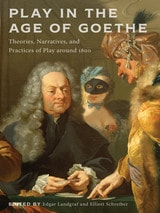
Play in the Age of Goethe
Theories, Narratives, and Practices of Play around 1800Edgar Landgraf
Bucknell University Press, 2020
Published by Bucknell University Press. Distributed worldwide by Rutgers University Press.

Poetic Writing and the Vietnam War in West Germany
On fireMererid Puw Davies
University College London, 2023
Though the Vietnam War did not directly involve West Germany, it was nonetheless a decisive catalyst for the era’s wider protest movements in that country, and it gave rise to an ardent anti-war discourse. Poetry and poetic writing were key to anti-war work. Hundreds of poems and related writings about Vietnam circulated in West Germany, yet they are almost entirely forgotten today. Poetic Writing and the Vietnam War in West Germany uncovers and explores some of that rich artistic production in order to present a new history of engaged poetic writing in West Germany in the 1960s and 1970s and to draw out distinctive characteristics of wider protest culture. In doing so, it makes the case for attending to marginal, non-canonical, or neglected literary and cultural forms, and for critical thinking about why they might, over time, have been obscured. The book also offers a case study for reflection on the representation of war, on ways in which German oppositional culture could imagine its others, and on the relationship of poetry to the historical world.
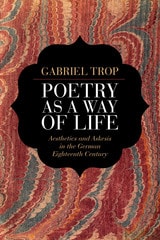
Poetry as a Way of Life
Aesthetics and Askesis in the German Eighteenth CenturyGabriel Trop
Northwestern University Press, 2014
What would it mean to make a work of art the focal point of one’s life practice? Poetry as a Way of Life goes back to the origins of aesthetics as a philosophical discipline in the early eighteenth century in order to uncover an understanding of the work of art as an exercise of the self. Engaging in close readings of works by both canonical and less well-known eighteenth-century German poets such as Friedrich Holderlin, Novalis, Friedrich von Hagedorn, and Johann Wilhelm Ludwig Gleim, Gabriel Trop illustrates the ways in which these authors tap into the potential of poetic form to redefine the limits of human perception and generate alternative ways of being in the world.
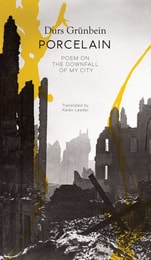
Porcelain
Poem on the Downfall of My CityDurs Grünbein
Seagull Books, 2020
Porcelain is a book-length cycle of forty-nine poems written over the course of more than a decade that together serve as a lament for Durs Grünbein’s hometown, Dresden, which was destroyed in the Allied firebombing of February 1945. The book is at once a history and “declaration of love” to the famed “Venice on the Elbe,” so catastrophically razed by British bombs; a musical fusion of eyewitness accounts, family memories, and stories, of monuments and relics; the story of the city’s destiny as seen through a prism of biographical enigmas, its intimate relation to the “white gold” porcelain that made its fortune and reflections on the power and limits of poetry. Musical, fractured, ironic, and elegiac, Porcelain is controversial, too, in setting itself against what Grünbein calls the “myth” of the Germans as innocent victims of a war crime. At the same time, it never loses sight of the horror deliberately visited on an unwitting civilian population, nor the devastation that looms so large in the German memory. Published for the first time in English, on the seventy-fifth year anniversary of the firebombing, this edition contains new images, notes, Grünbein’s own reflections, and an additional canto—an extraordinary act of poetic kintsugi for the fractured remains of Dresden’s memory.
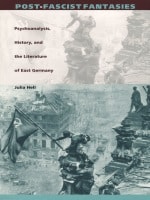
Post-Fascist Fantasies
Psychoanalysis, History, and the Literature of East GermanyJulia Hell
Duke University Press, 1997
By focusing on the unconscious fantasies about post-fascist body and post-fascist voice that suffuse the texts of Wolf and others, Hell radically reconceptualizes the notion of the author’s subjective authenticity. Since this notion occupies a key position in previous literary-historical accounts of East German culture, Hell’s psychoanalytic approach problematizes the established literary model of an "authentic feminine voice" that gradually liberates itself from the GDR’s dominant ideological narrative. Far from operating solely on a narrowly political level, the novels of Wolf and others were intricate family sagas portraying psychic structures linked in complex ways to the GDR’s social dynamics. Hell traces this link through East German literatrure’s dominant narrative, a paternal narrative organized around the figure of the Communist father as antifascist hero.
Postsecular Benjamin
Agency and TraditionBrian Britt
Northwestern University Press, 2016
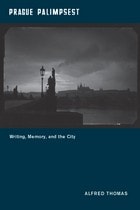
Prague Palimpsest
Writing, Memory, and the CityAlfred Thomas
University of Chicago Press, 2010
A city of immense literary mystique, Prague has inspired writers across the centuries with its beauty, cosmopolitanism, and tragic history. Envisioning the ancient city in central Europe as a multilayered text, or palimpsest, that has been constantly revised and rewritten—from the medieval and Renaissance chroniclers who legitimized the city’s foundational origins to the modernists of the early twentieth century who established its reputation as the new capital of the avant-garde—Alfred Thomas argues that Prague has become a paradoxical site of inscription and effacement, of memory and forgetting, a utopian link to the prewar and pre-Holocaust European past and a dystopia of totalitarian amnesia.
Considering a wide range of writers, including the city’s most famous son, Franz Kafka, Prague Palimpsest reassesses the work of poets and novelists such as Bohumil Hrabal, Milan Kundera, Gustav Meyrink, Jan Neruda, Vítĕzslav Nezval, and Rainer Maria Rilke and engages with other famous authors who “wrote” Prague, including Guillaume Apollinaire, Ingeborg Bachmann, Albert Camus, Paul Celan, and W. G. Sebald. The result is a comparative, interdisciplinary study that helps to explain why Prague—more than any other major European city—has haunted the cultural and political imagination of the West.
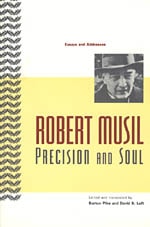
Precision and Soul
Essays and AddressesRobert Musil
University of Chicago Press, 1990
Best known as author of the novel The Man without Qualities, Robert Musil wrote these essays in Vienna and Berlin between 1911 and 1937. Offering a perspective on modern society and intellectual life, they are concerned with the crisis of modern culture as it manifests itself in science and mathematics, capitalism and nationalism, the changing roles of women and writers, and more. Writing to find his way in a world where moral systems everywhere were seemingly in decay, Musil strives to reconcile the ongoing conflict between functional relativism and the passionate search for ethical values.
Robert Musil was born in 1880 and died in 1942. His first novel, Young Törless, is available in English. A new two-volume translation by Burton Pike and Sophie Wilkins of The Man without Qualities is forthcoming from Alfred A. Knopf.
"Now we have these thirty-one invaluable and entertaining pieces, from an article on 'The Obscene and Pathological in Art' to the equally provocative talk 'On Stupidity,' which, with a new translation of The Man without Qualities forthcoming . . . amount to a literary event for the reader of English comparable to Constance Garnett's massive translation of Chekhov's stories."—Joseph Coates, Chicago Tribune
"Musil is one of the few great moderns, one of the handful who ventured to confront the issues that shape and define our time. . . . He has a range and a striking capacity every bit as great as that of Mann, Joyce, or Beckett."—Boston Review
"These essays are crucial in understanding a writer and critic whose lifelong task was an attempt to resolve the dichotomy between the precision of scientific form and the soul—the matter of life and art."—Choice
Preserving the Spell
Basile's "The Tale of Tales" and Its Afterlife in the Fairy-Tale TraditionArmando Maggi
University of Chicago Press, 2015
If we want to rediscover the power of fairy tales—as Armando Maggi thinks we should—we need to discover a new mythic lens, a new way of approaching and understanding, and thus re-creating, the transformative potential of these stories. In Preserving the Spell, Maggi argues that the first step is to understand the history of the various traditions of oral and written narrative that together created the fairy tales we know today. He begins his exploration with the ur-text of European fairy tales, Giambattista Basile’s The Tale of Tales, then traces its path through later Italian, French, English, and German traditions, with particular emphasis on the Grimm Brothers’ adaptations of the tales, which are included in the first-ever English translation in an appendix. Carrying his story into the twentieth century, Maggi mounts a powerful argument for freeing fairy tales from their bland contemporary forms, and reinvigorating our belief that we still can find new, powerfully transformative ways of telling these stories.
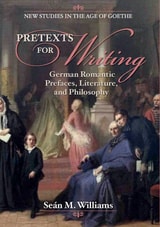
Pretexts for Writing
German Romantic Prefaces, Literature, and PhilosophyWilliams, Seán M
Bucknell University Press, 2019
Published by Bucknell University Press. Distributed worldwide by Rutgers University Press.
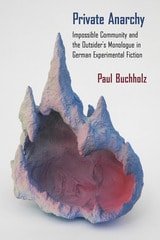
Private Anarchy
Impossible Community and the Outsider’s Monologue in German Experimental FictionPaul Buchholz
Northwestern University Press, 2018
Buchholz suggests that in their experimental prose Gustav Landauer, Franz Kafka, Thomas Bernhard, and Wolfgang Hilbig each considered how the "void" of mass society could be the precondition for a new, anarchic form of community that would rest not on any assumptions of shared origins or organic unity but on an experience of extreme emptiness that blurs the boundaries of the self and enables intimacy between total strangers. This community, Buchholz argues, is created through the verbal form most closely associated with alienation and isolation: the monologue.
By showing how these authors engaged with the idea of community and by relating these contributions to an extended intellectual genealogy of nihilism, Private Anarchy illustrates the distinct philosophical and sociopolitical stakes of German experimental writing in the twentieth century.
Prosaic Conditions
Heinrich Heine and the Spaces of Zionist LiteratureNa'ama Rokem
Northwestern University Press, 2013
Psyche Running
Selected Poems, 2005–2022Durs Grünbein
Seagull Books, 2023
Born in Dresden in 1962, Durs Grünbein is the most significant and successful poet of his generation in Germany. Since 1988, when the then-twenty-five-year-old burst onto the scene with his poetry collection Grauzone morgens—a mordant reckoning with the East Germany he grew up in—Grünbein has published more than thirty books of poetry and prose, which have been translated into dozens of languages.
In 2005 the volume Ashes for Breakfast introduced Grünbein to English-language readers for the first time by sampling poetry from his first four collections. Psyche Running picks up where that volume left off and offers a selection of poems from his nine subsequent collections, which shows how Grünbein has developed from his ironic take on the classical into an elegiac exploration of history through dream fragments and poems with a haunting existential unease.