Results by title
751 books match the query 'International Relations' and 50 start with p
PREDICTING POLITICS
Bruce Bueno de Mesquita
The Ohio State University Press, 2002
Palestine America, Volume 102
Mohammed Bamyeh, ed.
Duke University Press, 0
Bringing together a diverse group of contributors ranging from Roane Carey of the Nation to scholars in Arab, Jewish, and comparative literary studies, this special issue considers Palestinian gender and identity and their relationship to the conflict with Israel as represented in film, literature, and photography. Essays explore the failed peace process, misrepresentations of the Oslo meetings, the devastating effect of continued Israeli occupation of the Palestinian territories, and the growing controversy over the call for U.S. military divestment from Israel.
Contributors. Ammiel Alcalay, Amal Amireh, Mohammed Bamyeh, Roane Carey, Thomas W. Lockwood, Lisa Suhair Majaj, Saree Makdisi, Melani McAlister, Brinda J. Mehta, John Michael, Andrew N. Rubin, Kenneth Surin

Palestine's Horizon
Toward a Just PeaceRichard Falk
Pluto Press, 2017
Falk explores the intricacies and interconnections within the history and politics of Israel and Palestine, while delving into the complicated relationships the conflict has created within the global community. He refutes the notion that the Palestinian struggle is a lost cause and offers new tactics and possibilities for change. He also puts the ongoing conflict in context, reflecting on the legacy of Edward Said and drawing on the importance of his ideas as a humanist model for peace that is mindful of the formidable difficulties that come with achieving a solution to the long struggle. One of the most established and authoritative voices on the conflict, Falk now presents his most sustained and focused historical overview to date.
Palestinian Refugees
The Right of ReturnEdited by Naseer Aruri
Pluto Press, 2001
With renewed conflict in the Middle East, the prospect of a peaceful resolution looks more unlikely than ever. The Palestinian right of return to their homes has been upheld in international law and through United Nations' resolutions for fifty years. Equally the right of return has been denied by Israel and deferred to a "final status" issue in the Oslo Accords. It is on this right of return that the Palestinians are united. And it is this issue which is so frequently ignored by the international media.
With major contributions from a range of international experts, including Edward W. Said, Noam Chomsky, Ilan Pappe, Alain Gresh and Norman Finkelstein, this volume examines the Palestinians’ right of return. Chapters cover the historical roots of the Palestinian refugee question; the rights of the refugees under international law; the special case of Lebanon; Israeli perceptions of the refugee question; the practical feasibility of the return; the role of the United States and the European Union and the Refugee Question; the value of the refugee property; the principles of compensation; and a programme for an Independent Rights Campaign.
Panama Odyssey
By William J. Jorden
University of Texas Press, 1984
The Panama Canal Treaties of 1977 were the most significant foreign policy achievement of the Carter administration. Most Latin American nations had regarded the 1903 treaty and its later minor modifications as vestiges of "American colonialism" and obstacles to any long-term, stable relationship with the United States. Hence, at a time when conflicts were mushrooming in Central America, the significance of the new Panama treaties cannot be overestimated.
Former Ambassador to Panama William J. Jorden has provided the definitive account of the long and often contentious negotiations that produced those treaties. It is a vividly written reconstruction of the complicated process that began in 1964 and ended with ratification of the new pacts in 1978. Based on his personal involvement behind the scenes in the White House (1972–1974) and in the United States Embassy in Panama (1974–1978), Jorden has produced a unique living history. Access to documents and the personalities of both governments and, equally important, Jorden's personal recollections of participants on both sides make this historical study an incomparable document of U. S. foreign relations.
Beyond the singular story of the treaties themselves—and how diplomats negotiate in the modern world—is the rare description of how the United States deals with a major foreign policy problem. How does a superpower cope with a tiny nation that happens to occupy a strategically critical position? And how does the U. S. Senate face up to its constitutionally assigned power to "advise and consent"? Once treaties are approved, does the House of Representatives help or hinder? Panama Odyssey also deals with another crucial element in the shaping of policy—public opinion: how is it informed or led astray?
In sum, this is a history, a handbook on diplomacy, a course in government, and a revelation of foreign policy in action, all based on a fascinating and controversial episode in the U. S. experience.

Pandemic Solidarity
Mutual Aid during the Coronavirus CrisisMarina Sitrin
Pluto Press, 2020
“Helps us to rethink and re-imagine an egalitarian society where no one is left behind”—London School of Economics Review of Books
In times of crisis, when institutions of power are laid bare, people turn to one another. Pandemic Solidarity collects firsthand experiences from around the world of people creating their own narratives of solidarity and mutual aid in the time of the global crisis of COVID-19.
The world's media was quick to weave a narrative of selfish individualism, full of empty supermarket shelves and con-men. However, if you scratch the surface, you find a different story of community and self-sacrifice.
Looking at thirteen countries and regions, including India, Rojava, China and the US, the personal accounts in the book weave together to create a larger picture, revealing a universality of experience - a housewife in Istanbul supports her neighbor in the same way as a punk in Portland, and a grandmother in Italy does. Moving beyond the present, these stories reveal what an alternative society could look like, and reflect the skills and relationships we already have to create that society, challenging institutions of power that have already shown their fragility. Chapters include:
*Capitalism Kills, Solidarity Gives Life": A Glimpse of Solidarity Networks from Turkey
*Solidarity Network in Iraq During Covid-19: This Time the Enemy is Invisible
*Sharing Spaces and Crossing Borders: Voices from Taiwan
*Rethinking Minority and Mainstream in India
*Confronting State Authoritarianism: Civil Society and Community-Based Solidarity in Southern Africa
*On Intersectional Solidarity in Portugal
*Solidarity Networks in Greece
*Argentina: Injustices Magnified; Memories of Resistance Reactivated
*On Grassroots Organizing: Excerpts from Brazil
What happens to society when we are not held back by the neoliberal narrative? What can we do, to protect ourselves and one another, when we organize and act collectively? From the stories told here, maybe more than we expect.

Paradoxes of Nostalgia
Cold War Triumphalism and Global Disorder since 1989Penny M. Von Eschen
Duke University Press, 2022
Parallax Visions
Making Sense of American-East Asian Relations at the End of the CenturyBruce Cumings
Duke University Press, 1999
Using information based on thirty years of research, Cumings offers a new perspective on a wide range of issues that originated with the cold war—with particular focus on the possibly inappropriate collaboration between universities, foundations, and intelligence agencies. Seeking to explode the presuppositions that Americans usually bring to the understanding of our relations with East Asia, the study ranges over much of the history of the twentieth century in East Asian–American relations—Pearl Harbor, Hiroshima and Nagasaki, the Korean War, and more recent difficulties in U.S. relations with China and Japan. Cumings also rebuts U.S. media coverage of North Korea’s nuclear diplomacy in the 1990s and examines how experiences of colonialism and postcolonialism have had varying effects on economic development in each of these countries. Positing that the central defining experience of twentieth-century East Asia has been its entanglement first with British and Japanese imperialism, and then with the United States, Cumings ends with a discussion of how the situation could change over the next century as the economic and political global clout of the United States declines.
Illuminating the sometimes self-deluded ideology of cold war America, Parallax Visions will engage historians, political scientists, and students and scholars of comparative politics and social theory, as well as readers interested in questions of modernity and the role of the United States in shaping the destinies of modernizing societies in Asia.
Parity and War
Evaluations and Extensions of The War LedgerJacek Kugler and Douglas Lemke, Editors
University of Michigan Press, 1996
Partitioning Palestine
Legal Fundamentalism in the Palestinian-Israeli ConflictJohn Strawson
Pluto Press, 2010
Law lies at the roots of the Palestinian-Israeli conflict. Jews sought a national home by “Public Law” while Palestinians reject the project as illegal. Britain, the League of Nations and the United Nations all mobilised international law to justify their interventions. After the 1967 war, Israel organised an occupation with excessive legalism that most of the world viewed, in fact, as illegal.
Partitioning Palestine focuses on three key moments in the Palestinian-Israeli conflict: the League of Nations Mandate, the United Nations partition plan and the Oslo agreements. None of these documents are neutral but, rather, encode a variety of meanings. The book traces the way in which these legal narratives have both shaped national identity and sharpened the conflict.
In this pioneering text, John Strawson argues that a committed attachment to the belief in legal justice has hampered the search for a settlement. Law, far from offering conflict resolution, has reinforced the trenches from which Palestinians and Israelis confront one another.
Patents for Power
Intellectual Property Law and the Diffusion of Military TechnologyRobert M. Farley and Davida H. Isaacs
University of Chicago Press, 2020
The book probes two major issues: the effect of IP law on innovation itself and the effect of IP law on the international diffusion, or sharing, of technology. Discussing a range of inventions, from the AK-47 rifle to the B-29 Superfortress bomber to the MQ-1 Predator drone, the authors show how IP systems (or their lack) have impacted domestic and international relations across a number of countries, including the United States, Russia, China, and South Korea. The study finds, among other results, that while the open nature of the IP system may encourage industrial espionage like cyberwarfare, increased state uptake of IP law is helping to establish international standards for IP protection. This clear-eyed approach to law and national security is thus essential for anyone interested in history, political science, and legal studies.

Paying Calls in Shangri-La
Scenes from a Woman’s Life in American DiplomacyJudith M. Heimann
Ohio University Press, 2016
Judith M. Heimann entered the diplomatic life in 1958 to join her husband, John, in Jakarta, Indonesia, at his American Embassy post. This, her first time out of the United States, would set her on a path across the continents as she mastered the fine points of diplomatic culture. She did so first as a spouse, then as a diplomat herself, thus becoming part of one of the Foreign Service’s first tandem couples.
Heimann’s lively recollections of her life in Africa, Asia, and Europe show us that when it comes to reconciling our government’s requirements with the other government’s wants, shuttle diplomacy, Skype, and email cannot match on-the-ground interaction. The ability to gauge and finesse gesture, tone of voice, and unspoken assumptions became her stock-in-trade as she navigated, time and again, remarkably delicate situations.
This insightful and witty memoir gives us a behind-the-scenes look at a rarely explored experience: that of one of the very first married female diplomats, who played an unsung but significant role in some of the important international events of the past fifty years. To those who know something of today’s world of diplomacy, Paying Calls in Shangri-La will be an enlightening tour through the way it used to be—and for aspiring Foreign Service officers and students, it will be an inspiration.
Published in association with ADST-DACOR Diplomats and Diplomacy Series
Peacebuilding, Power, and Politics in Africa
Devon Curtis
Ohio University Press, 2012
Peacebuilding, Power, and Politics in Africa is a critical reflection on peacebuilding efforts in Africa. The authors expose the tensions and contradictions in different clusters of peacebuilding activities, including peace negotiations; statebuilding; security sector governance; and disarmament, demobilization, and reintegration. Essays also address the institutional framework for peacebuilding in Africa and the ideological underpinnings of key institutions, including the African Union, NEPAD, the African Development Bank, the Pan-African Ministers Conference for Public and Civil Service, the UN Peacebuilding Commission, the World Bank, and the International Criminal Court. The volume includes on-the-ground case study chapters on Sudan, the Great Lakes Region of Africa, Sierra Leone and Liberia, the Niger Delta, Southern Africa, and Somalia, analyzing how peacebuilding operates in particular African contexts.
The authors adopt a variety of approaches, but they share a conviction that peacebuilding in Africa is not a script that is authored solely in Western capitals and in the corridors of the United Nations. Rather, the writers in this volume focus on the interaction between local and global ideas and practices in the reconstitution of authority and livelihoods after conflict. The book systematically showcases the tensions that occur within and between the many actors involved in the peacebuilding industry, as well as their intended beneficiaries. It looks at the multiple ways in which peacebuilding ideas and initiatives are reinforced, questioned, reappropriated, and redesigned by different African actors.
A joint project between the Centre for Conflict Resolution in Cape Town, South Africa, and the Centre of African Studies at the University of Cambridge.
Peasants In Arms
War and Peace in the Mountains of Nicaragua, 1979–1994Lynn Horton
Ohio University Press, 1999
Drawing on testimonies from contra collaborators and ex-combatants, as well as pro-Sandinista peasants, this book presents a dynamic account of the growing divisions between peasants from the area of Quilalí who took up arms in defense of revolutionary programs and ideals such as land reform and equality and those who opposed the FSLN.
Peasants in Arms details the role of local elites in organizing the first anti-Sandinista uprising in 1980 and their subsequent rise to positions of field command in the contras. Lynn Horton explores the internal factors that led a majority of peasants to turn against the revolution and the ways in which the military draft, and family and community pressures reinforced conflict and undermined mid-decade FSLN policy shifts that attempted to win back peasant support.
People on the Move
The Security, Social, and Economic Implications of Mass Migration, Volume 15Nikolas A. Stavrou, ed.
Duke University Press, 0
This collection gathers a unique group of contributors, including representatives from Congress, the United Nations, and Israel’s Ministry of Justice, as well as senior diplomats from Canada, Bulgaria, Portugal, Spain, and Turkey. Presenting their diverse perspectives, the contributors address regional and policy issues related to the mass migration of people, as well as questions concerning citizenship and national security, human trafficking in the form of prostitution, and cultural discrimination. The result is a multifaceted exploration of issues underlying many of the world’s economic, security, and social challenges. Other topics include the impact of state failure on migration, immigration in California, security measures and “preferred” immigrants in Canada after September 11, 2001, and Albanian migration into Greece.
Contributors. Alexandre Afonso, David Binder, Andrew C. Danopoulos, Constantine P. Danopoulos, Francis M. Deng, Mohamed A. El-Khawas, Omar G. Encarnación, Rochelle Gershuni, Larry L. Gerston, Ahmet Içduygu, Benjamin Kline, Bojan Korenic, Erin Kruger, Robert S. Leiken, Marlene Mulder, Elena Poptodorova, Tom Tancredo

Peripheral Visions
Deterrence Theory and American Foreign Policy in the Third World, 1965-1990Ted Hopf
University of Michigan Press, 1994

Perspectives on War and Peace in Central America
Mis Lam#19Sung Ho Kim
Ohio University Press, 1992
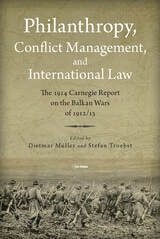
Philanthropy, Conflict Management and International Law
The 1914 Carnegie Report on the Balkan Wars of 1912/13Stefan Troebst
Central European University Press, 2022
This book centers on the Report of the International Commission to Inquire into the Causes and Conduct of the Balkan Wars, published in Washington in the early summer of 1914 by the Carnegie Endowment for International Peace. The volume was born from the conviction that the full assessment of the significance of the Carnegie Report—one of the first international non-governmental fact-finding missions with the intention to promote peace—requires a deeper exploration of the context of its birth.
The authors examine how the countries involved in the wars handled the inquires of the Carnegie Commission and the role of the report in the remembrance of the wars in the respective states. Although the report considered both the Ottoman Empire and the Balkan nation-states insufficiently civilized to wage wars within the limits of the codes of conduct of international law, this orientalist conclusion can in part be explained by the liberal internationalist strategy of the Carnegie Endowment, and of the commission members’ professional, political, and ethnic background. Overshadowed by the outbreak of World War I, the Carnegie Report’s direct impact on international arbitration or international criminal law was limited, yet—in the authors’ opinion—it ultimately contributed to the further juridification of international relations
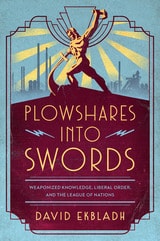
Plowshares into Swords
Weaponized Knowledge, Liberal Order, and the League of NationsDavid Ekbladh
University of Chicago Press, 2022
In Plowshares into Swords, David Ekbladh recaptures the power of knowledge and information developed between World War I and World War II by an international society of institutions and individuals committed to liberal international order and given focus by the League of Nations in Geneva. That information and analysis revolutionized critical debates in a world in crisis. In doing so, Ekbladh transforms conventional understandings of the United States’ postwar hegemony, showing that important elements of it were profoundly influenced by ideas that emerged from international exchanges. The League’s work was one part of a larger transnational movement that included the United States and which saw the emergence of concepts like national income, gross domestic product, and other attempts to define and improve the standards of living, as well as new approaches to old questions about the role of government. Forged as tools for peace these ideas were beaten into weapons as World War II threatened. Ekbladh recounts how, though the US had never been a member of the organization, vital parts of the League were rescued after the fall of France in 1940 and given asylum at the Institute for Advanced Study in Princeton. However, this presence in the US is just one reason its already well-regarded economic analyses and example were readily mobilized by influential American and international figures for an Allied “war of ideas,” plans for a postwar world, and even blueprints for the new United Nations. How did this body of information become so valuable? As Ekbladh makes clear, the answer is that information and analysis themselves became crucial currencies in global affairs: to sustain a modern, liberal global order, a steady stream of information about economics, politics, and society was, and remains, indispensable.
Plowshares into Swords
Weaponized Knowledge, Liberal Order, and the League of NationsDavid Ekbladh
University of Chicago Press, 2022
This is an Auto-narrated audiobook version of this book.
An in-depth look at how the ideas formulated by the interwar League of Nations shaped American thinking on the modern global order.
In Plowshares into Swords, David Ekbladh recaptures the power of knowledge and information developed between World War I and World War II by an international society of institutions and individuals committed to liberal international order and given focus by the League of Nations in Geneva. That information and analysis revolutionized critical debates in a world in crisis. In doing so, Ekbladh transforms conventional understandings of the United States’ postwar hegemony, showing that important elements of it were profoundly influenced by ideas that emerged from international exchanges. The League’s work was one part of a larger transnational movement that included the United States and which saw the emergence of concepts like national income, gross domestic product, and other attempts to define and improve the standards of living, as well as new approaches to old questions about the role of government. Forged as tools for peace these ideas were beaten into weapons as World War II threatened. Ekbladh recounts how, though the US had never been a member of the organization, vital parts of the League were rescued after the fall of France in 1940 and given asylum at the Institute for Advanced Study in Princeton. However, this presence in the US is just one reason its already well-regarded economic analyses and example were readily mobilized by influential American and international figures for an Allied “war of ideas,” plans for a postwar world, and even blueprints for the new United Nations. How did this body of information become so valuable? As Ekbladh makes clear, the answer is that information and analysis themselves became crucial currencies in global affairs: to sustain a modern, liberal global order, a steady stream of information about economics, politics, and society was, and remains, indispensable.
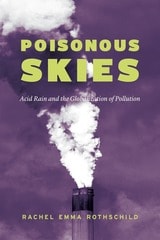
Poisonous Skies
Acid Rain and the Globalization of PollutionRachel Emma Rothschild
University of Chicago Press, 2019
The identification of acid rain in the 1960s changed scientific and popular understanding of fossil fuel pollution’s potential to cause regional—and even global—environmental harms. It showed scientists that the problem of fossil fuel pollution was one that crossed borders—it could travel across vast stretches of the earth’s atmosphere to impact ecosystems around the world. This unprecedented transnational reach prompted governments, for the first time, to confront the need to cooperate on pollution policies, transforming environmental science and diplomacy. Studies of acid rain and other pollutants brought about a reimagining of how to investigate the natural world as a complete entity, and the responses of policy makers, scientists, and the public set the stage for how societies have approached other prominent environmental dangers on a global scale, most notably climate change.
Grounded in archival research spanning eight countries and five languages, as well as interviews with leading scientists from both government and industry, Poisonous Skies is the first book to examine the history of acid rain in an international context. By delving deep into our environmental past, Rothschild hopes to inform its future, showing us how much is at stake for the natural world as well as what we risk—and have already risked—by not acting.
Polarizing Development
Alternatives to Neoliberalism and the CrisisEdited by Lucia Pradella and Thomas Marois
Pluto Press, 2015
The global economic crisis has exposed the limits of neoliberalism and dramatically deepened social polarization. Yet, despite increasing social resistance and opposition, neoliberalism prevails globally.
Radical alternatives, moreover, are only rarely debated. And if they are, such alternatives are reduced to new Keynesian and new developmental agendas, which fail to address existing class divisions and imperialist relations of domination.
This collection of essays polarizes the debate between radical and reformist alternatives by exploring head-on the antagonistic structure of capitalist development. The contributors ground their proposals in an international, non-Eurocentric and Marxian inspired analysis of capitalism and its crises. From Latin America to Asia, Africa to the Middle East and Europe to the US, social and labour movements have emerged as the protagonists behind creating alternatives.
This book’s new generation of scholars has written accessible yet theoretically informed and empirically rich chapters elaborating radical worldwide strategies for moving beyond neoliberalism, and beyond capitalism. The intent is to provoke critical reflection and positive action towards substantive change.
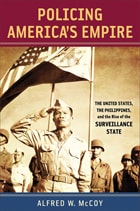
Policing America’s Empire
The United States, the Philippines, and the Rise of the Surveillance StateAlfred W. McCoy
University of Wisconsin Press, 2009
But security techniques bred in the tropical hothouse of colonial rule were not contained, McCoy shows, at this remote periphery of American power. Migrating homeward through both personnel and policies, these innovations helped shape a new federal security apparatus during World War I. Once established under the pressures of wartime mobilization, this distinctively American system of public-private surveillance persisted in various forms for the next fifty years, as an omnipresent, sub rosa matrix that honeycombed U.S. society with active informers, secretive civilian organizations, and government counterintelligence agencies. In each succeeding global crisis, this covert nexus expanded its domestic operations, producing new contraventions of civil liberties—from the harassment of labor activists and ethnic communities during World War I, to the mass incarceration of Japanese Americans during World War II, all the way to the secret blacklisting of suspected communists during the Cold War.
“With a breathtaking sweep of archival research, McCoy shows how repressive techniques developed in the colonial Philippines migrated back to the United States for use against people of color, aliens, and really any heterodox challenge to American power. This book proves Mark Twain’s adage that you cannot have an empire abroad and a republic at home.”—Bruce Cumings, University of Chicago
“This book lays the Philippine body politic on the examination table to reveal the disease that lies within—crime, clandestine policing, and political scandal. But McCoy also draws the line from Manila to Baghdad, arguing that the seeds of controversial counterinsurgency tactics used in Iraq were sown in the anti-guerrilla operations in the Philippines. His arguments are forceful.”—Sheila S. Coronel, Columbia University

Political Policing
The United States and Latin AmericaMartha K. Huggins
Duke University Press, 1998
After a historical review of policing in the United States and Europe over the past century, Huggins reveals how the United States, in order to protect and strengthen its position in the world system, has used police assistance to establish intelligence and other social control infrastructures in foreign countries. The U.S.-encouraged centralization of Latin American internal security systems, Huggins claims, has led to the militarization of the police and, in turn, to an increase in state-sanctioned violence. Furthermore, Political Policing shows how a domestic police force—when trained by another government—can lose its power over legitimate crime as it becomes a tool for the international interests of the nation that trains it.
Pointing to U.S. responsibility for violations of human rights by foreign security forces, Political Policing will provoke discussion among those interested in international relations, criminal justice, human rights, and the sociology of policing.
Political Psychology in International Relations
Rose McDermott
University of Michigan Press, 2004
In the wake of September 11, the American public has been besieged with claims that politics is driven by personality. Saddam Hussein, Osama bin Laden, Kim Chong-Il, Ayatollah Khameinei-America's political rogues' gallery is populated by individuals whose need for recognition supposedly drives their actions on the world stage. How does personality actually drive politics? And how is personality, in turn, formed by political environment? Political Psychology in International Relations provides students and scholars with the analytical tools they need to answer these pressing questions, and to assess their implications for policy in a real and sometimes dangerous world.
Politics Of The Global
Himadeep Muppidi
University of Minnesota Press, 2004
Examines globalism as a social production, opening up new paths of resistance
Though presented often as an objective process, globalization is frequently analyzed from subjective perspectives that are closed to their own historical and geographical specificity. Refusing the false choice between objectivity and subjectivity, Himadeep Muppidi considers the production of the global as an intersubjective process involving the interplay of meanings, identities, and practices from historically different locations.
Muppidi illustrates how the politics of globalization are played out in two multicultural democracies, India and the United States—particularly rich examples given the increasing interactions between them in the areas of global economy and security. Software experts and skilled professionals flow from India to the United States; the United States outsources service sector jobs to India. Although they differ in their approaches to worldwide regulation of weapons of mass destruction, India and the United States cooperate in opposing terrorism. Treating globalization as an intersubjective process reveals the different political possibilities (e.g., colonial coercion, postcolonial ambivalence, and postcolonial co-option) that are opened by global relays of meanings, identities, and power. Muppidi concludes by exploring a variety of spaces and strategies for resisting the colonization of the global.
Politics and Foreign Direct Investment
Nathan M. Jensen, Glen Biglaiser, Quan Li, Edmund Malesky, Pablo M. Pinto, Santiago M. Pinto, and Joseph L. Staats
University of Michigan Press, 2012
Politics at the Airport
Mark B. Salter
University of Minnesota Press, 2008
Establishes the airport as a crucial site in the rise of the surveillance state
Few sites are more symbolic of both the opportunities and vulnerabilities of contemporary globalization than the international airport.
Politics at the Airport brings together leading scholars to examine how airports both shape and are shaped by current political, social, and economic conditions. Focusing on the ways that airports have become securitized, the essays address a wide range of practices and technologies—from architecture, biometric identification, and CCTV systems to “no-fly lists” and the privatization of border control—now being deployed to frame the social sorting of safe and potentially dangerous travelers. This provocative volume broadens our understanding of the connections among power, space, bureaucracy, and migration while establishing the airport as critical to the study of politics and global life.Contributors: Peter Adey, Colin J. Bennett, Gillian Fuller, Francisco R. Klauser, Gallya Lahav, David Lyon, Benjamin J. Muller, Valérie November, Jean Ruegg.
Politics, Markets, and Grand Strategy
Foreign Economic Policies as Strategic InstrumentsLars S. Skalnes
University of Michigan Press, 2000
Skålnes explains changes in foreign economic policy in terms of shifting strategic assessments regarding the importance of military support from allies. When states need military support from their allies to meet threats to their security, they will adopt discriminatory foreign economic policies in an attempt to strengthen alliance relations. When states can go it alone without military support, by contrast, they will not pursue foreign economic policies that discriminate in favor of either allies or other countries. Discriminatory policies, Skalnes argues, are important strategic instruments for several reasons. First, they can be used to tie countries to a military alliance. Second, they are useful as signals of intention. Third, discriminatory policies may strengthen an ally militarily by increasing the economic resources available for military purposes.
Skålnes provides detailed accounts of the grand strategies of Germany (1879-1914), France (1887-1914), Great Britain (1919-1939), and the United States (1945-1967).
Politics, Markets, and Grand Strategy will be important reading for scholars and students in the fields of national security studies, international political economy, and economic history, and to economists working on problems associated with foreign investment and trade generally and customs union theory and discriminatory trade agreements specifically.
Lars S. Skålnes is Associate Professor of Political Science, University of Oregon.

Populist Seduction in Latin America
The Ecuadorian ExperienceCarlos De La Torre
Ohio University Press, 2000
earlier work up to date, comparing classical nationalist, populist regimes of the 1940s, such as those of Juan Perón and José María Velasco Ibarra, with their contemporary neoliberal and radical successors. De la Torre explores their similarities and differences, focusing on their discourses and uses of political symbols and myths.
Post-Authoritarian Cultures
Spain and Latin America's Southern ConeLuis Martín-Estudillo
Vanderbilt University Press, 2008
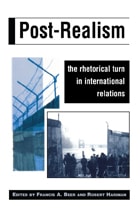
Post-Realism
The Rhetorical Turn in International RelationsFrancis A. Beer
Michigan State University Press, 1996
These essays demonstrate how realism operates rhetorically and point the way toward a richer understanding of world politics.
Post-Soviet Chaos
Violence and Dispossession in KazakhstanJoma Nazpary
Pluto Press, 2001
Power Ties
Economic Interdependence, Balancing, and WarPaul A. Papayoanou
University of Michigan Press, 1999
Power and Negotiation
I. William Zartman and Jeffrey Z. Rubin, Editors
University of Michigan Press, 2002
Power and Terror
Conflict, Hegemony, and the Rule of ForceNoam Chomsky
Pluto Press, 2011
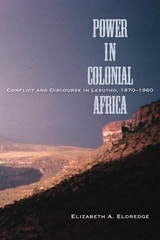
Power in Colonial Africa
Conflict and Discourse in Lesotho, 1870–1960Elizabeth A. Eldredge
University of Wisconsin Press, 2007
In Power in Colonial Africa: Conflict and Discourse in Lesotho, 1870–1960, Elizabeth A. Eldredge analyzes a panoply of archival and oral resources, visual signs and symbols, and public and private actions to show how power may be exercised not only by rulers but also by the ruled. The BaSotho—best known for their consolidation of a kingdom from the 1820s to 1850s through primarily peaceful means, and for bringing colonial forces to a standstill in the Gun War of 1880–1881—struggled to maintain sovereignty over their internal affairs during their years under the colonial rule of the Cape Colony (now part of South Africa) and Britain from 1868 to 1966. Eldredge explores instances of BaSotho resistance, resilience, and resourcefulness in forms of expression both verbal and non-verbal. Skillfully navigating episodes of conflict, the BaSotho matched wits with the British in diplomatic brinksmanship, negotiation, compromise, circumvention, and persuasion, revealing the capacity of a subordinate population to influence the course of events as it selectively absorbs, employs, and subverts elements of the colonial culture.
“A refreshing, readable and lucid account of one in an array of compositions of power during colonialism in southern Africa.”—David Gordon, Journal of African History
“Elegantly written.”—Sean Redding, Sub-Saharan Africa
“Eldredge writes clearly and attractively, and her studies of the war between Lerotholi and Masupha and of the conflicts over the succession to the paramountcy are essential reading for anyone who wants to understand those crises.”—Peter Sanders, Journal of Southern African Studies
Power in Concert
The Nineteenth-Century Origins of Global GovernanceJennifer Mitzen
University of Chicago Press, 2013
Power of Freedom
Hu Shih's Political WritingsChih-p'ing Chou and Carlos Yu-Kai Lin, Editors
University of Michigan Press, 2022
For decades—and today to a certain extent—Hu Shih’s political writings were considered sensitive and even dangerous. As a strident critic of the Chinese Communist Party’s oligarchical practices, he was targeted by the CCP in a concerted national campaign to smear his reputation, cast aspersions on his writings, and generally destroy any possible influence he might have in China. This volume brings together a collection of Hu Shih’s most important, mostly unpublished, English-language speeches, interviews, and commentaries on international politics, China-U.S. relations, and the International Communist Movement. Taken together, these works provide an insider’s perspective on Sino-American relations and the development of the International Communist Movement over the course of the 20th century.
Power without Victory
Woodrow Wilson and the American Internationalist ExperimentTrygve Throntveit
University of Chicago Press, 2017
In Power without Victory, Trygve Throntveit argues that there is more to the story of Wilson than these sad truths. Throntveit makes the case that Wilson was not a “Wilsonian,” as that term has come to be understood, but a principled pragmatist in the tradition of William James. He did not seek to stamp American-style democracy on other peoples, but to enable the gradual development of a genuinely global system of governance that would maintain justice and facilitate peaceful change—a goal that, contrary to historical tradition, the American people embraced. In this brilliant intellectual, cultural, and political history, Throntveit gives us a new vision of Wilson, as well as a model of how to think about the complex relationship between the world of ideas and the worlds of policy and diplomacy.
Power, Profit and Prestige
A History of American Imperial ExpansionPhilip S. Golub
Pluto Press, 2010
Power, Profit and Prestige applies incisive historical and sociological analysis to make sense of the United States’ post-Cold War imperial behaviour.
Philip Golub studies imperial identity formation and shows how an embedded culture of force and expansion has shaped American foreign policy. He argues that the US logic of world power and deeply rooted assumptions about American primacy inhibits democratic transformation at domestic and international levels. This resistance to change may lead the US empire into a crisis of its own making.
This enlightening book will be particularly useful to students of history and international relations as they explore a world where America is no longer able to set the global agenda.
Powerless by Design
The Age of the International CommunityMichel Feher
Duke University Press, 2000
Exemplary of this new approach were Western responses to ethnic cleansing in the former Yugoslavia and genocide in Rwanda. In order to avoid costly interventions, U.S. and European leaders traced these crimes to ancient tribal enmities and professed that the role of the international community should be limited to a humanitarian, impartial, and conciliatory engagement with all the warring parties. They thus managed to appear righteous but powerless, at least until NATO’s intervention in Kosovo. Faced with this doctrine, both the liberal and radical wings of the Western Left found themselves in an uneasy position. Liberals, while lured by their leaders’ humanitarianism were nonetheless disturbed by the dismal results of the policies carried out in the name of the international community. Conversely, anti-imperialist militants were quick to mock the hypocrisy of their governments’ helpless indignation, yet certainly not prepared to demand that Western powers resort to force.
Are we still in this “age of the international community”? Feher shows that with NATO’s intervention in Kosovo, both liberal and radical activists suddenly found their mark: the former welcomed the newfound resolve of their governments, while the latter condemned it as the return of the imperialist “new world order.” For Western leaders, however, the war against Serbia proved an accident rather than a turning point. Indeed, less than a year later, their indifference to the destruction of Chechnya by Russian troops suggested that the discursive strategy exposed in Powerless by Design might remain with us for quite some time.
Predators and Parasites
Persistent Agents of Transnational Harm and Great Power AuthorityOded Löwenheim
University of Michigan Press, 2007
—Robert O. Keohane, Princeton University
"An invaluable contribution to the growing body of constructivist literature in international relations and should be read by anyone interested in the use of force in contemporary global politics . . . Goes a long way toward explaining America's War on Terror against al Qaeda and the Taliban and the widespread global support for this policy, as well as the highly negative global reaction to America's own intervention in Iraq and its norm-threatening doctrine of preemption."
—Richard W. Mansbach, Iowa State University
—Rodney Bruce Hall, Oxford University
"Rejecting preventive war for moral consistency and just conduct, a fascinating discussion of pirates, terrorists, and revenge."
—Jon Mercer, University of Washington
Oded Löwenheim is Lecturer in the Department of International Relations at the Hebrew University of Jerusalem.
Prelude to Genocide
Arusha, Rwanda, and the Failure of DiplomacyDavid Rawson
Ohio University Press, 2018
As the initial US observer, David Rawson participated in the 1993 Rwandan peace talks at Arusha, Tanzania. Later, he served as US ambassador to Rwanda during the last months of the doomed effort to make them hold. Despite the intervention of concerned states in establishing a peace process and the presence of an international mission, UNAMIR, the promise of the Arusha Peace Accords could not be realized. Instead, the downing of Rwandan president Habyarimana’s plane in April 1994 rekindled the civil war and opened the door to genocide.
In Prelude to Genocide, Rawson draws on declassified documents and his own experiences to seek out what went wrong. How did the course of political negotiations in Arusha and party wrangling in Kigali, Rwanda, bring to naught a concentrated international effort to establish peace? And what lessons are there for other international humanitarian interventions? The result is a commanding blend of diplomatic history and analysis that is a milestone read on the Rwandan crisis and on what happens when conflict resolution and diplomacy fall short.
Published in partnership with the ADST-DACOR Diplomats and Diplomacy Series.
Presidents, Diplomats, and Other Mortals
Edited by J. Garry Clifford & Theodore A. Wilson
University of Missouri Press, 2007
From Abraham Lincoln’s stance on international slavery to George W. Bush’s incursions on the world stage, American presidents and other leaders have taken decisive actions to shape our country’s foreign policy. This new collection of essays provides analytical narratives of how and why policies were devised and implemented that would determine the place of the United States in the international arena from the 1860s to the present. Showing what individuals do—or choose not to do—is central to understanding diplomacy in peace and war.
These writings—by such prominent historians as Terry H. Anderson and Eugene P. Trani—examine presidents and other diplomats at their best and worst in the practice of statecraft. They take on issues ranging from America’s economic expansion abroad to the relations of democracies with authoritarian leaders and rogue nations to advocacy of such concepts as internationalism, unilateralism, nation building, and regime change. In so doing, they take readers on a virtual tour of American diplomatic history, tracing the ideas and actions of individuals in shaping our foreign policy, whether George F. Kennan as author of Soviet containment or Ronald Reagan as progenitor of “Star Wars.”
The essays range over a variety of scenarios to depict leaders coming to grips with real-world situations. They offer original views on such topics as American diplomacy toward Nicaragua, origins of U.S. attitudes toward Russia and the Soviet Union, FDR’s idiosyncratic approach to statecraft, and food diplomacy as practiced by LBJ and Richard Nixon. And in considering post–Cold War crises, they address Bill Clinton’s military interventions, George W. Bush’s war against Iraq, and the half-century background to the current nuclear standoff with Iran. Additional articles pay tribute to the outstanding career of Robert H. Ferrell as a scholar and teacher.
Throughout the volume, the authors seek to exemplify the scholarly standards of narrative diplomatic history espoused by Robert Ferrell—especially the notion that historians should attempt to explain fully the circumstances, opportunities, and pressures that influence foreign policy decisions while remembering that historical actors cannot with certainty predict the outcomes of their actions. Presidents, Diplomats, and Other Mortals is both a collection of compelling historical studies and an overarching case study of the role of individuals in foreign policy making and an insightful review of some of history’s most important moments. Taken together, these essays provide a fitting tribute to Ferrell, the trailblazing scholar in whose honor the book was written.

Pride, Not Prejudice
National Identity as a Pacifying Force in East AsiaEunbin Chung
University of Michigan Press, 2022
As shown by China’s relationship to Japan, and Japan’s relationship to South Korea, even growing regional economic interdependencies are not enough to overcome bitter memories grounded in earlier wars, invasions, and periods of colonial domination. Although efforts to ease historical animosity have been made, few have proven to be successful in Northeast Asia. In previous research scholars anticipated an improvement in relations through thick economic interdependence or increased societal contact. In economic terms, however, Japan and China already trade heavily: Japan has emerged as China’s largest trading partner and China as second largest to Japan. Societal contact is already intense, as millions of Chinese, Koreans, and Japanese visit one another’s countries annually as students, tourists, and on business trips. But these developments have not alleviated international distrust and negative perception, or resolved disagreement on what constitutes “adequate reparation” regarding the countries’ painful history.
Noticing clashes of strong nationalisms around the world in areas like Northeast Asia, numerous studies have suggested that more peaceful relations are likely only if countries submerge or paper over existing national identities by promoting universalism. Pride, Not Prejudice argues, to the contrary, that affirmation of national identities may be a more effective way to build international cooperation. If each national population reflects on the values of their national identity, trust and positive perception can increase between countries. This idea is consistent with the theoretical foundation that those who have a clear, secure, and content sense of self, in turn, can be more open, evenhanded, and less defensive toward others. In addition, this reduced defensiveness also enhances guilt admission by past “inflictors” of conflict and colonialism. Eunbin Chung borrows the social psychological theory of self-affirmation and applies it to an international context to argue that affirmation of a national identity, or reflecting on what it means to be part of one’s country, can increase trust, guilt recognition, and positive perception between countries.
Prisoners of Their Premises
How Unexamined Assumptions Lead to War and Other Policy DebaclesGeorge C. Edwards III
University of Chicago Press, 2022
Why do accomplished and stable leaders frequently make calamitous decisions with devastating consequences for their countries—and other nations? We debate debacles such as the American involvement in Vietnam, seeking to understand why leaders pursued disastrous policies. In Prisoners of Their Premises, George C. Edwards III argues that the failure of leaders to examine their premises—the assumptions they make about the world and situation they are dealing with—cause them to ignore real problems or pursue policies that, in costly ways, deal with problems that are different than they think or simply don’t exist. Edwards looks at the role of premises in identifying (or ignoring) a problem in a series of case studies that range from strategic decisions in World War I and the Korean War to the wars in Vietnam and Iraq. Too often, unexamined premises color initial decisions to pursue a policy and shape the strategies leaders employ to achieve their goals, with grave consequences for their countries, organizations, and potentially the world. Timely and important, Prisoners of Their Premises demonstrates the real costs leaders incur by failing to question their assumptions.
Privatizing Health Services in Africa
Turshen, Meredeth
Rutgers University Press, 1998
Privatizing Health Services in Africa analyzes the disappearance of public health in the form of state services in Africa, and the growth of a private market in health care that will serve primarily an urban elite. Meredeth Turshen considers the implications of introducing private insurance in countries with growing unemployment, a shrinking formal job sector, and a lack of social security programs or other safety nets. She debates the pros and cons of shifting the delivery of health services to the nongovernmental sector in the context of new concepts of the role of the state. Many of the schemes to privatize the purchase and sale of pharmaceuticals reverse decades of United Nations work challenging the power of the multinational drug industry. Turshen weighs these policy changes in light of the World Bank’s eclipse of the World Health Organization as the premier UN health policy agency. Until now, no book has disputed the World Bank’s plans to privatize health care in Africa. This is the first book-length analysis of policy changes in light of monetarism and globalization.
Throughout the book, Turshen examines the implications of privatization for gender equity. She also provides a case study of Zimbabwe and comparative material from Malawi, Mozambique, and Zambia. Her study makes a contribution to current debates on the impact of structural adjustment policies on health and the design of health services in the Third World.
Psychology and Constructivism in International Relations
An Ideational AllianceVaughn P. Shannon and Paul A. Kowert, Editors
University of Michigan Press, 2011
"The conversation between political psychology and constructivism is essential and long overdue. By exploring the interaction of individual cognition and social processes, this 'ideational alliance' more fully explains how ideas work all the way down to shape world politics."
---Theo Farrell, King's College London
"This is a worthwhile and engaging volume. Political psychology is gaining ground as an essential perspective to consider when analyzing international relations, and the book's focus on constructivism provides key insights into the relationship between identity, norms, and behavior---bedrock concepts in understanding the social underpinnings of global politics."
---Mira Sucharov, Carleton University
"An indispensable guide to understanding what distinguishes and what unites psychology and constructivism. A wonderful resource for political psychologists, constructivists, and their critics."
---Jonathan Mercer, University of Washington
Constructivist IR scholars study the ways in which international norms, culture, and identities---all intersubjective phenomena---inform foreign policy and affect the reaction to and outcomes of international events. Political psychologists similarly investigate divergent national self-conceptions as well as the individual cognitive and emotional propensities that shape ideology and policy. Given their mutual interest in human subjectivity and identity politics, a dialogue and synthesis between constructivism and political psychology is long overdue.
The contributors to this volume discuss both theoretical and empirical issues of complementarity and critique, with an emphasis on the potential for integrating the viewpoints within a progressive ideational paradigm. Moreover, they make a self-conscious effort to interrogate, rather than gloss over, their differences in the hope that such disagreements will prove particularly rich sources of analytical and empirical insight.
Jacket illustration © Ocean Photography/Veer
Public Opinion and American Foreign Policy
Ole R. Holsti
University of Michigan Press, 1996