Results by title
328 books match the query 'Islam' and 12 start with p
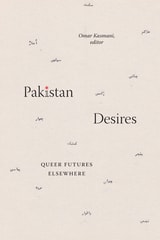
Pakistan Desires
Queer Futures ElsewhereOmar Kasmani, editor
Duke University Press, 2023
Contributors. Ahmed Afzal, Asad Alvi, Anjali Arondekar, Vanja Hamzić, Omar Kasmani, Pasha M. Khan, Gwendolyn S. Kirk, Syeda Momina Masood, Nida Mehboob, Claire Pamment, Geeta Patel, Nael Quraishi, Abdullah Qureshi, Shayan Rajani, Jeffrey A. Redding, Gayatri Reddy, Syma Tariq
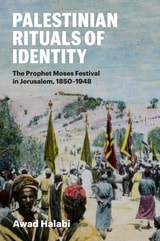
Palestinian Rituals of Identity
The Prophet Moses Festival in Jerusalem, 1850-1948Awad Halabi
University of Texas Press, 2023
Members of Palestine’s Muslim community have long honored al-Nabi Musa, or the Prophet Moses. Since the thirteenth century, they have celebrated at a shrine near Jericho believed to be the location of Moses’s tomb; in the mid-nineteenth century, they organized a civic festival in Jerusalem to honor this prophet. Considered one of the most important occasions for Muslim pilgrims in Palestine, the Prophet Moses festival yearly attracted thousands of people who assembled to pray, conduct mystical forms of worship, and hold folk celebrations.
Palestinian Rituals of Identity takes an innovative approach to the study of Palestine’s modern history by focusing on the Prophet Moses festival from the late Ottoman period through the era of British rule. Halabi explores how the festival served as an arena of competing discourses, with various social groups attempting to control its symbols. Tackling questions about modernity, colonialism, gender relations, and identity, Halabi recounts how peasants, Bedouins, rural women, and Sufis sought to influence the festival even as Ottoman authorities, British colonists, Muslim clerics, and Palestinian national leaders did the same. Drawing on extensive research in Arabic newspapers and Islamic and colonial archives, Halabi reveals how the festival has encapsulated Palestinians’ responses to modernity, colonialism, and the nation’s growing national identity.
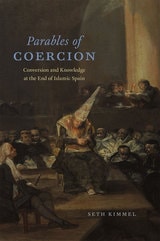
Parables of Coercion
Conversion and Knowledge at the End of Islamic SpainSeth Kimmel
University of Chicago Press, 2015
In its careful examination of how Spanish authors transformed the history of scholarship through debate about forced religious conversion, Parables of Coercion makes us rethink what we mean by tolerance and intolerance, and shows that debates about forced conversion and assimilation were also disputes over the methods and practices that demarcated one scholarly discipline from another.
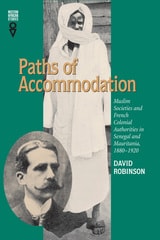
Paths of Accommodation
Muslim Societies and French Colonial Authorities in Senegal and Mauritania, 1880–1920David Robinson
Ohio University Press, 2000
Between 1880 and 1920, Muslim Sufi orders became pillars of the colonial regimes and economies of Senegal and Mauritania. In Paths of Accommodation, David Robinson examines the ways in which the leaders of the orders negotiated relations with the Federation of French West Africa in order to preserve autonomy within the religious, social, and economic realms while abandoning the political sphere to their non-Muslim rulers.
This was a striking development because the local inhabitants had a strong sense of belonging to the Dar al-Islam, the “world of Islam” in which Muslims ruled themselves.
Drawing from a wide variety of archival, oral, and Arabic sources, Robinson describes the important roles played by Muslim merchants and the mulatto community of St. Louis, Senegal. He also examines the impact of the electoral institutions established by the Third Republic, and the French effort to develop a reputation as a “Muslim power”—a European imperial nation with a capacity for ruling over Islamic subjects.
By charting the similarities and differences of the trajectories followed by leading groups within the region as they responded to the colonial regimes, Robinson provides an understanding of the relationship between knowledge and power, the concepts of civil society and hegemony, and the transferability of symbolic, economic, and social capital.
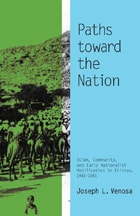
Paths toward the Nation
Islam, Community, and Early Nationalist Mobilization in Eritrea, 1941–1961Joseph L. Venosa
Ohio University Press, 2014
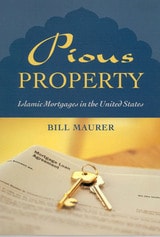
Pious Property
Islamic Mortgages in the United StatesBill Maurer
Russell Sage Foundation, 2006
Politicizing Islam in Austria
The Far-Right Impact in the Twenty-First CenturyFarid Hafez
Rutgers University Press, 2024
Politicizing Islam in Austria examines this anti-Muslim swerve in Austrian politics through a comprehensive analysis of government policies and regulations, as well as party and public discourses. In their innovative study, Hafez and Heinisch show how the far-right Austrian Freedom Party (FPÖ) adapted anti-Muslim discourse to their political purposes and how that discourse was then appropriated by the conservative center-right Austrian People’s Party (ÖVP). This reconfiguration of the political landscape prepared the way for a right-wing coalition government between conservatives and far-right actors that would subsequently institutionalize anti-Muslim political demands and change the shape of the civic conditions and public perceptions of Islam and the Muslim community in the republic.
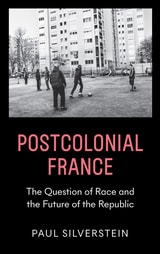
Postcolonial France
The Question of Race and the Future of the RepublicPaul Silverstein
Pluto Press, 2018
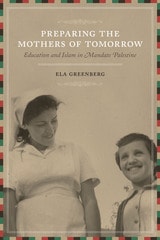
Preparing the Mothers of Tomorrow
Education and Islam in Mandate PalestineBy Ela Greenberg
University of Texas Press, 2009
From the late nineteenth century onward, men and women throughout the Middle East discussed, debated, and negotiated the roles of young girls and women in producing modern nations. In Palestine, girls' education was pivotal to discussions about motherhood. Their education was seen as having the potential to transform the family so that it could meet both modern and nationalist expectations.
Ela Greenberg offers the first study to examine the education of Muslim girls in Palestine from the end of the Ottoman administration through the British colonial rule. Relying upon extensive archival sources, official reports, the Palestinian Arabic press, and interviews, she describes the changes that took place in girls' education during this time. Greenberg describes how local Muslims, often portrayed as indifferent to girls' education, actually responded to the inadequacies of existing government education by sending their daughters to missionary schools despite religious tensions, or by creating their own private nationalist institutions.
Greenberg shows that members of all socioeconomic classes understood the triad of girls' education, modernity, and the nationalist struggle, as educated girls would become the "mothers of tomorrow" who would raise nationalist and modern children. While this was the aim of the various schools in Palestine, not all educated Muslim girls followed this path, as some used their education, even if it was elementary at best, to become teachers, nurses, and activists in women's organizations.
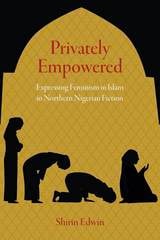
Privately Empowered
Expressing Feminism in Islam in Northern Nigerian FictionShirin Edwin
Northwestern University Press, 2016
Prophecy in Islam
Philosophy and OrthodoxyFazlur Rahman
University of Chicago Press, 2011
This longstanding and highly regarded volume is the first to explore the doctrine of prophetic revelation, a critical and definitive area of Islamic religious and political thought. In it, the esteemed Islamic scholar Fazlur Rahman traces the inception of this doctrine from ancient Greek texts, its interpretation and elaboration by Muslim philosophers in order to suit their vision of the Prophet, and, finally, the varying degrees of acceptance of these convergent ideas by the Muslim orthodoxy.
The latest edition of this classic text includes a new foreword by Islamic studies expert Michael Sells, confirming Prophecy in Islam as the best source on its subject after more than half a century. This longstanding and highly regarded volume is the first to explore the doctrine of prophetic revelation, a critical and definitive area of Islamic religious and political thought. In it, the esteemed Islamic scholar Fazlur Rahman traces the inception of this doctrine from ancient Greek texts, its interpretation and elaboration by Muslim philosophers in order to suit their vision of the Prophet, and, finally, the varying degrees of acceptance of these convergent ideas by the Muslim orthodoxy.
The latest edition of this classic text includes a new foreword by Islamic studies expert Michael Sells, confirming Prophecy in Islam as the best source on its subject after more than half a century.

Psychoanalysis and the Challenge of Islam
Fethi Benslama
University of Minnesota Press, 2009
Unveils the psychoanalytic undercurrents of contemporary Islam
Fethi Benslama is a psychoanalyst who, although a secular thinker, identifies himself as a person of Muslim culture who rejects ready-made explanations for Islamic fundamentalism. In that spirit, Benslama demythifies both Islam and Western ideas of the religion by addressing the psychoanalytic root causes of the Muslim world’s clash with modernity and subsequent turn to fundamentalism.
Tracing this ideological strain to its origins, Benslama shows that contemporary Islam consists of a fairly recent hybridization of Arab nationalism, theocracy, and an attempt (both naïve and deadly) to ground science in faith. Combining textual analysis and Lacanian and Freudian psychoanalysis, he examines Islam’s foundation, providing fresh readings of the book of Genesis, the Koran, The Arabian Nights, and the work of medieval Islamic philosophers.Refreshingly, Benslama writes without ideological bias and undoes the simplistic, Western view of Islam while refusing to romanticize terrorism or Muslim extremism. This is a penetrating work that reveals an alternate history of the Islamic religion and opens new possibilities for its future development.