Results by title
159 books match the query 'Minnesota' and 7 start with p
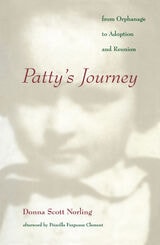
Patty’s Journey
From Orphanage To Adoption And ReunionDonna Scott Norling
University of Minnesota Press, 1998
The award-winning memoir of one woman’s struggles and triumphs to reclaim an identity she had lost.
This inspirational story of one girl’s search for a home is an engaging first-person narrative of life during the Great Depression and World War II. Readers and critics alike offer lavish praise for Norling’s graceful, simple prose and the heartbreaking, ultimately redemptive tale she shares.

Penumbra
The Premier Stage for African American DramaMacelle Mahala
University of Minnesota Press, 2013
Penumbra Theatre Company was founded in 1976 by Lou Bellamy as a venue for African American voices within the Twin Cities theatre scene and has stood for more than thirty-five years at the intersection of art, culture, politics, and local community engagement. It has helped launch the careers of many internationally respected theatre artists and has been repeatedly recognized for its artistic excellence as the nation’s foremost African American theatre.
Penumbra is the first-ever history of this barrier-breaking institution. Based on extensive interviews with actors, directors, playwrights, producers, funders, and critics, Macelle Mahala’s book offers a multifaceted view of the theatre and its evolution. Penumbra follows the company’s emergence from the influential Black Arts and settlement house movements; the pivotal role Penumbra played in the development of August Wilson’s career and, in turn, how Wilson became an avid supporter and advocate throughout his life; the annual production of Black Nativity as a community-building performance; and the difficult economics of African American theatre production and how Penumbra has faced these challenges for nearly four decades.
Penumbra is a testament to how a theatre can respond to and thrive within changing political and cultural realities while contributing on a national scale to the African American presence on the American stage. It is a celebration of theatre as a means of social and cultural involvement—both local and national—and ultimately, of Penumbra’s continuing legacy of theatre that is vibrant, diverse, and vital.

Peril in the Ponds
Deformed Frogs, Politics, and a Biologist's QuestJudy Helgen
University of Massachusetts Press, 2012
By the 1990s, wetlands across the United States were endangered from pollution and decades of drainage to convert them into farmland and urban developments. But when deformed frogs—many with missing legs or eyes, footless stumps, or misshapen jaws—began to emerge from Minnesota wetlands, alarm bells went off. What caused such deformities? Pollution? Ultraviolet rays? Biological agents? And could the mysterious cause also pose a threat to humans?
Judy Helgen writes with passionate concern about vulnerable frogs and wetlands as she navigates through a maze of inquisitive media and a reluctant government agency. She reports on the complexity of a growing catastrophe for frogs and broadens the issue as she researches and meets with scientists from around the world. She affirms the importance of examining aquatic life to understand pollution and the need to rescue our remaining wetlands. She also shares the fears expressed by the teachers, students, and other citizens who found these creatures, sensed a problem, and looked to her for answers. Ultimately, this is a story about the biological beauty of wetlands and our need to pay attention to the environment around us.
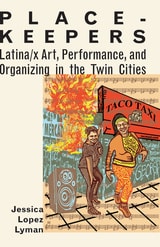
Place-Keepers
Latina/x Art, Performance, and Organizing in the Twin CitiesJessica Lopez Lyman
University of Minnesota Press, 2025
An in-depth look at how Latina/x artists transform art into activism and reclaim space in the Twin Cities
In Place-Keepers, Jessica Lopez Lyman examines how Latina/x artists in the Twin Cities navigate and challenge the region’s deep-seated racial injustices. Using “Inter-Latina movidas”—subtle yet strategic actions through which Latina/x artists forge solidarities, mobilize for justice, and reclaim space—these artists respond to systemic oppression through public performances and behind-the-scenes negotiations with the state, nonprofits, and other institutions.
Centering Latina/x women and gender nonconforming artists from Chicana/Mexicana, U.S. Central American, and Caribbean backgrounds, Place-Keepers confronts reductionist theories of Latinidad that flatten ethnic and racial identities. It demonstrates how the creative and activist practices of these cultural organizers address urgent social struggles from resisting gentrification and environmental destruction to opposing police violence. Lopez Lyman situates these efforts within the broader history of racial justice organizing in Minnesota, tracing a lineage of resistance that long precedes the 2020 Minneapolis uprising following the murder of George Floyd.
Through firsthand accounts and revealing case studies, Place-Keepers charts how these artists harness aesthetics as a tool for movement-building, strategically redistributing resources and transforming policy. Expanding the foundational concept of “movidas” in Chicana/o/x and Latina/o/x studies by highlighting maneuvers of infiltration, improvisation, individual ritual, and interdependence, Lopez Lyman establishes a crucial framework for understanding art as activism.
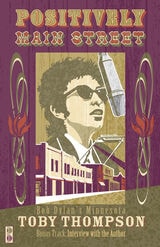
Positively Main Street
Bob Dylan’s MinnesotaToby Thompson
University of Minnesota Press, 2008
“That boy . . . this fellow, Toby . . . has got some lessons to learn.” —Bob Dylan, Rolling Stone, November 29, 1969
"Toby Thompson was there first." —Greil Marcus
“A first-rate novelistic account of Thompson’s own psyche as he uncovers the Dylan few people know . . . A new look at young Dylan done with kindness, enthusiasm and superb language.” —William Kennedy, Look Magazine
“Essential reading. Thompson, unprecedentedly, managed to interview not only Echo Helstrom, almost certainly the ‘Girl of the North Country,’ but Dylan’s mother and brother, his uncle, his friends.” —Michael Gray, Bob Dylan Encyclopedia
“Dylan fans will not want to miss this book.” —Sioux City Journal
“Enough to satisfy any Dylan fan with all the gossip he’ll ever need.” —Huntsville Times
“Well worth the attention of anyone who has fallen under the spell of the boy from the North Country.” —Los Angeles Times
“It’s a must.” —Ft. Worth Press
"Thompson tracked down anybody who knew 'Die-lan' (as the Hibbingites called him), including the guy at the local music store, the guy at the motorcycle shop, his English and music teachers, his uncles, his brother David and even his reluctant but ultimately charmingly chatty mother. Of course, Thompson traveled into a few dead ends. But the stuff with Dylan's mom and his high school girlfriend, Echo Helstrom, is priceless. Positively Main Street is a free-wheelin', fun and quick read that is surprisingly informative." —Minneapolis Star Tribune
"Hundreds of books have been written about Minnesota's most famous songwriter; Bob Dylan's life and music has been analyzed by fans, scholars, and even himself. So, why do we need Toby Thompson's Positively Main Street: Bob Dylan's Minnesota? Because it's a forgotten milestone. Published in 1971, it was the first biography on Dylan. Although it's been out of print since 1977, the book is, with the exception of Dylan's autobiography, perhaps the most readable and necessary volume on the folk icon." —City Pages
"The new Positively Main Street is a lovely little book, even better than the original, a cherished addition to the Dylan bookshelf. Thompson and the University of Minnesota Press have enhanced what was already a classic and made it available to a whole new audience. Dylan fans owe them a debt of gratitude." —The Dylan Daily
"[Thompson] ends up not only interviewing 'the Girl from the North Country,' Echo Haelstrom, and 'Bob’s' mother and brother and teachers etc., but also filling in for Dylan among his old friends and acquaintances, playing Dylan’s songs on the guitar and harmonica and singing them, in a way that may have seemed stratingly revolutionary at the time for a journalist to do, he actually recreates a bit of Dylan’s existence as his own." —Michael Lally, Lally's Alley

Pothole Confidential
My Life as Mayor of MinneapolisR.T. Rybak
University of Minnesota Press, 2016
A pajama party at the Minneapolis–St. Paul International Airport inadvertently helped launch R.T. Rybak’s political career (imagine a rumba line one hundred protesters long chanting, “We deserve to sleep, hey!”), but his earliest lessons in leadership occurred during his childhood. Growing up in a middle-class neighborhood, attending private school with students who had much more than he did, spending evenings at his family’s store in an area where people lived with much less, he witnessed firsthand the opportunity and injustice of the city he called home.
In a memoir that is at once a political coming-of-age story and a behind-the-scenes look at the running of a great city, the three-term mayor takes readers into the highs and lows and the daily drama of a life inextricably linked with Minneapolis over the past fifty years. With refreshing candor and insight, Rybak describes his path through journalism, marketing, and community activism that led to his unlikely (to him, at least) primary election—on September 11, 2001. His personal account of the challenges and crises confronting the city over twelve years, including the tragic collapse of the I-35W bridge, the rising scourge of youth violence, and the bruising fight over a ban on gay marriage (with Rybak himself conducting the first such ceremony at City Hall on August 1, 2013), is also an illuminating, often funny depiction of learning the workings of the job, frequently on the fly, while trying to keep up with his most important constituency, his family.
As bracing as the “fresh air” campaign that swept him into office, Rybak’s memoir is that rare document from a politician: one more concerned with the people he served and the issues of his time than with burnishing his own credentials. As such, it reflects what leadership truly looks like.
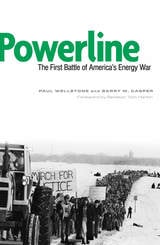
Powerline
The First Battle of America’s Energy WarPaul Wellstone
University of Minnesota Press, 2003
The inspiring story of a grassroots rebellion
Powerline describes the opposition of rural Minnesotans to the building of a high voltage powerline across 430 miles of farmland from central North Dakota to the Twin Cities suburbs. Convinced that the safety of their families and the health of their land was disregarded in favor of the gluttonous energy consumption of cities, the farmer-led revolt began as questioning and escalated to rampant civil disobedience, peaking in 1978 when nearly half of Minnesota’s state highway patrol was engaged in stopping sabotage of the project.
After construction was completed, the powerline proved difficult to defend and unprecedented guerrilla warfare brought many towers to the ground (due to “bolt weevils”). Through pulse-quickening personal interviews and big-picture analysis, Powerline lays bare the latent and unexpected power of the people of rural America—and resonates strongly with today’s energy debates.