Results by title
94 books match the query 'Miscellanea' and 4 start with p
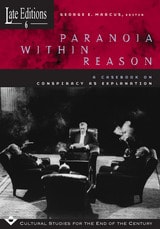
Paranoia within Reason
A Casebook on Conspiracy as ExplanationEdited by George E. Marcus
University of Chicago Press, 1999
Some pieces develop conversations that reveal the post-Cold War situations of countries such as Italy, Russia, Slovenia, and the United States where conspiratorial explanations of national dramas seem to make sense. Other pieces tackle paranoia as a style of debate in such diverse realms as science, psychotherapy, and popular entertainment, where conspiracy theories emerge as a compelling way to address the inadequacies of rational expertise and organization in the face of immense changes that undermine them. Like all of the volumes in the Late Edition series, Paranoia Within Reason offers a provocative challenge to our ways of understanding the ongoing watershed changes that face us.

Penny Loafers & Bobby Pins
Tales and Tips from Growing Up in the ’50s and ’60sSusan Sanvidge
Wisconsin Historical Society Press, 2010
“In the fifties, sleek Mixmasters were replacing rusty eggbeaters, and new pressure-cookers blew their tops in kitchens all over town. There were kids everywhere, and new ‘ranch-style’ houses filled vacant lots. . . . Turquoise Studebakers and dusty-rose Chevy BelAirs with flamboyant fins and lots of chrome replaced dark pre-war cars. Cameras took color snapshots instead of black-and-white. We wore red canvas tennis shoes and lemon yellow shorts, and bright blue popsicles melted down our chins.” —from the Introduction
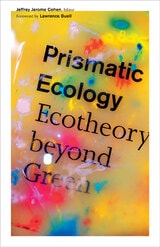
Prismatic Ecology
Ecotheory beyond GreenJeffrey Jerome Cohen
University of Minnesota Press, 2013
Emphasizing sustainability, balance, and the natural, green dominates our thinking about ecology like no other color. What about the catastrophic, the disruptive, the inaccessible, and the excessive? What of the ocean’s turbulence, the fecundity of excrement, the solitude of an iceberg, multihued contaminations? Prismatic Ecology moves beyond the accustomed green readings of ecotheory and maps a colorful world of ecological possibility.
In a series of linked essays that span place, time, and discipline, Jeffrey Jerome Cohen brings together writers who illustrate the vibrant worlds formed by colors. Organized by the structure of a prism, each chapter explores the coming into existence of nonanthropocentric ecologies. “Red” engages sites of animal violence, apocalyptic emergence, and activism; “Maroon” follows the aurora borealis to the far North and beholds in its shimmering alternative modes of world composition; “Chartreuse” is a meditation on postsustainability and possibility within sublime excess; “Grey” is the color of the undead; “Ultraviolet” is a potentially lethal force that opens vistas beyond humanly known nature.
Featuring established and emerging scholars from varying disciplines, this volume presents a collaborative imagining of what a more-than-green ecology offers. While highlighting critical approaches not yet common within ecotheory, the contributions remain diverse and cover a range of topics including materiality, the inhuman, and the agency of objects. By way of color, Cohen guides readers through a reflection of an essentially complex and disordered universe and demonstrates the spectrum as an unfinishable totality, always in excess of what a human perceives.
Contributors: Stacy Alaimo, U of Texas at Arlington; Levi R. Bryant, Collin College; Lowell Duckert, West Virginia U; Graham Harman, American U in Cairo; Bernd Herzogenrath, Goethe U of Frankfurt; Serenella Iovino, U of Turin, Italy; Eileen A. Joy; Robert McRuer, George Washington U; Tobias Menely, Miami U; Steve Mentz, St. John’s U, New York City; Timothy Morton, Rice U; Vin Nardizzi, U of British Columbia; Serpil Oppermann, Hacettepe U, Ankara; Margaret Ronda, Rutgers U; Will Stockton, Clemson U; Allan Stoekl, Penn State U; Ben Woodard; Julian Yates, U of Delaware.
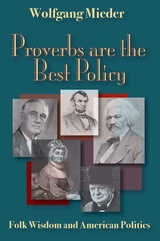
Proverbs Are The Best Policy
Folk Wisdom And American PoliticsWolfgang Mieder
Utah State University Press, 2005