Results by title
99 books match the query 'Motion picture producers and directors' and 7 start with p
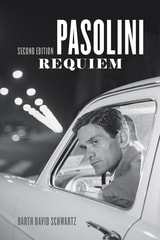
Pasolini Requiem
Second EditionBarth David Schwartz
University of Chicago Press, 2017
Pier Paolo Pasolini (1922–75) was one of the most important Italian intellectuals of the post–World War II era. An astonishing polymath—poet, novelist, literary critic, political polemicist, screenwriter, and film director—he exerted profound influence on Italian culture up to his untimely death at the age of fifty-three. This revised edition of what the New York Times Book Review has called “the standard Pasolini biography” introduces the artist to a new generation of readers.
Based on extensive interviews with those who knew Pasolini, both friends and enemies, admirers and detractors, Pasolini Requiem chronicles his growth from poet in the provinces to Italy’s leading “civil poet”; his flight to Rome in 1950; the scandalous success of his two novels and political writing; and his transition to film, where he started as a contributor to the golden age of Italian cinema and ended with the shocking Salò, or the 120 Days of Sodom. Pasolini’s tragic and still unsolved murder has remained a subject of contentious debate for four decades. The enduring fascination with who committed the crime—and why—reflects his vital stature in Italy’s political and social history.
Updated throughout and with a new afterword covering the efforts to reopen the investigation—and the legal maelstrom surrounding Pasolini’s demise—this edition of Pasolini Requiem is a riveting account of one of the twentieth century’s most controversial, ever-present iconoclasts.
[more]
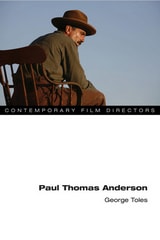
Paul Thomas Anderson
George Toles
University of Illinois Press, 2016
Since his explosive debut with the indie sensation Hard Eight , Paul Thomas Anderson has established himself as one of contemporary cinema's most exciting artists. His 2002 feature Punch-Drunk Love radically reimagined the romantic comedy. Critics hailed There Will Be Blood as a key film of the new millennium. In The Master , Anderson jarred audiences with dreamy amorphousness and a departure from conventional story mechanics. Acclaimed film scholar and screenwriter George Toles approaches these three films in particular, and Anderson's oeuvre in general, with a focus on the role of emergence and the production of the unaccountable. Anderson, Toles shows, is as an artist obsessed with history, workplaces, and environments but also intrigued by spaces as projections of the people who dwell within. Toles follows Anderson from the open narratives of Boogie Nights and Magnolia through the pivot that led to his more recent films, Janus-faced masterpieces that orbit around isolated central characters--and advance Anderson's journey into allegory and myth. Blending penetrative analysis with a deep knowledge of filmic storytelling, Paul Thomas Anderson tours an important filmmaker's ever-deepening landscape of disconnection.
[more]
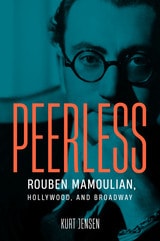
Peerless
Rouben Mamoulian, Hollywood, and BroadwayKurt Jensen
University of Wisconsin Press, 2024
A proud Armenian who claimed a distant link to nobility, born in what was then part of czarist Russia, Rouben Mamoulian (1897–1987) was one of the most astonishing and confounding figures in American film and theater, directing the original stage productions of Porgy and Bess, Carousel, and Oklahoma!, as well as films including Love Me Tonight, Queen Christina, City Streets, and Silk Stockings. He was famously fired from the film version of Porgy and Bess in a dispute over publicity and quit Cleopatra after arguments over a single scene. Mamoulian’s mercurial confidence and autocratic tendencies were among the reasons he had a reputation for being uncompromising. This frustrating mix of genius and stubbornness, of critical successes and financial flops, has proven challenging for biographers.
Kurt Jensen’s magisterial volume, extensively researched and filled with trenchant observations, brings to life this charming, flawed, and fascinating man—and demonstrates how the wellspring of his art contained the seeds of his own destruction. Drawing upon Mamoulian’s unfinished memoir and voluminous diaries, as well as interviews with the director’s surviving collaborators, Jensen delivers fresh and informative insider stories from seminal productions. Meanwhile, he explores Mamoulian’s aesthetic principles and strategies as manifested in lighting, choreography, and sound design. A tour de force, Peerless offers readers a multifaceted, in-depth look at an idiosyncratic genius.
Kurt Jensen’s magisterial volume, extensively researched and filled with trenchant observations, brings to life this charming, flawed, and fascinating man—and demonstrates how the wellspring of his art contained the seeds of his own destruction. Drawing upon Mamoulian’s unfinished memoir and voluminous diaries, as well as interviews with the director’s surviving collaborators, Jensen delivers fresh and informative insider stories from seminal productions. Meanwhile, he explores Mamoulian’s aesthetic principles and strategies as manifested in lighting, choreography, and sound design. A tour de force, Peerless offers readers a multifaceted, in-depth look at an idiosyncratic genius.
[more]
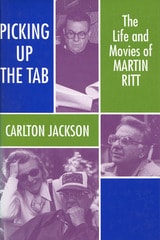
Picking Up the Tab
The Life and Movies of Martin RittCarlton Jackson
University of Wisconsin Press, 1994
Martin Ritt has been hailed as the United States’s greatest maker of social films. From No Down Payment early in his career to Stanley and Iris, his last production, he delineated the nuances of American society. In between were other social statements such as Hud, Sounder, The Spy Who Came In From the Cold, Norma Rae, and The Great White Hope.
[more]
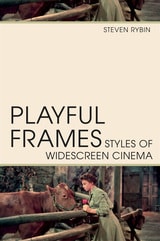
Playful Frames
Styles of Widescreen CinemaSteven Rybin
Rutgers University Press, 2024
A widescreen frame in cinema beckons the eye to playfully, creatively roam. Such technology also gives inventive filmmakers room to disrupt and redirect audience expectations, surprising viewers through the use of a wider, more expansive screen. Playful Frames: Styles of Widescreen Cinema studies the poetics of the auteur-driven widescreen image, offering nimble, expansive analyses of the work of four distinctive filmmakers – Jean Negulesco, Blake Edwards, Robert Altman, and John Carpenter – who creatively inhabited the nooks and crannies of widescreen moviemaking during the final decades of the twentieth century. Exploring the relationship between aspect ratio and subject matter, Playful Frames shows how directors make puckish use of widescreen technology. All four of these distinctive filmmakers reimagined popular genres (such as melodrama, slapstick comedy, film noir, science fiction, and horror cinema) through their use of the wide frame, and each brings a range of intermedial interests (painting, performance, and music) to their use of the widescreen image. This study looks specifically at the technological underpinnings, aesthetic shapes, and interpretive implications of these four directors’ creative use of widescreen, offering a way to reconsider the way wide imagery still has the potential to amaze and move us today.
[more]

Preston Sturges
The Last Years of Hollywood's First Writer-DirectorNick Smedley and Tom Sturges
Intellect Books, 2019
Few directors of the 1930s and ‘40s were as distinctive and popular as Preston Sturges, whose whipsmart comedies have entertained audiences for decades. Beginning with a foreword by Peter Bogdanovich, this book offers a new critical appreciation of Sturges’ whole oeuvre, incorporating a detailed study of the last ten years of his life from new primary sources. Preston Sturges details the many unfinished projects of Sturges’ last decade, including films, plays, TV series and his autobiography. Drawing on diaries, sketchbooks, correspondence, unpublished screenplays and more, Nick Smedley and Tom Sturges present the writer-director’s final years in more detail than we’ve ever seen, showing a master still at work—even if very little of that work ultimately made it to the screen or stage.
[more]
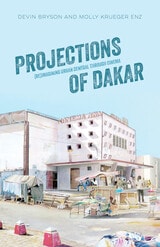
Projections of Dakar
(Re)Imagining Urban Senegal through CinemaDevin Bryson and Molly Krueger Enz
Ohio University Press, 2024
Projections of Dakar studies the audiovisual creations and practices of twenty-first-century Senegalese filmmakers living, working, and distributing their films in urban Senegal. Although some observers have described contemporary Senegalese cinema as a dying industry, this book shows that it retains great potential. Senegalese cinematic practitioners are forging unique, dynamic responses to social challenges and producing content in innovative forms.
Like contemporary Senegalese cinema, African urban centers are often perceived as sites of despair and social decay. In each chapter of this book, Devin Bryson and Molly Krueger Enz focus on a particular urban issue and analyze how Senegalese filmmakers document and reimagine it from diverse perspectives and contexts. The authors draw from interviews and ethnographic observations to center filmmakers’ practices and conceptualizations of contemporary cinema in Dakar. Bryson and Enz trace developments in production, distribution, viewership, and audience response since 2012 to study how these films and their production both reveal and contribute to how people live in the city, relate to one another, build their lives, advocate for change, find joy and meaning, and build community. They also document and articulate more equitable and inclusive forms of these activities. Ultimately, the book illustrates how Senegalese filmmakers reimagine Africa as a place that will lead to a better future for its inhabitants.
Like contemporary Senegalese cinema, African urban centers are often perceived as sites of despair and social decay. In each chapter of this book, Devin Bryson and Molly Krueger Enz focus on a particular urban issue and analyze how Senegalese filmmakers document and reimagine it from diverse perspectives and contexts. The authors draw from interviews and ethnographic observations to center filmmakers’ practices and conceptualizations of contemporary cinema in Dakar. Bryson and Enz trace developments in production, distribution, viewership, and audience response since 2012 to study how these films and their production both reveal and contribute to how people live in the city, relate to one another, build their lives, advocate for change, find joy and meaning, and build community. They also document and articulate more equitable and inclusive forms of these activities. Ultimately, the book illustrates how Senegalese filmmakers reimagine Africa as a place that will lead to a better future for its inhabitants.
[more]