Results by title
221 books match the query 'Personal narratives' and 5 start with p
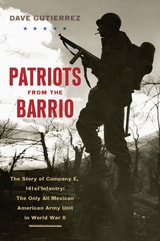
Patriots from the Barrio
The Story of Company E, 141st Infantry: The Only All Mexican American Army Unit in World War IIDave Gutierrez
Westholme Publishing, 2018
The Inspiring True Story of a Segregated Unit Whose Exploits Underscore the Forgotten Latino Contribution to the Allied Victory in World War II
As a child, Dave Gutierrez hung on every word his father recalled about his cousin Ramon, “El Sancudo” (the mosquito), and his service in World War II, where he earned a Silver Star, three Purple Hearts, and escaped from the Germans twice. Later, Dave decided to find out more about his father’s cousin, and in the course of his research he discovered that Ramon Gutierrez was a member of Company E, 141st Infantry, a part of the 36th “Texas” Division that was comprised entirely of Mexican Americans—the only such unit in the entire U.S. Army. The division landed at Salerno, Italy, in 1943, among first American soldiers to set foot in Europe. In the ensuing months, Company E and the rest of the 36th would battle their way up the mountainous Italian peninsula against some of Nazi Germany’s best troops. In addition to the merciless rain, mud, and jagged peaks, swift cold rivers crisscrossed the region, including the Rapido, where Company E would face its greatest challenge. In an infamous episode, the 36th Division was ordered to cross the Rapido despite reports that the opposite bank was heavily defended. In the ensuing debacle, the division was ripped apart, and Company E sustained appalling casualties. The company rebounded and made the storied landings at Anzio and ultimately invaded southern France for a final push into Germany. The men of Company E distinguished themselves as rugged fighters capable of warring amid the rubble of destroyed villages and in the devastated countryside.
Based on extensive archival research and veteran and family accounts, Patriots from the Barrio: The Story of Company E, 141st Infantry: The Only All Mexican American Army Unit in World War II brings to life the soldiers whose service should never have gone unrecognized for so long. With its memorable personalities, stories of hope and immigration, and riveting battle scenes, this beautifully written book is a testament to the shared beliefs of all who have fought for the ideals of the American flag.
Perilous Memories
The Asia-Pacific War(s)T. Fujitani, Geoffrey M. White, Lisa Yoneyama, eds.
Duke University Press, 2001
Firmly based on the insight that memory is always mediated and that the past is not a stable object, the volume demonstrates that we can intervene positively yet critically in the recovery and reinterpretation of events and experiences that have been pushed to the peripheries of the past. The contributors—an international list of anthropologists, cultural critics, historians, literary scholars, and activists—show how both dominant and subjugated memories have emerged out of entanglements with such forces as nationalism, imperialism, colonialism, racism, and sexism. They consider both how the past is remembered and also what the consequences may be of privileging one set of memories over others. Specific objects of study range from photographs, animation, songs, and films to military occupations and attacks, minorities in wartime, “comfort women,” commemorative events, and postwar activism in pursuing redress and reparations.
Perilous Memories is a model for war memory intervention and will be of interest to historians and other scholars and activists engaged with collective memory, colonial studies, U.S. and Asian history, and cultural studies.
Contributors. Chen Yingzhen, Chungmoo Choi, Vicente M. Diaz, Arif Dirlik, T. Fujitani, Ishihara Masaie, Lamont Lindstrom, George Lipsitz, Marita Sturken, Toyonaga Keisaburo, Utsumi Aiko, Morio Watanabe, Geoffrey M. White, Diana Wong, Daqing Yang, Lisa Yoneyama
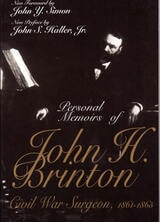
Personal Memoirs of John H. Brinton
Civil War Surgeon, 1861-1865John H. Brinton. Preface by John S. Haller, Jr. Foreword by John Y. Simon
Southern Illinois University Press, 1996
John Hill Brinton (1832–1907) met, observed, and commented on practically the entire hierarchy of the Union army; serving as medical director for Ulysses S. Grant, he came into contact with Philip H. Sheridan, John C. Frémont, Henry W. Halleck, William A. Hammond, D. C. Buell, John A. Rawlins, James Birdseye McPherson, C. F. Smith, John A. McClernand, William S. Rosecrans, and his first cousin George Brinton McClellan. John Y. Simon points out in his foreword that Brinton was one of the first to write about a relatively obscure Grant early in the war:
"Brinton found a quiet and unassuming man smoking a pipe—he could not yet afford cigars— and soon recognized a commander with mysterious strength of intellect and character."
Positioned perfectly to observe the luminaries of the military, Brinton also occupied a unique perspective from which to comment on the wretched state of health and medicine in the Union army and on the questionable quality of medical training he found among surgeons. With both A.B. and A.M. degrees from the University of Pennsylvania and postgraduate training in Paris and Vienna at a time when most medical schools required only a grammar school education, Brinton was exceptional among Civil War doctors. He found, as John S. Haller, Jr., notes in his preface, "the quality of candidates for surgeon’s appointments was meager at best." As president of the Medical Examining Board, Brinton had to lower his standards at the insistence of Secretary of War Edwin Stanton. Haller points out that one "self-educated candidate for an appointment as brigade surgeon explained to the board that he could do ‘almost anything, from scalping an Indian, up and down.’" Brinton assigned this singular candidate to duty in Kansas "where Brinton hoped he would do the least amount of damage." Throughout the war, the dearth of qualified surgeons created problems.
Brinton’s memoirs reveal a remarkable Civil War surgeon, a witness to conditions in Cairo, the Battle of Belmont, and the Siege of Fort Donelson who encountered almost every Union military leader of note.
Brinton wrote his memoirs for the edification of his family, not for public consumption. Yet he was, as Haller notes, a "keen observer of character." And with the exception of Brinton’s acceptance of late nineteenth-century gossip favorable to his cousin General McClellan, Simon finds the memoirs "remarkable for accuracy and frankness." His portrait of Grant is vivid, and his comments on the state of medicine during the war help explain, in Haller’s terms, why the "Civil War was such a medical and human tragedy."
Polish Literature and the Holocaust
Eyewitness Testimonies, 1942–1947Rachel Feldhay Brenner
Northwestern University Press, 2019
Polish Literature and the Holocaust: Eyewitness Testimonies,1942–1947 is a particularly timely book in view of the continuing debate about the attitudes of Poles toward the Jews during the war. The literary voices from the past that Brenner examines posit questions that are as pertinent now as they were then. And so, while this book speaks to readers who are interested in literary responses to the Holocaust, it also illuminates the universal issue of the responsibility of witnesses toward the victims of any atrocity.
Practicing Medicine in a Black Regiment
The Civil War Diary of Burt G. Wilder, 55th MassachusettsRichard M. Reid
University of Massachusetts Press, 2010
Burt Green Wilder, a Boston-born, Harvard-educated doctor-in-training, was among the first white officers commissioned to staff the 55th Massachusetts. Like other officers serving in the state's African American units, Wilder was selected for his military experience, his "firm Anti-Slavery principles," and his faith in the value of black troops. From the time he joined the 55th in May 1863 until the regiment was discharged in September 1865, Wilder recorded his experiences and observations. He described the day-to-day activities of a Civil War surgeon, the indignities suffered by black enlisted men at the hands of a War Department that denied them the same treatment offered to white troops, and the role of the regiment in the campaign around Charleston and in Florida.
Service in the southern states also allowed Wilder to indulge a passion for natural science and comparative anatomy, including the collection of unusual species, one of which—the spider known as Nephila wilderi—still bears his name. After the war he completed his medical studies at Harvard and joined the faculty of Cornell University, where he became a distinguished professor of zoology as well as an outspoken advocate of racial equality.
In his introduction to the volume, Richard M. Reid analyzes Burt Wilder's diary and places it within the context of the war, the experience of African American troops, and Wilder's life and career.