Results by title
64 books match the query 'Pets' and 2 start with p

Parlor Ponds
The Cultural Work of the American Home Aquarium, 1850 - 1970Judith Hamera
University of Michigan Press, 2012
Parlor Ponds: The Cultural Work of the American Home Aquarium, 1850–1970 examines the myriad cultural meanings of the American home aquarium during the nineteenth and twentieth centuries and argues that the home aquarium provided its enthusiasts with a potent tool for managing the challenges of historical change, from urbanization to globalization. The tank could be a window to an alien world, a theater for domestic melodrama, or a vehicle in a fantastical undersea journey. Its residents were seen as inscrutable and wholly disposable “its,” as deeply loved and charismatic individuals, and as alter egos by aquarists themselves.
Parlor Ponds fills a gap in the growing field of animal studies by showing that the tank is an emblematic product of modernity, one using elements of exploration, technology, science, and a commitment to rigorous observation to contain anxieties spawned by industrialization, urbanization, changing gender roles, and imperial entanglements. Judith Hamera engages advertisements, images, memoirs, public aquarium programs, and enthusiast publications to show how the history of the aquarium illuminates complex cultural attitudes toward nature and domestication, science and religion, gender and alterity, and national conquest and environmental stewardship with an emphasis on the ways it illuminates American public discourse on colonial and postcolonial expansion.
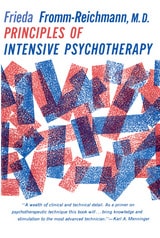
Principles of Intensive Psychotherapy
Frieda Fromm-Reichmann
University of Chicago Press, 1950
"One is continuously aware that here is a truly human being at work, human in the sense of exquisite awareness, on a profoundly intuitive level, of the workings of the human totality. . . . Because of this she can bridge the vast divide that separates us from the psychotic . . . thereby gaining access to the process of recalling the patient to his lost domain."—Louise E. DeRosis, M.D., American Journal of Psychoanalysis