Results by title
70 books match the query 'Postmodernism (Literature)' and 15 start with p
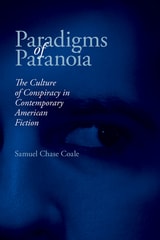
Paradigms of Paranoia
The Culture of Conspiracy in Contemporary American FictionSamuel Chase Coale
University of Alabama Press, 2005
Tracing paranoia as a defining pattern of modern American literature.
The recent popularity of The DaVinci Code and The Matrix trilogy exemplifies the fascination Americans have with conspiracy-driven subjects. Though scholars have suggested that in modern times the JFK assassination initiated an industry of conspiracy (i.e., Vietnam and the Pentagon Papers, Area 51, Iran-Contra Affair), Samuel Chase Coale reminds us in this book that conspiracy is foundational in American culture—from the apocalyptic Biblical narratives in early Calvinist households to the fear of Mormon, Catholic, Jewish, and immigrant populations in the 19th century.
Coale argues that contemporary culture—a landscape characterized by doubt, ambiguity, fragmentation, information overload, and mistrust—has fostered a radical skepticism so pervasive that the tendency to envision or construct conspiracies often provides the best explanation for the chaos that surrounds us.
Conspiracy as embodied in narrative form provides a fertile field for explorations of the anxiety lying at the heart of the postmodern experience. Thomas Pynchon's The Crying of Lot 49, Don DeLillo's Underworld, Toni Morrison's Jazz and Paradise, Joan Didion's Democracy, Tim O'Brien's In the Lake of the Woods, and Paul Auster's New York City Trilogy are some of the texts Coale examines for their representations of isolated individuals at the center of massive, anonymous master plots that lay beyond their control. These narratives remind us that our historical sense of national identity has often been based on the demonizing of others and that American fiction arose and still flourishes with apocalyptic visions.
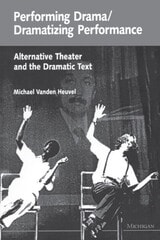
Performing Drama/Dramatizing Performance
Alternative Theater and the Dramatic TextMichael Vanden Heuvel
University of Michigan Press, 1993
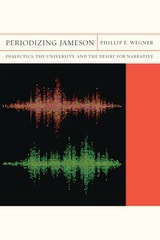
Periodizing Jameson
Dialectics, the University, and the Desire for NarrativePhillip E. Wegner
Northwestern University Press, 2014
For a half century, the American intellectual Fredric Jameson has been a driving force in literary and cultural theory. In Periodizing Jameson, Phillip E. Wegner builds upon Jameson’s unique dialectical method to demonstrate the value of Jameson’s tools—periodization, the fourfold hermeneutic, and the Greimasian semiotic square, among others—and to develop virtuoso readings of Jameson’s own work and the history of the contemporary American university in which it unfolds.
Wegner shows how Jameson’s work intervenes in particular social, cultural, and political situations, using his scholarship both to develop original explorations of nineteenth-century fiction, popular films, and other promiment theorists, and to examine the changing fortunes of theory itself. In this way, Periodizing Jameson casts new light on the potential of and challenges to humanist intellectual work in the present.
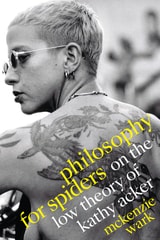
Philosophy for Spiders
On the Low Theory of Kathy AckerMcKenzie Wark
Duke University Press, 2021
Poetic License
Essays on Modernist and Postmodernist LyricMarjorie Perloff
Northwestern University Press, 1990
Poetry as Re-Reading
American Avant-Garde Poetry and the Poetics of Counter-MethodMing-Qian Ma
Northwestern University Press, 2008
Rereading and rewriting our understanding of the poetics of modernism and postmodernism, this truly revisionary work identifies a significant counter-tradition in twentieth-century poetry. Postmodernism, Ming-Qian Ma argues, does not so much follow from modernism as coexist with it, with postmodernists employing the anarchic poetics introduced by Gertrude Stein in countering the rationalist method of high modernists such as T. S. Eliot and Ezra Pound.
Grounded in a detailed and compelling account of the philosophy guiding such a project, Ma’s book traces a continuity of thought and practice through the very different poetic work of objectivists Louis Zukofsky, George Oppen, Carl Rakosi, and John Cage and language poets Susan Howe, Lyn Hejinian, Bruce Andrews, and Charles Bernstein. His deft individual readings provide an opening into this notoriously difficult work, even as his larger critique reveals a new and clarifying perspective on American modernist and post-modernist avant-garde poetics. Ma shows how we cannot understand these poets according to the usual way of reading but must see how they deliberately use redundancy, unpredictability, and irrationality to undermine the meaning-oriented foundations of American modernism--and to force a new and different kind of reading.
With its unusually clear explanation of the philosophy informing postmodern practice, and its unique insights into some of the more interesting and vexing poets of our time, this book points to a reading of an important strain of postmodern American poetry that is likely to develop well into the twenty-first century.
Pop Modernism
Noise and the Reinvention of the EverydayJuan A. Suarez
University of Illinois Press, 2007
Post-Modern Aura
The Act of Fiction in an Age of InflationCharles Newman
Northwestern University Press, 1985
In the twenty-first century as an interest in Marxist thought again coincides with the specter of financial inflation, The Post-Modern Aura is timely again.
Post-Postmodernist Fiction and the Rise of Digital Epitexts
Virginia Pignagnoli
The Ohio State University Press, 2023
Postmodern Theatric(k)s
Monologue in Contemporary American DramaDeborah Geis
University of Michigan Press, 1993
Postmodern/Postwar and After
Rethinking American LiteratureJason Gladstone, Andrew Hoberek, and Daniel Worden
University of Iowa Press, 2016
The first section of essays returns to the category of the “post-modern” and argues for the usefulness of key concepts and themes from postmodernism to the study of contemporary literature, or reevaluates postmodernism in light of recent developments in the field and historical and economic changes in the late twentieth and early twenty-first centuries. These essays take the contemporary abandonments of postmodernism as an occasion to assess the current states of postmodernity. After that, the essays move to address the critical shift away from postmodernism as a description of the present, and toward a new sense of postmodernism as just one category among many that scholars can use to describe the recent past. The final section looks forward and explores the question of what comes after the postwar/postmodern.
Taken together, these essays from leading and emerging scholars on the state of twenty-first-century literary studies provide a number of frameworks for approaching contemporary literature as influenced by, yet distinct from, postmodernism. The result is an indispensable guide that seeks to represent and understand the major overhauling of postwar American literary studies that is currently underway.
Postmodernism and Politics
Jonathon Arac
University of Minnesota Press, 1986
In eight essays, the contributors reach out to explore cinema and photography, psychology and ethics, social theory and economic reform. Taken together, the essays provide fresh perspectives on the problem of representation in many areas, from the constitution of the individual subject, through the status of the image, to the formation and transmission of social and moral knowledge.
The contributors: Paul A. Bove, Mary Louise Pratt, Dana Polan, Andrew Parker, Rainer Nagele, John Higgins, Cornel West, and Bruce Robbins.
Postmodernism, or, The Cultural Logic of Late Capitalism
Fredric Jameson
Duke University Press, 1992
Postmodernity in Latin America
The Argentine ParadigmSantiago Colás
Duke University Press, 1994
Focusing on literature, Colás uses Julio Cortázar’s Hopscotch to characterize modernity for Latin America as a whole, Manuel Puig’s Kiss of the Spider Woman to identify the transition to a more localized postmodernity, and Ricardo Piglia’s Artificial Respiration to exemplify the cultural coordinates of postmodernity in Argentina. Informed by the cycle of political transformation beginning with the Cuban Revolution, including its effects on Peronism, to the period of dictatorship, and finally to redemocratization, Colás’s examination of this literary progression leads to the reconstruction of three significant moments in the history of Argentina. His analysis provokes both a revised understanding of that history and the recognition that multiple meanings of postmodernity must be understood in ways that incorporate the complexity of regional differences.
Offering a new voice in the debate over postmodernity, one that challenges that debate’s leading thinkers, Postmodernity in Latin America will be of particular interest to students of Latin American literature and to scholars in all disciplines concerned with theories of the postmodern.

Power to Hurt
THE VIRTUES OF ALIENATIONWilliam Monroe
University of Illinois Press, 1998
Chosen as a Choice Magazine's Outstanding Academic Book for 1999.