Results by title
160 books match the query 'Poverty & Homelessness' and 16 start with p
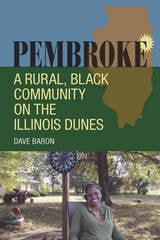
Pembroke
A Rural, Black Community on the Illinois DunesDave Baron
Southern Illinois University Press, 2016
With a population of about two thousand, Pembroke Township, one of the largest rural, black communities north of the Mason-Dixon Line, sits in an isolated corner of Kankakee County, Illinois, sixty-five miles south of Chicago. It is also one of the poorest places in the nation. Many black farmers from the South came to this area during the Great Migration; finding Chicago to be overcrowded and inhospitable, they were able to buy land in the township at low prices. The poor soil made it nearly impossible to establish profitable farms, however, and economic prosperity has eluded the region ever since. Pembroke: A Rural, Black Community on the Illinois Dunes chronicles the history of this inimitable township and shows the author’s personal transformation through his experiences with Pembroke and its people. A native of nearby Kankakee, author Dave Baron first traveled to Pembroke on a church service trip at age fifteen and saw real poverty firsthand, but he also discovered a community possessing grace and purpose.
Baron begins each chapter with a personal narrative from his initial trip to Pembroke. He covers the early history of the area, explaining how the unique black oak savanna ecosystem was created and describing early residents, including Potawatomi tribes and white fur traders. He introduces readers to Pap and Mary Tetter, Pembroke’s first black residents, who—according to local lore—assisted fugitives on the Underground Railroad; details the town’s wild years, when taverns offered liquor, drugs, and prostitution; discusses the many churches of Pembroke and the nearby high school where, in spite of sometimes strained relations, Pembroke’s black students have learned alongside white students of a neighboring community since well before Brown v. Board of Education; outlines efforts by conservation groups to preserve Pembroke’s rare black oak savannas; and analyzes obstacles to and failed attempts at economic development in Pembroke, as well as recent efforts, including organic farms and a sustainable living movement, which may yet bring some prosperity.
Based on research, interviews with residents, and the author’s own experiences during many return trips to Pembroke, this book—part social, cultural, legal, environmental, and political history and part memoir—profiles a number of the colorful, longtime residents and considers what has enabled Pembroke to survive despite a lack of economic opportunities. Although Pembroke has a reputation for violence and vice, Baron reveals a township with a rich and varied history and a vibrant culture.
Persistence, Privilege, and Parenting
The Comparative Study of Intergenerational MobilityTimothy Smeeding
Russell Sage Foundation, 2012
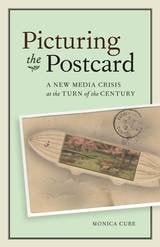
Picturing the Postcard
A New Media Crisis at the Turn of the CenturyMonica Cure
University of Minnesota Press, 2018
The first full-length study of a once revolutionary visual and linguistic medium
Literature has “died” many times—this book tells the story of its death by postcard. Picturing the Postcard looks to this unlikely source to shed light on our collective, modern-day obsession with new media. The postcard, almost unimaginably now, produced at the end of the nineteenth century the same anxieties and hopes that many people think are unique to twenty-first-century social media such as Facebook or Twitter. It promised a newly connected social world accessible to all and threatened the breakdown of authentic social relations and even of language.
Arguing that “new media” is as much a discursive object as a material one, and that it is always in dialogue with the media that came before it, Monica Cure reconstructs the postcard’s history through journals, legal documents, and sources from popular culture, analyzing the postcard’s representation in fiction by well-known writers such as E. M. Forster and Edith Wharton and by more obscure writers like Anne Sedgwick and Herbert Flowerdew. Writers deployed uproar over the new medium of the postcard by Anglo-American cultural critics to mirror anxieties about the changing nature of the literary marketplace, which included the new role of women in public life, the appeal of celebrity and the loss of privacy, an increasing dependence on new technologies, and the rise of mass media. Literature kept open the postcard’s possibilities and in the process reimagined what literature could be.
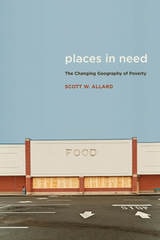
Places in Need
The Changing Geography of PovertyScott W. Allard
Russell Sage Foundation, 2017
Using census data, administrative data from safety net programs, and interviews with nonprofit leaders in the Chicago, Los Angeles, and Washington, D.C. metropolitan areas, Allard shows that poor suburban households resemble their urban counterparts in terms of labor force participation, family structure, and educational attainment. In the last few decades, suburbs have seen increases in single-parent households, decreases in the number of college graduates, and higher unemployment rates. As a result, suburban demand for safety net assistance has increased. Concerning is evidence suburban social service providers—which serve clients spread out over large geographical areas, and often lack the political and philanthropic support that urban nonprofit organizations can command—do not have sufficient resources to meet the demand.
To strengthen local safety nets, Allard argues for expanding funding and eligibility to federal programs such as SNAP and the Earned Income Tax Credit, which have proven effective in urban and suburban communities alike. He also proposes to increase the capabilities of community-based service providers through a mix of new funding and capacity-building efforts.
Places in Need demonstrates why researchers, policymakers, and nonprofit leaders should focus more on the shared fate of poor urban and suburban communities. This account of suburban vulnerability amidst persistent urban poverty provides a valuable foundation for developing more effective antipoverty strategies.

Playing with Feelings
Video Games and AffectAubrey Anable
University of Minnesota Press, 2018
How gaming intersects with systems like history, bodies, and code
Why do we so compulsively play video games? Might it have something to do with how gaming affects our emotions? In Playing with Feelings, scholar Aubrey Anable applies affect theory to game studies, arguing that video games let us “rehearse” feelings, states, and emotions that give new tones and textures to our everyday lives and interactions with digital devices. Rather than thinking about video games as an escape from reality, Anable demonstrates how video games—their narratives, aesthetics, and histories—have been intimately tied to our emotional landscape since the emergence of digital computers.
Looking at a wide variety of video games—including mobile games, indie games, art games, and games that have been traditionally neglected by academia—Anable expands our understanding of the ways in which these games and game studies can participate in feminist and queer interventions in digital media culture. She gives a new account of the touchscreen and intimacy with our mobile devices, asking what it means to touch and be touched by a game. She also examines how games played casually throughout the day create meaningful interludes that give us new ways of relating to work in our lives. And Anable reflects on how games allow us to feel differently about what it means to fail.
Playing with Feelings offers provocative arguments for why video games should be seen as the most significant art form of the twenty-first century and gives the humanities passionate, incisive, and daring arguments for why games matter.
Poor Whites of the Antebellum South
Tenants and Laborers in Central North Carolina and Northeast MississippiCharles C. Bolton
Duke University Press, 1994
Looking at two specific regions--the "settled" central piedmont of North Carolina and the "frontier" of northeast Mississippi--Bolton describes how poor whites played an important, though circumscribed, role in the local economy. Dependent on temporary employment, they represented a troubling presence in a society based on the principles of white independence and black slavery. Although perceived by southern leaders as a threat, poor whites, Bolton argues, did not form a political alliance with either free or enslaved blacks because of numerous factors including white racism, kinship ties, religion, education, and mobility. A concluding discussion of the crisis of 1860-61 examines the rejection of secession by significant numbers of poor whites, as well as the implications for their future as the Old South turned toward the new.
Poor Whites of the Antebellum South sheds light on a group often neglected in southern history. It is an important contribution that will be of interest to all students and historians of the American South.
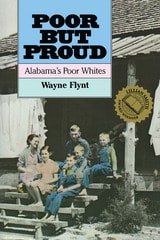
Poor but Proud
Alabama's Poor WhitesWayne Flynt
University of Alabama Press, 2001
CHOICE OUTSTANDING ACADEMIC BOOK (SPONSORED BY CHOICE MAGAZINE)
JAMES F. SULZBY BOOK AWARD (SPONSORED BY ALABAMA HISTORICAL ASSOCIATION)
ALABAMA LIBRARY AUTHOR AWARD (SPONSORED BY ALABAMA LIBRARY ASSOCIATION)
LILLIAN SMITH BOOK AWARD (SPONSORED BY SOUTHERN REGIONAL COUNCIL)
A groundbreaking history of class, culture, and resilience in the Alabama South.
First published in 1989 by The University of Alabama Press, this new paperback version will make the classic work available for general readers, bookstores, and classrooms.
Wayne Flynt addresses the life experiences of poor whites through their occupations, society, and culture. He explores their family structure, music, religion, folklore, crafts, and politics and describes their attempts to resolve their own problems through labor unions and political movements. He reveals that many of our stereotypes about poor whites are wildly exaggerated; few were derelicts or "white trash." Even though racism, emotionalism, and a penchant for violence were possible among poor whites, most bore their troubles with dignity and self-respect - working hard to eventually lift themselves out of poverty.
The phrase "poor but proud" aptly describes many white Alabamians who settled the state and persisted through time. During the antebellum years, poor whites developed a distinctive culture on the periphery of the cotton belt. As herdsmen, subsistence farmers, mill workers, and miners, they flourished in a society more renowned for its two-class division of planters and slaves. The New Deal era and the advent of World War II broke the long downward spiral of poverty and afforded new opportunities for upward mobility.
Poverty and Place
Ghettos, Barrios, and the American CityPaul A. Jargowsky
Russell Sage Foundation, 1997
Poverty in Common
The Politics of Community Action during the American CenturyAlyosha Goldstein
Duke University Press, 2012
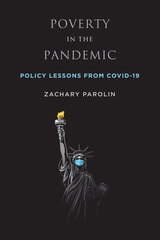
Poverty in the Pandemic
Policy Lessons from COVID-19Zachary Parolin
Russell Sage Foundation, 2023
Drawing on dozens of data sources ranging from debit and credit card spending, the first national databases of school and childcare center closures in the U.S., and bi-weekly Census-run surveys on well-being, Parolin finds that entering the pandemic in poverty substantially increased a person’s likelihood of experiencing negative health outcomes due to the pandemic, such as contracting and dying from COVID, as well as losing their job. Additionally, he found that students from poor families suffered the greatest learning losses as a result of school closures and the shift to distance learning during the pandemic.
However, unprecedented legislative action by the U.S. government, including the passage of the Families First Coronavirus Response Act (FFCRA), the Coronavirus Aid, Relief, and Economic Security (CARES) Act, and the American Rescue Plan (ARP) helped mitigate the economic consequences of the pandemic and lifted around 18 million Americans out of poverty. Based on the success of these policies, Parolin concludes with policy suggestions that the U.S. can implement in more ‘normal’ times to improve the living conditions of low-income households after the pandemic subsides, including expanding access to Unemployment Insurance, permanently expanding the Child Tax Credit, promoting greater access to affordable, high-quality healthcare coverage, and investing more resources into the Census Bureau’s data-collection capabilities. He also details a method of producing a monthly measurement of poverty, to be used in conjunction with the traditional annual measurement, in order to better understand the intra-year volatility of poverty that many Americans experience.
Poverty in the Pandemic provides the most complete account to date of the unique challenges that low-income households in the U.S. faced during the COVID-19 pandemic.
Poverty, Inequality, and the Future of Social Policy
Western States in the New World OrderKatherine McFate
Russell Sage Foundation, 1995

Powerless
The People's Struggle for EnergyDiana Hernández
Russell Sage Foundation, 2025
Approximately one in ten households in the U.S. are energy insecure and four in ten are at risk for energy insecurity. These statistics alone do not convey the acute pain of utility shutoffs, or the relentless toll of chronic energy hardships marked by difficult choices and harsh living conditions. Drawing on survey data and interviews with one hundred energy-insecure individuals and families, Hernández and Laird detail the experience of energy insecurity. Individuals and families suffering from energy insecurity endure economic hardships, such as difficulty paying utility bills, utility debt, and disconnection from utility services. They also struggle with physical challenges, such as poor housing conditions and poor or dysfunctional heating and cooling systems. They are often forced to make difficult choices about what bills to pay. These decisions are sometimes referred to as “heat or eat?” choices, as families cannot afford to pay for heating and food at the same time. Energy insecure individuals and families employ a variety of strategies to keep energy costs down to avoid having to make these hard choices. This includes deliberate underconsumption of energy, enduring physical discomfort, and using dangerous alternatives such as open flames, ovens, or space heaters to try to maintain a comfortable temperature in their home. To be energy insecure is to suffer. Despite the heavy toll of energy insecurity, most people confront these difficulties behind closed doors, believing it is a private matter. Thus, the enormous social crisis of energy insecurity goes unnoticed.
Hernández and Laird argue that household energy is a basic human right and detail policies and practices that would expand access to consistent, safe, clean, and affordable energy. Their proposals include improving the current energy safety net, which is limited and often does not serve the most energy insecure due to stringent program requirements and administrative burdens. They also suggest redesigning rates to accommodate income, promoting enrollment and expansion of discount programs, reforming utility disconnection policies, improving energy literacy, and ensuring an equitable shift to renewable energy resources.
Powerless creates a comprehensive picture of the complex social and environmental issue of energy insecurity and shows how energy equity is not just an aspiration but an achievable reality.
President Johnson's War On Poverty
Rhetoric and HistoryDavid Zarefsky
University of Alabama Press, 1986
How words waged war—and shaped the fate of a nation’s boldest social crusade.
In January 1964, in his first State of the Union address, President Lyndon Johnson announced a declaration of “unconditional war” on poverty. By the end of the year the Economic Opportunity Act became law.
War on Poverty illustrates the interweaving of rhetorical and historical forces in shaping public policy. Zarefsky suggests that an important problem lay in its discourse. He assumes that language plays a central role in the formulation of social policy by shaping the context within which people view the social world. By terming the anti-poverty effort a war, President Johnson imparted significant symbolism to the effort: it called for total victory and gave confidence that the “war” was winnable. It influenced the definition of the enemy as an intergenerational cycle of poverty, rather than the shortcomings of the individual; and it led to the choice of community action, manpower programs, and prudent management as weapons and tactics. Each of these implications involves a choice of language and symbols, a decision about how to characterize and discuss the world. Zarefsky contends that each of these rhetorical choices was helpful to the Johnson administration in obtaining passage of the Economic Opportunity Ac of 1964, but that each choice invited redefinition or reinterpretation of a symbol in a way that threatened the program.
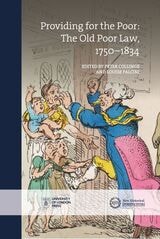
Providing for the Poor
The Old Poor Law, 1750-1834Edited by Peter Collinge and Louise Falcini
University of London Press, 2022
The Old Poor Law, which was established in 1601 in England and Wales and was in force until 1834, was administered by the local parish and dispensed goods and services to paupers, providing a uniquely comprehensive, premodern system of support for the poor. Providing for the Poor brings together academics and practitioners from across disciplines to reexamine the micropolitics of poverty in the long eighteenth century through the eyes of the poor, their providers, and enablers. Covering such topics as the providence of the parochial sixpence, which was given in order to get a beggar to move along to another parish, to coercive marriages, plebeian clothing, and the much broader implications of vagrancy toward the end of the long eighteenth century, this volume aims to bridge the gaps in our understanding of the experiences of people across the social spectrum whose lives were touched by the Old Poor Law. It brings together some of the wider arguments concerning the nature of welfare during economically difficult times and documents the rising bureaucracy inherent in the system to produce a radical new history of the Old Poor Law in astonishing detail.
Punishing the Poor
The Neoliberal Government of Social InsecurityLoïc Wacquant
Duke University Press, 2009
Putting Poor People to Work
How the Work-First Idea Eroded College Access for the PoorKathleen M. Shaw
Russell Sage Foundation, 2006