Results by title
119 books match the query 'Power (Social sciences)' and 23 start with p
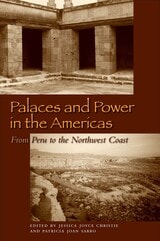
Palaces and Power in the Americas
From Peru to the Northwest CoastEdited by Jessica Joyce Christie and Patricia Joan Sarro
University of Texas Press, 2006
Ancient American palaces still captivate those who stand before them. Even in their fallen and ruined condition, the palaces project such power that, according to the editors of this new collection, it must have been deliberately drawn into their formal designs, spatial layouts, and choice of locations. Such messages separated palaces from other elite architecture and reinforced the power and privilege of those residing in them. Indeed, as Christie and Sarro write, "the relation between political power and architecture is a pervasive and intriguing theme in the Americas."
Given the variety of cultures, time periods, and geographical locations examined within, the editors of this book have grouped the articles into four sections. The first looks at palaces in cultures where they have not previously been identified, including the Huaca of Moche Site, the Wari of Peru, and Chaco Canyon in the U.S. Southwest. The second section discusses palaces as "stage sets" that express power, such as those found among the Maya, among the Coast Salish of the Pacific Northwest, and at El Tajín on the Mexican Gulf Coast. The third part of the volume presents cases in which differences in elite residences imply differences in social status, with examples from Pasado de la Amada, the Valley of Oaxaca, Teotihuacan, and the Aztecs. The final section compares architectural strategies between cultures; the models here are Farfán, Peru, under both the Chimú and the Inka, and the separate states of the Maya and the Inka.
Such scope, and the quality of the scholarship, make Palaces and Power in the Americas a must-have work on the subject.
Paths to Power
Elite Mobility in Contemporary ChinaBy David M. Lampton with the assistance of Yeung Sai-cheung
University of Michigan Press, 2000
Police
Streetcorner PoliticiansWilliam K. Muir Jr.
University of Chicago Press, 1979
"Other social scientists have observed policemen on patrol, or have interviewed them systematically. Professor Muir has brought the two together, and, because of the philosophical depth he brings to his commentaries, he has lifted the sociology of the police on to a new level. He has both observed the men and talked with them at length about their personal lives, their conceptions of society and of the place of criminals within it. His ambition is to define the good policeman and to explain his development, but his achievement is to illuminate the philosophical and occupational maturation of patrol officers in 'Laconia' (a pseudonym) . . . . His discussions of [the policemen's] moral development are threaded through with analytically suggestive formulations that bespeak a wisdom very rarely encountered in reports of sociological research."—Michael Banton, Times Literary Supplement
Political Anthropology
Helmuth Plessner, Translated from the German by Nils F. Schott, Edited and with an introduction by Heike Delitz and Robert Seyfert and an epilogue by Joachim Fischer
Northwestern University Press, 2018
In Political Anthropology (originally published in 1931 as Macht und menschliche Natur), Helmuth Plessner considers whether politics—conceived as the struggle for power between groups, nations, and states—belongs to the essence of the human. Building on and complementing ideas from his Levels of the Organic and the Human (1928), Plessner proposes a genealogy of political life and outlines an anthropological foundation of the political. In critical dialogue with thinkers such as Carl Schmitt, Eric Voegelin, and Martin Heidegger, Plessner argues that the political relationships cultures entertain with one other, their struggle for acknowledgement and assertion, are expressions of certain possibilities of the openness and unfathomability of the human.
Translated into English for the first time, and accompanied by an introduction and an epilogue that situate Plessner's thinking both within the context of Weimar-era German political and social thought and within current debates, this succinct book should be of great interest to philosophers, political theorists, and sociologists interested in questions of power and the foundations of the political.
Political Elites in Modern Societies
Empirical Research and Democratic TheorySamuel J. Eldersveld
University of Michigan Press, 1989
Political Monopolies in American Cities
The Rise and Fall of Bosses and ReformersJessica Trounstine
University of Chicago Press, 2008
Situating her in-depth studies of Chicago and San Jose in the broad context of data drawn from more than 240 cities over the course of a century, she finds that the answer—a resounding yes—illuminates the nature of political power. Both political machines and reform governments, she reveals, bias the system in favor of incumbents, effectively establishing monopolies that free governing coalitions from dependence on the support of their broader communities. Ironically, Trounstine goes on to show, the resulting loss of democratic responsiveness eventually mobilizes residents to vote monopolistic regimes out of office. Envisioning an alternative future for American cities, Trounstine concludes by suggesting solutions designed to free urban politics from this damaging cycle.
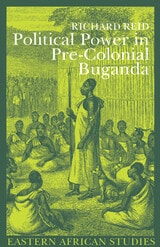
Political Power in Pre-Colonial Buganda
Economy, Society, and Warfare in the Nineteenth CenturyRichard Reid
Ohio University Press, 2002
Blessed with fertile and well-watered soil, East Africa’s kingdom of Buganda supported a relatively dense population and became a major regional power by the mid-nineteenth century. This complex and fascinating state has also long been in need of a thorough study that cuts through the image of autocracy and military might.
Political Power in Pre-Colonial Buganda explores the material basis of Ganda political power, gives us a new understanding of what Ganda power meant in real terms, and relates the story of how the kingdom used the resources at its disposal to meet the challenges that confronted it. Reid further explains how these same challenges ultimately limited Buganda’s dominance of the East African great lakes region.
Politics as Leadership
Revised EditionRobert C. Tucker
University of Missouri Press, 1995
Robert C. Tucker begins this invaluable book with an analytical look at politics, leadership, and the effect each has on the other. Aligning himself with Plato's view of politics as leadership, Tucker argues that politics is more usefully defined from this perspective than from the more familiar stance of the exercise of power. He maintains leaders must define collective problems, prescribe actions or policies, and finally seek support for their diagnoses and policy prescriptions.
Tucker contends that political science must take account not only of leadership by those in state authority, but also of sociopolitical movements for change as vehicles of attempted leadership of political communities. Dividing such movements into those for reform and those for revolution, he illustrates this distinction with examples, including Martin Luther King Jr. as a reform leader and Lenin as a revolutionary one.
Finally, Tucker raises a central question of his study: how can leadership save humankind from itself in the troubled world of today? In an insightful and moving discussion of what he calls the "crisis syndrome," Tucker analyzes problems such as population growth, resource depletion, and environmental degradation with respect to leadership. He argues that the current political process has focused on the immediate present while ignoring crises with far-reaching implications that require tough solutions.
In the epilogue to this revised edition, Tucker draws on his expertise as a Russian specialist, extending the book's discussion of leadership by viewing Mikhail Gorbachev as a reform leader in Soviet Russia and Boris Yeltsin as a post-Soviet Russian leader. Tucker also readdresses the "crisis syndrome" by examining leaders' responses in the 1980s and early 1990s.
Tucker's incisive reasoning, original insights, and commentary on the theory and practice of politics should make this revised edition of Politics as Leadership equally valuable and fascinating for experts in the field of political science and for concerned citizens.
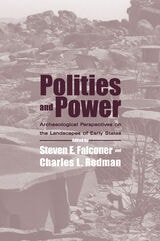
Polities and Power
Archaeological Perspectives on the Landscapes of Early StatesEdited by Steven E. Falconer and Charles L. Redman
University of Arizona Press, 2009
Polities and Power features detailed studies from an intentionally disparate array of regions, including Mesoamerica, Andean South America, southwestern Asia, East Africa, and the Indian subcontinent. Each chapter or pair of chapters is followed by a critical commentary. In concert, these studies strive to infer social, political, and economic meaning from archaeologically discerned landscapes associated with societies that incorporate some expression of state authority. The contributions engage a variety of themes, including the significance of landscapes as they condition and reflect complex polities; the interplay of natural and cultural elements in defining landscapes of state; archaeological landscapes as ever-dynamic entities; and archaeological landscapes as recursive structures, reflected in palimpsests of human activity.
Individually, many of these contributions are provocative, even controversial. Taken together, they reveal the contours of landscape archaeology at this particular evolutionary moment.
Power
Keith Dowding
University of Minnesota Press, 1996
Power & Persuasion Late Antiquity
Towards A Christian EmpirePeter Brown
University of Wisconsin Press, 1992
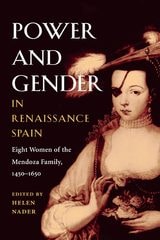
Power and Gender in Renaissance Spain
Eight Women of the Mendoza Family, 1450-1650Edited by Helen Nader
University of Illinois Press, 2003
These essays explore the lives of powerful women whose lineage gave them status within a patriarchal society designed to keep women from public life. Each of the influential and literary women discussed in this volume handled her status differently, and their concerns were not dissimilar from the concerns of feminists today: the blurring of the personal and the political, public versus private space, language and voice, and property.
Spanning the two centuries between Juana Pimentel, a widow who manipulated the patronage system to her own ends, and Luisa de Carvajal y Mendoza, who rejected both convent and marriage in favor of missionary work, Power and Gender in Renaissance Spain reveals a complex society in which women were limited by law, and yet their social status made those laws negotiable.
These women found that their personal agendas had a broad societal impact, challenging the laws of the land and patriarchal assumptions about women's inferiority.
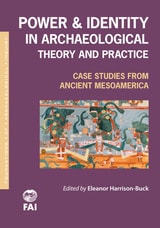
Power and Identity in Archaeological Theory and Practice
Case Studies from Ancient MesoamericaEleanor Harrison-Buck
University of Utah Press, 2012
The contributions to this volume represent a diverse array of Mesoamerican archaeological studies that are all theo-retically rooted to larger, global debates concerning issues of power and identity—two logically paired concepts. While social identity has been the focus of more critical analysis in recent years, the concept of power has received far less attention. Most studies focus on large-scale, institutional forms of power and the ruling body. Here, the focus is on relations of power, addressing broader segments of society outside the dominant group, that often are ignored in traditional reconstructions of past societies.
Harrison-Buck has compiled works that address a common criticism of social theory in the field of anthropological archaeology—the lack of strong case studies and corroborating facts supporting the abstract and often complex social theoretical concepts presented by scholars. Each contributor offers innovative method and theory and provides alternative and varied approaches to understanding power and identity in the archaeological record. They draw from a wide range of related disciplines and theoretical frameworks, including feminism, queer theory, cognitive studies, and postcolonial theory. The provocative case studies and exciting theoretical applications presented here will stimulate lively debate among scholars working both in and outside of Mesoamerica.

Power and Its Disguises
Anthropological Perspectives on PoliticsJohn Gledhill
Pluto Press, 2000
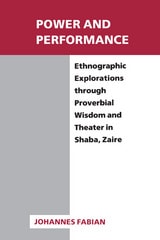
Power and Performance
Ethnographic Explorations through Proverbial Wisdom and Theater in Shaba, ZaireJohannes Fabian
University of Wisconsin Press, 1990
In 1985 Johannes Fabian, while engaged in fieldwork in the Shaba province of Zaire, first encountered this saying. Its implications—for the charismatic religious movements Fabian was examining, for the highly charged political atmosphere of Zaire, and for the cultures of the Luba peoples—continued to intrigue him, though its meaning remained elusive. On a later visit, he mentioned the saying to a company of popular actors, and triggered an ethnographic brainstorm. “Spontaneously, they decided it would be just the right topic for their next play. On the spot they began planning—suggestions for a plot were made, problems of translating the French term ‘pouvoir’ were debated, several actors cited sayings and customs from their home villages. . . .”
Power and Performance examines traditional proverbs about power as it illustrates how the performance of Le pouvoir se mange entier was created, rehearsed, and performed. The play deals with the issue of power through a series of conflicts between villagers and their chief. Both rehearsal and performance versions of the text of this drama are included, in Swahili and in English translation.
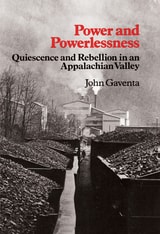
Power and Powerlessness
Quiescence and Rebellion in an Appalachian ValleyJohn Gaventa
University of Illinois Press, 1980
Using Clear Fork Valley in central Appalachia as an empirical example, Gaventa attempts to discern the "hidden faces of power" - those forces which shape actions and consciousness in ways not readily apparent in formal American political processes. He seeks to clarify and expand upon past theories (by such writers as Bachrach and Lukes) on the nature and maintenance of power.
The region studied here is characterized by stark incongruity - the co-existence of massive natural wealth (coal and land) with pervasive human poverty attended by high unemployment, limited education, malnutrition, and the prevalent hazards of mining coal: black lung, dismemberment, death, and ecological ruin. This has been the region's status quo under the decades of domination by a British company and its absentee owners. Despite these departure conditions and frequently violent union struggles, culminating in the 1969 murder of UMW reformist Jock Yablonski, acquiescence to this status quo has been maintained. Gaventa searches out the answers to how and why wealth and poverty continue to coexist and the powerless continue to accede to the powerful. His astute analysis poses broader questions about the politics of poverty, working-class consciousness, and corporate power in America.
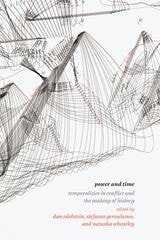
Power and Time
Temporalities in Conflict and the Making of HistoryEdited by Dan Edelstein, Stefanos Geroulanos, and Natasha Wheatley
University of Chicago Press, 2020
A collection of essays that challenges how we interpret history by focusing on the nexus of two concepts— “power” and “time”—as they manifest in a wide variety of case studies.
Time is the backdrop of historical inquiry, yet it is much more than a featureless setting for events. Different temporalities interact dynamically; sometimes they coexist tensely, sometimes they clash violently. In this innovative volume, editors Dan Edelstein, Stefanos Geroulanos, and Natasha Wheatley challenge how we interpret history by focusing on the nexus of two concepts—“power” and “time”—as they manifest in a wide variety of case studies. Analyzing history, culture, politics, technology, law, art, and science, this engaging book shows how power is constituted through the shaping of temporal regimes in historically specific ways. Power and Time includes seventeen essays on human rights; sovereignty; Islamic, European, Chinese, and Indian history; slavery; capitalism; revolution; the Supreme Court; the Anthropocene; and even the Manson Family. Power and Time will be an agenda-setting volume, highlighting the work of some of the world’s most respected and original contemporary historians and posing fundamental questions for the craft of history.
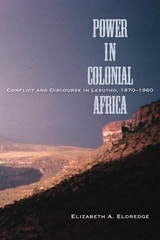
Power in Colonial Africa
Conflict and Discourse in Lesotho, 1870–1960Elizabeth A. Eldredge
University of Wisconsin Press, 2007
In Power in Colonial Africa: Conflict and Discourse in Lesotho, 1870–1960, Elizabeth A. Eldredge analyzes a panoply of archival and oral resources, visual signs and symbols, and public and private actions to show how power may be exercised not only by rulers but also by the ruled. The BaSotho—best known for their consolidation of a kingdom from the 1820s to 1850s through primarily peaceful means, and for bringing colonial forces to a standstill in the Gun War of 1880–1881—struggled to maintain sovereignty over their internal affairs during their years under the colonial rule of the Cape Colony (now part of South Africa) and Britain from 1868 to 1966. Eldredge explores instances of BaSotho resistance, resilience, and resourcefulness in forms of expression both verbal and non-verbal. Skillfully navigating episodes of conflict, the BaSotho matched wits with the British in diplomatic brinksmanship, negotiation, compromise, circumvention, and persuasion, revealing the capacity of a subordinate population to influence the course of events as it selectively absorbs, employs, and subverts elements of the colonial culture.
“A refreshing, readable and lucid account of one in an array of compositions of power during colonialism in southern Africa.”—David Gordon, Journal of African History
“Elegantly written.”—Sean Redding, Sub-Saharan Africa
“Eldredge writes clearly and attractively, and her studies of the war between Lerotholi and Masupha and of the conflicts over the succession to the paramountcy are essential reading for anyone who wants to understand those crises.”—Peter Sanders, Journal of Southern African Studies
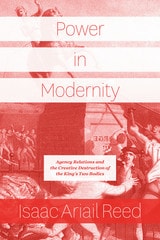
Power in Modernity
Agency Relations and the Creative Destruction of the King’s Two BodiesIsaac Ariail Reed
University of Chicago Press, 2020
He mobilizes this theory to investigate the onset of modernity in the Atlantic world, with a focus on rebellion, revolution, and state formation in colonial North America, the early American Republic, the English Civil War, and French Revolution. Modernity, Reed argues, dismantled the “King’s Two Bodies”—the monarch’s physical body and his ethereal, sacred second body that encompassed the body politic—as a schema of representation for forging power relations. Reed’s account then offers a new understanding of the democratic possibilities and violent exclusions forged in the name of “the people,” as revolutionaries sought new ways to secure delegation, build hierarchy, and attack alterity.
Reconsidering the role of myth in modern politics, Reed proposes to see the creative destruction and eternal recurrence of the King’s Two Bodies as constitutive of the modern attitude, and thus as a new starting point for critical theory. Modernity poses in a new way an eternal human question: what does it mean to be the author of one’s own actions?
Power without Force
The Political Capacity of Nation-StatesRobert W. Jackman
University of Michigan Press, 1993
Decolonization after World War II led to a significant global increase in the number of states. Each new nation was born with high expectations. But these hopes were soon eroded by the ineffectiveness and capriciousness of many of the new regimes. In many states military juntas have become the order of the day, and even where juntas have not taken power, political differences have repeatedly degenerated into violent exchanges that do not readily lend themselves to political settlement. Not only the new states have suffered from these problems; indeed, political solutions to conflict have become depressingly conspicuous by their absence.
Against this background, the last decade has seen a resurgence of interest in evaluating the political capacity or strength of modern nation-states. In Power without Force, Robert Jackman argues that political capacity has two broad components: organizational age and legitimacy. Thus, it is essential to focus both on institutions conceived in organizational terms and the amount of compliance and consent that leaders are able to engender. The emphasis on each reflects the view that political life centers on the exercise of power, and that, unlike physical force, power is intrinsically relational. Although all states have he capability to inflict physical sanctions, their ability to exercise power is the key element of their political capacity.
Drawing on a wide range of studies from political science, sociology, and political economy, Power without Force redirects attention to the central issues of political capacity. By stressing that effective conflict resolution must be addressed in political terms, this volume underscores perennial issues of governance and politics that form the heart of comparative politics and political sociology.
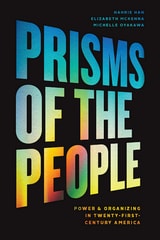
Prisms of the People
Power & Organizing in Twenty-First-Century AmericaHahrie Han, Elizabeth McKenna, and Michelle Oyakawa
University of Chicago Press, 2021
Prisms of the People addresses those questions and more. Using data from six movement organizations—including a coalition that organized a 104-day protest in Phoenix in 2010 and another that helped restore voting rights to the formerly incarcerated in Virginia—Hahrie Han, Elizabeth McKenna, and Michelle Oyakawa show that the power of successful movements most often is rooted in their ability to act as “prisms of the people,” turning participation into political power just as prisms transform white light into rainbows. Understanding the organizational design choices that shape the people, their leaders, and their strategies can help us understand how grassroots groups achieve their goals.
Linking strong scholarship to a deep understanding of the needs and outlook of activists, Prisms of the People is the perfect book for our moment—for understanding what’s happening and propelling it forward.
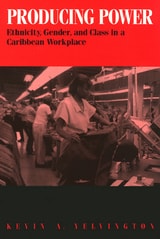
Producing Power
Ethnicity, Gender, and Class in a Caribbean WorkplaceKevin A. Yelvington
Temple University Press, 1995
In a small, locally owned Trinidadian factory that produces household goods, 80 percent of the line workers are women, almost all black or East Indian. The supervisors are all men, either white or East Indian. Kevin Yelvington worked for a year in this factory to study how ethnicity and gender are integral elements of the class structure, a social and economic structure that permeates all relations between men and women in the factory. These primary divisions determine the way the production process is ordered and labor divided.
Unlike women in other industries in "underdeveloped" parts of the world who are recruited by foreign firms, Caribbean women have always contributed to the local economy. Within this historical context, Yelvington outlines the development of the state, and addresses exploitation and domination in the labor process. Yelvington also documents the sexually charged interactions between workers and managers and explores how both use flirting and innuendo to their advantage. Weddings and other social events outside the factory provide insightful details about how the creation of social identities carries over to all aspects of the local culture.
Professional Powers
A Study of the Institutionalization of Formal KnowledgeEliot Freidson
University of Chicago Press, 1986
"As an attempt to provide a complex, wide-ranging account this book should be essential reading for specialist students, and it should act as a stimulus for the extension of both empirical research and theory."—Alex Faulkner, Sociological Review
"Freidson's book is a concise introduction to the professions, challenging specialists with its puncturing of theoretically induced misconceptions and offering general readers a clear but critical entrée to the theoretical literature concerning this central aspect of modern society."—Andrew Abbott, Science
"This is a stimulating and well-written book which opens up a new perspective on the professions as well as contributing to existing debates."—David Podmore, Times Higher Education Supplement