Results by title
70 books match the query 'Protection' and 15 start with p
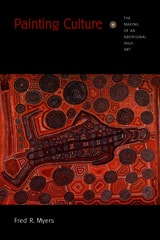
Painting Culture
The Making of an Aboriginal High ArtFred R. Myers
Duke University Press, 2002
Painting Culture describes in detail the actual practice of painting, insisting that such a focus is necessary to engage directly with the role of the art in the lives of contemporary Aboriginals. The book includes a unique local art history, a study of the complete corpus of two painters over a two-year period. It also explores the awkward local issues around the valuation and sale of the acrylic paintings, traces the shifting approaches of the Australian government and key organizations such as the Aboriginal Arts Board to the promotion of the work, and describes the early and subsequent phases of the works’ inclusion in major Australian and international exhibitions. Myers provides an account of some of the events related to these exhibits, most notably the Asia Society’s 1988 "Dreamings" show in New York, which was so pivotal in bringing the work to North American notice. He also traces the approaches and concerns of dealers, ranging from semi-tourist outlets in Alice Springs to more prestigious venues in Sydney and Melbourne.
With its innovative approach to the transnational circulation of culture, this book will appeal to art historians, as well as those in cultural anthropology, cultural studies, museum studies, and performance studies.

Playing Darts with a Rembrandt
Public and Private Rights in Cultural TreasuresJoseph L. Sax
University of Michigan Press, 2001
Some incidents are famous. A great artist's mural is demolished because the rich man who commissioned it is offended by its political implications. One of America's most famous collections is closed to virtually every notable person in the art world, whose requests for visits produce only a postcard from the owner saying "go to Blazes." Scholars who seek access to the Dead Sea Scrolls, monopolized and secreted by a handful of individuals for nearly forty years, are dismissed as "slime," "fleas," "gang-snatchers," and "manure," and told, "You will not see these things in your lifetime."
Playing Darts with a Rembrandt explores abuses of ownership of cultural treasures in a wide range of settings, including material of historic and scientific interest, as well as art and antiquities. It examines the claims made on behalf of the public for preservation, protection, and access to important artifacts, balancing those claims against proprietary and privacy interests, and discusses the proper role of institutions such as museums and libraries that act as repositories. Acknowledging the complexities that sometimes arise (such as the claims of history against the desire of a great figure's family to withhold private letters), Playing Darts with a Rembrandt proposes a new species of qualified ownership: to own an object of great public importance is to become a "fortunate, if provisional, trustee, having no right to deprive others who value the objects as much as they do themselves."
The fascinating stories that comprise the bulk of the book, ranging from dinosaur excavations and the Dead Sea Scrolls to the fate of presidential papers and the secrets held by the Library of Congress, will be of interest to a wide range of general readers. The extensive discussion of collectors, and their role, should commend the book to those in the art world, as well as to those professionally associated with museums, libraries, and archives. While written in a readable and untechnical way, it should also be of interest to those in the legal community who are interested in the philosophical and theoretical underpinnings of our property system.
"Sax turns his attention from public rights to conserve land and water to protection of cultural treasures. As always, he sees both sides of the argument and comes to reasoned and wise conclusions, balancing private and public interests. His prose is lucid, and his examples are both instructive and entertaining. An invaluable book for anyone interested in the preservation of our cultural resources." --I. Michael Heyman, Secretary, Smithsonian Institution
Joseph L. Sax is Professor of Law, University of California, Berkeley. He was formerly the counselor to the Secretary of the Interior and Professor of Law, the University of Michigan Law School.
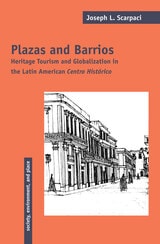
Plazas and Barrios
Heritage Tourism and Globalization in the Latin American Centro HistóricoJoseph L. Scarpaci
University of Arizona Press, 2004
This book explores how heritage tourism and globalization are reshaping the Latin American centro histórico, analyzing the transformation of the urban core from town plaza to historic center in nine cities: Bogotá, Colombia; Buenos Aires, Argentina; Cartagena, Colombia; Cuenca, Ecuador; Havana, Cuba; Montevideo, Uruguay; Puebla, Mexico; Quito, Ecuador; and Trinidad, Cuba. It tells how these pressures, combined with the advantage of a downtown location, have raised the potential of redeveloping these inner city areas but have also created the dilemma of how to restore and conserve them while responding to new economic imperatives.
In an eclectic and interdisciplinary study, Joseph Scarpaci documents changes in far-flung corners of the Latin American metropolis using a broad palette of tools: urban morphology profiles, an original land-use survey of 30,000 doorways in nine historic districts, numerous photographs, and a review of the political, economic, and globalizing forces at work in historic districts. He examines urban change as reflected in architectural styles, neighborhood growth and decline, real estate markets, and local politics in order to show the long reach of globalization and modernity.
Plazas and Barrios spans all of Spanish-speaking America to address the socio-political dimensions of urban change. It offers a means for understanding the tensions between the modern and traditional aspects of the built environment in each city and provides a key resource for geographers, urban planners, architectural historians, and all concerned with the implications of the emerging global economy.
Polyphonic Federalism
Toward the Protection of Fundamental RightsRobert A. Schapiro
University of Chicago Press, 2009
The relationship between the states and the national government is among the most contested issues in the United States. And questions about where power should reside, how decisions should be made, and how responsibility should be allocated have been central to the American experiment in federalism. In Polyphonic Federalism, Robert A. Schapiro defends the advantages of multiple perspectives in government, arguing that the resulting “polyphony” creates a system that is more efficient, democratic, and protective of liberties.
This groundbreaking volume contends that contemporary views of federalism are plagued by outmoded dualist notions that seek to separate state and federal authority. Instead, Schapiro proposes a polyphonic model that emphasizes the valuable interaction of state and federal law, one that more accurately describes the intersecting realities of local and national power. Through an analysis of several legal and policy debates, Polyphonic Federalism demonstrates how a multifaceted government can best realize the potential of federalism to protect fundamental rights.

Power System Protection
Application, Volume 3The Electricity Training Association Electricity Training Association
The Institution of Engineering and Technology, 1995

Power System Protection
Digital protection and signalling, Volume 4The Electricity Training Association Electricity Training Association
The Institution of Engineering and Technology, 1995
Power System Protection
Principles and components, Volume 1The Electricity Training Association Electricity Training Association
The Institution of Engineering and Technology, 1995

Power System Protection
Systems and methods, Volume 2The Electricity Training Association Electricity Training Association
The Institution of Engineering and Technology, 1995
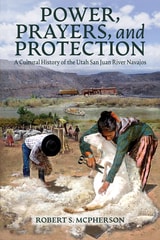
Power, Prayers, and Protection
A Cultural History of the Utah San Juan River NavajoRobert S. McPherson
University Press of Colorado, 2022
Navajo oral tradition is rich in stories and themes that form the basis for ceremonial performance. Everything that is physical, emotional, or spiritual has been placed in this world by the holy people at the time of creation, a process recognized in these accounts and teachings. Each chapter references sacred narratives that provide power through prayers that bring protection and a path for believers to follow. Topics include life on the river before and during the introduction of the white man, efficacy of the chantways, teachings of medicine people, childhood memories, arrival of trading posts, encounters with the automobile and other technology, livestock reduction and its aftermath, and the development of the Aneth oilfield with its ensuing protests. This is the Navajo elders’ story as seen through their eyes and told in their voice.
Preserving and Enhancing Communities
A Guide for Citizens, Planners, and PolicymakersElisabeth M. Hamin
University of Massachusetts Press, 2007
This book starts from the premise that each community chooses its future every day, through the incremental decisions made by planning and zoning boards and other citizen volunteers, as well as professional staff. The challenge is to ensure that these decisions support the preservation of what is special about the community, while still fostering necessary and appropriate growth.
In this volume, twenty-nine experts from a variety of fields describe in very practical terms the “community preservation” approach to these issues. As opposed to the top-down regulatory mechanisms that are sometimes used to manage growth, the contributors favor a more flexible, locally based approach that has proven successful in Massachusetts and elsewhere. They show how residents can be empowered to become involved in local decision-making, building coalitions and expressing their views on a wide range of issues, such as zoning, water and land protection, transportation, historic preservation, economic diversity, affordable housing, and reuse of brown-fields. When done properly, development can enhance the sense of place and provide needed homes and jobs. Done improperly, it can generate sprawl and a multitude of problems.
Preserving and Enhancing Communities will be particularly useful to members of planning and other regulatory boards, as well as students of community planning. The book covers not just typical ways of doing things, but also the full spectrum of innovative and emerging practices. Each chapter includes illustrations and case studies, some from Massachusetts and many from other states. The volume concludes with a set of indicators that communities can use to track their progress in community preservation and enhancement.
Protecting Heritage in the Caribbean
Peter E. Siegel
University of Alabama Press, 2011

Protection of Electricity Distribution Networks
Juan M. Gers
The Institution of Engineering and Technology, 2011

Protection of Electricity Distribution Networks
Juan M. Gers
The Institution of Engineering and Technology, 2022

Protection of Electricity Distribution Networks, 2nd Edition
Juan M. Gers
The Institution of Engineering and Technology, 2004
A properly coordinated protection system is vital to ensure that an electricity distribution network can operate within preset requirements for safety for individual items of equipment, staff and public, and the network overall. Suitable and reliable equipment should be installed on all circuits and electrical equipment and to do this, protective relays are used to initiate the isolation of faulted sections of a network in order to maintain supplies elsewhere on the system. This then leads to an improved electricity service with better continuity and quality of supply.
Protection of Global Biodiversity
Converging StrategiesLakshman D. Guruswamy and Jeffrey A. McNeely, eds.
Duke University Press, 1998
Although the global community has recently adopted a Convention of Biological Diversity, the agreement sets forth only abstract goals. Contributors to this volume advance the Convention’s initial steps by providing workable solutions that can be implemented regionally, nationally, and locally. The contributors—including natural, social, and political scientists; economists; lawyers; and environmentalists; and decisionmakers in business, agriculture, and government—have united to create a common discourse and to evaluate and propose strategies for halting this alarming loss of biodiversity. In recognizing the diverse aspects of this task—scientific, economic, institutional, moral, and legal—this book presents a new picture of emerging action.
Contributors. S. James Anaya, Gregory Benford, Graciela Chichilnisky, S. Todd Crider, Yvonne Cripps, Robert T. Fraley, Anil K. Gupta, Lakshman D. Guruswamy, G. M. Heal, Brent Hendricks, Robert B. Horsch, Laura L. Jackson, Annie Lovejoy, Ariel E. Lugo, Jeffrey A. McNeely, Brian G. Norton, Elinor Ostrom, Peter H. Raven, John W. Reid, Walter V. Reid, Mark Sagoff, Roger A. Sedgo, R. David Simpson, Ana Sittenfeld, Christopher D. Stone, Gary H. Toenniessen