Results by title
597 books match the query 'Psychological aspects' and 26 start with p
Packaged Pleasures
How Technology and Marketing Revolutionized DesireGary S. Cross and Robert N. Proctor
University of Chicago Press, 2014
In Packaged Pleasures, Gary S. Cross and Robert N. Proctor delve into an uncharted chapter of American history, shedding new light on the origins of modern consumer culture and how technologies have transformed human sensory experience. In the space of only a few decades, junk foods, cigarettes, movies, recorded sound, and thrill rides brought about a revolution in what it means to taste, smell, see, hear, and touch. New techniques of boxing, labeling, and tubing gave consumers virtually unlimited access to pleasures they could simply unwrap and enjoy. Manufacturers generated a seemingly endless stream of sugar-filled, high-fat foods that were delicious but detrimental to health. Mechanically rolled cigarettes entered the market and quickly addicted millions. And many other packaged pleasures dulled or displaced natural and social delights. Yet many of these same new technologies also offered convenient and effective medicines, unprecedented opportunities to enjoy music and the visual arts, and more hygienic, varied, and nutritious food and drink. For better or for worse, sensation became mechanized, commercialized, and, to a large extent, democratized by being made cheap and accessible. Cross and Proctor have delivered an ingeniously constructed history of consumerism and consumer technology that will make us all rethink some of our favorite things.
Pain in Relation
On Causality, Chronicity, and (Crip) EvidenceAlyson Patsavas
University of Michigan Press, 2026
Pain in Relation: On Causality, Chronicity, and (Crip) Evidence argues that the dominant stories circulating within contemporary US culture are marked by seemingly contradictory certainties: pain is at once subjective yet universal; that pain makes life unlivable and can be overcome with perseverance. These certainties graft onto pained people as impossible imperatives: the imperatives to live “despite” our pain and to defend the value of lives imagined to be compromised “because of” it. Alyson Patsavas outlines the harm these imperatives cause and draws on feminist, queer, and disability theory to offer alternative frameworks for making sense of and relating to pain.
The study fleshes out “crip autotheory” and experiments with evidencing practices, using anecdotes, journal entries, personal reflections, list-making, and photography to map “cripistemologies of pain,” or critical, disability-informed experiential ways of knowing pain. Equal parts cultural critique, intimate portrait of pained life, and commentary, Pain in Relation invites readers to challenge what they think they know about pain and explore new ways of relating to pain, pained life, and the futures we imagine for pained people.

Paper Tangos
Julie Taylor
Duke University Press, 1998
Taylor, born in the United States, has lived much of her adult life in Latin America. She has spent years studying the tango in Buenos Aires, dancing during and after the terror of military dictatorships. This book is at once an account of a life lived crossing the borders of two distinct and complex cultures and an exploration of the conflicting meanings of tango for women who love the poetry of its movement yet feel uneasy with the roles it bestows on the male and female dancers. Drawing parallels among the violences of the Argentine Junta, the play with power inherent in tango dancing, and her own experiences with violence both inside and outside the intriguing tango culture, Taylor weaves the line between engaging memoir and insightful cultural critique. Within the contexts of tango’s creative birth and contemporary presentations, this book welcomes us directly into the tango subculture and reveals the ways that personal, political, and historical violence operate in our lives.
The book’s experimental design includes photographs on every page, which form a flip-book sequence of a tango. Not simply a book for tango dancers and fans, Paper Tangos will reward students of Latin American studies, cultural studies, anthropology, feminist studies, dance studies, and the art of critical memoir.
Paradigms and Conventions
Uncertainty, Decision Making, and EntrepreneurshipYoung Back Choi
University of Michigan Press, 1993
Paranatures in Culinary Culture
An Alimentary EcologyThomas R. Parker
University of Minnesota Press, 2025
Uncovering the intricate cultural threads that inform our dietary practices
Paranatures in Culinary Culture embarks on a gastronomic odyssey, redefining foods we thought we knew and revealing the extraordinary stories of ordinary ingredients and the cultural forces shaping our diets. The book begins with a simple premise: to eat is to assimilate the outer world into the inner body, both physically and mentally. But what happens when this assimilation process goes awry? Thomas R. Parker reveals how culinary staples are not only elements of identity formation but also instruments of cultural disruption when their true nature emerges and challenges our preconceptions.
Parker explores how certain foods—bread, oysters, pigs, cheese, and wine—can both create and destabilize narratives, unsettle assimilation, and decenter Western culinary traditions. Taking inspiration from architectural historian David Gissen’s concept of “subnature” and Michel Serres’s idea of the “parasite,” Parker develops the concept of paranatures: flavors, foods, and practices considered unpalatable by different societies at different times. He reveals how certain ordinary foods live parallel paranatural lives, addressing larger issues of colonial and postcolonial food theory and challenging long-held notions that cuisine was meant to uphold.
Serving up a rich blend of history, culture, and gastronomy, Parker leads readers to perceive food as an adventure, inviting them to taste the untamed side of nature. He offers a thought-provoking invitation to reconceptualize the roles and narratives we assign to the natural world and its produce, allowing us to see food, nature, and ourselves in new ways.
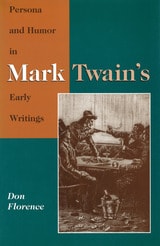
Persona and Humor in Mark Twain's Early Writings
Don Florence
University of Missouri Press, 1995
In Persona and Humor in Mark Twain's Early Writings, Don Florence explains that Samuel Clemens did more than use the borrowed name of Mark Twain to sign his writings. He also developed a separate identity, or persona, becoming "a literary personality in his own right."
Challenging mainstream Twain criticism on many fronts, Florence focuses exclusively on Twain's early writings. He demonstrates how Twain evolved in his early narratives into the "Mark Twain" we now recognize. Florence maintains that this process was evolutionary: Although Twain might have been dependent on Clemens for the initial experiences, they become Twain's experiences, necessary for his development as a persona. Traditionally, critics of Twain have been preoccupied with dualities, but Florence sees this emphasis upon polarities as an oversimplification. He argues that much of Twain's humor strives to shape more and more of the world, giving Twain multiple narrative voices and letting him be inclusive, not exclusive.
Finally, this study asserts that there is more continuity to Mark Twain's career than has been generally recognized. Many Twain scholars have argued that Twain's later writings are radically different from his earlier writings because of their emphasis upon illusion and dream. Florence argues that the preoccupation with illusion and fantasy is scarcely new. Whether Twain's mood is exuberant or dark, he emphasizes subjectivity over objectivity, the dominance of fantasy, the creative powers of humor, and his ability as persona to determine what we consider "reality." Florence contends that Twain's early writings show Mark Twain gradually evolving into a masterfully comic persona.
Jargon-free and eloquently written, Persona and Humor in Mark Twain's Early Writings provides a fascinating look at Mark Twain's developing genius and will be a welcome addition to Twain literature.
Photography and the Optical Unconscious
Shawn Michelle Smith and Sharon Sliwinski, editors
Duke University Press, 2017
Contributors. Mary Bergstein, Jonathan Fardy, Kristan Horton, Terri Kapsalis, Sarah Kofman, Elisabeth Lebovici, Zoe Leonard, Gabrielle Moser, Mignon Nixon, Thy Phu, Mark Reinhardt, Shawn Michelle Smith, Sharon Sliwinski, Laura Wexler, Kelly Wood, Andrés Mario Zervigón
Pink and Blue
Gender, Culture, and the Health of ChildrenElena Conis
Rutgers University Press, 2021
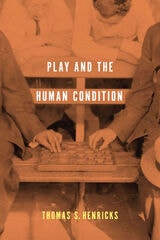
Play and the Human Condition
Thomas S. Henricks
University of Illinois Press, 2015
Imaginative and stimulating, Play and the Human Condition shows how play allows us to learn about our qualities and those of the world around us--and in so doing make sense of ourselves.

Play in the Age of Goethe
Theories, Narratives, and Practices of Play around 1800Edgar Landgraf
Bucknell University Press, 2020
Published by Bucknell University Press. Distributed worldwide by Rutgers University Press.
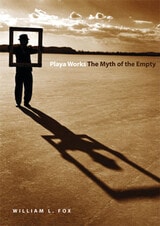
Playa Works
The Myth of the EmptyWilliam L. Fox
University of Nevada Press, 2024
In eight brilliant essays, Fox explores many of the major playas of the American West , examining locations as diverse as Nellis Air Force Base and Frenchman Flat, where the federal government has tested experimental aircraft and atomic weaponry; the Great Salt Lake Desert, where land-speed records have been broken; and the Black Rock Desert of Northern Nevada, site of the colorful Burning Man arts festival. He analyzes the geological and climatological conditions that created the playas and the historical role that playas played in the exploration and settlement of the West. And he offers lucid and keenly perceptive discussions of the ways that artists have responded to the playas, from the ancient makers of geoglyphs to the work of contemporary artists who have found inspiration in these enigmatic spaces, including earthworks builder Michael Heizer, photographer Richard Misrach, and painter Michael Moore. The ensemble is a compelling combination of natural history, philosophy, and art criticism, a thoughtful meditation on humankind's aversion to and fascination with the void.
Players and Pawns
How Chess Builds Community and CultureGary Alan Fine
University of Chicago Press, 2015
Full of idiosyncratic characters and dramatic gameplay, Players and Pawns is a celebration of the fascinating world of serious chess.
Playing Sociology
Theory and Games for Coping with Mimetic Crisis and Social ConflictMartino Doni
Michigan State University Press, 2024
Playing the Past
History and Nostalgia in Video GamesZach Whalen
Vanderbilt University Press, 2008
Playing with Feelings
Video Games and AffectAubrey Anable
University of Minnesota Press, 2018
How gaming intersects with systems like history, bodies, and code
Why do we so compulsively play video games? Might it have something to do with how gaming affects our emotions? In Playing with Feelings, scholar Aubrey Anable applies affect theory to game studies, arguing that video games let us “rehearse” feelings, states, and emotions that give new tones and textures to our everyday lives and interactions with digital devices. Rather than thinking about video games as an escape from reality, Anable demonstrates how video games—their narratives, aesthetics, and histories—have been intimately tied to our emotional landscape since the emergence of digital computers.
Looking at a wide variety of video games—including mobile games, indie games, art games, and games that have been traditionally neglected by academia—Anable expands our understanding of the ways in which these games and game studies can participate in feminist and queer interventions in digital media culture. She gives a new account of the touchscreen and intimacy with our mobile devices, asking what it means to touch and be touched by a game. She also examines how games played casually throughout the day create meaningful interludes that give us new ways of relating to work in our lives. And Anable reflects on how games allow us to feel differently about what it means to fail.
Playing with Feelings offers provocative arguments for why video games should be seen as the most significant art form of the twenty-first century and gives the humanities passionate, incisive, and daring arguments for why games matter.
Pockets of Crime
Broken Windows, Collective Efficacy, and the Criminal Point of ViewPeter K. B. St. Jean
University of Chicago Press, 2007
Why, even in the same high-crime neighborhoods, do robbery, drug dealing, and assault occur much more frequently on some blocks than on others? One popular theory is that a weak sense of community among neighbors can create conditions more hospitable for criminals, and another proposes that neighborhood disorder—such as broken windows and boarded-up buildings—makes crime more likely. But in his innovative new study, Peter K. B. St. Jean argues that we cannot fully understand the impact of these factors without considering that, because urban space is unevenly developed, different kinds of crimes occur most often in locations that offer their perpetrators specific advantages.
Drawing on Chicago Police Department statistics and extensive interviews with both law-abiding citizens and criminals in one of the city’s highest-crime areas, St. Jean demonstrates that drug dealers and robbers, for example, are primarily attracted to locations with businesses like liquor stores, fast food restaurants, and check-cashing outlets. By accounting for these important factors of spatial positioning, he expands upon previous research to provide the most comprehensive explanation available of why crime occurs where it does.
Poetics of Cognition
Thinking through Experimental PoemsJessica Lewis Luck
University of Iowa Press, 2023
The cognitive research Luck draws upon suggests that the strangeness of experimental poetry can reshape the activity of the reader’s mind, creating new forms of attention, perception, and cognition. This book closes by shifting from theory to praxis, extracting forms of teaching from the forms of thinking that experimental poems instill in order to better enable their transformative effects in readers and to bring poetry pedagogy into the twenty-first century.
Popular Stories and Promised Lands
Fan Cultures and Symbolic PilgrimagesRoger C. Aden
University of Alabama Press, 2007
A conversation about who we are, where we’ve been, and where we might be going.
Popular Stories and Promised Lands enters a conversation about who we are, where we’ve been, and where we might be going by suggesting that possible answers to those questions can be found in the popular stories we encounter at the movies, on television, in popular magazines, and even on the funny pages.
As countless scholars and popular writers have noted, those of us living in the United States find ourselves at a cultural crossroads. We are increasingly aware that the stories that once permeated life in these United States, stories that tell us that social and economic progress comes from working hard, that everyone has an equal opportunity to experience such progress, do not resonate to the degree they once did. Because many Americans have traditionally defined themselves, others, and their unique sense of place through these stories, we find ourselves displaced socially, economically, politically, and/or culturally.
So, Roger Aden says, we go to places of our own making. Fans of the television series The X-Files return to the Funhouse each week for a dose of frightening fun. Fans of the weekly magazine Sports Illustrated play in the American Elysian Fields where democratic efforts at balancing work and play are valued. Fans of the movie Field of Dreams work as altruistic producers in an alternative garden spot.
Grounded in the author’s own experiences and reinforced by the voices of approximately two hundred additional fans of the four popular stories, this book offers a compelling case for understanding the alleged wasteland of popular culture as a fertile site of individually and communally created sacred places.
Prehistory, Personality, and Place
Emil W. Haury and the Mogollon ControversyJefferson Reid and Stephanie Whittlesey
University of Arizona Press, 2011
Reid and Whittlesey present the arguments and actions surrounding the Mogollon discovery, definition, and debate. Drawing on extensive interviews conducted with Haury before his death in 1992, they explore facets of the debate that scholars pursued at various times and places and how ultimately the New Archaeology shifted attention from the research questions of cultural affiliation and antiquity that had been at the heart of the controversy. In gathering the facts and anecdotes surrounding the debate, Reid and Whittlesey offer a compelling picture of an academician who was committed to understanding the unwritten past, who believed wholeheartedly in the techniques of scientific archaeology, and who used his influence to assist scholarship rather than to advance his own career.
Prehistory, Personality, and Place depicts a real archaeologist practicing real archaeology, one that fashioned from potsherds and pit houses a true understanding of prehistoric peoples. But more than the chronicle of a controversy, it is a book about places and personalities: the role of place in shaping archaeologists’ intellect and personalities, as well as the unusual intersections of people and places that produced resolutions of some intractable problems in Southwest history.
Principles of Soundscape Ecology
Discovering Our Sonic WorldBryan C. Pijanowski
University of Chicago Press, 2024
What do the sounds of a chorus of tropical birds and frogs, a clap of thunder, and a cacophony of urban traffic have in common? They are all components of a soundscape, acoustic environments that have been identified by scientists as a combination of the biophony, geophony, and anthrophony, respectively, of all of Earth’s sound sources. As sound is a ubiquitous occurrence in nature, it is actively sensed by most animals and is an important way for them to understand how their environment is changing. For humans, environmental sound is a major factor in creating a psychological sense of place, and many forms of sonic expression by people embed knowledge and culture. In this book, soundscape ecology pioneer Bryan C. Pijanowski presents the definitive text for both students and practitioners who are seeking to engage with this thrilling new field. Principles of Soundscape Ecology clearly outlines soundscape ecology’s critical foundations, key concepts, methods, and applications. Fundamentals include concise and valuable descriptions of the physics of sound as well as a thorough elucidation of all sounds that occur on Earth. Pijanowski also presents a rich overview of the ecological, sociocultural, and technical theories that support this new science, illustrating the breadth of this amazingly transdisciplinary field. In methods, he describes the principles of data mining, signal processing, and mixed methods approaches used to study soundscapes in ecological, social, or socio-ecological contexts. The final section focuses on terrestrial, aquatic, urban, and music applications, demonstrating soundscape ecology’s utility in nearly all spaces.
Private Subjects
Family Photography in South Africa and the Right to OpacityJohn Peffer
Duke University Press, 2026
Privileged Spectatorship
Theatrical Interventions in White SupremacyDani Snyder-Young
Northwestern University Press, 2021
Many professional theater artists attempt to use live performances in formal theater spaces to disrupt racism and create a more equitable society. Privileged Spectatorship: Theatrical Interventions in White Supremacy examines the impact of such projects, looking at how and why they do and do not intervene in white supremacy. In this incisive study, Dani Snyder-Young examines audience responses to a range of theatrical events that focus on race‑related conflict or racial identity in the contemporary United States. The audiences for these performances, produced at mainstream not‑for‑profit professional theaters in major American cities in 2013–18, reflect dominant patterns of theater attendance: the majority of spectators are older, affluent, white, and describe themselves as politically progressive. Snyder-Young studies the ways these audience members consume the stories of racialized others and analyzes how different artistic, organizational, and programmatic strategies can (or cannot) mitigate white privilege.
This book is essential reading for scholars and students of theater, performance studies, and critical ethnic studies and for theater practitioners interested in equity and inclusion.
Prospero and Caliban
The Psychology of ColonizationO. Mannoni
University of Michigan Press, 1990
Noted anthropologist Maurice Bloch has written a powerful and critical new foreword to the English translation, which allows the reader to view Mannoni’s unique work in its historical and intellectual context.
Psychiatric Contours
New African Histories of MadnessNancy Rose Hunt and Hubertus Büschel, editors
Duke University Press, 2024
Contributors. Hubertus Büschel, Raphaël Gallien, Matthew M. Heaton, Richard Hölzl, Nancy Rose Hunt, Richard C. Keller, Sloan Mahone, Nana Osei Quarshie, Jonathan Sadowsky, Romain Tiquet
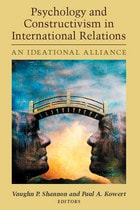
Psychology and Constructivism in International Relations
An Ideational AllianceVaughn P. Shannon and Paul A. Kowert, Editors
University of Michigan Press, 2011
"The conversation between political psychology and constructivism is essential and long overdue. By exploring the interaction of individual cognition and social processes, this 'ideational alliance' more fully explains how ideas work all the way down to shape world politics."
---Theo Farrell, King's College London
"This is a worthwhile and engaging volume. Political psychology is gaining ground as an essential perspective to consider when analyzing international relations, and the book's focus on constructivism provides key insights into the relationship between identity, norms, and behavior---bedrock concepts in understanding the social underpinnings of global politics."
---Mira Sucharov, Carleton University
"An indispensable guide to understanding what distinguishes and what unites psychology and constructivism. A wonderful resource for political psychologists, constructivists, and their critics."
---Jonathan Mercer, University of Washington
Constructivist IR scholars study the ways in which international norms, culture, and identities---all intersubjective phenomena---inform foreign policy and affect the reaction to and outcomes of international events. Political psychologists similarly investigate divergent national self-conceptions as well as the individual cognitive and emotional propensities that shape ideology and policy. Given their mutual interest in human subjectivity and identity politics, a dialogue and synthesis between constructivism and political psychology is long overdue.
The contributors to this volume discuss both theoretical and empirical issues of complementarity and critique, with an emphasis on the potential for integrating the viewpoints within a progressive ideational paradigm. Moreover, they make a self-conscious effort to interrogate, rather than gloss over, their differences in the hope that such disagreements will prove particularly rich sources of analytical and empirical insight.
Jacket illustration © Ocean Photography/Veer
Putting On Appearances
Gender and AdvertisingDiane Barthel
Temple University Press, 1989
In this lively critical analysis, Diane Barthel reveals the previously overlooked and underestimated depth of cultural meaning behind contemporary American advertising. Focusing mainly on ads for beauty products directed at women, she demonstrates how stereotypical gender identities are emphasized and how advertising itself creates a gendered relationship with the consumer. She explores psychological, sociological, and cultural messages in advertising to show how Putting on Appearances is anything but a purely personal matter, and how the social realities in which we are forced to live are conditioned by the personal appearances we choose to create.
Most advertisements are not sexually obvious, but rely instead on sexual story-telling in which seduction, deception, and passion are portrayed as acceptable means for achieving selfhood. Advertisements that proclaim, "Now is the time to paint your knees" speak with one form of authority: those that present the voice of the all-knowing scientist or the nurturing mother rely on others. Celebrities figure as professional beauties and wise older sisters, sharing their secrets with the consumer. "The Gentle Treatment Great Model Search Made Me a Star. Now it’s your turn."
Inseparable from the clothes we wear and the products we use are our ideas and fantasies about our bodies. Beauty products present beauty rituals as transcendent occasions, and diet products call up religious imagery of guilt and salvation. The body itself is to be anxiously manipulated and systematically worked over until the consumer "turns her body into...an advertisement for herself, a complicated sign to be read and admired."
In the series Women in the Political Economy, edited by Ronnie J. Steinberg.