Results by title
52 books match the query 'Public administration' and 10 start with p
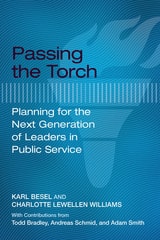
Passing the Torch
Planning for the Next Generation of Leaders in Public ServiceKarl Besel
University of Arkansas Press, 2016
Public-service executives, both elected and appointed within the public and nonprofit sectors, are retiring at record levels, and the number of Americans reaching age sixty-five annually will continue to rise over the next decade and is expected to surpass four million in 2020. Finding qualified, motivated leaders to fill vital public-service positions will challenge the public and nonprofit sectors.
Unfortunately, recent studies show that few proactive steps are being taken by public-service organizations to plan for the next generation. Passing the Torch: Planning for the Next Generation of Public-Service Leaders provides an outline for those who will be facing and managing these looming changes.
In this valuable guide, the factors that influence selection of a career in public service are explored through the authors’ years of experience as leaders in public-service organizations and through interviews with other public-service professionals. Passing the Torch will be essential for leaders of nonprofit organizations, university faculty, researchers in the field of nonprofit management, and students in nonprofit management courses.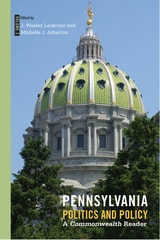
Pennsylvania Politics and Policy, Volume 2
A Commonwealth ReaderEdited by Michelle J. Atherton and J. Wesley Leckrone
Temple University Press, 2019
Designed to showcase current issues of interest, Pennsylvania Politics and Policy, Volume 2 isthe second reader consisting of updated chapters from recent issues of Commonwealth: A Journal of Pennsylvania Politics and Policy. The editors and contributors to this volume focus on government institutions, election laws, the judiciary, government finance and budgeting, the opioid crisis, childcare, property taxes, environmental policy, demographics, and more. Each chapter is supplemented by discussion questions, suggestions for further reading, and forums with arguments in support of or opposed to contested elements of state policy.
In addition, Pennsylvania Politics and Policy, Volume 2 includes a detailed guide to researching state government and policy online, as well as a comprehensive chapter on the structure of Pennsylvania government. It is designed as a text or supplement for college or advanced high school classes in American government, state and local politics, public policy, and public administration.
Contributors include: John Arway, Jenna Becker Kane, Jeffrey Carroll, Bob Dick, Ashley Harden, Stefanie I. Kasparek, Vera Krekanova, Maureen W. McClure, John F. McDonald, Josh Shapiro, Marc Stier, Jennie Sweet-Cushman, James Vike, and the editors.
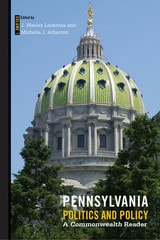
Pennsylvania Politics and Policy
A Commonwealth ReaderJ. Wesley Leckrone
Temple University Press, 2018
The activities of state governments have always been important in the American federal system. However, recent partisan gridlock in Washington, DC has placed states at the forefront of policymaking as the national government maintains the status quo. Pennsylvania Politics and Policy, Volume 1 is designed to showcase current issues of interest to Pennsylvanians. This reader contains updated chapters from recent issues of Commonwealth: A Journal of Pennsylvania Politics and Policy on education, health care, public finance, tax policy, environmental policy, alcohol policy and more. Each chapter is supplemented by forums with arguments in support of or opposed to contested elements of state policy, discussion questions, and suggestions for further reading.
In addition, Pennsylvania Politics and Policy, Volume 1 includes a comprehensive guide to researching state government and policy online. It is designed as a text or supplement for college or advanced high school classes in American government, state and local politics, public policy, and public administration.
Contributors include: David G. Argall, Tom Baldino, Michele Deegan, Michael Dimino, George Hale, Rachel L. Hampton , Paula Duda Holoviak Jon Hopcraft, Vera Krekanova, Maureen W. McClure, Barry G. Rabe, Marguerite Roza, Lanethea Mathews Shultz, Jennie Sweet-Cushman, Amanda Warco, and the editors.
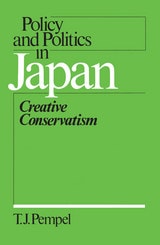
Policy & Politics Japan
T. Pempel
Temple University Press, 1982
Politics, Policy, and Organizations
Frontiers in the Scientific Study of BureaucracyGeorge A. Krause & Kenneth J. Meier, Editors
University of Michigan Press, 2003

Power, Patronage, and the Local State in Ghana
Barry Driscoll
Ohio University Press, 2023
Public Administration and the State
A Postmodern PerspectiveMichael W. Spicer
University of Alabama Press, 2005
A critical examination of public administration's pervasive vision of a powerful state
Woodrow Wilson argued for a state led by a powerful government, guided by science and enlightened experts, for the accomplishment of a set of collective purposes—in other words, a purposive state. Michael Spicer contends that though Wilson and those who followed him have not typically explored questions of political and constitutional theory in their writing, a clear and strong vision of the state has emerged in their work nonetheless.
Building upon the work of Dwight Waldo and others who have sought to explore and reveal the political theory behind the seemingly neutral language of administration, Spicer explores the roots—both historical and philosophical—of the purposive state. He considers the administrative experience of 18th-century Prussia and its relationship to the vision of the purposive state, and examines the ways this idea has been expressed in the 20th century. He then looks at the practical problems such a vision creates for public policy in a fragmented postmodern political culture. Finally, Spicer explores an alternative view of public administration—one based on a civil association model appropriate to our constitutional traditions and contemporary culture.
Public Administration's Final Exam
A Pragmatist Restructuring of the Profession and the DisciplineMichael M. Harmon
University of Alabama Press, 2006
A bold rethinking of public administration through the lens of pragmatism, governance, and democratic practice.
Michael Harmon employs the literary conceit of a Final Exam, first “written” in the early 1930s, in a critique of the field’s answers to the legitimacy question. Because the assumptions that underwrite the question preclude the possibility of a coherent answer, the exam should be canceled and its question rewritten. Envisaging a public administration no longer hostage to the legitimacy question, Harmon explains how the study and practice of public administration might proceed from adolescence to maturity.
Drawing chiefly from pragmatist philosophy, he argues that despite the universal rejection of the “politics/administration” dichotomy on factual grounds, the pseudo-problem of legitimacy nonetheless persists in the guise of four related conceptual dualisms: 1) values and facts, 2) thinking and doing, 3) ends and means, and 4) theory and practice. Collectively, these dualisms demand an impossible answer to the practical question of how we might live, and govern, together in a world of radical uncertainty and interdependence. Only by dissolving them can the legitimacy question (Woodrow Wilson’s ghost) finally be banished, clearing away the theoretical debris that obscures a more vital and useful conception of governance.
Public Management Reform and Innovation
Research, Theory, and ApplicationH. George Frederickson
University of Alabama Press, 1999
A foundational examination of how research, theory, and innovation shape effective public management and democratic governance.
The subject of reform in the public sector is not new; indeed, its latest rubric, reinventing government, has become good politics. Still, as the contributors ask in this volume, is good politics necessarily good government?
Given the growing desire to reinvent government, there are hard questions to be asked: Is the private sector market model suitable and effective when applied to reforming public and governmental organizations? What are the major political forces affecting reform efforts in public management? How is public management reform accomplished in a constitutional democratic government? How do the values of responsiveness, professionalism, and managerial excellence shape current public management reforms? In this volume, editors H. George Frederickson and Jocelyn M. Johnston bring together scholars with a shared interest in empirical research to confront head-on the toughest questions public managers face in their efforts to meet the demands of reform and innovation.
Throughout the book, the authors consider the bureaucratic resistance that results when downsizing and reinvention are undertaken simultaneously, the dilemma public managers face when elected executives set a reform agenda that runs counter to the law, and the mistaken belief that improved management can remedy flawed policy.
Public Office in Early Rome
Ritual Procedure and Political PracticeRoberta Stewart
University of Michigan Press, 2010
---Bryn Mawr Classical Review