Results by title
436 books match the query 'Renaissance' and 23 start with p
Panaceia's Daughters
Noblewomen as Healers in Early Modern GermanyAlisha Rankin
University of Chicago Press, 2013
Papal Justice
Subjects and Courts in the Papal State, 1500-1750Irene Fosi
Catholic University of America Press, 2011
Pastoral’s End
Art, Ecology, and Catastrophe in Renaissance ItalyJames Pilgrim
University of Chicago Press, 2026
In the sixteenth century, Italian artist Jacopo Bassano painted pictures of herdsmen and animals moving through dark and muddy landscapes. But he also participated in the agricultural development of the region in which he lived, producing topographical maps of local mountains and forests, inventing new methods of drainage and irrigation, and studying the latest techniques of crop rotation and fertilization. The relationship between Bassano’s rustic art and his participation in environmental transformation has, however, never been explored.
One of the first studies of Italian Renaissance art to grapple with the connections between visual culture and the environment, Pastoral’s End explores this crucial, formative relationship. James Pilgrim looks at Bassano’s career holistically, demonstrating how his involvement in a world marked by agricultural expansion, industrialization, resource extraction, environmental degradation, social transformation, and radical philosophical development informed his paintings of country life. Introducing new archival and visual evidence of Bassano’s knowledge of hydrology, agronomy, husbandry, and architecture, Pastoral’s End argues that he transformed the more placid rustic imagery of previous Renaissance artists into visions of dangerous ecological instability.
Patron to Painter
Elizabethan Programs for Five Allegorical PaintingsDavid Evett
Arizona Center for Medieval and Renaissance Studies, 2020
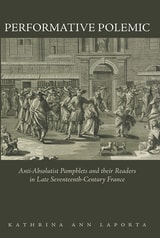
Performative Polemic
Anti-Absolutist Pamphlets and their Readers in Late Seventeenth-Century FranceKathrina Ann LaPorta
University of Delaware Press, 2021
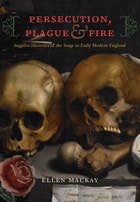
Persecution, Plague, and Fire
Fugitive Histories of the Stage in Early Modern EnglandEllen MacKay
University of Chicago Press, 2011
The theater of early modern England was a disastrous affair. The scant record of its performance demonstrates as much, for what we tend to remember today of the Shakespearean stage and its history are landmark moments of dissolution: the burning down of the Globe, the forced closure of playhouses during outbreaks of the plague, and the abolition of the theater by its Cromwellian opponents.
Persecution, Plague, and Fire is a study of these catastrophes and the theory of performance they convey. Ellen MacKay argues that the various disasters that afflicted the English theater during its golden age were no accident but the promised end of a practice built on disappearance and erasure—a kind of fatal performance that left nothing behind but its self-effacing poetics. Bringing together dramatic theory, performance studies, and theatrical, religious, and cultural history, MacKay reveals the period’s radical take on the history and the future of the stage to show just how critical the relation was between early modern English theater and its public.
Philosophers of the Renaissance
Paul Richard Blum
Catholic University of America Press, 2010
Philosophy in the Renaissance
An AnthologyPaul Richard Blum
Catholic University of America Press, 2022
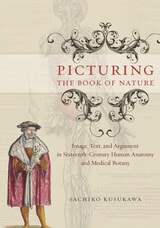
Picturing the Book of Nature
Image, Text, and Argument in Sixteenth-Century Human Anatomy and Medical BotanySachiko Kusukawa
University of Chicago Press, 2012
Because of their spectacular, naturalistic pictures of plants and the human body, Leonhart Fuchs’s De historia stirpium and Andreas Vesalius’s De humani corporis fabrica are landmark publications in the history of the printed book. But as Picturing the Book of Nature makes clear, they do more than bear witness to the development of book publishing during the Renaissance and to the prominence attained by the fields of medical botany and anatomy in European medicine. Sachiko Kusukawa examines these texts, as well as Conrad Gessner’s unpublished Historia plantarum, and demonstrates how their illustrations were integral to the emergence of a new type of argument during this period—a visual argument for the scientific study of nature.
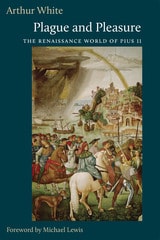
Plague and Pleasure
The Renaissance World of Pius IIArthur White
Catholic University of America Press, 2014
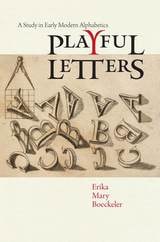
Playful Letters
A Study in Early Modern AlphabeticsErika Mary Boeckeler
University of Iowa Press, 2017
Drawing on Shakespeare, anthropomorphic typography, figured letters, and Cyrillic pedagogy and politics, this book explores the ways in which alphabetic thinking and writing inform literature and the visual arts, and it develops reading strategies for the “letterature” that underwrites such cultural production. Playful Letters begins with early modern engagements with the alphabet and the human body—an intersection where letterature emerges with startling force. The linking of letters and typography with bodies produced a new kind of literacy. In turn, educational habits that shaped letter learning and writing permeated the interrelated practices of typography, orthography, and poetry. These mutually informing processes render visible the persistent crumbling of words into letters and their reconstitution into narrative, poetry, and image.
In addition to providing a rich history of literary and artistic alphabetic interrogation in early modern Western Europe and Russia, Playful Letters contributes to the continuous story of how people use new technologies and media to reflect on older forms, including the alphabet itself.
Poetic Relations
Intimacy and Faith in the English ReformationConstance M. Furey
University of Chicago Press, 2017
As Furey demonstrates, John Donne, George Herbert, Anne Bradstreet, and others describe inner lives that are surprisingly crowded, teeming with human as well as divine companions. The same early modern writers who bequeathed to us the modern distinction between self and society reveal here a different way of thinking about selfhood altogether. For them, she argues, the self is neither alone nor universally connected, but is forever interactive and dynamically constituted by specific relationships. By means of an analysis equally attentive to theological ideas, social conventions, and poetic form, Furey reveals how poets who understand introspection as a relational act, and poetry itself as a form ideally suited to crafting a relational self, offer us new ways of thinking about selfhood today—and a resource for reimagining both secular and religious ways of being in the world.
Poetics Of Plot
The Case of English Renaissance DramaThomas Pavel
University of Minnesota Press, 1985
Thomas Pavel has written extensively on poetics, linguistics, and narratology. In this book he proposes an original theory and methodology of plot analysis—a reading that draws upon the most fruitful aspects of literary structuralism and upon contemporary linguistic models (specifically generative grammar). Theorists have tended to use formal plot analysis to examine relatively simple literary artifacts, like folk tales and short stories; Pavel, however, applies his model to a group of English Renaissance tragedies and demonstrates that plot analysis can make a major contribution to the understanding of sophisticated literary texts.
Pavel leads the reader through step-by-step analyses of increasingly complex plot structures as he explicates Marlowe’s Tamburlaine I, the Jew of Malta, Doctor Faustus and Edward the Second; Kyd’s Spanish Tragedy; The Arden Feversham; and, finally, Shakespeare’s King Lear. He has chosen these plays for their chronological proximity, yet their diversity allows for contrasts and typological considerations. The inclusion of most of Marlowe’s tragedies enables Pavel to gain new insights into a single writer’s strategies of plot construction.The Poetics of Plot moves beyond the establishment and application of a new theory of plot to address broader issues in cultural studies: the role of linguistic models in literary studies, the nature and function of agency in plot advancement and history, the universal features of plot organization, and the relation of plot patterns to period styles and dominant modes of organized knowledge. In his foreword to The Poetics of Plot, Wlad Godzich sketches the historical context in which Pavel’s discussion of plot appears and makes explicit the way that the study of plot challenges both the presuppositions of linguistic analysis and the status of action in philosophical thought.
Poetics of the Legal Sea in English Renaissance Literature
Hayley Cotter
University of Alabama Press, 2026
A vivid exploration of how early modern literature transformed the law of the sea into a rich imaginative realm of maritime space and poetic possibility
Poetics of the Legal Sea in English Renaissance Literature is a richly layered study that traces how early modern writers imagined the sea as both a legal landscape and a site of narrative possibility. Through an interdisciplinary lens, the book illuminates the ways literary forms conceptualized the maritime laws that governed the early modern world. Its narrative moves fluidly between legal frameworks and poetic language, revealing a dynamic exchange between artistic expression and the systems that regulated life at sea.
Hayley Cotter’s analysis charts a metaphorical voyage, guiding readers from the calm departure of genre and jurisdiction through turbulent encounters with piracy, shipwreck, and salvage. Plays and poems become vessels that carry ideas about authority, justice, and sovereignty, while rhetorical devices such as metaphor, synecdoche, and metonymy deepen the imaginative pull of maritime experience. This journey foregrounds the cognitive effects of literary language, showing how early modern authors engaged with legal culture in ways that often moved beneath the surface of conscious thought.
As the chapters progress, literary texts become active participants in shaping understandings of law and maritime space. Shakespearean drama, Elizabethan pirate tales, sonneteering traditions, and anonymous sea poems all contribute to a vibrant conversation about how societies negotiated law and commerce on the open water. Bringing together readers interested in early modern literature, maritime history, and interdisciplinary inquiry, Poetics of the Legal Sea in English Renaissance Literature offers a compelling exploration of how the ocean’s vast, shifting expanse inspired new ways of thinking about power and the stories that give shape to legal life.
Poetry in a World of Things
Aesthetics and Empiricism in Renaissance EkphrasisRachel Eisendrath
University of Chicago Press, 2018
In Poetry in a World of Things, Rachel Eisendrath explores how poetry responded to this new detachment by becoming a repository for a more complex experience of the world. The book focuses on ekphrasis, the elaborate literary description of a thing, as a mode of resistance to this new empirical objectivity. Poets like Petrarch, Spenser, Marlowe, and Shakespeare crafted highly artful descriptions that recovered the threatened subjective experience of the material world. In so doing, these poets reflected on the emergence of objectivity itself as a process that was often darker and more painful than otherwise acknowledged. This highly original book reclaims subjectivity as a decidedly poetic and human way of experiencing the material world and, at the same time, makes a case for understanding art objects as fundamentally unlike any other kind of objects.
Poets and the Visual Arts in Renaissance England
By Norman K. Farmer, Jr.
University of Texas Press, 1984
In the twentieth century, the pioneering work of such art historians as Erwin Panofsky and Edgar Wind heightened our awareness of the relationship between Renaissance literature and the visual arts. By focusing on that relationship in the work of such poets as Sir Philip Sidney, John Donne, Richard Crashaw, Edmund Waller, and Robert Herrick, Norman K. Farmer, Jr., convincingly shows that they and other writers of the late sixteenth and early seventeenth centuries in England wrote with a lively and creative sense of the visual—a sense richly informed by the theory and practice of Renaissance art.
Farmer begins by describing the powerful visual matrix that underlies the narrative structure of Sidney's New Arcadia. He compares the role of the visual in the poetry of Donne and Ben Jonson, and demonstrates how works by both Thomas Carew and Lord Herbert exhibit poetic invention according to familiar Renaissance pictorial themes. Herrick's Hesperides is shown to be the major seventeenth-century poetic application of the Horatian idea ut pictura poesis.
A special feature of this gracefully written and enlightening volume is Farmer's discussion of Lady Drury's oratory at Hawstead Hall. Published here for the first time are photographs of this uniquely decorated oratory, in which themes from a variety of English and Continental emblem books were painted on the walls of a room apparently designed for private meditation.
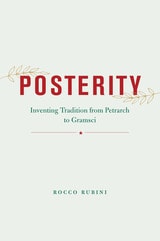
Posterity
Inventing Tradition from Petrarch to GramsciRocco Rubini
University of Chicago Press, 2022
Rocco Rubini studies the motives and literary forms in the making of a “tradition,” not understood narrowly, as the conservative, stubborn preservation of received conventions, values, and institutions, but instead as the deliberate effort on the part of writers to transmit a reformulated past across generations. Leveraging Italian thinkers from Petrarch to Gramsci, with stops at prominent humanists in between—including Giambattista Vico, Carlo Goldoni, Francesco De Sanctis, and Benedetto Croce—Rubini gives us an innovative lens through which to view an Italian intellectual tradition that is at once premodern and modern, a legacy that does not depend on a date or a single masterpiece, but instead requires the reader to parse an expanse of writings to uncover deeper transhistorical continuities that span six hundred years. Whether reading work from the fourteenth century, or from the 1930s, Rubini elucidates the interplay of creation and the reception underlying the enactment of tradition, the practice of retrieving and conserving, and the revivification of shared themes and intentions that connect thinkers across time. Building on his award-winning book, The Other Renaissance, this will prove a valuable contribution for intellectual historians, literary scholars, and those invested in the continuing humanist legacy.
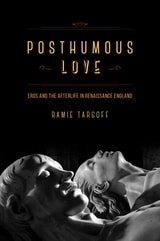
Posthumous Love
Eros and the Afterlife in Renaissance EnglandRamie Targoff
University of Chicago Press, 2014
Targoff shows that medieval notions of the somewhat flexible boundaries between love in this world and in the next were hardened by Protestant reformers, who envisioned a total break between the two. Tracing the narrative of this rupture, she focuses on central episodes in poetic history in which poets developed rich and compelling compensations for the lack of posthumous love—from Thomas Wyatt’s translations of Petrarch’s love sonnets and the Elizabethan sonnet series of Shakespeare and Spencer to the carpe diem poems of the seventeenth century. Targoff’s centerpiece is Romeo and Juliet, where she considers how Shakespeare’s reworking of the Italian story stripped away any expectation that the doomed teenagers would reunite in heaven. Casting new light on these familiar works of poetry and drama, this book ultimately demonstrates that the negation of posthumous love brought forth a new mode of poetics that derived its emotional and aesthetic power from its insistence upon love’s mortal limits.
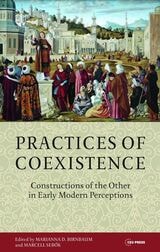
Practices of Coexistence
Constructions of the Other in Early Modern PerceptionsMarianna D. Birnbaum
Central European University Press, 2017

Prayer and Power
George Herbert and Renaissance CourtshipMichael C. Schoenfeldt
University of Chicago Press, 1991
Before entering the priesthood, Herbert nourished contacts in court, was elected University Orator at Cambridge, and served in Parliament. In turning to God, Schoenfeldt argues, Herbert did not simply turn away from the secular world but also turned its language, particularly the language of courtesy, into the medium for his lyric worship of God. The confluence of courtesy and spirituality in Herbert's poetry provides a fascinating insight into a society searching for an appropriate discourse of reverence in a time of baffling change. The first five chapters investigate the manifold ways in which Herbert's life and works exemplify the interdependence of social and religious behavior in the English Renaissance. The sixth and final chapter extends this investigation into the nervous eroticism of Herbert's poems.
Considering The Temple as well as Herbert's letters, speeches, Latin poems, collections of foreign proverbs, translations, The Country Parson, and less familiar lyrics, Schoenfeldt offers a thorough and detailed reading of Herbert's rich and conflicted corpus. Prayer and Power is not only a bold redefinition of the accomplishment of one of the finest poets of the English Renaissance but also the first sustained study to advance a cultural poetics of the religious lyric.
Prosdocimo de' Beldomandi's Musica Plana and Musica Speculativa
Prosdocimo de Beldomandi. Translated by Jan Herlinger.
University of Illinois Press, 2007
Available in English for the first time, Prosdocimo's Tractatus plane musice (1412) and Tractatus musice speculative (1425) are exemplary texts for understanding the high sophistication of music theory in the early fifteenth century. Known for considering music as a science based on demonstrable mathematical principles, Prosdocimo praises Marchetto for his theory of plainchant but criticizes his influential Lucidarium for its heterodox mathematics. In dismissing Marchetto as a “mere performer,” Prosdocimo takes up matters as broad as the nature and definition of music and as precise as counterpoint, tuning, and ecclesiastical modes. The treatises also reveal much about Prosdocimo’s understanding of plainchant; his work with Euclid's Elementa; and his familiarity with the music theory of Boethius, Macrobius, and Johannes de Muris. A foremost authority on Italian music theory of the Middle Ages and early Renaissance, Jan Herlinger consults manuscripts from Bologna, Cremona, and Lucca in preparing these valuable first critical editions.

Prostitution, Repentance and Social Welfare in Renaissance Florence
Gillian Jack
University of London Press, 2026
A study of the survival of Sant'Elisabetta delle Convertite, the Florence monastery for repentant prostitutes, during the long Renaissance.
From the fourteenth century, prostitutes in Florence were encouraged to leave their profession and spend their lives in repentance at the monastery of Sant’Elisabetta delle Convertite. Many did over its five hundred years, and the monastery was soon one of the most populous in Florence. As the longest enduring monastery for repentant prostitutes, Sant’Elisabetta is an integral part of the history of nuns and of prostitution in the medieval and early modern periods, and it had an important place in municipal responses to social welfare and civic morality. It is only by uncovering successive governments’ involvement in Sant'Elisabetta that we can fully understand how the city attempted to manage both prostitution and welfare.
This is the first book-length study to put Sant’Elisabetta into its full historical context. It establishes the place of this often-overlooked nunnery in the wider world of medieval penitential piety, renaissance charity, and early modern social welfare, exploring the myriad ways in which the Florentine authorities attempted to stabilize Sant’Elisabetta’s finances and ensure its continued survival. Drawing on diverse archival sources, the book’s long chronological scope offers valuable insights into the broader histories of the relationship between the Florentine state and monastic institutions, public policy, welfare, and women in the long Renaissance.
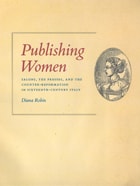
Publishing Women
Salons, the Presses, and the Counter-Reformation in Sixteenth-Century ItalyDiana Robin
University of Chicago Press, 2007
Even the most comprehensive Renaissance histories have neglected the vibrant groups of women writers that emerged in cities across Italy during the mid-1500s—and the thriving network of printers, publishers, and agents that specialized in producing and selling their books. In Publishing Women, Diana Robin finally brings to life this story of women’s cultural and intellectual leadership in early modern Italy, illuminating the factors behind—and the significance of—their sudden dominance.
Focusing on the collective publication process, Robin portrays communities in Naples, Venice, Rome, Siena, and Florence, where women engaged in activities that ranged from establishing literary salons to promoting religious reform. Her innovative cultural history considers the significant roles these women played in tandem with men, rather than separated from them. In doing so, it collapses the borders between women’s history, Renaissance and Reformation studies, and book history to evoke a historical moment that catapulted women’s writings and women-sponsored books into the public sphere for the first time anywhere in Europe.