Results by title
322 books match the query 'Social Policy' and 16 start with p

Philosophy, Crime, and Criminology
Edited by Bruce A. Arrigo and Christopher R. Williams
University of Illinois Press, 2006
Charting a provocative and original direction, editors Bruce A. Arrigo and Christopher R. Williams couple theoretically oriented chapters with those centered on application and case study. In doing so, they develop an insightful, sensible, and accessible approach for a philosophical criminology in step with the political and economic challenges of the twenty-first century. Revealing the ways in which philosophical conceits inform prevailing conceptions of crime, Philosophy, Crime, and Criminology is required reading for any serious student or scholar concerned with crime and its impact on society and in our lives.
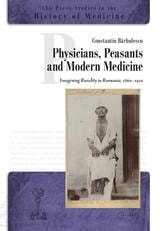
Physicians, Peasants, and Modern Medicine
Imagining Rurality in Romania, 1860-1910Constantin Barbulescu
Central European University Press, 2019

Planning Families in Nepal
Global and Local Projects of ReproductionBrunson, Jan
Rutgers University Press, 2016

Policing the Project
State Violence and the Dismantling of Chicago Public HousingMadeleine Hamlin
University of Chicago Press, 2027
Shows how policing shaped the trajectory of public housing in Chicago and paved the way for its eradication and privatization.
Public housing should be a great public good, providing an essential basic need for people with lower incomes. Unfortunately, in the United States, policymakers turned their backs on public housing early on. Intended to be a utopia for the working poor, public housing in many cities became characterized by racial isolation, extreme poverty, and infrastructural breakdown, all of which left residents vulnerable to crime. State abandonment had one major exception, however: policing. In Policing the Project, geographer Madeleine Hamlin details how police played an important role in Chicago’s public housing from its origins in 1937 to the eve of its demolition at the turn of the millennium.
Based on archival data as well as extensive interviews with former residents and police officers, Hamlin describes the progressive institutional entanglement of public housing and policing as it unfurled over the course of the twentieth century. Policing the Project transcends mere description of how policing impacted everyday life for public housing residents, instead considering how policing shaped the institution of public housing as a whole. Hamlin argues that policing conditioned public housing’s downfall: draining housing budgets while exacerbating rather than mitigating crime and violence. Thus, policing played an important role in shaping the dramatic transformation of Chicago’s housing landscape, which entailed widespread privatization and the displacement of tens of thousands of Black Chicagoans.
Policy & Politics Japan
T. Pempel
Temple University Press, 1982
Policy Politics Canada
Carolyn J. Tuohy
Temple University Press, 1992
At a time when Canadian political institutions are being fundamentally questioned, this book provides a comparative perspective on the distinctive features of the Canadian policy process hich have enabled conflict to be resolved in the past. In comparison with other Western industrial nations, Canada's policies in some arenas appear as models of workable compromise; in others, they stand out as marked by continuing irresolution. In this first book-length treatment of Canadian public policy in comparative perspective, Carolyn Tuohy focuses on constitutional change, health care delivery, industrial relations and labor market policy, economic development and adjustment, oil and gas policy, and minority language rights.
What distinguishes Canada's characteristic policy process is its quintessential ambivalence: ambivalence about the appropriate role of the state, about definitions of political community, and about individual and collective values and conceptions of rights. Embedded in the country's political institutions, it has deep roots in Canada's relationship to the United States, its history of English-French tensions, and its regional diversity.
Examining in particular the delicate federal-provincial division of power and the legislative-judicial relationship, Tuohy discusses how the constitutional debates of the 1980s and 1990s are testing Canada's institutions to resolve conflict.
In the series Policy and Politics in Industrial States, edited by Douglas E. Ashford, Peter J. Katzenstein, and T.J. Pempel.
Possessive Investment In Whiteness
George Lipsitz
Temple University Press, 1998
Lipsitz's ultimate point is not to condemn all white people as racists but to challenge everyone to begin a principled examination of personal actions and political commitments. Exposing the system of unfairness is not enough. People of all groups -- but especially white people because they benefit from that system -- have to work toward eradicating the rewards of whiteness.
Poverty, Inequality, and the Future of Social Policy
Western States in the New World OrderKatherine McFate
Russell Sage Foundation, 1995
Power to the Transfer
Critical Race Theory and a Transfer Receptive CultureDimpal Jain
Michigan State University Press, 2020

Power-Sharing
Institutional and Social Reform in Divided SocietiesIan O'Flynn & David Russell, Editors
Pluto Press, 2005
Power-Sharing seeks to explore the unintended consequences of power-sharing for the communities themselves, their individual members, and for others in society. More specifically, it is distinctive in questioning explicitly whether power sharing: perpetuates inter-communal conflict by institutionalising difference at the political level; inhibits conflict resolution by encouraging extremism; stifles internal diversity; and fails to leave sufficient space for individual autonomy.
This book not only provides a theoretical exploration and critique of these questions, but comprehensively examines specific test cases where power-sharing institutions have been established, including in Northern Ireland, Belgium, Bosnia-Herzegovina, Macedonia and Lebanon. It also explores such issues as the role of political leaders, human rights
instruments, the position of women, and the prospects for reconciliation within such societies.
Furthermore it provides a detailed set of policy recommendations to meet the challenges of transition in deeply-divided societies.

Predatory Welfare
Debt, Race, and Cash TransfersErin Torkelson
Duke University Press, 2026
President Johnson's War On Poverty
Rhetoric and HistoryDavid Zarefsky
University of Alabama Press, 1986
How words waged war—and shaped the fate of a nation’s boldest social crusade.
In January 1964, in his first State of the Union address, President Lyndon Johnson announced a declaration of “unconditional war” on poverty. By the end of the year the Economic Opportunity Act became law.
War on Poverty illustrates the interweaving of rhetorical and historical forces in shaping public policy. Zarefsky suggests that an important problem lay in its discourse. He assumes that language plays a central role in the formulation of social policy by shaping the context within which people view the social world. By terming the anti-poverty effort a war, President Johnson imparted significant symbolism to the effort: it called for total victory and gave confidence that the “war” was winnable. It influenced the definition of the enemy as an intergenerational cycle of poverty, rather than the shortcomings of the individual; and it led to the choice of community action, manpower programs, and prudent management as weapons and tactics. Each of these implications involves a choice of language and symbols, a decision about how to characterize and discuss the world. Zarefsky contends that each of these rhetorical choices was helpful to the Johnson administration in obtaining passage of the Economic Opportunity Ac of 1964, but that each choice invited redefinition or reinterpretation of a symbol in a way that threatened the program.
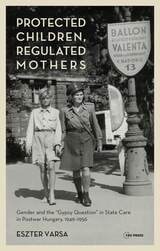
Protected Children, Regulated Mothers
Gender and the "Gypsy Question" in State Care in Postwar Hungary, 1949–1956Eszter Varsa
Central European University Press, 2021
Protected Children, Regulated Mothers examines child protection in Stalinist Hungary as a part of twentieth-century East Central, Eastern, and Southeastern European history. Across the communist bloc, the prewar foster care system was increasingly replaced after 1945 by institutionalization in residential homes. This shift was often interpreted as a further attempt to establish totalitarian control. However, this study—based on hundreds of children's case files and interviews with institution leaders, teachers, and people formerly in state care—provides a new perspective. Rather than being merely a tool of political repression, state care in postwar Hungary was often shaped by the efforts of policy actors and educators to address the myriad of problems engendered by the social and economic transformations that emerged after World War II. This response built on, rather than broke with, earlier models of reform and reformatory education. Yet child protection went beyond safeguarding and educating children; it also focused on parents, particularly lone mothers, regulating not only their entrance to paid work but also their sexuality. In so doing, children's homes both reinforced and changed existing cultural and social patterns, whether about gendered division of work or the assimilation of minorities. Indeed, a major finding of the book is that state socialist child protection continued a centuries-long national project of seeking a “solution to the Gypsy question,” rooted in efforts to eliminate the perceived “workshyness” of Roma.
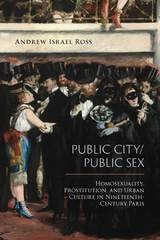
Public City/Public Sex
Homosexuality, Prostitution, and Urban Culture in Nineteenth-Century ParisAndrew Israel Ross
Temple University Press, 2019
In the 1800s, urban development efforts modernized Paris and encouraged the creation of brothels, boulevards, cafés, dancehalls, and even public urinals. However, complaints also arose regarding an apparent increase in public sexual activity, and the appearance of “individuals of both sexes with depraved morals” in these spaces. Andrew Israel Ross’s illuminating study, Public City/Public Sex, chronicles the tension between the embourgeoisement and democratization of urban culture in nineteenth-century Paris and the commercialization and commodification of a public sexual culture, the emergence of new sex districts, as well as the development of gay and lesbian subcultures.
Public City/Public Sex examines how the notion that male sexual desire required suitable outlets shaped urban policing and development. Ross traces the struggle to control sex in public and argues that it was the very effort to police the city that created new opportunities for women who sold sex and men who sought sex with other men. Placing public sex at the center of urban history, Ross shows how those who used public spaces played a central role in defining the way the city was understood.
Public Policy and the Income Distribution
Alan J. Auerbach
Russell Sage Foundation, 2006
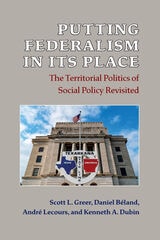
Putting Federalism in Its Place
The Territorial Politics of Social Policy RevisitedScott L. Greer, Daniel Béland, André Lecours, and Kenneth A. Dubin
University of Michigan Press, 2023
What does federalism do to welfare states? This question arises in scholarly debates about policy design as well as in discussions about the right political institutions for a country. It has frustrated many, with federalism seeming to matter in all sorts of combinations with all sorts of issues, from nationalism to racism to intergovernmental competition. The diffuse federalism literature has not come to compelling answers for very basic questions.
Scott L. Greer, Daniel Béland, André Lecours, and Kenneth A. Dubin argue for a new approach—one methodologically focused on configurations of variables within cases rather than a fruitless attempt to isolate “the” effect of federalism; and one that is substantively engaged with identifying key elements in configurations as well as with when and how their interactions matter. Born out of their work on a multi-year, eleven-country project (published as Federalism and Social Policy: Patterns of Redistribution in Eleven Countries, University of Michigan Press, 2019), this book comprises a methodological and substantive agenda. Methodologically, the authors shift to studies that embraced and understood the complexity within which federal political institutions operate. Substantively, they make an argument for the importance of plurinationalism, changing economic interests, and institutional legacies.