Results by title
51 books match the query 'Songs and music' and 5 start with p
P'ungmul
South Korean Drumming and DanceNathan Hesselink
University of Chicago Press, 2006
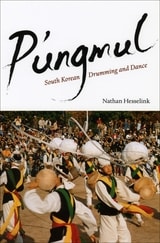
Composed of a core set of two drums and two gongs, p’ungmul is a South Korean tradition of rural folk percussion. Steeped in music, dance, theater, and pageantry, but centrally focused on rhythm, such ensembles have been an integral part of village life in South Korea for centuries, serving as a musical accompaniment in the often overlapping and shifting contexts of labor, ritual, and entertainment.
The first book to introduce Korean drumming and dance to the English-speaking world, Nathan Hesselink’s P’ungmul offers detailed descriptions of its instrumentation, dance formations, costuming, actors, teaching lineages, and the complexities of training. Hesselink also evaluates how this tradition has taken on new roles and meanings in the twentieth and early-twenty-first centuries, investigating the interrelated yet contested spheres of history, memory, government policy, grassroots politics, opportunities for musical transmission, and performance practices and aesthetics.
P’ungmul offers those interested in ethnomusicology, world music, anthropology, sociology, and Asian studies a special glimpse into the inner workings of a historically rich, artistically complex, and aesthetically and aurally beautiful Korean musical and dance tradition.
[more]
Passamaquoddy Ceremonial Songs
Aesthetics and SurvivalAnn Morrison Spinney
University of Massachusetts Press, 2010
Based on extensive research across several disciplines, this book examines the songs and dances involved in public ceremonies of the Wabanaki Confederacy, a coalition of five Algonquian First Nations that figured importantly in the political history of New England and the Maritimes from the seventeenth century on. Ethnomusicologist Ann Morrison Spinney analyzes these ceremonial performances as they have been maintained in one of those nations, the Passamaquoddy community of Maine. She compares historical accounts with forms that have persisted to the present, showing how versions of the same songs, dances, and ritual speeches have continued to play a vital role in Passamaquoddy culture over time. A particular focus of the study is the annual Sipayik Indian Day, a public presentation of the dances associated with the protocols of the Wabanaki Confederacy. Spinney interprets these practices using melodic analysis and cultural contextual frameworks, drawing on a variety of sources, including written documents, sound and video recordings, interviews with singers, dancers, and other cultural practitioners, and her own fieldwork observations. Her research shows that Passamaquoddy techniques of song composition and performance parallel both the structure of the Passamaquoddy language and the political organizations that these ceremonies support.
[more]
Pinery Boys
Songs and Songcatching in the Lumberjack EraEdited by Franz Rickaby with Gretchen Dykstra and James P. Leary
University of Wisconsin Press, 2017
As the heyday of the lumber camps faded, a young scholar named Franz Rickaby set out to find songs from shanty boys, river drivers, and sawmill hands in the Upper Midwest. Traveling mostly on foot with a fiddle slung over his shoulder, Rickaby fell into easy conversation with the men, collecting not just the words of songs, but the tunes, making careful notes about his informants and their performances. Shortly before his groundbreaking and much-praised Ballads and Songs of the Shanty Boy was published in 1926, Rickaby died, leaving later folklorists, cultural historians, and folksong enthusiasts with little knowledge of his life and other unpublished research.
Pinery Boys now incorporates, commemorates, contextualizes, and complements Rickaby's early work. It includes an introduction and annotations throughout by eminent folklore scholar James P. Leary and an engaging, impressively researched biography by Rickaby's granddaughter Gretchen Dykstra. Central to this edition are Rickaby's own introduction and the original fifty-one songs that he published—including "Jack Haggerty's Flat River Girl," "The Little Brown Bulls," "Ole from Norway," "The Red Iron Ore," and "Morrissey and the Russian Sailor"—plus fourteen additional songs selected to represent the varied collecting Rickaby did beyond the lumber camps.
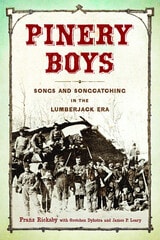
Supplemented by historical photographs, Pinery Boys fully reveals Franz Rickaby as a visionary artist and scholar and provides glimpses into the past lives of woods poets and singers.
[more]
Prison Song
Music and Incarceration in the United StatesDavid Metzer
University of Michigan Press, 2026
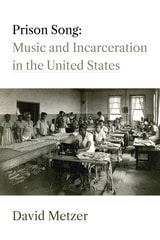
From Johnny Cash to Jay-Z, musicians have long used their voices to challenge the injustices of the prison system. Prison Song: Music and Incarceration in the United States reveals how musicians have confronted the prison system by telling the life stories of imprisoned individuals, creating empathetic bonds between listeners and those individuals, and critiquing the racial and social inequalities that incarceration preys upon. Prison Song takes a broad, interdisciplinary approach to explore how artists across genres—hip hop, country, blues, folk, rock, jazz, and classical—have protested the prison system. David Metzer examines the works of incarcerated, formerly incarcerated, and non-incarcerated musicians from diverse racial and ethnic backgrounds. Drawing on a wide range of sources, including prison records, government reports, legislation, court decisions, and scholarship from carceral studies, each chapter reveals how musicians responded to developments in the prison system at particular historical moments and how their works have shaped public understanding of the prison system in the United States.
[more]
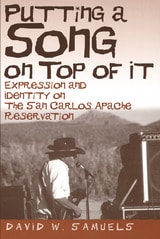
Putting a Song on Top of It
Expression and Identity on the San Carlos Apache ReservationDavid W. Samuels
University of Arizona Press, 2004
As in many Native American communities, people on the San Carlos Apache reservation in southeastern Arizona have for centuries been exposed to contradictory pressures. One set of expectations is about conversion and modernization—spiritual, linguistic, cultural, technological. Another is about steadfast perseverance in the face of this cultural onslaught. Within this contradictory context lies the question of what validates a sense of Apache identity.
For many people on the San Carlos reservation, both the traditional calls of the Mountain Spirits and the hard edge of a country, rock, or reggae song can evoke the feeling of being Apache. Using insights gained from both linguistic and musical practices in the community—as well as from his own experience playing in an Apache country band—David W. Samuels explores the complex expressive lives of these people to offer new ways of thinking about cultural identity.
Samuels analyzes how people on the reservation make productive use of popular culture forms to create and transform contemporary expressions of Apache cultural identity. As Samuels learned, some popular songs—such as those by Bob Marley—are reminiscent of history and bring about an alignment of past and present for the Apache listener. Thinking about Geronimo, for instance, might mean one thing, but “putting a song on top of it” results in a richer meaning. Samuels also proposes that the concept of the pun, as both a cultural practice and a means of analysis, helps us understand the ways in which San Carlos Apaches are able to make cultural symbols point in multiple directions at once. Through these punning, layered expressions, people on the reservation express identities that resonate with the complicated social and political history of the Apache community.
This richly detailed study challenges essentialist notions of Native American tribal and ethnic identity by revealing the turbulent complexity of everyday life on the reservation. Samuels’s work is a multifaceted exploration of the complexities of sound, of language, and of the process of constructing and articulating identity in the twenty-first century.
[more]