Results by title
353 books match the query 'World War II' and 22 start with p

Pacific Airman
The World War II Journal of a B-24 Liberator NavigatorEdward S. Goode, edited by Robert A. Taylor
University of Alabama Press, 2026
A World War II bomber navigator’s diary, documenting perilous missions, survival, sacrifice, and the legendary 90th Bomb Group
Pacific Airman: The World War II Journal of a B-24 Liberator Navigator presents the hand-written pocket diary of US Army Air Forces bomber navigator Edward S. Goode of West Virginia. Goode was a member of the 400th Bomber Squadron (the “Black Pirates”), part of the legendary 90th Bomb Group the “Jolly Rogers.” With approximately seventy-four combat missions to his credit and an Air Medal with six Oak Leaf clusters, Goode experienced the war close-up, with group losses and the horror of grisly deaths in and out of combat.
The journal details costly bombing raids against Japanese targets, as well as the dangers of the Southwest Pacific area with its wild and unpredictable weather and terrain. Editor Robert A. Taylor also documents Goode’s failed postwar attempt to receive the Distinguished Flying Cross for heroism for the Peleliu bombing mission in 1944.
Taylor offers detailed historical and other context to the journal. Three appendixes comprise a guide for B-24 navigators’ duties and responsibilities, Goode’s own record of 90th Bomb Group losses for 1944–1945, and a hometown newspaper clipping announcing his return home. This book will appeal to readers interested in World War II history, military aviation, the Pacific theater, and firsthand wartime narratives.
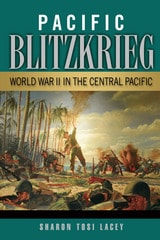
Pacific Blitzkrieg
World War II in the Central PacificSharon Tosi Lacey
University of North Texas Press, 2013
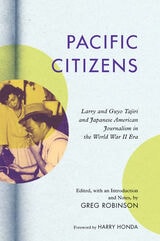
Pacific Citizens
Larry and Guyo Tajiri and Japanese American Journalism in the World War II EraEdited, with and Introduction and Notes, by Greg Robinson: Foreword by Harry Honda
University of Illinois Press, 2012
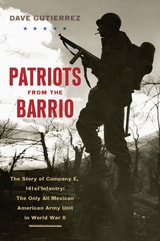
Patriots from the Barrio
The Story of Company E, 141st Infantry: The Only All Mexican American Army Unit in World War IIDave Gutierrez
Westholme Publishing, 2018
The Inspiring True Story of a Segregated Unit Whose Exploits Underscore the Forgotten Latino Contribution to the Allied Victory in World War II
As a child, Dave Gutierrez hung on every word his father recalled about his cousin Ramon, “El Sancudo” (the mosquito), and his service in World War II, where he earned a Silver Star, three Purple Hearts, and escaped from the Germans twice. Later, Dave decided to find out more about his father’s cousin, and in the course of his research he discovered that Ramon Gutierrez was a member of Company E, 141st Infantry, a part of the 36th “Texas” Division that was comprised entirely of Mexican Americans—the only such unit in the entire U.S. Army. The division landed at Salerno, Italy, in 1943, among first American soldiers to set foot in Europe. In the ensuing months, Company E and the rest of the 36th would battle their way up the mountainous Italian peninsula against some of Nazi Germany’s best troops. In addition to the merciless rain, mud, and jagged peaks, swift cold rivers crisscrossed the region, including the Rapido, where Company E would face its greatest challenge. In an infamous episode, the 36th Division was ordered to cross the Rapido despite reports that the opposite bank was heavily defended. In the ensuing debacle, the division was ripped apart, and Company E sustained appalling casualties. The company rebounded and made the storied landings at Anzio and ultimately invaded southern France for a final push into Germany. The men of Company E distinguished themselves as rugged fighters capable of warring amid the rubble of destroyed villages and in the devastated countryside.
Based on extensive archival research and veteran and family accounts, Patriots from the Barrio: The Story of Company E, 141st Infantry: The Only All Mexican American Army Unit in World War II brings to life the soldiers whose service should never have gone unrecognized for so long. With its memorable personalities, stories of hope and immigration, and riveting battle scenes, this beautifully written book is a testament to the shared beliefs of all who have fought for the ideals of the American flag.
Patton's Pawns
The 94th US Infantry Division at the Siegfried LineTony Le Tissier
University of Alabama Press, 2007
The 94th US Infantry Division was an organization formed late in the Second World War, made up largely of draft-deferred university students as enlisted men and an officer corps pulled together from various domestic postings with unfortunate consequences for mutual trust and respect.
Initially used as part of the force blockading the Brittany ports after D-Day, in December of 1944, the division was incorporated into General Patton’s Third Army south of the Moselle-Saar Triangle, the base of which was a portion of the Siegfried Line known as the Orscholz Switch. Its first combat experience came in battalion-sized attacks during that terrible winter while the Battle of the Bulge raged to the north, and the Division suffered heavy casualties, many due to the ferocity of the winter weather. Patton, with characteristic zeal, excoriated the division’s officers and senior NCOs for the rate of non-combat casualties. Thereafter, the division was ordered forward on an all-out assault to break through the Siegfried Line. After horrific fighting against entrenched defenders, with ice turning to mud as spring approached, on February 19, 1945, the 94th broke through to open the roads to Trier and the Rhine.
This book is the most comprehensive study to date of the fierce fighting between the 94th U.S. Infantry Division and their German counterparts during that spring of 1945. It sheds new light on the achievements of the outnumbered division in penetrating Germany’s Westwall. With characteristic verve and detail, Tony Le Tissier narrates the action and illuminates the tribulations and sacrifices of American soldiers who won their laurels at great cost.
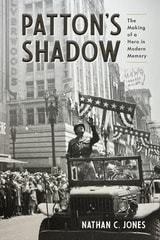
Patton's Shadow
The Making of a Hero in Modern MemoryNathan C. Jones
University of Alabama Press, 2024
An engrossing account of the myth and legend of George S. Patton and what his reputation illuminates about American culture and hero worship
Patton’s Shadow by Nathan C. Jones, a leading authority on George S. Patton, offers a definitive account of the creation of the Patton legend and what it illuminates about American culture and the worship of heroes. Jones traces how the persona of Patton, a brash and brilliant general in the European theater of World War II, transcended the individual man and became a cultural icon and byword for triumphal American might.
Patton was a hero lionized and celebrated in his own time. Patton as well as the US Army cultivated his persona during and after the war. His image was used to promote patriotism, commercial goods, and military recruitment. The 1970 Academy Award–winning film starring George C. Scott cemented his iconic image for millions of Americans, further embellishing Patton’s persona and introducing him to entirely new generations of young Americans.
Patton’s Shadow is an intellectually omnivorous tour de force that draws on ideas about heroes from sources as timeless as ancient mythology and as contemporary as Abraham Maslow, Max Weber, and Carl Jung. Jones artfully locates the honored altar that heroes occupy in the human heart and then answers insightful questions about what America’s embrace of Patton in particular as a military hero illuminates about the United States, about Patton’s generation, and about our own.
Jones’s engrossing work will fascinate readers interested in American history, military history, and the psychology of heroism.
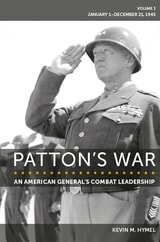
Patton's War
An American General's Combat Leadership Volume 3: January 1-December 21, 1945Kevin M. Hymel
University of Missouri Press, 2026
As with his previous volume, Hymel relies on Patton’s original diaries (not the transcribed, embellished versions historians have relied on for many years) and personal letters to tell the general’s story. Hymel also mined various archives to explain Patton’s encounters with soldiers, government officials, civilians, and reporters to expand on his narrative.
Throughout this three-volume work, Patton emerges not as a larger-than-life myth, but as a human being, one held back by the personal prejudices and antisemitism that ultimately proved to be his demise. Despite these personal failings, Patton was, above all, as Hymel reveals, a commander bent on winning, or, as the general himself might have put it, getting the enemy to dance to his tune.
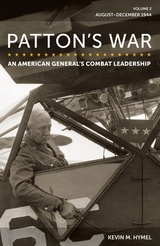
Patton's War
An American General's Combat Leadership, Volume 2: August–December 1944Kevin M. Hymel
University of Missouri Press, 2023
Finalist for the 2023 Gilder Lehrman Military History Prize
This second of three volumes of Patton’s War picks up where the first one left off, examining General George S. Patton’s leadership of the U.S. Third Army. The book follows Patton’s contributions to both the Normandy and Brittany campaigns—the closing of the Falaise Pocket in Normandy, and racing to the port cities in Brittany. It ends with Patton and his corps rescuing the besieged town of Bastogne in the Battle of the Bulge.
As he did in the preceding volume, Hymel relies not only on Patton’s diaries and letters, but countless veteran interviews, surveys, and memoirs. He also provides a unique insight missed by previous Patton scholars. Instead of using Patton’s transcribed diaries, which were heavily edited and embellished, he consults Patton’s original, hand-written diaries to uncover previously unknown information about the general.
This second volume of Hymel’s groundbreaking work shows Patton at the height of his generalship, successfully leading his army without the mistakes and caustic behavior that almost got him sent home earlier—even if we also see a Patton still guided at times by racism and antisemitism.
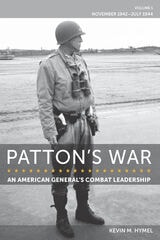
Patton's War
An American General's Combat Leadership, Volume I: November 1942–July 1944Kevin M. Hymel
University of Missouri Press, 2021
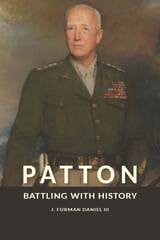
Patton
Battling with HistoryJ. Furman Daniel
University of Missouri Press, 2025
Patton deliberately cultivated the image of himself as a warrior from ages past; the more interesting truth is that he was an exceptionally dedicated student of history. He was a hard worker and voracious reader who gave a great deal of thought to how military history might inform his endeavors. Most scholars have overlooked this element of Patton’s character, which Daniel argues is essential to understanding the man’s genius.
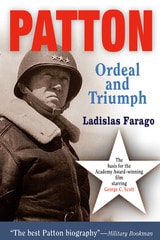
Patton
Ordeal and TriumphLadislas Farago
Westholme Publishing, 2005
"The best Patton biography."—Military Bookman
He is America's most famous general. He represents toughness, focus, determination, and the ideal of achievement in the face of overwhelming odds. He was the most feared and respected adversary to his enemies and an object of envy, admiration, and sometimes, scorn to his professional peers. An early proponent of tank warfare, George S. Patton moved from being a foresighted lieutenant in the First World War to commanding the Third Army in the next, leading armored divisions in the Allied offensive that broke the back of Nazi Germany. Patton was an enigmatic figure. His image among his troops and much of the press achieved legendary status through his bold and colorful comments and combat leadership, yet these same qualities nearly jeopardized his career and forced him out of the battle on several occasions. Victory was impossible without Patton, and returning to the field, his army was responsible for one of the most crushing advances in the history of warfare.
In Ladislas Farago's masterpiece, Patton: Ordeal and Triumph, the complete story of this fascinating personality is revealed. Born into an aristocratic California family, Patton rose in military rank quickly and was tapped to lead the Allied landings in North Africa in 1942. Under Patton's direction, American troops cut their teeth against Rommel's Afrikakorps, advanced further and more quickly than British General Montgomery's army in the conquest of Sicily, and ultimately continued their exploits by punching into Germany and checking the Russian westward advance at the end of World War II. A sweeping, absorbing biography and critically hailed, Patton: Ordeal and Triumph provides unique insights into Patton's life and leadership style and is military history at its finest.
Perilous Memories
The Asia-Pacific War(s)T. Fujitani, Geoffrey M. White, Lisa Yoneyama, eds.
Duke University Press, 2001
Firmly based on the insight that memory is always mediated and that the past is not a stable object, the volume demonstrates that we can intervene positively yet critically in the recovery and reinterpretation of events and experiences that have been pushed to the peripheries of the past. The contributors—an international list of anthropologists, cultural critics, historians, literary scholars, and activists—show how both dominant and subjugated memories have emerged out of entanglements with such forces as nationalism, imperialism, colonialism, racism, and sexism. They consider both how the past is remembered and also what the consequences may be of privileging one set of memories over others. Specific objects of study range from photographs, animation, songs, and films to military occupations and attacks, minorities in wartime, “comfort women,” commemorative events, and postwar activism in pursuing redress and reparations.
Perilous Memories is a model for war memory intervention and will be of interest to historians and other scholars and activists engaged with collective memory, colonial studies, U.S. and Asian history, and cultural studies.
Contributors. Chen Yingzhen, Chungmoo Choi, Vicente M. Diaz, Arif Dirlik, T. Fujitani, Ishihara Masaie, Lamont Lindstrom, George Lipsitz, Marita Sturken, Toyonaga Keisaburo, Utsumi Aiko, Morio Watanabe, Geoffrey M. White, Diana Wong, Daqing Yang, Lisa Yoneyama
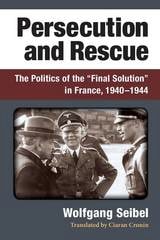
Persecution and Rescue
The Politics of the “Final Solution” in France, 1940-1944Wolfgang Seibel
University of Michigan Press, 2016
Drawing on German and French sources, Wolfgang Seibel traces the twisted process of political decision-making that shaped the fate of the Jews in German-occupied France during World War II. By analyzing the German-French negotiations, he reveals the underlying logic as well as the actual course of the bargaining process as both the Vichy Regime and the Germans sought a stable relationship. Yet that relationship was continually reshaped by the progress of the war, Germany’s deteriorating prospects, France’s economic and geopolitical position, and the Vichy government’s quest for domestic political support. The Jews’ suffering intensified when the Germans had the upper hand; but when the French felt empowered, the Vichy Regime stopped collaborating in the completion of the “final solution.” Persecution and Rescue: The Politics of the “Final Solution” in France, 1940–1944 demonstrates the ways in which political circumstances can mitigate—or foster—mass crime.
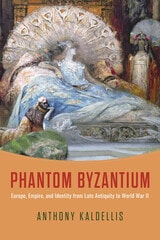
Phantom Byzantium
Europe, Empire, and Identity from Late Antiquity to World War IIAnthony Kaldellis
University of Chicago Press, 2026
Unveiling the ideological foundations of Byzantine studies, Phantom Byzantium is a pioneering survey of western European perceptions of the eastern Roman empire (also known as Byzantium) spanning late antiquity to World War II. Through ten chronological chapters, Anthony Kaldellis makes the case that western Europe gradually formed its identity by adopting prestigious cultural elements from the eastern empire but simultaneously portraying the east as inferior. The West modeled its Roman imperial style on Constantinople while minimizing the latter as Greek rather than Roman; appropriated a host of Christian traditions from the east while casting the east as schismatic, heretical, or treacherous; and, during the Renaissance, used classical Hellenic philology from Greek scholars before marginalizing them as unworthy bearers of that tradition. This orientalizing impulse worked to buttress western exceptionalism and resulted in the fictitious construction of “Byzantium” as Europe’s evil doppelgänger, embodying the worst versions of traditions fundamental to European identity and casting the region as despotic, superstitious, and degenerate.
Explaining the creation, history, and functions of the ideological construct of Byzantium in the western imagination and European self-fashioning, this book has critical implications for contemporary views of European history.
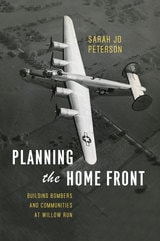
Planning the Home Front
Building Bombers and Communities at Willow RunSarah Jo Peterson
University of Chicago Press, 2013

Polonium in the Playhouse
The Manhattan Project's Secret Chemistry Work in Dayton, OhioLinda Carrick Thomas
The Ohio State University Press, 2017
Seized by the War Department in 1944 for the bomb project, the Runnymede Playhouse was transformed into a polonium processing facility, providing a critical radioactive ingredient for the bomb initiator—the mechanism that triggered a chain reaction. With the help of a Soviet spy working undercover at the site, it was also key to the Soviet Union’s atomic bomb program.
The work was directed by industrial chemist Charles Allen Thomas who had been chosen by J. Robert Oppenheimer and General Leslie Groves to coordinate Manhattan Project chemistry and metallurgy. As one of the nation’s first science administrators, Thomas was responsible for choreographing the plutonium work at Los Alamos and the Project’s key laboratories. The elegant glass-roofed building belonged to his wife’s family.
Weaving Manhattan Project history with the life and work of the scientist, industrial leader and singing-showman Thomas, Polonium in the Playhouse offers a fascinating look at the vast and complicated program that changed world history and introduces the men and women who raced against time to build the initiator for the bomb.
Power at Sea, Volume 2
The Breaking Storm, 1919-1945Lisle A. Rose
University of Missouri Press, 2006
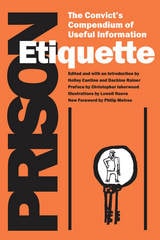
Prison Etiquette
The Convict's Compendium of Useful InformationEdited by Holley Cantine and Dachine Rainer. Foreword by Philip Metres.
Southern Illinois University Press, 2001
Of the fifty thousand Americans who declared themselves conscientious objectors during World War II, nearly six thousand went to prison, many serving multiyear sentences in federal lockups. Some conscientious objectors, notably Robert Lowell, William Everson, and William Stafford, went on to become important figures in the literary life of their country, while others were participants and teachers in the civil rights and antiwar movements of the 1950s, 1960s, and 1970s. This long out-of-print book, reprinted from the rare original 1951 edition, collects firsthand accounts by conscientious objectors who were imprisoned for their beliefs.
Prison Etiquette is illustrated with eleven line drawings by Lowell Naeve.
Profiles in Survival
The Experiences of American POWs in the Philippines during World War IIJohn C. Shively
Indiana Historical Society Press, 2012
Project 9
The Birth of the Air Commandos in World War IIDennis R. Okerstrom
University of Missouri Press, 2026

Proud Warriors
African American Combat Units in World War IIAlexander M. Bielakowski
University of North Texas Press, 2021
Providence Watching
Journeys from Wartorn Poland to the Canadian PrairiesKazimierz Patalas
University of Manitoba Press, 2003