Results by title
18284 books match the query 'United States' and 850 start with p
Politics and the Muse
Studies in the Politics of Recent American LiteratureAdam J. Sorkin
University of Wisconsin Press, 1989
Politics by Formula
How Congressional Policymaking Creates DisparitiesLeah Rosenstiel
University of Chicago Press, 2026
A clear-eyed study that reveals how politics shapes and often distorts important federal programs, driving inequalities across states.
From Medicaid to Section 8 Housing Choice Vouchers, a large percentage of the annual US federal budget (approximately $1 trillion) is distributed through grants-in-aid, a policy tool that allocates aid to state and local governments rather than to individual Americans. When members of Congress use grants-in-aid to fund healthcare, housing, and other forms of support, they are not solely determining how much assistance one person receives. Instead, they can allot certain localities larger grants, which carry big implications for the quality of public services available to citizens living in different states.
Many reasonably assume that these assistance programs distribute funding to states impartially because they use statistical formulas based on population levels, poverty, and other characteristics that, ostensibly, measure need. However, in Politics by Formula, Leah Rosenstiel shows how this seemingly technocratic aspect of federal policymaking is deeply affected by both the structure of political institutions and the motivations of elected officials. Key congressional committees—and especially their leaders—design formulas to benefit their constituencies. Superficially neutral formulas can shield these political decisions from scrutiny, but formulas also constrain congressmembers. Drawing on formal modeling and quantitative and qualitative evidence, Rosenstiel elucidates how these dynamics shape whose and what needs are met and where.

Politics for People
Finding a Responsible Public VoiceDavid Mathews
University of Illinois Press, 1999
Politics in the Pews
The Political Mobilization of Black ChurchesEric L. McDaniel
University of Michigan Press, 2008
"Politics in the Pews probes the internal dynamics of political decision making within the Black church."
---William E. Nelson, Jr., Research Professor, Department of African American and African Studies, Ohio State University
As Eric McDaniel demonstrates in his study of Black congregations in the U.S., a church's activism results from complex negotiations between the pastor and the congregation. The church's traditions, its institutional organization, and its cultural traditions influence the choice to make politics part of the church's mission. The needs of the local community and opportunities to vote, lobby, campaign, or protest are also significant factors.
By probing the dynamics of churches as social groups, McDaniel opens new perspectives on civil rights history and the evangelical politics of the twenty-first century. Politics in the Pews contributes to a clearer understanding of the forces that motivate any organization, religious or otherwise, to engage in politics.
Eric L. McDaniel is Assistant Professor in the Department of Government at the University of Texas at Austin.

Politics in the Trenches
Citizens, Politicians, and the Fate of DemocracyThomas J. Volgy
University of Arizona Press, 2001
Now ask Tom Volgy. This former mayor of a major western city, who is also a political scientist, contends that most elected officials are the very opposite of what the public thinks: honest, hardworking people whose real work goes unnoticed by most of their constituents and the media.
Volgy has interviewed more than 300 elected officials—mayors, city council members, legislators—from all over the United States to offer a decidedly contrarian view of politics. He explores the lives and working conditions of elected officials at the local level— the area of democracy closest to the public— to show that officeholders are for the most part average citizens, not the slick lawyers or political pros we usually imagine them to be. Most are motivated by a sense of civic duty, and they often work for token salaries, yet once elected they give up their personal lives and fall prey to every conceivable brickbat of public and media outrage.
In Politics in the Trenches, Volgy shows what really happens behind the scenes of government. He contrasts perception with reality regarding the rewards and perks of office. He examines the process of experimentation in the political laboratory and shows how the news media distort it. He provides a case study of homelessness to illustrate the system's constraints and limitations. And he offers a chapter on a typical week in office that will be an eye-opener for most readers.
Although admittedly there are many flaws in the democratic political process, observes Volgy, all are correctable as long as citizens believe in the essential worth of the system itself. His book offers a fresh perspective on democratic governance and tackles tough issues such as campaign finance reform, urging citizens to understand the process before they condemn its players out of hand. More than that, this is a call to action, warning us that we could lose true democracy if we don't get involved.
Politics of Democratic Inclusion
Christina Wolbrecht
Temple University Press, 2005
Politics of Wilderness Preservation
Craig W. Allin
University of Alaska Press, 2008
Politics of Writing Studies
Reinventing Our Universities from BelowRobert Samuels
Utah State University Press, 2017
A friendly critique of the field, The Politics of Writing Studies examines a set of recent pivotal texts in composition to show how writing scholarship, in an effort to improve disciplinary prestige and garner institutional resources, inadvertently reproduces structures of inequality within American higher education. Not only does this enable the exploitation of contingent faculty, but it also puts writing studies—a field that inherently challenges many institutional hierarchies—in a debased institutional position and at odds with itself.
Instead of aligning with the dominant paradigm of research universities, where research is privileged over teaching, theory over practice, the sciences over the humanities, and graduate education over undergraduate, writing studies should conceive itself in terms more often associated with labor. By identifying more profoundly as workers, as a collective in solidarity with contingent faculty, writing professionals can achieve solutions to the material problems that the field, in its best moments, wants to address. Ultimately, the change compositionists want to see in the university will not come from high theory or the social science research agenda; it must come from below.
Offering new insight into a complex issue, The Politics of Writing Studies will be of great interest to writing studies professionals, university administrators, and anyone interested in the political economy of education and the reform of institutions of higher education in America.

Politics on the Endless Frontier
Postwar Research Policy in the United StatesDaniel Lee Kleinman
Duke University Press, 1995
Although it ended up as only one among a host of federal research policymaking agencies, the National Science Foundation was originally conceived as central to the federal research policymaking system. Kleinman’s historical examination of the National Science Foundation exposes the sociological and political workings of the system, particularly the way in which a small group of elite scientists shaped the policymaking process and defined the foundation’s structure and future. Beginning with Vannevar Bush’s 1945 manifesto The Endless Frontier, Kleinman explores elite and populist visions for a postwar research policy agency and shows how the structure of the American state led to the establishment of a fragmented and uncoordinated system for federal research policymaking. His book concludes with an analysis of recent efforts to reorient research policy and to remake federal policymaking institutions in light of the current "crisis" of economic competitiveness.
A particularly timely study, Politics on the Endless Frontier will be of interest to historians and sociologists of science and technology and to science policy analysts.
Politics the Wellstone Way
How to Elect Progressive Candidates and Win on IssuesWellstone Action Wellstone Action Wellstone Action
University of Minnesota Press, 2005
Wellstone Action is a nonprofit organization dedicated to continuing Paul and Sheila Wellstone’s fight for progressive change and economic justice by teaching effective political action skills to people across the country. Politics the Wellstone Way is a workshop in book form, providing the detailed framework needed to jump-start a new generation of activists plus plenty of helpful tools for old pros, including articulating a strong message, base building, field organizing, budgeting, fundraising, scheduling, getting out the vote, and grassroots advocacy and lobbying, illustrated by practical and inspirational examples.
From the school board all the way to the White House, Politics the Wellstone Way instructs people on becoming better organizers, candidates, campaign workers, and citizen activists, empowering them to make their voices heard.
Wellstone Action was established by the Wellstones’ two surviving sons, David and Mark. The main vehicle for this ongoing work is Camp Wellstone, a weekend training program that Wellstone Action leads regularly in locations across the country. Jeff Blodgett, Paul Wellstone’s longtime campaign manager, is the executive director of Wellstone Action. For more information visit www.wellstoneaction.org.
Politics, Faith, and the Making of American Judaism
Peter Adams
University of Michigan Press, 2014
In 1862, in the only instance of a Jewish expulsion in America, General Ulysses S. Grant banished Jewish citizens from the region under his military command. Although the order was quickly revoked by President Lincoln, it represented growing anti-Semitism in America. Convinced that assimilation was their best defense, Jews sought to Americanize by shedding distinctive dress, occupations, and religious rituals.
American Jews recognized the benefit and urgency of bridging the divide between Reform and Orthodox Judaism to create a stronger alliance to face the challenges ahead. With Grant’s 1868 presidential campaign, they also realized they could no longer remain aloof from partisan politics. As they became a growing influence in American politics, both political parties courted the new Jewish vote.
Once in office, Grant took notice of the persecution of Jews in Romania and Russia, and he appointed more Jews to office than any president before him. Indeed, Simon Wolf, a Washington lawyer who became one of Grant’s closest advisers, was part of a new generation of Jewish leaders to emerge in the post–Civil War era—thoroughly Americanized, politically mature, and committed to the modernized Judaism of the Reform movement.
In Politics, Faith, and the Making of American Judaism, Peter Adams recounts the history of the American Jewish Community’s assimilation efforts, organization, and political mobilization in the late 19th century, as political and cultural imperatives crafted a new, American brand of Judaism.
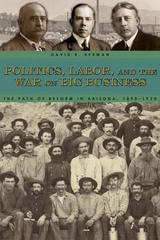
Politics, Labor, and the War on Big Business
The Path of Reform in Arizona, 1890-1920David R. Berman
University Press of Colorado, 2012
In the 1890s, once-heavily courted corporations had become, in the eyes of many, outside "money interests" or "beasts" that exploited the wealth of the sparsely settled area. Arizona's anticorporate reformers condemned the giant corporations for mistreating workers, farmers, ranchers, and small-business people and for corrupting the political system. During a thirty-year struggle, Arizona reformers called for changes to ward off corporate control of the political system, increase corporate taxation and regulation, and protect and promote the interests of working people.
Led by George W.P. Hunt and progressive Democrats, Arizona's brand of Progressivism was heavily influenced by organized labor, third parties, and Socialist activists. As highly powerful railroad and mining corporations retaliated, conflict took place on both political levels and industrial backgrounds, sometimes in violent form.
Politics, Labor and the War on Big Business places Arizona's experience in the larger historical discussion of reform activity of the period, considering issues involving the role of government in the economy and the possibility of reform, topics highly relevant to current debates.
Politics, Process, and American Trade Policy
Sharyn O'Halloran
University of Michigan Press, 1994
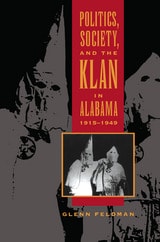
Politics, Society, and the Klan in Alabama, 1915-1949
Glenn Feldman
University of Alabama Press, 1999
This first book-length examination of the Klan in Alabama represents exhaustive research that challenges traditional interpretations.
The Ku Klux Klan has wielded considerable power both as a terrorist group and as a political force. Usually viewed as appearing in distinct incarnations, the Klans of the 20th century are now shown by Glenn Feldman to have a greater degree of continuity than has been previously suspected. Victims of Klan terrorism continued to be aliens, foreigners, or outsiders in Alabama: the freed slave during Reconstruction, the 1920s Catholic or Jew, the 1930s labor organizer or Communist, and the returning black veteran of World War II were all considered a threat to the dominant white culture. Feldman offers new insights into this "qualified continuity" among Klans of different eras, showing that the group remained active during the 1930s and 1940s when it was presumed dormant, with elements of the "Reconstruction syndrome" carrying over to the smaller Klan of the civil rights era.
In addition, Feldman takes a critical look at opposition to Klan activities by southern elites. He particularly shows how opponents during the Great Depression and war years saw the Klan as an impediment to attracting outside capital and federal relief or as a magnet for federal action that would jeopardize traditional forms of racial and social control. Other critics voiced concerns about negative national publicity, and others deplored the violence and terrorism.
This in-depth examination of the Klan in a single state, which features rare photographs, provides a means of understanding the order's development throughout the South. Feldman's book represents definitive research into the history of the Klan and makes a major contribution to our understanding of both that organization and the history of Alabama.
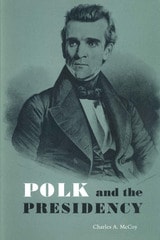
Polk and the Presidency
By Charles A. McCoy
University of Texas Press, 1960
“Who is James K. Polk?” was a rallying cry of the Whigs during the campaign of 1844. Polk answered that question adequately by winning the election against his Whig opponent, Henry Clay.
Today the question might be recast—respectfully, not derisively—“Who was James K. Polk?” Few persons could give more than a perfunctory answer, even though when he left office the United States was half again larger than it was when he became president.
Polk, unlike his close friend Andrew Jackson, has been the subject of but few books. Stern and serious-minded, intent upon his work, he never caught the public’s imagination as did some of the more magnetic personalities who filled the office of president. His lack of personal charm, however, should not hide from generations of Americans the great benefit he brought their country and his key role in developing the powers of the presidency.
This book will be a revelation to readers who might be confounded, even momentarily, by the question “Who was James K. Polk?” It is based on the assumption that the presidential power-role, though expressed in the Constitution and prescribed by law, is not a static role but a dynamic one, shaped and developed by a president’s personal reaction to the crises and circumstances of the times during which he serves. And Polk faced many crises, among them the Mexican War, the Oregon boundary dispute, the tariff question, Texas’s admission to the Union, and the establishment by the United States of a more stable and respected position in the world of nations.
Based on the dynamic power-role theory, the book analyzes its theme of how and why James K. Polk, the eleventh president of the United States, responded to the challenges of his times and thereby increased the authority and importance of the presidential role for future incumbents.
Charles McCoy became interested in writing this book after two of his friends, both informed historians, pointed out to him that James K. Polk was a neglected figure in American history. Preliminary research showed this to be true, but without reason—for, as the eminent historian George Bancroft said, “viewed from the standpoint of results, [Polk’s administration] was perhaps the greatest in our national history, certainly one of the greatest.” For his own astute appraisal of the Polk administration, McCoy emphasized the use of firsthand sources of information: the Polk Diary; newspapers of the period; the unpublished papers of Polk, Jackson, Trist, Marcy, and Van Buren; and congressional documents and reports.

Polka Heartland
Why the Midwest Loves to PolkaRick March
Wisconsin Historical Society Press, 2015
"Polka Heartland" captures the beat that pulses in the heart of Midwestern culture--the polka--and offers up the fascinating history of how "oompah-pah" came to be the sound of middle America. From the crowded dance tent at Pulaski Polka Days to an off-the-grid Mexican polka dance in small-town Wisconsin, "Polka Heartland" explores the people, places, and history behind the Midwest's favorite music.
From polka's surprising origin story as a cutting-edge European fad to an exploration of the modern-day polka scene, author Rick March and photographer Dick Blau take readers on a joyful romp through this beloved, unique, and richly storied genre. "Polka Heartland" describes the artists, venues, instruments, and music-makers who have been pivotal to polka's popularity across the Midwest and offers six full-color photo galleries to immerse readers in today's vibrant polka scene.

Polpop 2
Politics and Popular Culture in America TodayJames Combs
University of Wisconsin Press, 1991
This book takes another look at politics and popular culture. The author has tried to explain the politics of popular culture as part of historical and cultural processes, helping the reader understand not only how popular culture has affected our politics, but also where it is taking us.

Polygamy Question
Janet Bennion
Utah State University Press, 2015
The practice of polygamy occupies a unique place in North American history and has had a profound effect on its legal and social development. The Polygamy Question explores the ways in which indigenous and immigrant polygamy have shaped the lives of individuals, communities, and the broader societies that have engaged with it. The book also considers how polygamy challenges our traditional notions of gender and marriage and how it might be effectively regulated to comport with contemporary notions of justice.
The contributors to this volume—scholars of law, anthropology, sociology, political science, economics, and religious studies—disentangle diverse forms of polygamy and polyamory practiced among a range of religious and national backgrounds including Mormon and Muslim. They chart the harms and benefits these models have on practicing women, children, and men, whether they are independent families or members of coherent religious groups. Contributors also address the complexities of evaluating this form of marriage and the ethical and legal issues surrounding regulation of the practice, including the pros and cons of legalization.
Plural marriage is the next frontier of North American marriage law and possibly the next civil rights battlefield. Students and scholars interested in polygamy, marriage, and family will find much of interest in The Polygamy Question.
Contributors include Kerry Abrams, Martha Bailey, Lori Beaman, Janet Bennion, Jonathan Cowden, Shoshana Grossbard, Melanie Heath, Debra Majeed, Rose McDermott, Sarah Song, and Maura Irene Strassberg.
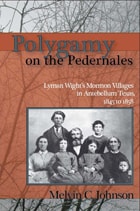
Polygamy on the Pedernales
Lyman Wight's Mormon Village in Antebellum TexasMelvin C. Johnson
Utah State University Press, 2006
In the wake of Joseph Smith Jr.’s murder in 1844, his following splintered, and some allied themselves with a maverick Mormon apostle, Lyman Wight. Sometimes called the "Wild Ram of Texas," Wight took his splinter group to frontier Texas, a destination to which Smith, before his murder, had considered moving his followers, who were increasingly unwelcome in the Midwest. He had instructed Wight to take a small band of church members from Wisconsin to establish a Texas colony that would prepare the ground for a mass migration of the membership. Having received these orders directly from Smith, Wight did not believe the former’s death changed their significance. If anything, he felt all the more responsible for fulfilling what he believed was a prophet’s intention.
Antagonism with Brigham Young and the other LDS apostles grew, and Wight refused to join with them or move to their new gathering place in Utah. He and his small congregation pursued their own destiny, becoming an interesting component of the Texas frontier, where they had a significant economic role as early millers and cowboys and a political one as a buffer with the Comanches. Their social and religious practices shared many of the idiosyncracies of the larger Mormon sect, including polygamous marriages, temple rites, and economic cooperatives. Wight was a charismatic but authoritarian and increasingly odd figure, in part because of chemical addictions. His death in 1858 while leading his shrinking number of followers on yet one more migration brought an effective end to his independent church.
Polyphonic Federalism
Toward the Protection of Fundamental RightsRobert A. Schapiro
University of Chicago Press, 2009
The relationship between the states and the national government is among the most contested issues in the United States. And questions about where power should reside, how decisions should be made, and how responsibility should be allocated have been central to the American experiment in federalism. In Polyphonic Federalism, Robert A. Schapiro defends the advantages of multiple perspectives in government, arguing that the resulting “polyphony” creates a system that is more efficient, democratic, and protective of liberties.
This groundbreaking volume contends that contemporary views of federalism are plagued by outmoded dualist notions that seek to separate state and federal authority. Instead, Schapiro proposes a polyphonic model that emphasizes the valuable interaction of state and federal law, one that more accurately describes the intersecting realities of local and national power. Through an analysis of several legal and policy debates, Polyphonic Federalism demonstrates how a multifaceted government can best realize the potential of federalism to protect fundamental rights.
Poor Dancer's Almanac
Managing Life & Work in the Performing ArtsDavid R. White, Lise Friedman, and Tia Tibbitts Levinson, eds.
Duke University Press, 1993
Organized and compiled by Dance Theater Workshop in New York and authored by more than fifty leading professionals in the field, Poor Dancer's Almanac offers in-depth discussions of everything from personal livelihood to professional career development, from medical care, housing, and unemployment insurance to management, touring, and legal issues. Each chapter is followed by an appendix containing extensive and varied listings, giving names and addresses for finding internship programs, videotaping, flooring, grant-writing, and reference publications. Although centered on New York the Almanac includes lists of resources and contacts for many other states—California, Washington D.C, Illinois, Minnesota, North Carolina, Texas, Florida, and Ohio. An entirely new section has been added dealing with health issues and the crisis of AIDS.
In personal anecdotes and essays various performers offer their own insights and stories—both of struggles and of successes—to bring to life the practical realities of working in the arts. We hear from Merce Cunningham, Eric Bogosian, Karen Finley, Paul Zaloom, and Bill T. Jones, among others. Illustrated with original drawings by Janie Geiser, this thoroughly revised and updated edition of the Poor Dancer's Almanac will continue to serve as one of the leading sources for those concerned with managing life and work in the performing arts.
Poor Discipline
Jonathan Simon
University of Chicago Press, 1993
When parole first emerged as a corrections strategy in the nineteenth century, work was supposed to keep ex-prisoners out of trouble. This strategy foundered in the changing economy after World War II. What followed was a rehabilitative strategy, where the clinical expertise of the parole agent replaced the discipline of the industrial labor market in defining and controlling criminal deviance. Today, Simon argues, as drastic changes in the economy have virtually locked out an entire class, rehabilitation has given way to mere management. The effect is isolation of the offender, either in jail or in an underclass community; the result is an escalating cycle of imprisonment, destabilization, and insecurity.
No significant improvement in the current penal crisis can be expected until we better understand the relationship between punishment and social order, a relationship which this book explores in theoretical, historical, and practical detail.

Poor Kids in a Rich Country
America's Children in Comparative PerspectiveLee Rainwater
Russell Sage Foundation, 2003
Poor Pearl, Poor Girl!
The Murdered-Girl Stereotype in Ballad and NewspaperBy Anne B. Cohen
University of Texas Press, 1973
The year was 1896, and nineteenth-century journalists called the murder of Pearl Bryan the "Crime of the Century." From the day Pearl's headless body was found to the execution of her murderers on the gallows, the details of the murder fascinated newspaper reporters and ballad composers alike.
Often glossing over the facts of the case, newspaper accounts presented the events according to stereotypes that were remarkably similar to those found in well-known murdered-girl ballads, such as "Pretty Polly," "Omie Wise," and "The Jealous Lover." Events, characters, motivations, and plot were presented through this framework: the simple country girl led astray by a clever degenerate. Nearly all variants of the Pearl Bryan ballad point the same moral:
Young ladies now take warning
Young men are so unjust,
It may be your best lover
But you know not whom to trust.
Representations of this formula appear in such diverse genres as the ballad "Poor Ellen Smith" and the novel An American Tragedy.
As Anne Cohen demonstrates, both newspaper accounts and ballads tell the Pearl Bryan story from the same moral stance, express the same interpretation of character, and are interested in the same details. Both distort facts to accommodate a shared pattern of storytelling. This pattern consists of a plot formula—the murdered-girl formula—that is accompanied by stereotyped scenes, actors, and phrases. The headless body—surely the most striking element in the Pearl Bryan case—is absent from those ballads that have survived. Anne Cohen contends that a decapitated heroine does not belong to the formula—a murdered heroine, yes, but not a decapitated one. Similarly, newspapers made much of Pearl's "innocence" and tended to downplay the second murderer. Only one murderer, the lover, belongs to the stereotype.
Poor Pearl, Poor Girl! is a ballad study conducted on historic- geographic lines; that is, it seeks to trace the history and interrelations of a series of ballad texts and to relate the ballads directly to their ideological and historical context in the American scene. It also compares the narrative techniques of ballad composition with the techniques of other forms of popular narrative, especially newspaper journalism.

Poor People's Medicine
Medicaid and American Charity Care since 1965Jonathan Engel
Duke University Press, 2006
Starting with a brief overview of the history of charity medical care, Jonathan Engel presents the debates surrounding Medicaid’s creation and the compromises struck to allow federal funding of the nascent programs. He traces the development of Medicaid through the decades, as various states attempted to both enlarge the programs and more finely tailor them to their intended targets. At the same time, he describes how these new programs affected existing institutions and initiatives such as public hospitals, community clinics, and private pro bono clinical efforts. Along the way, Engel recounts the many political battles waged over Medicaid, particularly in relation to larger discussions about comprehensive health care and social welfare reform. Poor People’s Medicine is an invaluable resource for understanding the evolution and present state of programs to deliver health care to America’s poor.
Poor Queer Studies
Confronting Elitism in the UniversityMatt Brim
Duke University Press, 2020
Poor Relations
The Children of the State in Illinois, 1818-1990Joan Gittens
University of Illinois Press, 1994
This comprehensive history traces the care of dependent, delinquent,
and disabled children in Illinois from the early nineteenth century to
current times, focusing on the dilemmas raised by both public intervention
and the lack of it. Joan Gittens explores the inadequacies of a system
that has allowed problems in the public care of children to recur regularly
but at the same time insists that the state's own history makes it clear
that the potential for improvements exists.
Poor Whites of the Antebellum South
Tenants and Laborers in Central North Carolina and Northeast MississippiCharles C. Bolton
Duke University Press, 1994
Looking at two specific regions--the "settled" central piedmont of North Carolina and the "frontier" of northeast Mississippi--Bolton describes how poor whites played an important, though circumscribed, role in the local economy. Dependent on temporary employment, they represented a troubling presence in a society based on the principles of white independence and black slavery. Although perceived by southern leaders as a threat, poor whites, Bolton argues, did not form a political alliance with either free or enslaved blacks because of numerous factors including white racism, kinship ties, religion, education, and mobility. A concluding discussion of the crisis of 1860-61 examines the rejection of secession by significant numbers of poor whites, as well as the implications for their future as the Old South turned toward the new.
Poor Whites of the Antebellum South sheds light on a group often neglected in southern history. It is an important contribution that will be of interest to all students and historians of the American South.
Poor but Proud
Alabama's Poor WhitesWayne Flynt
University of Alabama Press, 2001
CHOICE OUTSTANDING ACADEMIC BOOK (SPONSORED BY CHOICE MAGAZINE)
JAMES F. SULZBY BOOK AWARD (SPONSORED BY ALABAMA HISTORICAL ASSOCIATION)
ALABAMA LIBRARY AUTHOR AWARD (SPONSORED BY ALABAMA LIBRARY ASSOCIATION)
LILLIAN SMITH BOOK AWARD (SPONSORED BY SOUTHERN REGIONAL COUNCIL)
A groundbreaking history of class, culture, and resilience in the Alabama South.
First published in 1989 by The University of Alabama Press, this new paperback version will make the classic work available for general readers, bookstores, and classrooms.
Wayne Flynt addresses the life experiences of poor whites through their occupations, society, and culture. He explores their family structure, music, religion, folklore, crafts, and politics and describes their attempts to resolve their own problems through labor unions and political movements. He reveals that many of our stereotypes about poor whites are wildly exaggerated; few were derelicts or "white trash." Even though racism, emotionalism, and a penchant for violence were possible among poor whites, most bore their troubles with dignity and self-respect - working hard to eventually lift themselves out of poverty.
The phrase "poor but proud" aptly describes many white Alabamians who settled the state and persisted through time. During the antebellum years, poor whites developed a distinctive culture on the periphery of the cotton belt. As herdsmen, subsistence farmers, mill workers, and miners, they flourished in a society more renowned for its two-class division of planters and slaves. The New Deal era and the advent of World War II broke the long downward spiral of poverty and afforded new opportunities for upward mobility.

Pop Modernism
Noise and the Reinvention of the EverydayJuan A. Suarez
University of Illinois Press, 2007

Pop Out
Queer WarholJennifer Doyle, Jonathan Flatley, and Jose Esteban Muñoz, eds.
Duke University Press, 1996
Written from the perspectives of art history, critical race theory, psychoanalysis, feminist theory, cinema studies, and social and literary theory, these essays consider Warhol in various contexts and within the history of the communities in which he figured. The homoerotic subjects, gay audiences, and queer contexts that fuel a certain fascination with Warhol are discussed, as well as Batman, Basquiat, and Valerie Solanas. Taken together, the essays in this collection depict Warhol’s career as a practical social reflection on a wide range of institutions and discourses, including those, from the art world to mass culture, that have almost succeeded in sanitizing his work and his image.
Contributors. Jennifer Doyle, Jonathan Flatley, Marcie Frank, David E. James, Mandy Merck, Michael Moon, José Esteban Muñoz, Eve Kosofsky Sedgwick, Brian Selsky, Sasha Torres, Simon Watney, Thomas Waugh

Pop Song Piracy
Disobedient Music Distribution since 1929Barry Kernfeld
University of Chicago Press, 2011

Popular Culture in America
Paul Buhle, Editor
University of Minnesota Press, 1987
Popular Culture in America was first published in 1987. Minnesota Archive Editions uses digital technology to make long-unavailable books once again accessible, and are published unaltered from the original University of Minnesota Press editions.
This book collects some of the best work from the journal Cultural Correspondence (1975–83), which editor Paul Buhle calls "the first political journal of culture to assume its readers (and writers) watched television." The twenty-four contributors are part of a new generation of cultural critics and historians who are self-conscious products of the mass culture of the fifties and sixties. Their work attempts to update an elementary democratic principle - that people seek understanding and solutions, real or fanciful, through the mechanisms available to them. Although these writers condemn the manipulative qualities of commercial culture, they just as vehemently reject most of what has passed for Marxist (or liberal or conservative) orthodoxy on popular culture. Americans, they argue, have had a unique opportunity as well as a unique need to make the most of popular culture; the collective cultural experience is our only shared past. The richness and vitality of that culture is the focus of this book.
The thirty-four essays work toward an understanding of American mass culture not through abstraction but by exploring the real pleasures of ordinary people's lives. Pulp literature (utopian and horror themes, sports and nurse novels, and contemporary science fiction); radio thrillers; TV horror movies: television evangelists; sitcoms; music (polka, country-western, blues, jazz, and rock 'n roll); comic strips (Krazy Kat, Dick Tracy, Zippy); women's humor—these and other topics are given sensitive, detailed—sometimes humorous—attention. Paul Buhle's essay, "The 1960s Meet the 1980s," discusses popular culture scholarship, drawing on a wide range of theory—the Frankfort School, art history, literary criticism, and social science approaches. Buhle argues for the importance of this scholarship as a way of understanding "that missed connection between the cultural promise of a richly diverse, democratic society and the reality at hand."
Popular Culture
An Introductory TextEdited by Jack Nachbar and Kevin Lause
University of Wisconsin Press, 1992
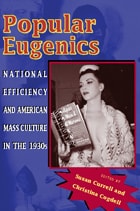
Popular Eugenics
National Efficiency and American Mass Culture in the 1930sSusan Currell
Ohio University Press, 2006
The essays in this generously illustrated collection demonstrate how, after the scientific foundations of the eugenics movement had been weakened in the 1930s, eugenic beliefs spread into the popular media, including newspapers, movies, museum exhibits, plays, and novels, and even fashion shows and comic strips.
Popular Eugenics shows that eugenic thought persisted in science and culture as well as in social policy and goes a long way toward explaining the durability of eugenic thinking and its effects on social policy in the United States. Popular Eugenics will be of interest to scholars and students in a broad range of disciplines, especially American literature and history, popular culture, media studies, and the history of science.
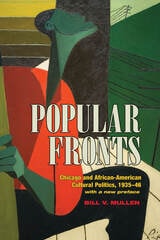
Popular Fronts
Chicago and African-American Cultural Politics, 1935-46Bill V. Mullen
University of Illinois Press, 2015
With a new preface Bill V. Mullen updates his dynamic reappraisal of a critical moment in American cultural history. Mullen's study includes reassessments of the politics of Richard Wright's critical reputation and a provocative reading of class struggle in Gwendolyn Brooks' A Street in Bronzeville. He also takes an in-depth look at the institutions that comprised Chicago's black popular front: the Chicago Defender, the period's leading black newspaper; Negro Story, the first magazine devoted to publishing short stories by and about African Americans; and the WPA-sponsored South Side Community Art Center.

Popular History and the Literary Marketplace, 1840–1920
Gregory M. Pfitzer
University of Massachusetts Press, 2008
Prior to the mid-nineteenth century, most Americans “heard” rather than “read” national history. They absorbed lessons from the past more readily by attending Patriots' Day orations and anniversary commemorations than by reading expensive, multivolume works of patrician historians. By the 1840s, however, innovations in publishing led to the marketing of inexpensive, mass-produced “popular” histories that had a profound influence on historical literacy and learning in the United States. In this book, Gregory M. Pfitzer charts the rise and fall of this genre, demonstrating how and why it was born, flourished, and then became unpopular over time.
Pfitzer begins by exploring how the emergence of a new literary marketplace in the mid-nineteenth century affected the study of history in America. Publishers of popular works hoped to benefit from economies of scale by selling large numbers of inexpensive books at small profit. They hired authors with substantial literary reputations to make the past accessible to middle-class readers. The ability to write effectively for wide audiences was the only qualification for those who dominated this field. Privileging narration and effusive literary style over dispassionate prose, these artists adapted their favorite fictional and poetic conventions with an ease that suggests the degree to which history was viewed as literary art in the nineteenth century.
Beginning as a small cottage industry, popular histories sold in the hundreds of thousands by the 1890s. In an effort to illuminate the cultural conditions for this boom, Pfitzer focuses on the business of book making and book promotion. He analyzes the subscription sales techniques of book agents as well as the aggressive prepublication advertising campaigns of the publishers, including the pictorial embellishments they employed as marketing devices.
He also examines the reactions of professional historians who rejected the fictionalizing and poetic tendencies of popular history, which they equated with loose and undisciplined scholarship. Pfitzer explains how and why these professionals succeeded in challenging the authority of popular histories, and what the subsequent “unpopularity of popular history” meant for book culture and the study of history in the twentieth century.
Popular Music Perspectives
Ideas, Themes, and Patterns in Contemporary LyricsB. Lee Cooper
University of Wisconsin Press, 1991

Popular Print and Popular Medicine
Almanacs and Health Advice in Early AmericaThomas A. Horrocks
University of Massachusetts Press, 2008
In this innovative study of the relationship between popular print and popular attitudes toward the body, health, and disease in antebellum America, Thomas A. Horrocks focuses our attention on a publication long neglected by scholars—the almanac.
Approaching his subject as both a historian of the book and a historian of medicine, Horrocks contends that the almanac, the most popular secular publication in America from the late eighteenth century to the first quarter of the nineteenth, both shaped and was shaped by early Americans' beliefs and practices pertaining to health and medicine. Analyzing the astrological, therapeutic, and regimen advice offered in American almanacs over two centuries, and comparing it with similar advice offered in other genres of popular print of the period, Horrocks effectively demonstrates that the almanac was a leading source of health information in America prior to the Civil War. He contends that the almanac was an integral component of a complicated, fragmented, semi-vernacular health literature of the period, and that the genre played a leading role in disseminating astrological health advice as well as shaping contemporary and future perceptions of astrology.
In terms of therapeutic and regimen advice, Horrocks asserts that the almanac performed a complementary role, confirming and reinforcing traditional beliefs and practices. By analyzing the almanac as a cultural artifact that represents a time, a place, and a certain set of assumptions and beliefs, he demonstrates that the genre can provide a lens through which scholars may examine early American attitudes and practices concerning their health in particular and American popular culture in general.
Popular Religion in America
Symbolic Change and the Modernization Process in Historical PerspectivePeter W. Williams
University of Illinois Press, 1989
"Williams provides a thought-provoking overview of popular religion in America that will intrigue specialist and student alike. . . . He has both answered many questions and raised important new ones on the nature and development of American popular religion." --Journal for the Scientific Study of Religion
"Pioneering. . . . I for one am glad he combined scholarship and chutzpah for this modestly immodest first word." --Catholic Historical Review

Popular Stories and Promised Lands
Fan Cultures and Symbolic PilgrimagesRoger C. Aden
University of Alabama Press, 2007
A conversation about who we are, where we’ve been, and where we might be going.
Popular Stories and Promised Lands enters a conversation about who we are, where we’ve been, and where we might be going by suggesting that possible answers to those questions can be found in the popular stories we encounter at the movies, on television, in popular magazines, and even on the funny pages.
As countless scholars and popular writers have noted, those of us living in the United States find ourselves at a cultural crossroads. We are increasingly aware that the stories that once permeated life in these United States, stories that tell us that social and economic progress comes from working hard, that everyone has an equal opportunity to experience such progress, do not resonate to the degree they once did. Because many Americans have traditionally defined themselves, others, and their unique sense of place through these stories, we find ourselves displaced socially, economically, politically, and/or culturally.
So, Roger Aden says, we go to places of our own making. Fans of the television series The X-Files return to the Funhouse each week for a dose of frightening fun. Fans of the weekly magazine Sports Illustrated play in the American Elysian Fields where democratic efforts at balancing work and play are valued. Fans of the movie Field of Dreams work as altruistic producers in an alternative garden spot.
Grounded in the author’s own experiences and reinforced by the voices of approximately two hundred additional fans of the four popular stories, this book offers a compelling case for understanding the alleged wasteland of popular culture as a fertile site of individually and communally created sacred places.
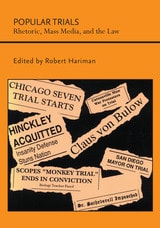
Popular Trials
Rhetoric, Mass Media, and the LawRobert Hariman
University of Alabama Press, 1993
Examining how landmark trials become public dramas that shape law, culture, and collective memory.
Contemporary scholarship illustrates the law’s increasingly powerful role in American life; legal education, in turn, has focused on the problems and techniques of communication. This book addresses these interests through critical study of eight popular trials: the 17th-century trial of Dr. Henry Sacheverell, and the 20th-century trials of Scopes, the Rosenbergs, the Chicago Seven, the Catonsville Nine, John Hinckley, Claus von Bulow, and San Diego Mayor Larry Hedgecock. Such trials spark major public debates, become symbols of public life, and legitimize particular beliefs and institutions. Despite high visibility and drama, however, the popular trial has not received sufficient study as persuasive event. Lying at the intersection of the institutional practices of law and the mass media, the popular trial has confounded study according to the conventional assumptions of scholarship in both law and communication studies.
This volume defines popular trials as a genre of public communication, a genre that includes trials unusually prominent within public discourse. Further, popular trials are often characterize by special media presentations through televised coverage of the trial itself and news analysis, intense audience identification with the principal actors, and political and social consequences independent of the legal action. The essays in this volume stress the rhetorical functions of popular trials. Contributors in addition to the editor include Lawrance M. Bernabo, Barry Brummett, Celeste Michelle Condit, Juliet Dee, Susan J. Drucker, J. Justin Gustainis, Janice Platt Hunold, William Lewis, John Louis Lucaites, and Larry A. Williamson.
Popularizing the Past
Historians, Publishers, and Readers in Postwar AmericaNick Witham
University of Chicago Press, 2023
What’s the matter with history? For decades, critics of the discipline have argued that the historical profession is dominated by scholars unable, or perhaps even unwilling, to write for the public. In Popularizing the Past, Nick Witham challenges this interpretation by telling the stories of five historians—Richard Hofstadter, Daniel Boorstin, John Hope Franklin, Howard Zinn, and Gerda Lerner—who, in the decades after World War II, published widely read books of national history.
Witham compellingly argues that we should understand historians’ efforts to engage with the reading public as a vital part of their postwar identity and mission. He shows how the lives and writings of these five authors were fundamentally shaped by their desire to write histories that captivated both scholars and the elusive general reader. He also reveals how these authors’ efforts could not have succeeded without a publishing industry and a reading public hungry to engage with the cutting-edge ideas then emerging from American universities. As Witham’s book makes clear, before we can properly understand the heated controversies about American history so prominent in today’s political culture, we must first understand the postwar effort to popularize the past.
Popularizing the Past
Historians, Publishers, and Readers in Postwar AmericaNick Witham
University of Chicago Press, 2023
This is an auto-narrated audiobook edition of this book.
Popularizing the Past tells the stories of five postwar historians who changed the way ordinary Americans thought about their nation’s history.
What’s the matter with history? For decades, critics of the discipline have argued that the historical profession is dominated by scholars unable, or perhaps even unwilling, to write for the public. In Popularizing the Past, Nick Witham challenges this interpretation by telling the stories of five historians—Richard Hofstadter, Daniel Boorstin, John Hope Franklin, Howard Zinn, and Gerda Lerner—who, in the decades after World War II, published widely read books of national history.
Witham compellingly argues that we should understand historians’ efforts to engage with the reading public as a vital part of their postwar identity and mission. He shows how the lives and writings of these five authors were fundamentally shaped by their desire to write histories that captivated both scholars and the elusive general reader. He also reveals how these authors’ efforts could not have succeeded without a publishing industry and a reading public hungry to engage with the cutting-edge ideas then emerging from American universities. As Witham’s book makes clear, before we can properly understand the heated controversies about American history so prominent in today’s political culture, we must first understand the postwar effort to popularize the past.
Population Trends in New Jersey
James W. Hughes
Rutgers University Press, 2022
The authors also highlight key trends that will continue to transform the state: domestic migration out of the state and immigration into it; increasing diversity; slower overall population growth; contracting fertility; the household revolution and changing living arrangements; generational disruptions; and suburbanization versus re-urbanization. All of these factors help place in context the result of the 2020 decennial U.S. Census.
While the book focuses on New Jersey, the Garden State is a template of demographic, economic, social, and other forces characterizing the United States in the twenty-first century.
Populism to Progressivism In Alabama
Sheldon Hackney
University of Alabama Press, 2010
WINNER OF THE ALBERT J. BEVERIDGE AWARD OF THE AMERICAN HISTORICAL ASSOCIATION
A classic study of race, reform, and political change in the New South.
Populism to Progressivism in Alabama by Sheldon Hackney is a landmark study of the political and social transformation of Alabama during the pivotal years between 1890 and 1910. Widely recognized as a classic work of Southern history, the book examines the rise of the Populist movement, the emergence of Progressive reform, and the forces that reshaped political power in the state at the turn of the twentieth century.
Hackney explores the complex relationships among race, class, economic change, agrarian protest, and democratic participation. He investigates how farmers, laborers, political leaders, and reformers responded to industrialization, shifting economic conditions, and the challenges of governance in the New South. Central to the narrative are debates over voting rights, disfranchisement, race relations, and the creation of new political institutions that would shape Alabama's future for generations.
Combining quantitative methods with traditional historical scholarship, Hackney provides a nuanced interpretation of both Populism and Progressivism, challenging simplistic accounts of reform and political change. Essential reading for understanding Alabama and the modern South, this influential volume remains a foundational resource for historians, political scientists, students, and anyone interested in the history of American democracy and regional transformation.
Populist Revolt
A History of the Farmers' Alliance and the People's PartyJohn D. Hicks
University of Minnesota Press, 1931
Populist Revolt was first published in 1931. Minnesota Archive Editions uses digital technology to make long-unavailable books once again accessible, and are published unaltered from the original University of Minnesota Press editions.
When The Populist Revolt was originally published, the New York Times critic called it "far and away the best account of populism that we have—and one not likely to be replaced." That prophecy proved right; the book has not been replaced, and historians and critics agree that it is the definitive work on its subject. Now it is made available once more, after being out of print for some time.
This is a history of the Farmers' Alliance and the People's Party, under whose banners a great crusade for farm relief was waged in the 1880's and 1890's. As important as the chronicle of the political movement itself is the detailed picture which Professor Hicks gives of the conditions which set the stage for this agrarian revolt. He describes the inequities and malpractices which beset both the new settlers of the West and the poverty-ridden whites and Negroes of the South following the Civil War.
The story of Populism itself is a lively one, people with such picturesque leaders as "Pitchfork" Ben Tillman of South Carolina, "Sockless" Jerry Simpson and Mary Elizabeth Lease—the "Patrick Henry in petticoats"—of Kansas, "Bloody Bridles" Waite of Colorado, Thomas E. Watson of Georgia, Dr. C. W. Macune of Texas, James B. Weaver of Iowa, and Ignatius Donnelly of Minnesota.
In these pages, Professor Hicks has, as Frederic L. Paxson pointed out, "presented the case for Populism better than the Populists themselves could do it." Henry Steele Commanger calls the book a "thorough, scholarly, sympathetic and spirited history of the entire Populist movement."

Porches of North America
Thomas Durant Visser
University Press of New England, 2012

Porcupine, Picayune, & Post
How Newspapers Get Their NamesJim Bernhard
University of Missouri Press, 2007
Why a Gazette? When one stops to think about it, Times or News is easy to understand, but why do some newspapers have strange names such as Jimplecute or Bazoo? And not to be picayune, but why Picayune?
Word sleuth Jim Bernhard stopped to consider such questions and began a quest that resulted in the only book-length account of the history of newspaper titles. Cataloging names from the most common to the most bizarre, Porcupine, Picayune, & Post explores the history and etymology of newspapers’ names—names that, by their very peculiarity, cry out for explanation.
Bernhard focuses on printed general-interest English-language dailies and weeklies, from the Choteau (Montana) Acantha to the Moab (Utah) Zephyr, with everything in between—including the Gondolier of Venice, Florida, and the Iconoclast of Crawford, Texas. He explains why there are more Heralds, Journals, Posts, and Tribunes than you can shake a typestick at. He also goes beyond America’s borders to consider such oddities as the Banbury Cake in England and the Gawler Bunyip in Australia.
As Bernhard shows, the reasons for newspaper names vary: sometimes their origins are political or historical, sometimes personal or simply whimsical. Many names have lost their original purposes over time but were chosen with care to symbolize a philosophy or mission or else were created by word association with the paper’s location or community role.
This book is bursting with little-known facts that will delight anyone who picks up a daily paper: how the Oil City Derrick in Pennsylvania got its name from a seventeenth-century English hangman, why a Londoner printed a newspaper on calico and named it the Handkerchief, and what meaning lurks behind the Unterrified Democrat of Linn, Missouri. There’s even a chapter on noteworthy fictional newspapers, from Superman’s Daily Planet to Lake Wobegon’s Herald-Star.
With the naming of newspapers fast becoming a lost art, Porcupine, Picayune, & Post tells what’s behind the banners we see each day but probably never stop to think about. Thanks to Bernhard, we may never see them in the same way again.
Porkopolis
American Animality, Standardized Life, and the Factory FarmAlex Blanchette
Duke University Press, 2020