18284 books match the query 'United States' and 850 start with p
cover of Processing Politics: Learning from Television in the Internet Age

Processing Politics

Learning from Television in the Internet Age

Doris A. Graber

University of Chicago Press, 2001

How often do we hear that Americans are so ignorant about politics that their civic competence is impaired, and that the media are to blame because they do a dismal job of informing the public? Processing Politics shows that average Americans are far smarter than the critics believe. Integrating a broad range of current research on how people learn (from political science, social psychology, communication, physiology, and artificial intelligence), Doris Graber shows that televised presentations—at their best—actually excel at transmitting information and facilitating learning. She critiques current political offerings in terms of their compatibility with our learning capacities and interests, and she considers the obstacles, both economic and political, that affect the content we receive on the air, on cable, or on the Internet.

More and more people rely on information from television and the Internet to make important decisions. Processing Politics offers a sound, well-researched defense of these remarkably versatile media, and challenges us to make them work for us in our democracy.
[more]
cover of Producers, Parasites, Patriots: Race and the New Right-Wing Politics of Precarity

Producers, Parasites, Patriots

Race and the New Right-Wing Politics of Precarity

Daniel Martinez HoSang

University of Minnesota Press, 2019

The shifting meaning of race and class in the age of Trump
 

The profound concentration of economic power in the United States in recent decades has produced surprising new forms of racialization. In Producers, Parasites, Patriots, Daniel Martinez HoSang and Joseph E. Lowndes show that while racial subordination is an enduring feature of U.S. political history, it continually changes in response to shifting economic and political conditions, interests, and structures. 

The authors document the changing politics of race and class in the age of Trump across a broad range of phenomena, showing how new forms of racialization work to alter the economic protections of whiteness while promoting some conservatives of color as models of the neoliberal regime. Through careful analyses of diverse political sites and conflicts—racially charged elections, attacks on public-sector unions, new forms of white precarity, the rise of black and brown political elites, militia uprisings, multiculturalism on the far right—they highlight new, interwoven deployments of race in the ascendant age of inequality. Using the concept of “racial transposition,” the authors demonstrate how racial meanings and signification can be transferred from one group to another to shore up both neoliberalism and racial hierarchy.

From the militia movement to the Alt-Right to the mainstream Republican Party, Producers, Parasites, Patriots brings to light the changing role of race in right-wing politics.

[more]
cover of Producing American Races: Henry James, William Faulkner, Toni Morrison

Producing American Races

Henry James, William Faulkner, Toni Morrison

Patricia McKee

Duke University Press, 1999

In Producing American Races Patricia McKee examines three authors who have powerfully influenced the formation of racial identities in the United States: Henry James, William Faulkner, and Toni Morrison. Using their work to argue that race becomes visible only through image production and exchange, McKee illuminates the significance that representational practice has had in the process of racial construction.
McKee provides close readings of six novels—James’s The Wings of the Dove and The Golden Bowl, Faulkner’s The Sound and the Fury and Light in August, and Morrison’s Sula and Jazz—interspersed with excursions into Lacanian and Freudian theory, critical race theory, epistemology, and theories of visuality. In James and Faulkner, she finds, race is represented visually through media that highlight ways of seeing and being seen. Written in the early twentieth century, the novels of James and Faulkner reveal how whiteness depended on visual culture even before film and television became its predominant media. In Morrison, the culture is aural and oral—and often about the absence of the visual. Because Morrison’s African American communities produce identity in nonvisual, even anti-visual terms, McKee argues, they refute not just white representations of black persons as objects but also visual orders of representation that have constructed whites as subjects and blacks as objects.
With a theoretical approach that both complements and transcends current scholarship about race—and especially whiteness—Producing American Races will engage scholars in American literature, critical race theory, African American studies, and cultural studies. It will also be of value to those interested in the novel as a political and aesthetic form.

[more]
cover of Producing Success: The Culture of Personal Advancement in an American High School

Producing Success

The Culture of Personal Advancement in an American High School

Peter Demerath

University of Chicago Press, 2009

Middle- and upper-middle-class students continue to outpace those from less privileged backgrounds. Most attempts to redress this inequality focus on the issue of access to financial resources, but as Producing Success makes clear, the problem goes beyond mere economics. In this eye-opening study, Peter Demerath examines a typical suburban American high school to explain how some students get ahead.

Demerath undertook four years of research at a Midwestern high school to examine the mercilessly competitive culture that drives students to advance. Producing Success reveals the many ways the community’s ideology of achievement plays out: students hone their work ethics and employ various strategies to succeed, from negotiating with teachers to cheating; parents relentlessly push their children while manipulating school policies to help them get ahead; and administrators aid high performers in myriad ways, even naming over forty students “valedictorians.” Yet, as Demerath shows, this unswerving commitment to individual advancement takes its toll, leading to student stress and fatigue, incivility and vandalism, and the alienation of the less successful. Insightful and candid, Producing Success is an often troubling account of the educationally and morally questionable results of the American culture of success.

[more]
cover of Producing the Sacred: AN ESSAY ON PUBLIC RELIGION

Producing the Sacred

AN ESSAY ON PUBLIC RELIGION

Robert Wuthnow

University of Illinois Press, 1994

What is Public religion? How does it manifest the sacred? These are the fundamental questions Robert Wuthnow addresses in Producing the Sacred.
Wuthnow uses as a guiding assumption the idea that cultural expressions, religious or otherwise, do not simply happen but are produced. He considers the major kinds of organizations that produce public religion--congregations, hierarchies, special interests, academies, and public rituals--showing how these organizational vehicles shape public religion's messages and how specific types of religious organization draw resources from their environments. He also reveals the implicit and unintended ways in which sacredness is expressed in modern society.
 
A volume in the series Public Expressions of Religion in America  
 
[more]
cover of Productivity Growth in Japan and the United States

Productivity Growth in Japan and the United States

Edited by Charles R. Hulten

University of Chicago Press, 1991

Emerging from the ruins of the Second World War, the Japanese economy has grown at double-digit rate throughout much of the 1950s and 1960s, and, when the oil crisis of the 1970s slowed growth throughout the industrialized world, Japanese growth throughout the industrialized world, Japanese growth rates remained relatively strong. There have been many attempts by scholars from a wide range of disciplines to explain this remarkable history, but for economists interested in the quantitative analysis of economic growth and the principal question addressed is how Japan was able to grow so rapidly.

The contributors focus their efforts on the accurate measurement and comparison of Japanese and U.S. economic growth. Assuming that any sustained increase in real GNP must be due either to an increase in the quantity of capital and labor used in production or to the more efficient use of these inputs, the authors analyze the individual contributions of various factors and their importance in the process of output growth.

These essays extend the methodology of growth analysis and offer many insights into the factors leading to the superior performance of the Japanese economy. They demonstrate that growth is a complex process and no single factor can explain the Japanese 'miracle.'
[more]
cover of Productivity in Higher Education

Productivity in Higher Education

Edited by Caroline M. Hoxby and Kevin Stange

University of Chicago Press, 2019

How do the benefits of higher education compare with its costs, and how does this comparison vary across individuals and institutions? These questions are fundamental to quantifying the productivity of the education sector. The studies in Productivity in Higher Education use rich and novel administrative data, modern econometric methods, and careful institutional analysis to explore productivity issues. The authors examine the returns to undergraduate education, differences in costs by major, the productivity of for-profit schools, the productivity of various types of faculty and of outcomes, the effects of online education on the higher education market, and the ways in which the productivity of different institutions responds to market forces. The analyses recognize five key challenges to assessing productivity in higher education: the potential for multiple student outcomes in terms of skills, earnings, invention, and employment; the fact that colleges and universities are “multiproduct” firms that conduct varied activities across many domains; the fact that students select which school to attend based in part on their aptitude; the difficulty of attributing outcomes to individual institutions when students attend more than one; and the possibility that some of the benefits of higher education may arise from the system as a whole rather than from a single institution. The findings and the approaches illustrated can facilitate decision-making processes in higher education.
[more]
cover of Professing Literature: An Institutional History

Professing Literature

An Institutional History

Gerald Graff

University of Chicago Press, 1987
[more]
cover of Professing Literature: An Institutional History, Twentieth Anniversary Edition

Professing Literature

An Institutional History, Twentieth Anniversary Edition

Gerald Graff

University of Chicago Press, 2007

Widely considered the standard history of the profession of literary studies, Professing Literature unearths the long-forgotten ideas and debates that created the literature department as we know it today. In a readable and often-amusing narrative, Gerald Graff shows that the heated conflicts of our recent culture wars echo—and often recycle—controversies over how literature should be taught that began more than a century ago.

Updated with a new preface by the author that addresses many of the provocative arguments raised by its initial publication, Professing Literature remains an essential history of literary pedagogy and a critical classic.

“Graff’s history. . . is a pathbreaking investigation showing how our institutions shape literary thought and proposing how they might be changed.”— The Norton Anthology of Theory and Criticism
[more]
cover of Professional Autonomy in Video Relay Service Interpreting

Professional Autonomy in Video Relay Service Interpreting

Erica Alley

Gallaudet University Press, 2019

Video relay service (VRS) is a federally funded service that provides telecommunications access for deaf people. It is also a for-profit industry with guidelines that may limit the autonomy of the sign language interpreters who work in VRS settings. In this volume, Erica Alley examines how VRS interpreters, or “Communication Assistants,” exercise professional autonomy despite the constraints that arise from rules and regulations established by federal agencies and corporate entities. Through interviews with VRS interpreters, Alley reveals the balance they must achieve in providing effective customer service while meeting the quantitative measures of success imposed by their employer in a highly structured call center environment.

Alley considers the question of how VRS fits into the professional field of interpreting, and discovers that—regardless of the profit-focused mentality of VRS providers—interpreters make decisions with the goal of creating quality customer service experiences for deaf consumers, even if it means “breaking the rules.” Her findings shed light on the decision-making process of interpreters and how their actions are governed by principles of self-care, care for colleagues, and concern for the quality of services provided. Professional Autonomy in Video Relay Service Interpreting is essential reading in interpreter education courses and interpreter training programs.
[more]
cover of Professional Communities and the Work of High School Teaching

Professional Communities and the Work of High School Teaching

Milbrey W. McLaughlin and Joan E. Talbert

University of Chicago Press, 2001

American high schools have never been under more pressure to reform: student populations are more diverse than ever, resources are limited, and teachers are expected to teach to high standards for all students. While many reformers look for change at the state or district level, the authors here argue that the most local contexts—schools, departments, and communities—matter the most to how well teachers perform in the classroom and how satisfied they are professionally. Their findings—based on one of the most extensive research projects ever done on secondary teaching—show that departmental cultures play a crucial role in classroom settings and expectations. In the same school, for example, social studies teachers described their students as "apathetic and unwilling to work," while English teachers described the same students as "bright, interesting, and energetic."

With wide-ranging implications for educational practice and policy, this unprecedented look into teacher communities is essential reading for educators, administrators, and all those concerned with U. S. High Schools.

[more]
cover of Professional Identity Crisis: Race, Class, Gender, and Success at Professional Schools

Professional Identity Crisis

Race, Class, Gender, and Success at Professional Schools

Carrie Yang Costello

Vanderbilt University Press, 2006

The fact that women and people of color tend to underperform at professional schools is a source of controversy. Conservatives blame affirmative action, while liberals blame intentional discrimination. The extensive research reported in Professional Identity Crisis belies both conspiracy theories.

The author spent over 400 hours observing how first-year students are socialized in two very different environments, Boalt School of Law and the School of Social Welfare at UC Berkeley, watching how they adapted to different expectations of how to speak, dress, and behave in the classroom.

Costello found that students who were female, of color, disabled, or poor were not underqualified compared with their privileged peers. Nor did the research uncover intentional bigotry. Instead, the disproportionate success of white men can be explained by the fact that they are more likely to acquire appropriate professional identities swiftly, with little inner conflict. Students from less privileged backgrounds, however, suffered from "identity dissonance." For example, Jasmine, a Filipino student from Los Angeles, explained, "In the legal culture you have to adopt a different way of being, a different vocabulary and way to carry yourself . . . That's how I got this far. And when I go home, if I act the way I do here, they won't get it. My cousins and my friends say, 'You're kind of whitewashed.' And when I come back here I have to get back my law style."

[more]
cover of Professional Liability Issues for Librarians and Information Professionals

Professional Liability Issues for Librarians and Information Professionals

American Library Association, 2008
[more]
cover of Professional Powers: A Study of the Institutionalization of Formal Knowledge

Professional Powers

A Study of the Institutionalization of Formal Knowledge

Eliot Freidson

University of Chicago Press, 1986

"This is an immensely useful book for sociologists working in a wide range of sub-fields. It confirms Freidson's status among the leading exponents of the old Chicago tradition. This book is catholic in its reading, sophisticated in its arguments and cautious in its judgements."—Robert Dingwall, Sociology

"As an attempt to provide a complex, wide-ranging account this book should be essential reading for specialist students, and it should act as a stimulus for the extension of both empirical research and theory."—Alex Faulkner, Sociological Review

"Freidson's book is a concise introduction to the professions, challenging specialists with its puncturing of theoretically induced misconceptions and offering general readers a clear but critical entrée to the theoretical literature concerning this central aspect of modern society."—Andrew Abbott, Science

"This is a stimulating and well-written book which opens up a new perspective on the professions as well as contributing to existing debates."—David Podmore, Times Higher Education Supplement
[more]
cover of Professionalizing Multimodal Composition

Professionalizing Multimodal Composition

Santosh Khadka

Utah State University Press, 2023

Multimodal composition is becoming increasingly popular in university classrooms as faculty, students, and institutions come to recognize that old and new technologies have enabled, and even demanded, the use of more than one composing mode for communicating, solving problems, and keeping up with the latest discourse. Professionalizing Multimodal Composition embraces and enacts multimodal composition in various writing courses and programs by exploring institutional, programmatic, and individual faculty initiatives for capacity building and human resource development across institutions.
 
Academic leaders, scholars, and faculty who have successfully designed and launched academic programs or faculty development initiatives discuss the theoretical and logistical questions considered in their design, the outcomes they achieved, and how others can emulate them. This exchange of knowledge, insight, experiences, and lessons learned among community members is critical for enabling or inspiring other programs, departments, and institutions to conceive, design, and launch academic programs or faculty development initiatives for their own faculty.
 
The larger goal of professionalizing is to work with teaching faculty to increase their interactional expertise with multimodal composition, and this collection offers a set of models for how faculty can do that at their own institutions and in their own programs.
[more]
cover of Professions: Conversations on the Future of Literary and Cultural Studies

Professions

Conversations on the Future of Literary and Cultural Studies

Edited by Donald E. Hall

University of Illinois Press, 2001

Sometimes playful, always provocative, Professions is a collection of searching and candid conversations--ranging from dialogues to tongue-in-cheek diatribes--on the issues that face literary and cultural critics today.
 
This volume bares professional concerns, relationships, ambitions, and insecurities about working in academe. Professions provides hard-to-get insider information for students contemplating an academic career. It also challenges professional scholars to retrieve the intellectual curiosity that drew them to scholarship in the first place while demonstrating how disagreement on controversial issues can be conducted with respect, good humor, and an open mind.
 
Professions features:
 
Jane Tompkins and Gerald Graff
John McGowan and Regenia Gagnier
James Phelan and James Kincaid
Marjorie Perloff and Robert von Hallberg
Judith Jackson Fossett and Kevin Gaines
Dennis W. Allen and Judith Roof
Niko Pfund, Gordon Hutner, and Martha Banta
Geoffrey Galt Harpham
Donald E. Hall and Susan S. Lanser
J. Hillis Miller, Herbert Lindenberger, Sandra Gilbert, Bonnie Zimmerman, Nellie Y. McKay, and Elaine Marks
 
[more]
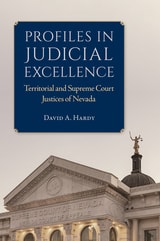
cover of Profiles in Judicial Excellence: Territorial and Supreme Court Justices of Nevada

Profiles in Judicial Excellence

Territorial and Supreme Court Justices of Nevada

David A. Hardy

University of Nevada Press, 2025

The Nevada judiciary began with territorial judges appointed by President Abraham Lincoln and transitioned to elected judges after statehood in 1864. The courts officiated by these judges have influenced the evolution of Nevada from a territory created in the chaos of mining litigation; through the expansion of divorce, gaming, and tourism jurisprudence; to what is now a vibrant venue for commercial development and corporate law. Along the way, the state’s judges weighed in on issues of civil liberties, water rights, personal injury, and a variety of other legal subjects affecting all Nevada citizens. The collective work of these courts has solidified the rule of law and allowed Nevadans to live peacefully.

Until the publication of Judge David A. Hardy’s Profiles in Judicial Excellence: Territorial and Supreme Court Justices of Nevada, there has been no single source containing biographies of these influential figures from the state’s history from 1861 to 1997. Hardy curates various sources and presents profiles of these judges in sequential order of their service. He also examines the influence of territorial judges in the 1864 vote for statehood. The Nevada judiciary has played an integral, but often unrecognized, role in shaping the unique character of the Silver State.
 
[more]
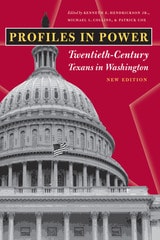
cover of Profiles in Power: Twentieth-Century Texans in Washington, New Edition

Profiles in Power

Twentieth-Century Texans in Washington, New Edition

Edited by Kenneth E. Hendrickson, Jr., Michael L. Collins, and Patrick Cox

University of Texas Press, 2004

Profiles in Power offers concise biographies of fourteen twentieth-century Texans who wielded significant political power and influence in Washington, D.C. First published in 1993 by Harlan Davidson, it has been revised and updated with new chapters on John Nance Garner and Henry Gonzalez and expanded chapters on Lyndon Johnson, Barbara Jordan, Ralph Yarborough, Jim Wright, and John Tower. Demonstrating the validity of a biographical approach to history, the book as a whole covers all the major political issues of the twentieth century, as well as the pivotal role of Texans in defining the national agenda.

[more]
cover of Profiles in Survival: The Experiences of American POWs in the Philippines during World War II

Profiles in Survival

The Experiences of American POWs in the Philippines during World War II

John C. Shively

Indiana Historical Society Press, 2012
The stories of seven men and one woman from Indiana who survived the horrors of captivity under the Japanese in the Pacific during World War II are captured in vivid detail. These Hoosiers were ordered to surrender following the fall of Bataan and Corregidor in 1942. It was the largest surrender of American armed forces in U.S. history and the beginning of three years of hell starting with the infamous Bataan Death March, facing brutal conditions in POW camps in the Philippines, and horrific journeys to Japan for some onboard what came to be known as “hellships.” Former Indiana governor Edgar D. Whitcomb, one of those featured in the book, notes that the American prisoners had to endure “unimaginable misery and brutality at the hands of sadistic Japanese guards,” as they were routinely beaten and many were executed for the most minor offenses, or for mere sport. In addition to Whitcomb, those profiled include Irvin Alexander, Harry Brown, William Clark, James Duckworth, Eleanor Garen, Melvin McCoy, and Hugh Sims.
[more]
cover of Profiles of Popular Culture: A Reader

Profiles of Popular Culture

A Reader

Edited by Ray B. Browne

University of Wisconsin Press, 2005

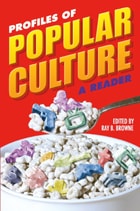
From Hank Williams to hip hop, Aunt Jemima to the Energizer Bunny, scrap-booking to NASCAR racing, Profiles of Popular Culture cuts a generous swath across what is perhaps the fastest growing discipline of the past several decades.  Edited by a pioneer in the field, this volume invites readers to reflect on a diverse sampling of modern myths, icons, archetypes, rituals, and pastimes.  Adopting an inclusive approach, editor Ray B. Browne has mined both scholarly and mainstream media to bring together penetrating essays on fads and fashions, sports fandom, the shaping of body image, aesthetic surgery, the marketing of food, vacationing and sightseeing, toys and games, genre fiction, post-9/11 entertainment, and much more.  Like Jack Nachbar and Kevin Lause's Popular Culture: An Introductory Text, this book opens critical doors into the study of popular culture-and does so within a fresh context that includes points of reference both established and new.
[more]
cover of Profiles of Social Research: The Scientific Study of Human Interaction

Profiles of Social Research

The Scientific Study of Human Interaction

Morton M. Hunt

Russell Sage Foundation, 1985

This splendid introduction to social research describes an area of scientific investigation that profoundly influences our daily lives and thoughts, but about which most of us know very little. We can picture a research chemist at work, white-coated and surrounded by beakers and test tubes—but what is the nature of social research? For interested general readers and particularly for students entering the various social science fields, Morton Hunt paints an immensely informative and accessible portrait. He begins with a lucid overview of the important varieties of social research, describing their advantages and limitations. Against this background, Hunt then details five remarkable case histories, eyewitness accounts of significant recent episodes in social research. Woven skillfully through each narrative are explorations of the basic methodological, practical, moral and political issues raised by social research. The story of a noteworthy series of sociopsychological experiments on teamwork, for example, enables Hunt to weigh the merits of using a laboratory setting to study social behavior and the ethics of deceiving human subjects. In similar fashion, Hunt depicts a historic cross-sectional survey on segregated schooling; a complex attempt to measure the impact of welfare programs; a real-world experiment with guaranteed annual incomes; and a path-breaking study of human aging that followed its subjects for a generation. This engaging and intelligent book will give readers a new understanding of the breadth and richness of social research as well as an informed appreciation of its significance for their lives.
[more]
cover of Profiting from the Peak: Landscape and Liberty in Colorado Springs

Profiting from the Peak

Landscape and Liberty in Colorado Springs

John Harner

University Press of Colorado, 2021

Colorado Springs, Colorado, has long profited from Pikes Peak and built an urban infrastructure to sustain that relationship. In Profiting from the Peak, geographer John Harner surveys the events and socioeconomic conditions that formed the city, analyzing the built landscape to offer insight into the origins of its urban forms and spatial layout, focusing particularly on historic downtown architecture and public spaces. He examines the cultural values that have come to define the city, showing how military and other institutions, tourism, political and economic conditions, cultural movements, key individual actors, and administrative policies have created a singular urban personality.

Capital accumulation has been a defining theme of Colorado Springs from its very beginning, with enormous profits generated from regional industrialization, railroads, land sales, water appropriation, and extraction of coal and gold. These conditions and its setting in the Rocky Mountain West formed a libertarian-oriented, limited governance philosophy.
This persistent prioritization of liberty at the heart of Colorado Springs’s identity, specifically the freedom to conduct business and generate profits in a relatively unconstrained setting, has directed the urban sprawl of the built landscape and molded the region’s political culture. Profiting from the Peak will be of interest to historical and urban geographers, historians of Colorado and the American West, and anyone seeking a deeper understanding of the cultural identity of Colorado Springs.
 
[more]
cover of Progress: Fact or Illusion?

Progress

Fact or Illusion?

Leo Marx and Bruce Mazlish, Editors

University of Michigan Press, 1996
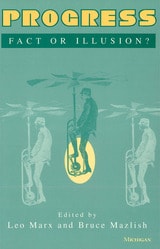
Progress, perhaps the fundamental secular belief of modern Western society, has come under heavy fire recently because, after three centuries, advances in science and technology seem increasingly to bring problems in their wake: alienation, environmental degradation, the threat of nuclear destruction. The idea of progress is brought into question by postmodern critique, attacking the notion of science as truth. Yet no other meaningful organization of humankind's sense of time looms on the horizon. This volume seeks to reassess the meaning and prospects of the idea of progress. Looking toward the millennium, the volume seeks to evaluate the idea's worth both in theory--is it intellectually viable and defensible today?--and practice--even if theoretically defensible, is the idea undermined in actual life? Approaching these questions from the perspectives of science, anthropology, economics, religion, political philosophy, feminism, medicine, environmental studies, and the Third World, the contributors, all distinguished scholars, provide a unique and critical balance. Ultimately, the contributors find that progress is both a fact and an illusion: it does occur in certain areas, but it does not sweep all before it as its Enlightenment votaries thought it would. This foundational idea permeates discourse in the natural and social sciences as well as the humanities and will engage historians, students of the history of science and technology, sociologists, political scientists, philosophers, literary scholars, and art critics, as well as those interested in civilization in general. Contributors include: Jill Ker Conway, Zhiyuan Cui, Leon Eisenberg, Robert Heilbroner, Gerald Holton, Leo Marx, Bruce Mazlish, Ali A. Mazrui, Alan Ryan, John M. Staudenmaier, George W. Stocking, Jr., and Richard White. "A discerning reconsideration of the idea of 'progress' in a variety of carefully defined theoretical and empirical-historical contexts." --David Hollinger, University of California, Berkeley Leo Marx is Professor of American Cultural History, Emeritus, Massachusetts Institute of Technology. Bruce Mazlish is Professor of History, Massachusetts Institute of Technology.
[more]
cover of Progressive Cities: The Commission Government Movement in America, 1901–1920

Progressive Cities

The Commission Government Movement in America, 1901–1920

By Bradley Robert Rice

University of Texas Press, 1977

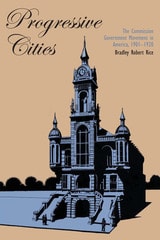
Although the commission government movement is often treated by historians as an element of the reform surge of the Progressive Era, this is the first full-scale study of the origins, spread, and decline of the commission idea.

Commission government originated in Galveston, Texas, where business leaders conceived the plan as a temporary measure to speed recovery from the great hurricane of 1900. Other cities in Texas and across the nation soon followed; by 1920, about 500 municipalities had adopted the plan in which elected representatives serve as heads of city departments and, collectively, as a policy-making body.

Beginning with Galveston and Houston and Des Moines, Iowa, Bradley Robert Rice presents detailed case studies of the earliest commission cities and shows how the plan was developed and modified to suit each community’s needs. He goes on to chronicle the adoption of the commission plan by other cities across the country that strove for “businesslike efficiency” as a reaction against corruption and machine politics in urban government. Most commission charters included a wide-ranging package of municipal reforms, such as the short ballot, at-large representation, nonpartisanship, civil service, and direct legislation. Yet Rice shows that the commission plan generally offered little in the way of social reform to accompany its reorganization of municipal government.

Applying a model of innovation diffusion, the author analyzes how and why the new form of city government spread across Progressive Era America. He also thoroughly explores the relationship between the commission plan and other Progressive Era reforms and reports on the reasons for its decline from both a social and a practical perspective.

Progressive Cities is described by Professor Bruce M. Stave, editor of the Journal of Urban History, as “a sound piece of work which should make a useful and worthwhile contribution to the existing scholarship on urban reform and should appeal to an audience which cuts across disciplines: history, political science, urban studies and urban planning.”

[more]
cover of Progressive Constitutionalism: Reconstructing the Fourteenth Amemdment

Progressive Constitutionalism

Reconstructing the Fourteenth Amemdment

Robin L. West

Duke University Press, 1994

The Fourteenth Amendment guarantees all citizens equal protection under the law as well as immunity from laws that deprive them of life, liberty, or property without due process of law. In Progressive Constitutionalism, Robin West develops an interpretation of this amendment that contrasts with the views, conservative and liberal, of the Rehnquist, Burger, and Warren Courts, and with the radical "antisubordinationist" account provided by the critical legal studies movement and many prominent feminist and critical race theorists. Her interpretation consists of a "substantive" argument regarding the Amendment’s core meaning, and a jurisprudential argument regarding the role of the courts and Congress in fulfilling the Amendment’s progressive promise.
West shows how the "equal protection" clause, far from insulating the private spheres of culture, market, and home life, as is commonly held, directly targets abuses of power within those spheres. She develops a number of arguments for the modern relevance of this understanding, from the failure of the state to provide equal protection against private domestic violence, permitting a "private sovereignty" of patriarchal power within the home, to the the state’s failure to provide equal protection against material deprivation, allowing "private sovereignty" between economically privileged and desperate people in private markets.
West’s argument extends to the "liberty" prong of the due process clause, seen here as a protection of the positive, not negative, liberty of citizens, covering rights in such typically controversial areas as welfare, education, and domestic safety. This interpretation recasts a number of contemporary constitutional issues, such as affirmative action and hate speech, and points to very different problems—notably private, unchecked criminal violence and extreme economic deprivation—as the central constitutional dilemmas of our day.
Progressive Constitutionalism urges a substantive, institutional, and jurisprudential reorientation of our understanding of the Fourteenth Amendment, one that would necessarily be pursued through Congressional rather than judicial channels. In doing so, with attention to history and both feminist and critical race scholarship, it should reinvigorate our politics and our constitutional conversations—and, perhaps, point us toward a more just society.
[more]
cover of Progressive Country: How the 1970s Transformed the Texan in Popular Culture

Progressive Country

How the 1970s Transformed the Texan in Popular Culture

By Jason Mellard

University of Texas Press, 2013

Winner, Coral Horton Tullis Memorial Prize, Texas State Historical Association, 2014

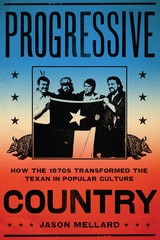
During the early 1970s, the nation’s turbulence was keenly reflected in Austin’s kaleidoscopic cultural movements, particularly in the city’s progressive country music scene. Capturing a pivotal chapter in American social history, Progressive Country maps the conflicted iconography of “the Texan” during the ’70s and its impact on the cultural politics of subsequent decades.

This richly textured tour spans the notion of the “cosmic cowboy,” the intellectual history of University of Texas folklore and historiography programs, and the complicated political history of late-twentieth-century Texas. Jason Mellard analyzes the complex relationship between Anglo-Texan masculinity and regional and national identities, drawing on cultural studies, American studies, and political science to trace the implications and representations of the multi-faceted personas that shaped the face of powerful social justice movements. From the death of Lyndon Johnson to Willie Nelson’s picnics, from the United Farm Workers’ marches on Austin to the spectacle of Texas Chic on the streets of New York City, Texas mattered in these years not simply as a place, but as a repository of longstanding American myths and symbols at a historic moment in which that mythology was being deeply contested.

Delivering a fresh take on the meaning and power of “the Texan” and its repercussions for American history, this detail-rich exploration reframes the implications of a populist moment that continues to inspire progressive change.

[more]
cover of Progressive Women in Conservative Times: Racial Justice, Peace, and Feminism

Progressive Women in Conservative Times

Racial Justice, Peace, and Feminism

Susan Lynn

Rutgers University Press, 1992

Susan Lynn explores women's progressive social reform efforts in the 1940s and 1950s, an era when women activists promoted a postwar vision of a society based on an expanded welfare state, a powerful labor movement, a strong tradition of civil liberties, racial equality, and a peaceful international order. Lynn focuses on two organizations, the YWCA and the American Friends Service Committee, to explore this agenda.

[more]
cover of Prohibition Gangsters: The Rise and Fall of a Bad Generation

Prohibition Gangsters

The Rise and Fall of a Bad Generation

Mappen, Marc

Rutgers University Press, 2013

Master story teller Marc Mappen applies a generational perspective to the gangsters of the Prohibition era—men born in the quarter century span from 1880 to 1905—who came to power with the Eighteenth Amendment.

On January 16, 1920, the Eighteenth Amendment to the Constitution went into effect in the United States, “outlawing the manufacture, sale, or transportation of intoxicating liquors.” A group of young criminals from immigrant backgrounds in cities around the nation stepped forward to disobey the law of the land in order to provide alcohol to thirsty Americans.

Today the names of these young men—Al Capone, Lucky Luciano, Dutch Schultz, Legs Diamond, Nucky Johnson—are more familiar than ever, thanks in part to such cable programs as Boardwalk Empire. Here, Mappen strips way the many myths and legends from television and movies to describe the lives these gangsters lived and the battles they fought. Placing their criminal activities within the context of the issues facing the nation, from the Great Depression, government crackdowns, and politics to sexual morality, immigration, and ethnicity, he also recounts what befell this villainous group as the decades unwound.

Making use of FBI and other government files, trial transcripts, and the latest scholarship, the book provides a lively narrative of shootouts, car chases, courtroom clashes, wire tapping, and rub-outs in the roaring 1920s, the Depression of the 1930s, and beyond. Mappen asserts that Prohibition changed organized crime in America. Although their activities were mercenary and violent, and they often sought to kill one another, the Prohibition generation built partnerships, assigned territories, and negotiated treaties, however short lived. They were able to transform the loosely associated gangs of the pre-Prohibition era into sophisticated, complex syndicates. In doing so, they inspired an enduring icon—the gangster—in American popular culture and demonstrated the nation’s ideals of innovation and initiative.

View a three minute video of Marc Mappen speaking about Prohibition Gangsters.

[more]
cover of Prohibition in Turkey: Alcohol and the Politics of Identity

Prohibition in Turkey

Alcohol and the Politics of Identity

Emine Ö. Evered

University of Texas Press, 2024

A social history of alcohol, identity, secularism, and modernization from the late Ottoman and early Turkish republican eras to the present day.

Prohibition in Turkey investigates the history of alcohol, its consumption, and its proscription as a means to better understand events and agendas of the late Ottoman and early Turkish republican eras. Through a comprehensive examination of archival, literary, popular culture, media, and other sources, it unveils a traditionally overlooked—and even excluded—aspect of human history in a region that many do not associate with intoxicants, inebriation, addiction, and vigorous wet-dry debates.

Historian Emine Ö. Evered’s account uniquely chronicles how the Turko-Islamic Ottoman Empire developed strategies for managing its heterogeneous communities and their varied rights to produce, market, and consume alcohol, or to simply abstain. The first author to reveal this experience’s connections with American Prohibition, she demonstrates how—amid modernization, sectarianism, and imperial decline—drinking practices reflected, shifted, and even prompted many of the changes that were underway and that hastened the empire’s collapse. Ultimately, Evered’s book reveals how Turkey’s alcohol question never went away but repeatedly returns in the present, in matters of popular memory, public space, and political contestation.
[more]
cover of Prohibition, the Constitution, and States' Rights

Prohibition, the Constitution, and States' Rights

Sean Beienburg

University of Chicago Press, 2019

Colorado’s legalization of marijuana spurred intense debate about the extent to which the Constitution preempts state-enacted laws and statutes. Colorado’s legal cannabis program generated a strange scenario in which many politicians, including many who freely invoke the Tenth Amendment, seemed to be attacking the progressive state for asserting states’ rights. Unusual as this may seem, this has happened before—in the early part of the twentieth century, as America concluded a decades-long struggle over the suppression of alcohol during Prohibition.
           
Sean Beienburg recovers a largely forgotten constitutional debate, revealing how Prohibition became a battlefield on which skirmishes of American political development, including the debate over federalism and states’ rights, were fought. Beienburg focuses on the massive extension of federal authority involved in Prohibition and the passage of the Eighteenth Amendment, describing the roles and reactions of not just Congress, the presidents, and the Supreme Court but political actors throughout the states, who jockeyed with one another to claim fidelity to the Tenth Amendment while reviling nationalism and nullification alike. The most comprehensive treatment of the constitutional debate over Prohibition to date, the book concludes with a discussion of the parallels and differences between Prohibition in the 1920s and debates about the legalization of marijuana today.

 
[more]
cover of Project 9: The Birth of the Air Commandos in World War II

Project 9

The Birth of the Air Commandos in World War II

Dennis R. Okerstrom

University of Missouri Press, 2026
Project 9: The Birth of the Air Commandos in World War II is a thoroughly researched narrative of the Allied joint project to invade Burma by air. Beginning with its inception at the Quebec Conference of 1943 and continuing through Operation Thursday until the death of the brilliant British General Orde Wingate in March 1944, less than a month after the successful invasion of Burma, Project 9 details all aspects of this covert mission, including the selection of the American airmen, the procurement of the aircraft, the joint training with British troops, and the dangerous night-time assault behind Japanese lines by glider.
Based on review of hundreds of documents as well as interviews with surviving Air Commandos, this is the history of a colorful, autonomous, and highly effective military unit that included some of the most recognizable names of the era. Tasked by the General of the Army Air Forces, H. H. “Hap” Arnold, to provide air support for British troops under the eccentric Major General Wingate as they operated behind Japanese lines in Burma, the Air Commandos were breaking entirely new ground in operational theory, tactics, and inter-Allied cooperation. Okerstrom’s in-depth research and analysis in Project 9 shed light on the operations of America’s first foray into special military operations, when these heroes led the way for the formation of modern special operations teams such as Delta Force and Seal Team Six.
[more]
cover of Projections of Power: Framing News, Public Opinion, and U.S. Foreign Policy

Projections of Power

Framing News, Public Opinion, and U.S. Foreign Policy

Robert M. Entman

University of Chicago Press, 2003

To succeed in foreign policy, U.S. presidents have to sell their versions or framings of political events to the news media and to the public. But since the end of the Cold War, journalists have increasingly resisted presidential views, even offering their own spin on events. What, then, determines whether the media will accept or reject the White House perspective? And what consequences does this new media environment have for policymaking and public opinion?

To answer these questions, Robert M. Entman develops a powerful new model of how media framing works—a model that allows him to explain why the media cheered American victories over small-time dictators in Grenada and Panama but barely noticed the success of far more difficult missions in Haiti and Kosovo. Discussing the practical implications of his model, Entman also suggests ways to more effectively encourage the exchange of ideas between the government and the media and between the media and the public. His book will be an essential guide for political scientists, students of the media, and anyone interested in the increasingly influential role of the media in foreign policy.
[more]
cover of Projections of Power: The United States and Europe in Colonial Southeast Asia, 1919-1941

Projections of Power

The United States and Europe in Colonial Southeast Asia, 1919-1941

Anne L. Foster

Duke University Press, 2010
Throughout its history, the United States has been both imperialistic and anticolonial: imperialistic in its expansion across the continent and across oceans to colonies such as the Philippines, and anticolonial in its rhetoric and ideology. How did this contradiction shape its interactions with European colonists and Southeast Asians after the United States joined the ranks of colonial powers in 1898? Anne L. Foster argues that the actions of the United States functioned primarily to uphold, and even strengthen, the colonial order in Southeast Asia. The United States participated in international agreements to track and suppress the region’s communists and radical nationalists, and in economic agreements benefiting the colonial powers. Yet the American presence did not always serve colonial ends; American cultural products (including movies and consumer goods) and its economic practices (such as encouraging indigenous entrepreneurship) were appropriated by Southeast Asians for their own purposes. Scholars have rarely explored the interactions among the European colonies of Southeast Asia in the early twentieth century. Foster is the first to incorporate the United States into such an analysis. As she demonstrates, the presence of the United States as a colonial power in Southeast Asia after the First World War helps to explain the resiliency of colonialism in the region. It also highlights the inexorable and appealing changes that Southeast Asians perceived as possibilities for the region’s future.
[more]
cover of Proletpen: America’s Rebel Yiddish Poets

Proletpen

America’s Rebel Yiddish Poets

Edited by Amelia Glaser and David Weintraub

University of Wisconsin Press, 2005

This anthology presents a rich but little-known body of American Yiddish poetry from the 1920s to the early 1950s by thirty-nine poets who wrote from the perspective of the proletarian left. Presented on facing pages in Yiddish and English translation, these one hundred poems are organized thematically under such headings as Songs of the Shop, United in Struggle, Matters of the Heart, The Poet on Poetry, and Wars to End All Wars. One section is devoted to verse depicting the struggles of African Americans, including several poems prompted by the infamous Scottsboro trial of nine African American men falsely accused of rape. Home to many of the writers, New York City is the subject of a varied array of poems. The volume includes an extensive introduction by Dovid Katz, a biographical note about each poet, a bibliography, and a timeline of political, social, and literary events that provide context for the poetry.

Winner of the Fenia and Yaakov Leviant Memorial Prize in Yiddish Studies for Outstanding Translation

A Choice Outstanding Academic Title

[more]
cover of Prologue to a Farce: Communication and Democracy in America

Prologue to a Farce

Communication and Democracy in America

Mark Lloyd

University of Illinois Press, 2006

“A popular Government without popular information or the means of acquiring it, is but a Prologue to a Farce or a Tragedy or perhaps both.”--James Madison, 1822

Mark Lloyd has crafted a complex and powerful assessment of the relationship between communication and democracy in the United States. In Prologue to a Farce, he argues that citizens’ political capabilities depend on broad public access to media technologies, but that the U.S. communications environment has become unfairly dominated by corporate interests.

Drawing on a wealth of historical sources, Lloyd demonstrates that despite the persistent hope that a new technology (from the telegraph to the Internet) will rise to serve the needs of the republic, none has solved the fundamental problems created by corporate domination. After examining failed alternatives to the strong publicly owned communications model, such as antitrust regulation, the public trustee rules of the Federal Communications Commission, and the underfunded public broadcasting service, Lloyd argues that we must re-create a modern version of the Founder’s communications environment, and offers concrete strategies aimed at empowering citizens.
[more]
cover of Promiscuous Knowledge: Information, Image, and Other Truth Games in History

Promiscuous Knowledge

Information, Image, and Other Truth Games in History

Kenneth Cmiel and John Durham Peters

University of Chicago Press, 2020
Sergey Brin, a cofounder of Google, once compared the perfect search engine to “the mind of God.” As the modern face of promiscuous knowledge, however, Google’s divine omniscience traffics in news, maps, weather, and porn indifferently. This book, begun by the late Kenneth Cmiel and completed by his close friend John Durham Peters, provides a genealogy of the information age from its early origins up to the reign of Google. It examines how we think about fact, image, and knowledge, centering on the different ways that claims of truth are complicated when they pass to a larger public. To explore these ideas, Cmiel and Peters focus on three main periods—the late nineteenth century, 1925 to 1945, and 1975 to 2000, with constant reference to the present. Cmiel’s original text examines the growing gulf between politics and aesthetics in postmodern architecture, the distancing of images from everyday life in magical realist cinema, the waning support for national betterment through taxation, and the inability of a single presentational strategy to contain the social whole. Peters brings Cmiel’s study into the present moment, providing the backstory to current controversies about the slipperiness of facts in a digital age.  A hybrid work from two innovative thinkers, Promiscuous Knowledge enlightens our understanding of the internet and the profuse visual culture of our time.
[more]
cover of Promise of Justice: Essays on Brown v. Board of Education

Promise of Justice

Essays on Brown v. Board of Education

Mac A. Stewart

The Ohio State University Press, 2008
Brown v. Board of Education of Topeka Kansas (1954) was a landmark decision of the United States Supreme Court in the twentieth century. It overturned the Court’s earlier ruling in Plessy v. Ferguson (1896), declaring the establishment of separate public schools for black and white students, as inherently unequal. This victory paved the way for integration in public schools and the civil rights movement of the 1960s. The Promise of Justice: Essays on Brown v. Board of Education assembles fourteen essays about Brown and its consequences in the fifty years following the decision.
 
Several of the essayists in this anthology provide personal recollections of the conditions before and immediately after the decision in Brown. One of the authors was a child plaintiff in a related case. Another was the federal district judge responsible for deciding in favor of, and then overseeing, integration in a major northern city. Contributors to this volume include legal specialists, sociologists, educators, and political scientists. A history of the legal milestones of integration is included, as well as judgments about the progress that has been made and the need for additional actions to assure racial equality under the law. Ten of these essays first appeared in a special issue of The Negro Educational Review published in January 2005, and four were written expressly for this volume.
 
 
[more]
cover of Promise to Pay: The Politics and Power of Money in Early America

Promise to Pay

The Politics and Power of Money in Early America

Katie A. Moore

University of Chicago Press, 2024

An incisive account of the crucial role money played in the formation and development of British North America.
 
Promise to Pay follows America’s first paper money—the “bills of credit” of British North America—from its seventeenth-century origins as a means of war finance to its pivotal role in catalyzing the American Revolution. Katie A. Moore combs through treasury records, account books, and the bills themselves to tell a new story of money’s origins that challenges economic orthodoxy and mainstream histories. Promise to Pay shows how colonial governments imposed paper bills on settler communities through existing labor and kinship relations, their value secured by thousands of individual claims on the public purse—debts—and the state’s promise to take them back as payment for taxes owed. Born into a world of hierarchy and deference, early American money eroded old social ties and created new asymmetries of power, functioning simultaneously as a ticket to the world of goods, a lifeline for those on the margins, and a tool of imperial domination.

Grounded in sustained engagement with scholarship from multiple disciplines, Promise to Pay breathes new life into old debates and offers an incisive account of the centrality of money in the politics and conflicts of empire, community, and everyday life. 
 
[more]
cover of Promise to Pay: The Politics and Power of Money in Early America

Promise to Pay

The Politics and Power of Money in Early America

Katie A. Moore

University of Chicago Press, 2024

This is an auto-narrated audiobook version of this book.

An incisive account of the crucial role money played in the formation and development of British North America.

 
Promise to Pay follows America’s first paper money—the “bills of credit” of British North America—from its seventeenth-century origins as a means of war finance to its pivotal role in catalyzing the American Revolution. Katie A. Moore combs through treasury records, account books, and the bills themselves to tell a new story of money’s origins that challenges economic orthodoxy and mainstream histories. Promise to Pay shows how colonial governments imposed paper bills on settler communities through existing labor and kinship relations, their value secured by thousands of individual claims on the public purse—debts—and the state’s promise to take them back as payment for taxes owed. Born into a world of hierarchy and deference, early American money eroded old social ties and created new asymmetries of power, functioning simultaneously as a ticket to the world of goods, a lifeline for those on the margins, and a tool of imperial domination.

Grounded in sustained engagement with scholarship from multiple disciplines, Promise to Pay breathes new life into old debates and offers an incisive account of the centrality of money in the politics and conflicts of empire, community, and everyday life. 

 
[more]
cover of Promised Lands

Promised Lands

Edited by Derek Rubin

Brandeis University Press, 2010
This vibrant anthology showcases new, unpublished short stories by a rapidly growing crop of highly talented young Jewish American fiction writers. Cohering around the core Jewish theme of the Promised Land, all the stories were written especially for this volume. With the kind of depth and imagination that only fiction allows, they offer striking variations on the multivalent theme of the Promised Land and how it continues to shape the collective consciousness of contemporary American Jews. This anthology provides a rich reading experience and a unique window onto Jewish American life and culture at the beginning of the twenty-first century. A scholarly introduction by Derek Rubin provides literary context, discusses the organization of the volume, and illuminates expected and unexpected connections among the stories. Promised Lands features 23 stories by Elisa Albert, Melvin Jules Bukiet, Janice Eidus, Rebecca Newberger Goldstein, Lauren Grodstein, Aaron Hamburger, Dara Horn, Rachel Kadish, Binnie Kirshenbaum, Joan Leegant, Yael Goldstein Love, Rivka Lovett, Tova Mirvis, Lev Raphael, Nessa Rapoport, Jonathan Rosen, Thane Rosenbaum, Joey Rubin, Edward Schwarzschild, Steve Stern, Lara Vapnyar, Adam Wilson, and Jonathan Wilson.
[more]
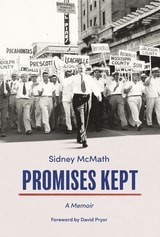
cover of Promises Kept: A Memoir

Promises Kept

A Memoir

Sidney S. McMath

University of Arkansas Press, 2003

Winner of the 2006 Booker Worthen Literary Prize and the 2004 Ragsdale Award

A dominating spirit of public service animated the life of Sidney Sanders McMath (1912–2003), the thirty-fourth governor of Arkansas. Promises Kept, completed and published when McMath was in his nineties, tells his story in his own words—from the piney hills of South Arkansas to the battlefields of World War II; through the human dramas of the courtroom to the marbled corridors of the State Capitol.

In Promises Kept, McMath recounts a rural upbringing that grounded him in the concerns of everyday Arkansans. He tells his life story through key milestones, including distinguished military service and a dramatic political rise to governor of Arkansas. During his four years in office, he pursued reform and modernization by expanding roads and electricity to rural areas, fighting the poll tax, building the state’s first medical center, opening Democratic primaries to Black voters, and standing with President Harry Truman in resisting the segregationist Dixiecrats. McMath’s political career ended amid unproven allegations tied to the highway program—charges he addresses directly here—and concludes with his return to the law, where landmark cases earned him honors.

Throughout, McMath reveals the excitement and the hard choices of real democracy, offering compelling human stories and a crucial perspective of a pivotal time in Arkansas history.
[more]
cover of Promotion of Social Awareness: Powerful Lessons for the Partnership of Developmental Theory and

Promotion of Social Awareness

Powerful Lessons for the Partnership of Developmental Theory and

Robert L. Selman

Russell Sage Foundation, 2003

Education specialists have written volumes on the best ways to help children learn to read and write, but who is helping them navigate the potentially treacherous waters of social interactions? While in school to study, children are also preoccupied with understanding the rules governing social relationships. Issues of trust and loyalty, rivalry and conflict, belonging and exclusion affect all school-aged children, but very few lesson plans include social development skills. The Promotion of Social Awareness summarizes thirty years of research on the social development of children in elementary and middle school, and shows how this work has led to a series of programs that promote the social competence of children and adolescents. Rich with lessons drawn from real life, the book includes an in-depth account of the author's partnership with an innovative program designed to help educators promote a sound ethic of social relationships among children, a case study of a teacher particularly gifted at promoting such relationships, and the tale of how the author's theoretical framework fared cross-culturally when exported to Iceland. The Promotion of Social Awareness documents Robert Selman's efforts both as a practitioner trying to help young people develop their interpersonal skills and as a researcher attempting to understand the factors that promote or hinder social development. Selman believes that getting along with others involves concrete and measurable social skills and actions that can be taught. The book underlines how the science of social development has given rise to initiatives and programs that can be used in educational settings to help children get along with each other, and may in the long run help prevent violence, drug abuse, and prejudice. Unique in its marriage of theory and practice, The Promotion of Social Awareness will appeal to a wide readership, including developmental psychologists, educators, and parents.
[more]
cover of Proofs of Genius: Collected Editions from the American Revolution to the Digital Age

Proofs of Genius

Collected Editions from the American Revolution to the Digital Age

Amanda Gailey

University of Michigan Press, 2015
Proofs of Genius: Collected Editions from the American Revolution to the Digital Age is the first extensive study of the collected edition as an editorial genre within American literary history. Unlike editions of an author’s “selected works” or thematic anthologies, which clearly indicate the presence of non-authorial editorial intervention, collected editions have typically been arranged to imply an unmediated documentary completeness. By design, the collected edition obscures its own role in shaping the cultural reception of the author.

In Proofs of Genius, Amanda Gailey argues that decisions to re-edit major authorial corpora are acts of canon-formation in miniature that indicate more foundational shifts in the way a culture views its literature and itself. By combining a theoretically-informed approach with a broad historical view of collected editions from the late eighteenth century to the present (including the rise of digital editions), Gailey fills a gap in the textual scholarship of the editing history of major figures like Emily Dickinson and Walt Whitman and of the American literary canon itself.
 
[more]
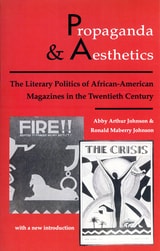
cover of Propaganda and Aesthetics: The Literary Politics of Afro-American Magazines in the Twentieth Century

Propaganda and Aesthetics

The Literary Politics of Afro-American Magazines in the Twentieth Century

Abby Arthur Johnson

University of Massachusetts Press, 1979

The literary materials in Afro-American magazines of the twentieth century weave into a rich narrative. The journals provide insight, not available in a comparable manner elsewhere, into the evolution of Afro-American literature. They trace the contributions made by major figures, including W.E.B. Du Bois, Langston Hughes, Charles S. Johnson, Alain Locke, and Richard Wright, among several others. They record the discussions over art and propaganda which have been long prominent in black literature. Decade by decade, black artists and intellectuals have debated the function of Afro-American literature: should it serve the aesthetic tastes of the individual writer, or should it advance the interests of Afro-Americans as a group. Some writers favored art-for-art's sake, or approximations of that emphasis; others articulated the need for art-for-people's sake, as they termed it.

Little work has been done on individual Afro-American periodicals and nothing, up to this point, has been published on twentieth-century black journals as a group. Studies of magazines in general are relatively rare, with only The Little Magazine, by Frederick Hoffman, Charles Allen, and Carolyn P. Ulrich, attempting a survey of small journals in this century. This book fills a considerable gap in literary history by detailing the development of Afro-American magazines in this century.

[more]
cover of Property Rules: Political Economy in Chicago, 1833-1872

Property Rules

Political Economy in Chicago, 1833-1872

Robin L. Einhorn

University of Chicago Press, 1991

In Property Rules, Robin L. Einhorn uses City Council records-previously thought destroyed-and census data to track the course of city government in Chicago, providing an important reinterpretation of the relationship between political and social structures in the nineteenth-century American city.

A Choice "Outstanding Academic Book"
"[A] masterful study of policy-making in Chicago."—Choice

"[A] major contribution to urban and political history. . . . [A]n excellent book."—Jeffrey S. Adler, American Historical Review

"[A]n enlightening trip. . . . Einhorn's foray helps make sense out of the transition from Jacksonian to Gilded Age politics on the local level. . . . [She] has staked out new ground that others would do well to explore."—Arnold R. Hirsch, American Journal of Legal History

"A well-documented and informative classic on urban politics."—Daniel W. Kwong, Law Books in Review

[more]
cover of Prophet, Pariah, and Pioneer: Walter W. Taylor and Dissension in American Archaeology

Prophet, Pariah, and Pioneer

Walter W. Taylor and Dissension in American Archaeology

Allan Maca

University Press of Colorado, 2026

In his 1948 work A Study of Archeology, recently minted Harvard Ph.D. Walter W. Taylor delivered the strongest and most substantial critique of American archaeology ever published. He created many enemies with his dissection of the research programs of America's leading scholars, who took it as a personal affront. Taylor subsequently saw his ideas co-opted, his research pushed to the margins, and his students punished. Publicly humiliated at the 1985 Society for American Archaeology meeting, he suffered ridicule until his death in 1997.

Nearly everyone in the archaeological community read Taylor's book at the time, and despite the negative reaction, many were influenced by it. Few young scholars dared to directly engage and build on his "conjunctive approach," yet his suggested methods nevertheless began to be adopted and countless present-day authors highlight his impact on the 1960s formation of the "New Archaeology."

In Prophet, Pariah, and Pioneer, peers, colleagues, and former students offer a critical consideration of Taylor's influence and legacy. Neither a festschrift nor a mere analysis of his work, the book presents an array of voices exploring Taylor and his influence, sociologically and intellectually, as well as the culture of American archaeology in the second half of the twentieth century.
[more]
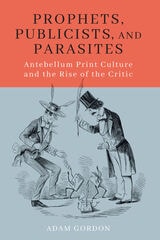
cover of Prophets, Publicists, and Parasites: Antebellum Print Culture and the Rise of the Critic

Prophets, Publicists, and Parasites

Antebellum Print Culture and the Rise of the Critic

Adam Gordon

University of Massachusetts Press, 2020

Print culture expanded significantly in the nineteenth century due to new print technologies and more efficient distribution methods, providing literary critics, who were alternately celebrated and reviled, with an ever-increasing number of venues to publish their work. Adam Gordon embraces the multiplicity of critique in the period from 1830 to 1860 by exploring the critical forms that emerged. Prophets, Publicists, and Parasites is organized around these sometimes chaotic and often generative forms and their most famous practitioners: Edgar Allan Poe and the magazine review; Ralph Waldo Emerson and the quarterly essay; Rufus Wilmot Griswold and the literary anthology; Margaret Fuller and the newspaper book review; and Frederick Douglass's editorial repurposing of criticism from other sources. Revealing the many and frequently competing uses of criticism beyond evaluation and aesthetics, this insightful study offers a new vision of antebellum criticism, a new model of critical history, and a powerful argument for the centrality of literary criticism to modern life.
[more]
cover of Proposed: The University of the United States

Proposed

The University of the United States

Edgar Wesley

University of Minnesota Press, 1936
Proposed: The University of the United States was first published in 1936. Minnesota Archive Editions uses digital technology to make long-unavailable books once again accessible, and are published unaltered from the original University of Minnesota Press editions.In Proposed: The University of the United States, Edgar Bruce Wesley claims that a reduction in the number of bureaucrats and special advisers to the government, and fewer “blunders of national proportions,” would result from the establishment of a national university in Washington.Such a university would be devoted entirely to graduate and research work. Exchange professors and visiting scholars would contribute to its services. Students would pay no tuition fees since the institution, founded and directed by the federal government, would be supported by taxation. It would be empowered to grant the usual graduate degrees and much of its work would be in the training of promising young people for government service and in carrying on “a continuous and inclusive program of social research.”The establishment of a national university is not a new idea, as Professor Wesley explains, but one that has been proposed by numerous educators and statesmen, including ten presidents of the United States. This book relates the history of the idea, presents arguments in favor of the establishment of such an institution, outlines a plan for its organization, and presents a specific bill for enactment by Congress.
[more]
cover of Prosperity For All?: The Economic Boom and African Americans

Prosperity For All?

The Economic Boom and African Americans

Robert Cherry

Russell Sage Foundation, 2000
With the nation enjoying a remarkable long and robust economic expansion, AfricanAmerican employment has risen to an all-time high. Does this good news refute the notion of a permanently disadvantaged black underclass, or has one type of disadvantage been replaced by another? Some economists fear that many newly employed minority workers will remain stuck in low-wage jobs, barred from better-paying, high skill jobs by their lack of educational opportunities and entrenched racial discrimination. Prosperity for All? draws upon the research and insights of respected economists to address these important issues. Prosperity for All? reveals that while African Americans benefit in many ways from a strong job market, serious problems remain. Research presented in this book shows that the ratio of black to white unemployment has actually increased over recent expansions. Even though African American men are currently less likely to leave the workforce, the number of those who do not find work at all has grown substantially, indicating that joblessness is now concentrated among the most alienated members of the population. Other chapters offer striking evidence that racial inequality is still pervasive. Among men, black high school dropouts have more difficulty finding work than their Latino or white counterparts. Likewise, the glass ceiling that limits minority access to higher paying promotions persists even in a strong economy. Prosperity for All? ascribes black disadvantage in the labor force to employer discrimination, particularly when there is strong competition for jobs. As one study illustrates, economic upswings do not appear to change racial preferences among employers, who remain less willing to hire African Americans for more skilled low-wage jobs. Prosperity for All? offers a timely investigation into the impact of strong labor markets on low-skill African-American workers, with important insights into the issues engendered by the weakening of federal assistance, job training, and affirmative action programs.
[more]
cover of Prospero's Son: Life, Books, Love, and Theater

Prospero's Son

Life, Books, Love, and Theater

Seth Lerer

University of Chicago Press, 2013

“This book is the record of a struggle between two temperaments, two consciousnesses and almost two epochs.” That’s how Edmund Gosse opened Father and Son, the classic 1907 book about his relationship with his father. Seth Lerer’s Prospero’s Son is, as fits our latter days, altogether more complicated, layered, and multivalent, but at its heart is that same problem: the fraught relationship between fathers and sons.
 
At the same time, Lerer’s memoir is about the power of books and theater, the excitement of stories in a young man’s life, and the transformative magic of words and performance. A flamboyantly performative father, a teacher and lifelong actor, comes to terms with his life as a gay man. A bookish boy becomes a professor of literature and an acclaimed expert on the very children’s books that set him on his path in the first place. And when that boy grows up, he learns how hard it is to be a father and how much books can, and cannot, instruct him. Throughout these intertwined accounts of changing selves, Lerer returns again and again to stories—the ways they teach us about discovery, deliverance, forgetting, and remembering.
 
“A child is a man in small letter,” wrote Bishop John Earle in the seventeenth century. “His father hath writ him as his own little story.” With Prospero’s Son, Seth Lerer acknowledges the author of his story while simultaneously reminding us that we all confront the blank page of life on our own, as authors of our lives.
[more]