Results by title
668 books match the query 'History & Surveys' and 76 start with p
Plotinus Ennead II.4
On Matter: Translation with an Introduction and CommentaryA.A. Long
Parmenides Publishing, 2022
Plotinus Ennead III.4
On Our Allotted Guardian Spirit: Translation with an Introduction and CommentaryWiebke-Marie Stock
Parmenides Publishing, 2020
The introduction offers an overview of ancient demonologies, starting with Homer and the Presocratics, and is followed by an in-depth examination of Plato, the Stoics, Plotinus, and later Neoplatonic developments. As such the book presents Plotinus’ specific rationalizing response to the idea of a guardian spirit in the context of ancient philosophical demonologies.
Plotinus Ennead V.8
On Intelligible Beauty: Translation with an Introduction and CommentaryAndrew Smith
Parmenides Publishing, 2017
Plotinus Ennead VI.9
On the Good or the One: Translation with an Introduction and CommentaryStephen R. L. Clark
Parmenides Publishing, 2020
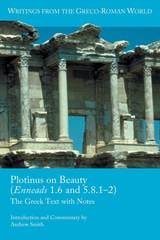
Plotinus on Beauty (Enneads 1.6 and 5.8.1–2)
The Greek Text with NotesAndrew Smith
SBL Press, 2019
A Greek edition of Plotinus's philosophical works with notes for students of Classical Greek
Plotinus, the father of Neoplatonism, composed the treatise On Beauty (Ennead 1.6) as the first of a series of philosophical essays devoted to interpreting and elucidating Platonic ideas. This treatise is one of the most accessible and influential of Plotinus's works, and it provides a stimulating entrée into the many facets of his philosophical activity. In this volume Andrew Smith first introduces readers to the Greek of Plotinus and to his philosophy in general, then provides the Greek text of and English notes on Plotinus's systematic argument and engaging exhortation to foster the inner self. The volume ends with the text of and notes on Plotinus's complementary statements in On Intelligible Beauty (Ennead 5.8.1–2).
Features:
- An overview of Plotinus's life
- Background discussion of Plotinus's thought and outline of his philosophical system
- Analysis of the relationship of Plotinus's thought to Plato’s
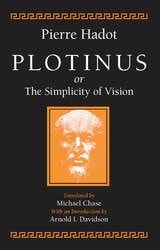
Plotinus or the Simplicity of Vision
Pierre Hadot
University of Chicago Press, 1993
Pierre Hadot's lively philosophical portrait of Plotinus is the preeminent introduction to the man and his thought. Michael Chase's lucid translation—complete with a useful chronology and analytical bibliography—at last makes this book available to the English-speaking world.
Hadot carefully examines Plotinus's views on the self, existence, love, virtue, gentleness, and solitude. He shows that Plotinus, like other philosophers of his day, believed that Plato and Aristotle had already articulated the essential truths; for him, the purpose of practicing philosophy was not to profess new truths but to engage in spiritual exercises so as to live philosophically. Seen in this light, Plotinus's counsel against fixation on the body and all earthly matters stemmed not from disgust or fear, but rather from his awareness of the negative effect that bodily preoccupation and material concern could have on spiritual exercises.
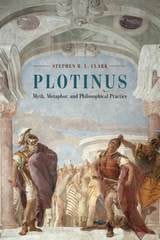
Plotinus
Myth, Metaphor, and Philosophical PracticeStephen R. L. Clark
University of Chicago Press, 2016
Clark examines a variety of Plotinus’s myths and metaphors within the cultural and philosophical context of his time, asking probing questions about their contemplative effects. What is it, for example, to “think away the spatiality” of material things? What state of mind is Plotinus recommending when he speaks of love, or drunkenness, or nakedness? What star-like consciousness is intended when he declares that we were once stars or are stars eternally? What does it mean to say that the soul goes around God? And how are we supposed to “bring the god in us back to the god in all”? Through these rich images and structures, Clark casts Plotinus as a philosopher deeply concerned with philosophy as a way of life.
Poetic Interaction
Language, Freedom, ReasonJohn McCumber
University of Chicago Press, 1989
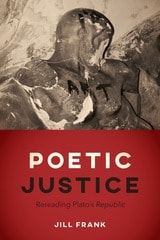
Poetic Justice
Rereading Plato's "Republic"Jill Frank
University of Chicago Press, 2018
With Poetic Justice, Jill Frank overturns the conventional view that the Republic endorses a hierarchical ascent to knowledge and the authoritarian politics associated with that philosophy. When learning to read is understood as the passive absorption of a teacher’s beliefs, this reflects the account of Platonic philosophy as authoritative knowledge wielded by philosopher kings who ruled the ideal city. When we learn to read by way of the method Socrates introduces in the Republic, Frank argues, we are offered an education in ethical and political self-governance, one that prompts citizens to challenge all claims to authority, including those of philosophy.
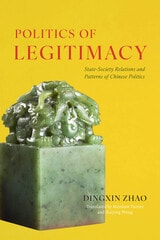
Politics of Legitimacy
State-Society Relations and Patterns of Chinese PoliticsDingxin Zhao
University of Chicago Press, 2026
The Chinese communist state has survived massive social changes, including the introduction of capitalist markets, an ongoing explosion of technological innovation, and an unprecedented jump in wealth and education, accompanied by a major cultural transformation. How has China managed to maintain its power even as the ground has so profoundly shifted? In Politics of Legitimacy, Dingxin Zhao argues that state power can be legitimized in three ideal-typical ways: a set of values upheld by the state (ideological legitimacy), recognized political processes such as regular competitive elections (procedural legitimacy), and the state’s capacity to provide public goods (performance legitimacy).
Building on this theoretical framework, Zhao analyzes different aspects of Chinese politics, including the tragic ending of the 1989 pro-democracy movement, the weak development of mass-based nationalism in post-Mao China, the reasons behind China’s economic success, the anti-establishment tendency of the Chinese mass media and social media, and the sources of political tension in China, despite a superb economy. Moreover, Zhao’s innovative framework is widely applicable beyond China, shifting our attention from regime-type categories to the tools and relationships that determine their survival or collapse, and illuminating the current global emergence of conservatism and religious nationalism.
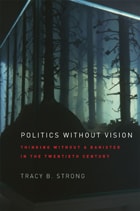
Politics without Vision
Thinking without a Banister in the Twentieth CenturyTracy B. Strong
University of Chicago Press, 2012
From Plato through the nineteenth century, the West could draw on comprehensive political visions to guide government and society. Now, for the first time in more than two thousand years, Tracy B. Strong contends, we have lost our foundational supports. In the words of Hannah Arendt, the state of political thought in the twentieth and twenty-first centuries has left us effectively “thinking without a banister.”
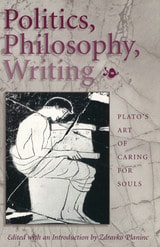
Politics, Philosophy, Writing
Plato's Art of Caring for SoulsEdited & Intro by Zdravko Planinc
University of Missouri Press, 2001
The leading scholars represented in Politics, Philosophy, Writing examine six key Platonic dialogues and the most important of the epistles, moving from Plato's most public or political writings to his most philosophical. The collection is intended to demonstrate the unity of Plato's concerns, the literary quality of his writing, and the integral relation of form and content in his work. Taken together, these essays show the consistency of Plato's understanding of the political art, the art of writing, and the philosophical life.
Studies emphasizing the unity of Plato's lifework have given way in recent scholarship to specialized and overspecialized examinations of individual dialogues. While each of the contributors to Politics, Philosophy, Writing studies one text, his or her work is oriented toward illuminating the whole of Plato's project. Each of the essays is an innovative contribution to scholarship on its topic; as a collection, they constitute a unique reading of Plato's political philosophy.
Plato scholars have generally divided themselves into two camps: those who concentrate on the analytic or logical aspects of the dialogues, and those who concentrate on the literary-critical features. In one camp are the philologists and classicists, and in the other, the writers of inventive interpretive commentaries. By avoiding distinctions between Plato the poet and Plato the philosopher, Politics, Philosophy, Writing allows a deeper exploration of the comprehensiveness of Plato's theoretical vision and illuminates the lasting challenge of his understanding of the human condition.
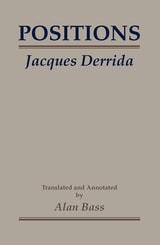
Positions
Jacques Derrida
University of Chicago Press, 1982
The interviews included in this volume offer a multifaceted view of Derrida. "Implications: Interview with Henri Ronse" contains a succinct statement of principles. "Seminology and Grammatology: Interview with Julia Kristeva" provides important clarifications of the role played by linguistics in Derrida's work. "Positions: Interview with Jean-Louis Houdebine and Guy Scarpetta" is a wide-ranging discussion that touches on many of the polemics that Derrida's work has provoked.
Alan Bass, whose translation of Writing and Difference was highly praised for its clarity, accuracy, and readability, has provided extremely useful critical notes, full of vital information, including historical background.
Postmodern Explained
Correspondence 1982-1985Jean-Fracois Lyotard
University of Minnesota Press, 1992
Postmodern Fables
Jean-Francois Lyotard
University of Minnesota Press, 1999

Postmodern Platos
Nietzsche, Heidegger, Gadamer, Strauss, DerridaCatherine H. Zuckert
University of Chicago Press, 1996
Poststructuralism and Critical Theory's Second Generation
Edited by Alan D. Schrift
University of Chicago Press, 2010
From Kant to Kierkegaard, from Hegel to Heidegger, continental philosophers have indelibly shaped the trajectory of Western thought since the eighteenth century. Although much has been written about these monumental thinkers, students and scholars lack a definitive guide to the entire scope of the continental tradition. The most comprehensive reference work to date, this eight-volume History of Continental Philosophy will both encapsulate the subject and reorient our understanding of it. Beginning with an overview of Kant’s philosophy and its initial reception, the History traces the evolution of continental philosophy through major figures as well as movements such as existentialism, phenomenology, hermeneutics, and poststructuralism. The final volume outlines the current state of the field, bringing the work of both historical and modern thinkers to bear on such contemporary topics as feminism, globalization, and the environment. Throughout, the volumes examine important philosophical figures and developments in their historical, political, and cultural contexts.
The first reference of its kind, A History of Continental Philosophy has been written and edited by internationally recognized experts with a commitment to explaining complex thinkers, texts, and movements in rigorous yet jargon-free essays suitable for both undergraduates and seasoned specialists. These volumes also elucidate ongoing debates about the nature of continental and analytic philosophy, surveying the distinctive, sometimes overlapping characteristics and approaches of each tradition. Featuring helpful overviews of major topics and plotting road maps to their underlying contexts, A History of Continental Philosophy is destined to be the resource of first and last resort for students and scholars alike.

Practice, Power, and Forms of Life
Sartre’s Appropriation of Hegel and MarxTerry Pinkard
University of Chicago Press, 2022
Jean-Paul Sartre’s Critique of Dialectical Reason, released to great fanfare in 1960, has since then receded in philosophical visibility. As Sartre’s reputation is now making a comeback, it is time for a reappraisal of his later work. In Practice, Power, and Forms of Life, philosopher Terry Pinkard interprets Sartre’s late work as a fundamental reworking of his earlier ideas, especially in terms of his understanding of the possibility of communal action as genuinely free, which the French philosopher had previously argued was impossible.
Pinkard reveals how Sartre was drawn back to Hegel, a move that was itself incited by Sartre’s newfound interest in Marxism. Pinkard argues that Sartre constructed a novel position on freedom that has yet to be adequately taken up and analyzed within philosophy and political theory. Through Sartre, Pinkard advances an argument that contributes to the history of philosophy as well as key debates on action and freedom.
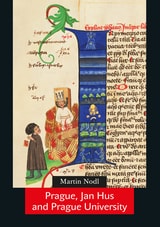
Prague, Jan Hus and Prague University
Martin Nodl
Karolinum Press, 2024
The Czech Reformation offered a radical solution to the spiritual and institutional crisis of the late medieval church at the end of the fourteenth century. The beginnings of this reform are distinctly connected with Prague University, which drew many educated people to Prague from across Europe. Through John Hus—a former Prague University student who became its rector in 1402—the Czech Reformation gave rise to a new, radical ecclesiology. Not only did Hus challenge the hierarchical system of the church, but under his influence, the Czech Reformation acquired a specific national shape, and elements of Czech messianism emerged with the university.
Prague, John Hus and Prague University explores that sentiment within Prague University, as well as its limits and restrictive consequences for the Czech Reformation and Czech medieval society. Emphasis is placed on showing how Prague and the university became a world that existed outside the Christian ecumenism of the time.
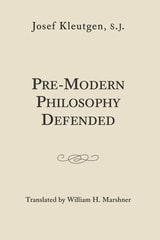
Pre-Modern Philosophy Defended
Josef Kleutgen
St. Augustine's Press, 2014
“Pre-modern philosophy” means the line of reflection that started with Plato andvAristotle, passed through Augustine and Boethius, and reached its acme in Aquinas, Scotus, and Suarez. The whole line was harshly judged by Descartes, then mocked by the empiricsts of the 18th Century. Why, then, did Pope Leo XII make a determined effort to revive it? And, more importantly, why was the revival a stunning success by the middle of the 20th Century?
The answers to both questions are found in a famous German book, Philosophie der Vorzeit by Josef Kleutgen, now available for the first time in English. Pre-ModernPhilosophy Defended shaped and strengthened Pope Leo’s resolve. It showed how inaccurate the harsh judgments had been and how sadly inferior the modern replacements from Descartes to Hegel had turned out to be in many respects.
Not in all. Kleutgen was no knee-jerk reactionary. He made no bones about the obsolete status of pre-Newtonian physics and cosmology. Rather, he focused on the central boast of “modern” thought, namely, that it had turned at least to the “subject” and had provided a long-needed thing called a “critique of knowledge.”
This book is must reading for intellectual historians and for philosophers working today in epistemology. But most of all, it is essential reading for laity and clergy concerned about revivals of modernism in the church. What was modernism, after all, but an attempt to make the Church revise her theology in the “light” of Kant or Hegel? This is why every Modernist knew Kleutgen’s name and hated this book.
Here is the first English translation (from the German) of the master work of Josef Kleutgen, the nineteenth century social philosopher whose thought lies at, or near, the heart of Catholic Social Thought. Kleutgen is widely and rightly seen as the shadow author of the social encyclicals of Leo XII. Leo’s Rerum Novarum remains the origin and constant reference point of all Catholic Social Teaching. And Popes since have dated their own social encyclicals from Rerum Novarum – hence, Quadragesimo anno and Centesimus annus. —Gerard V. Bradley, University of Notre Dame
Pre-Modern Philosophy Defended is must reading for intellectual historians and for philosophers working today in epistemology. And it is essential reading for laity and clergy concerned about revivals of modernism in the church. What was modernism, after all, but an attempt to make the Church revise her theology in the ‘light’ of Kant or Hegel? This is why every Modernist knew Kleutgen's name and hated Philosophie der Vorzeit (Pre-Modern Philosophy Defended).
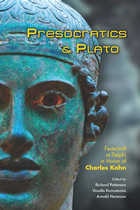
Presocratics and Plato
Festschrift at Delphi in Honor of Charles KahnRichard Patterson
Parmenides Publishing, 2012
Charles Kahn taught Classics and Philosophy at Columbia University from 1957 to 1965, and has since been teaching in the Philosophy Department of the University of Pennsylvania. He spent a year as Visiting Professor at the American School of Classical Studies in Athens, and had additional Visiting Fellowships at Balliol College, Oxford and Clare Hall, Cambridge, and a term as Visiting Professor at Harvard. He is the recipient of several prestigious research grants, from the American Council of Learned Societies (1963/64 and 1984/85), the National Endowment for the Humanities (1974/75 and 1990/91), and the Guggenheim Foundation (1979/80). In 2000 he was elected Fellow of the National Academy of Arts and Sciences. He is the author of Anaximander and the Origins of Greek Cosmology, The Verb “Be” in Ancient Greek, The Art and Thought of Heraclitus, Plato and the Socratic Dialogue, Pythagoras and the Pythagoreans, and Essays on Being. His latest book,Plato and the Post-Socratic Dialogue, is forthcoming from Cambridge University Press.
Sarah Broadie
Lesley Brown
Tomás Calvo-Martínez
Diskin Clay
John M. Dillon
Dorothea Frede
Arnold Hermann
Carl A. Huffman
Enrique Hülsz Piccone
D. M. Hutchinson
Paul Kalligas
Vassilis Karasmanis
Aryeh Kosman
Anthony A. Long
Richard McKirahan
Susan Sauvé Meyer
Alexander P.D.Mourelatos
Satoshi Ogihara
Richard Patterson
Christopher J. Rowe
David Sedley
Richard Sorabji
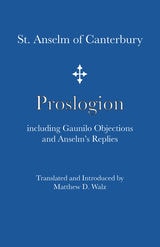
Proslogion
including Gaunilo Objections and Anselm's RepliesSt. Anselm of Canterbury
St. Augustine's Press, 2013
Written for his brother Benedictine monks around 1077, Anselm’s Proslogion is perhaps the best-known partially-read book of the Middle Ages. Many readers are familiar only with Anselm’s well-known argument for God’s existence in Chapters 2–4, which is often called the “ontological argument,” a misleading appellation coined centuries later by Immanuel Kant. In this argument Anselm begins with the thought of “something than which nothing greater is able to be thought,” and subsequently he leads the reader to see that such a reality necessarily exists and cannot be thought not to be. This argument – which is, to be sure, crucial to the work constitutes – but a small portion of the whole. Preceding it is a profound but oft-overlooked opening chapter in which Anselm contemplates his all-too-human condition and disposes the reader to receive aptly his argument for God’s existence in the next three chapters. And following this argument are 20 chapters in which Anselm artfully unfolds the depth and breadth of God’s true existence as that than which nothing greater is able to be thought, showing God to be (among other things) able-to-sense, pity-hearted, just, good, and uncircumscribed. Indeed, if the reader is willing to give himself over to the work as whole, he will be compelled, under Anselm’s deft guidance, to “endeavor to straighten up his mind toward contemplating God,” which is how Anselm describes his own role in the work in his prefatory remarks.
This edition provides a faithful yet readable English rendering of the whole Proslogion, the objections raised to Anselm’s argument by his contemporary Gaunilo, and Anselm’s replies to those objections. (After responding to Gaunilo, Anselm himself requested that these objections and replies be included in subsequent editions of the Proslogion.) This edition also includes an introduction that contextualizes the Proslogion within the monastic, pre-Scholastic age in which it first made its appearance. In addition, by means of notes and commentary, this edition articulates how to contextualize Anselm’s famous argument in the Proslogion as a whole and in light of his replies to Gaunilo, how to appreciate the artistry whereby Anselm knit the Proslogion together into a coherent and concise unity, and how the work may be taught effectively to interested students. These features set this affordable English edition of the Proslogion apart from those currently available, which too often fail to capture accurately the beauty of Anselm’s prose, which often treat the work through the lens of either later Scholasticism or contemporary analytic philosophy of religion, and which take little note of the craftsmanship whereby Anselm constructed this masterfully integrated work that is remembered too often for too few of its 24 chapters.
Matthew Walz has taught in the interdisciplinary program at Thomas Aquinas College in California, and since 2008 he has been a professor in the Philosophy Department of the University of Dallas.
Prospects for Natural Theology
Eugene Thomas Long
Catholic University of America Press, 2018
Published Essays, 1934-1939 (CW9)
Eric Voegelin, Edited & Intro by Thomas W. Heilke, & Translated by M. J. Hanak
University of Missouri Press, 2001
In this collection of essays, which covers the years from 1934 to1939, we see Eric Voegelin in the role of both scholar and public intellectual in Vienna until he was forced to flee the Nazi terror that descended on Austria in 1938. Revealing the broad spectrum of thinking and scientific study of this relatively young scholar, Voegelin's essays range from Austrian politics, Austrian constitutional history, and European racism to questions of the formation and expression of public opinion, theories of administrative law, and the role of political science in public university education. Several essays serve as useful commentaries on, elaborations of, or synopses of arguments Voegelin made in the five books he had published between 1928 and 1938.
Within these topical headings, there are multiple thematic threads that wind their way through these essays and that remain of interest to contemporary readers. Thirteen of the pieces contained in this collection are short items that Voegelin published in trade journals and newspapers, of which nine appeared in the Wiener Zeitung in 1934 and the Neue Freie Presse in 1937. In these we see two brief periods in which Voegelin played the role of public intellectual not only as a lecturer but also in print.
These essays will be of interest to a wide range of scholars, including constitutional historians, historians of political science, political theorists, and students of Voegelin's later work.
Published Essays, 1953-1965 (CW11)
Eric Voegelin & Edited & Intro by Ellis Sandoz
University of Missouri Press, 2000
The period covered by the material published in this volume marks the transition in Eric Voegelin's career from Louisiana to Munich. After twenty years in the United States, in 1958 Voegelin accepted an invitation to fill the political science chair at Ludwig Maximilian University, a position left vacant throughout the Nazi period and last occupied by the famous Max Weber, who had died in 1920.
The themes most prominent in the fourteen items reprinted here reflect the concerns of a transition, not only in a scholar's career, and in the momentous shifts in world politics taking place around him, but also in the development of his understanding of the stratification of reality and the attendant demands for a science of human affairs adequate to the challenges posed by the persistent crisis of the West in its latest configurations and by contemporary philosophy.
Several of the items herein originated as talks to a specific organization on problems facing German democratization and the development of a market economy amid the ruins of a fragmented culture and infrastructure in a society without historically evolved institutional supports for a satisfactory social and political order. Accordingly, pragmatic matters occupy a central place in a number of these pieces, especially the overriding question of how Germany could move from an illiberal and ideological political order into a modern liberal democratic one.
Those accustomed to the theoretical profundity of Voegelin's writings may find welcome relief in the down-to-earth, commonsensical drift of this material addressed, often, to laymen and businessmen. But, of course, the philosophical subject matter lurks everywhere. It finds full expression in several instances as the controlling context of even the least pretentious presentations. One of the attractions of these essays is what the author brings forward as serviceable elementary guideposts under adverse conditions of intellectual disarray, social decay, and turmoil.
Published Essays, 1966-1985 (CW12)
Eric Voegelin & Edited & Intro by Ellis Sandoz
University of Missouri Press, 0