3785 books match the query 'Poetry' and 203 start with p
cover of Photographing Eden: Poems

Photographing Eden

Poems

Jason Gray

Ohio University Press, 2008

Photographing Eden presents the first full-length collection of poems by a major new talent. The work meditates on several ideas, the crux of which is Eden: spirituality, environmentalism, and the relationships between men and women. Observing, often through the lens of a camera, our state in the world, the poems try to focus sharply on what often seems a blur. The poems are always attentive to artistic mediums and the craft behind them because our struggle is to make something perfect in the imperfect world in which we live, while acknowledging the impossibility of that quest. Gray’s poems range all over, from adventures in Egyptian ruins with machine-gun-toting tourist police to the western edge of the foggy Irish coastline, and to the mythic past, where Adam and Eve visit a zoo and Eden has become a nature preserve.

[more]
cover of Phyla of Joy

Phyla of Joy

Karen An-hwei Lee

Tupelo Press, 2012

“Karen An-hwei Lee’s third book is a beautiful and sustained meditation on the impermanence of humanity’s essential components: memory, spirituality, emotion, thought….Contemplative and linguistically sophisticated,Phyla of Joy is simply exquisite —‘ink and stanza / flow like wind on grass.’” — Rigoberto González

There’s an undeniable audacity in a poet using the word “joy” in our beleaguered world. In her new book, Karen An-hwei Lee combines scientific precision and an appetite for far-flung vocabularies with a fascination for the sources of rapturous emotion.

In poems that roam from the intimacy of prayer to the art of brewing tea, from bamboo-related famine to quasars, the globe’s minor seas, and the nuptial flight of ants, Phyla of Joy reaches toward ecstasy.

[more]
cover of Physics Envy: American Poetry and Science in the Cold War and After

Physics Envy

American Poetry and Science in the Cold War and After

Peter Middleton

University of Chicago Press, 2015

At the close of the Second World War, modernist poets found themselves in an increasingly scientific world, where natural and social sciences claimed exclusive rights to knowledge of both matter and mind. Following the overthrow of the Newtonian worldview and the recent, shocking displays of the power of the atom, physics led the way, with other disciplines often turning to the methods and discoveries of physics for inspiration.
           
In Physics Envy, Peter Middleton examines the influence of science, particularly physics, on American poetry since World War II. He focuses on such diverse poets as Charles Olson, Muriel Rukeyser, Amiri Baraka, and Rae Armantrout, among others, revealing how the methods and language of contemporary natural and social sciences—and even the discourse of the leading popular science magazine Scientific American—shaped their work. The relationship, at times, extended in the other direction as well: leading physicists such as Robert Oppenheimer, Werner Heisenberg, and Erwin Schrödinger were interested in whether poetry might help them explain the strangeness of the new, quantum world. Physics Envy is a history of science and poetry that shows how ultimately each serves to illuminate the other in its quest for the true nature of things.
[more]
cover of Piano in the Dark

Piano in the Dark

Nancy Naomi Carlson

Seagull Books, 2023

Poetry from an especially deft magician of words.
 
This latest book of wonders from Nancy Naomi Carlson fixes upon one of the few defenses we have to confront the body’s betrayals—our words. Though in the end, even the world’s last word “forgets its name . . . has no word for this forgetting.” At once vulnerable and open, tempered and tempted equally by the erotic and the empathic, such dualities limn these affectingly beautiful and lyrical poems. Carlson’s lines, entreating as Scheherazade, “weave chords / into tales within tales, whirlpools within seas” to save her life. Indeed, music has no need for voice or harp, as “in anechoic chambers, you become / the only instrument of your worldly sounds,” echoing Mozart’s credo “that music lies / in the silence between notes.” In a world scarred by pandemics, wars, and violent tribalism, the givens are gone—“talismans we clung to, believing / we might be spared in some way / by marking our doors / with our own sacrificial blood.” In these unflinching free and formal verse poems, Carlson seduces us with the promise of the joy yet to be had, were we to look in the right places.
 
[more]
cover of Picture Books for Children: Fiction, Folktales, and Poetry

Picture Books for Children

Fiction, Folktales, and Poetry

Mary Northrup

American Library Association, 2012
[more]
cover of Picturing Religious Experience: George Herbert, Calvin, and the Scriptures

Picturing Religious Experience

George Herbert, Calvin, and the Scriptures

Daniel Doerksen

University of Delaware Press, 2012

Little has been said about the relationship of Herbert’s writings to those of John Calvin, yet the latter were abundant and influential in Herbert’s Church of England. Accordingly Picturing Religious Experience studies Herbert’s poetry in relation to those writings, particularly regarding “spiritual conflicts,” which the poet himself said would be found depicted in his book of poems. Much more than is generally realized, Calvin wrote about the experience of living the Christian life—which is also Herbert’s subject in many of his poems. Altogether, this study maintains that Herbert owes to his religious orientation not just themes or details, but an impulse to observe and depict the inner life, and scriptural patterns which significantly contribute to the substance and literary excellence of The Temple.

Published by University of Delaware Press. Distributed worldwide by Rutgers University Press.
 
[more]
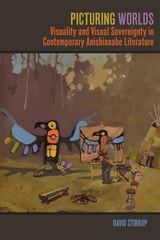
cover of Picturing Worlds: Visuality and Visual Sovereignty in Contemporary Anishinaabe Literature

Picturing Worlds

Visuality and Visual Sovereignty in Contemporary Anishinaabe Literature

David Stirrup

Michigan State University Press, 2020
Paying attention to the uses that Anishinaabe authors make of visual images and marks made on surfaces such as rock, bark, paper, and canvas, David Stirrup argues that such marks—whether ancient pictographs or contemporary paintings—intervene in artificial divisions like that separating precolonial/oral from postcontact/alphabetically literate societies. Examining the ways that writers including George Copway, Jane Johnston Schoolcraft, Gordon Henry, Louise Erdrich, Gerald Vizenor, and others deploy the visual establishes frameworks for continuity, resistance, and sovereignty in that space where conventional narratives of settlement read rupture. This book is a significant contribution to studies of the ways traditional forms of inscription support and amplify the oral tradition and in turn how both the method and aesthetic of inscription contribute to contemporary literary aesthetics and the politics of representation.
[more]
cover of Piers Plowan: The A Version, Revised Edition

Piers Plowan

The A Version, Revised Edition

William Langland

Catholic University of America Press, 2023
Passionate about trying to create social justice in a time of crisis after the Black Plague, William Langland spent his entire life working on Piers Plowman, an epic study of the human quest for truth, justice, and community. The "A Version," the first and shortest of the three versions he crafted, is wonderfully relatable and completely teachable to a modern student audience. Piers Plowman is becoming ever more relevant to students and scholars in English studies. Perhaps because the poem involves culture, religion, community, and work and engages explicitly with the histories of government and popular revolt, this allegorical tale of a wandering Christian named "Will," searching for truth with the aid of a humble plowman named Piers, has found new critical and pedagogic life in the last 20 years. Currently there are no translations of the A-version of Piers Plowman in print, so readers, scholars and teachers have been longing for an affordable, student-centered translation. The apparatus includes a 30-page historical and critical introduction, footnotes, a bibliography, a note on translation theory and practice, and samplings of the original text in Middle English, with a guide to pronunciation of that language. Piers Plowman is an extraordinary important document about the issues dramatically relevant to this day. It confronts poverty and inequity in 14th-century England and explores the need for virtue and social justice, encouraging its readers to create equality with open access for people of all classes and abilities. Though a Christian poem, Piers addresses issues of inclusivity, social responsibility and communal duty, as the poem’s protagonist wanders about the world, facing injustice and persecution as he looks for truth and salvation. Michael Calabrese, author of An Introduction to Piers Plowman and director of the Chaucer Studio’s Middle English recording of the poem, brings Piers Plowman to life for 21st-century students and for all readers interested in the history of society, virtue, faith and salvation.
[more]
cover of Piers Plowman: The A Version

Piers Plowman

The A Version

William Langland

Catholic University of America Press, 2020

Passionate about trying to create social justice in a time of crisis after the Black Plague, William Langland spent his entire life working on Piers Plowman, an epic study of the human quest for truth, justice, and community. The “A Version,” the first and shortest of the three versions he crafted, is wonderfully relatable and completely teachable to a modern student audience. Piers Plowman is becoming ever more relevant to students and scholars in English studies. Perhaps because the poem involves culture, religion, community, and work and engages explicitly with the histories of government and popular revolt, this allegorical tale of a wandering Christian named “Will,” searching for truth with the aid of a humble plowman named Piers, has found new critical and pedagogic life in the last 20 years. Currently there are no translations of the A-version of Piers Plowman in print, so readers, scholars and teachers have been longing for an affordable, student-centered translation. The apparatus includes a 30-page historical and critical introduction, footnotes, a bibliography, a note on translation theory and practice, and samplings of the original text in Middle English, with a guide to pronunciation of that language. Piers Plowman is an extraordinary important document about the issues dramatically relevant to this day. It confronts poverty and inequity in 14th-century England and explores the need for virtue and social justice, encouraging its readers to create equality with open access for people of all classes and abilities. Though a Christian poem, Piers addresses issues of inclusivity, social responsibility and communal duty, as the poem’s protagonist wanders about the world, facing injustice and persecution as he looks for truth and salvation. Michael Calabrese, author of An Introduction to Piers Plowman and director of the Chaucer Studio’s Middle English recording of the poem, brings Piers Plowman to life for 21st-century students and for all readers interested in the history of society, virtue, faith and salvation.
[more]
cover of Pine

Pine

Jonathan Johnson

Carnegie Mellon University Press, 2025

Poems that travel through time and terrain, seeking solace in the raw physicality of the world.

To grieve is to search. In Pine, Jonathan Johnson’s poems travel across continents: through Michigan’s Upper Peninsula, the Scottish Highlands, the Greek islands, and the mountain wildernesses of the American Northwest, seeking meaning in the spaces left behind. These poems embrace the raw physicality of place, uncovering the deep textures of the natural world as both a witness and companion to loss.

Amid the perpetual elegy of everything, Pine offers moments of improbable wonder. Johnson’s voice is steady and rich with narrative, guiding us through landscapes of memory and wilderness alike. In this intimate collection, grief and grace are intertwined, and the world—against all odds—goes on.
[more]
cover of Pinion

Pinion

Monica Rico

Four Way Books, 2024

“I / step into the kitchen because I can / no longer smell the lilac / bush my father cut down,” Monica Rico writes in the opening poem of her astonishing debut collection. Deeply invested in unearthing women’s identity from a patriarchal family structure, these pages catalog life beside loss, the truth of cruelty accompanied by a defiant vitality. Here, where the declaration “I can” is modified to “I can / no longer,” Rico untangles the paradox of love, how a persistent absence keeps the missing object present, asserting itself through grief and memory; the scent of lilac lingers precisely because we cannot smell it anymore. The dual meaning of "pinion" scaffolds this collection, which considers Rico's family and their experiences in the context of her grandparents' immigration to the USA from México, American racial capitalism, and the mass migration catalyzed and necessitated by Western colonialism. “Pinion” in noun form refers to a bird's outer flight feathers; in verb form, it means to bind or sever this part of the wing to hinder flight. Bound up in this word, then, is a thing and its destruction — a possibility and a thwarted hope side by side. Rico creates her own motifs to write a representative genealogy, approaching her family as an ornithologist: across poems, her grandfather (who worked at General Motors) appears as an owl, her grandmother figures as a robin, and the American project shows up in the eagle's warped beak and surveilling eye. A field work of restoration, these poems compose a personal history and a deconstruction of global capitalism as articulated through an encyclopedia of birds. From the chaos of our flawed world, Rico salvages an enduring hope, reminding us that “a broken / song like an ugly duckling isn’t ugly / but unique, and stands out like the flightless / dodo who trusts because it is too awful not to.” 
[more]
cover of Pink Waves

Pink Waves

Sawako Nakayasu

Omnidawn, 2021

A poem in conversation with literature and written during a durational performance.
 
Written in loose sonata form, Pink Waves is a poem of radiant elegy and quiet protest. Moving through the shifting surfaces of inarticulable loss, and along the edges of darkness and sadness, Pink Waves was completed in the presence of audience members over the course of a three-day durational performance. Sawako Nakayasu accrues lines written in conversation with Waveform by Amber DiPietro and Denise Leto, and micro-translations of syntax in the Black Dada Reader by Adam Pendleton, itself drawn from Ron Silliman’s Ketjak. Pink Waves holds an amalgamation of texts, constructing a shimmering haunting of tenderness, hunger, and detritus.

 
[more]
cover of Pitch Dark Anarchy: Poems

Pitch Dark Anarchy

Poems

Randall Horton

Northwestern University Press, 2013

Pitch Dark Anarchy investigates the danger of one single narrative with multilayered poems that challenge concepts of beauty and image, race and identity, as well as the construction of skin color. Through African American memory and moments in literature, the poems seek to disrupt and dismantle foundations that create erasures and echoes of the unremembered. Pitch Dark Anarchy uses the slave revolt of the Amistad as a starting point, a metaphor for "opposition" and "against." These themes run through the very core for the book while drawing on inventive and playful language. The poems bring to life human experiences and conditions created by an "elite" society. In these poems, locations and landscapes are always shifting, proving that our shared experiences can be interchangeable. At the very core of Pitch Dark Anarchy is a seven-part poem based on the artist Margret Bowland’s "Another Thorny Crown Series," which are paintings of an African American girl in white face.

Through innovative formal and visual techniques, such as fractured syntax and typographical disruption, Horton evokes the disorienting experiences of urban life, while also calling into question the complicity of language in the oppressive structures he anatomizes.
 
[more]
cover of Pitch of Poetry

Pitch of Poetry

Charles Bernstein

University of Chicago Press, 2016

Praised in recent years as a “calculating, improvisatory, essential poet” by Daisy Fried in the New York Times, Charles Bernstein is a leading voice in American literary theory. Pitch of Poetry is his irreverent guide to modernist and contemporary poetics.

Subjects range across Holocaust representation, Occupy Wall Street, and the figurative nature of abstract art. Detailed overviews of formally inventive work include essays on—or “pitches” for—a set of key poets, from Gertrude Stein and Robert Creeley to John Ashbery, Barbara Guest, Larry Eigner, and Leslie Scalapino. Bernstein also reveals the formative ideas behind the magazine L=A=N=G=U=A=G=E. The final section, published here for the first time, is a sweeping work on the poetics of stigma, perversity, and disability that is rooted in the thinking of Edgar Allan Poe, Emily Dickinson, Ralph Waldo Emerson, and William Blake.

Pitch of Poetry makes an exhilarating case for what Bernstein calls echopoetics: a poetry of call and response, reason and imagination, disfiguration and refiguration.
[more]
cover of Pitfalls of Prestige: Black Women and Literary Recognition

Pitfalls of Prestige

Black Women and Literary Recognition

Laura Elizabeth Vrana

The Ohio State University Press, 2024

Winner, 2025 College Language Association Book Award

From 1987, when Rita Dove won the Pulitzer Prize for Poetry, to 2021, when Amanda Gorman skyrocketed to celebrity status after performing during Biden’s inauguration and the Super Bowl, Black women have seemingly attained secure, stable positions at the forefront of American poetry. But this prominence comes at a price. As figures like Dove and Elizabeth Alexander have become well known, receiving endorsements and gaining visible platforms from major prizes, academic institutions, and publishing houses, the underlying terms of evaluation that greet Black women’s poetics often remain superficial, reflecting efforts to co-opt and contain rather than meaningfully consider new voices and styles. In Pitfalls of Prestige, Laura Elizabeth Vrana surveys how developments in American literary institutions since 1980 have shaped—and been shaped by—Black women poets. Grappling with the refulgent works of the most acclaimed contemporary figures alongside those of lesser-known poets, Vrana both elucidates how seeming gestures of inclusion can actually result in constraining Black women poets’ works and also celebrates how these writers draw on a rich lineage and forge alternative communities in order to craft continually innovative modes of transgressing such limits, on the page and in life.

[more]
cover of Pittsburghese

Pittsburghese

Robert Gibb

Michigan State University Press, 2024
Pittsburghese, Robert Gibb’s latest book of poems, is a work of poignant remembrance, filled with revelations found in the everyday “debris of paradise.” The collection is anchored by personal and public histories, the city’s “consensus things” and “standard archaeologies,” as well as by music—jazz, blues, R&B and gospel—“sweet rebuttal” to the world’s “cold hymns.” Throughout, motifs function like the thorns on the jaggers—Pittsburghese for brambles—whose points engage the reader “one by one.” Other poems elegize the great buildings and working stiffs of the city’s industrial past, celebrating its artifacts and artworks, the “necessary mystery” of its trees and wild creatures. Particulars of a world in which dialect is the alembic, the means of expression and the shapes it takes on as well—habitation and name.
[more]
cover of Pivotal Voices, Era of Transition: Toward a 21st Century Poetics

Pivotal Voices, Era of Transition

Toward a 21st Century Poetics

Rigoberto González

University of Michigan Press, 2017

Pivotal Voices, Era of Transition gathers Rigoberto González’s most important essays and book reviews, many of which consider the work of emerging poets whose identities and political positions are transforming what readers expect from contemporary poetry. A number of these voices represent intersectional communities, such as queer writers of color like Natalie Díaz, Danez Smith, Ocean Vuong, and Eduardo C. Corral, and many writers, such as Carmen Giménez Smith and David Tomás Martínez, have deep connections to their Latino communities. Collectively, these writers are enriching American poetry to reflect a more diverse, panoramic, and socially conscious literary landscape. Also featured are essays on the poets’ literary ancestors—including Juan Felipe Herrera, Alurista, and Francisco X. Alarcón—and speeches that address the need to leverage poetry as agency.

This book fills a glaring gap in existing poetry scholarship by focusing exclusively on writers of color, and particularly on Latino poetry. González makes important observations about the relevance, urgency, and exquisite craft of the work coming from writers who represent marginalized communities. His insightful connections between the Latino, African American, Asian American, and Native American literatures persuasively position them as a collective movement critiquing, challenging, and reorienting the direction of American poetry with their nuanced and politicized verse. González’s inclusive vision covers a wide landscape of writers, opening literary doors for sexual and ethnic minorities.

 
[more]
cover of Places in the Making: A Cultural Geography of American Poetry

Places in the Making

A Cultural Geography of American Poetry

Jim Cocola

University of Iowa Press, 2016

Places in the Making maps a range of twentieth- and twenty-first century American poets who have used language to evoke the world at various scales. Distinct from related traditions including landscape poetry, nature poetry, and pastoral poetry—which tend toward more idealized and transcendent lyric registers—this study traces a poetics centered upon more particular and situated engagements with actual places and spaces. Close generic predecessors of this mode, such as topographical poetry and loco-descriptive poetry, folded themselves into the various regionalist traditions of the late-nineteenth and early-twentieth centuries, but place making in modern and contemporary American poetics has extended beyond its immediate environs, unfolding at the juncture of the proximate and the remote, and establishing transnational, planetary, and cosmic formations in the process. Turning to geography as an interdisciplinary point of departure, Places in the Making distinguishes itself by taking a comparative and multiethnic approach, considering the relationship between identity and emplacement among a more representative demographic cross-section of Americans, and extending its inquiry beyond national borders.

Positing place as a pivotal axis of identification and heralding emplacement as a crucial model for cultural, intellectual, and political activity in a period marked and imperiled by a tendency toward dislocation, the critical vocabulary of this project centers upon the work of place-making. It attends to a poetics that extends beyond epic and lyric modes while relying simultaneously on auditory and visual effects and proceeding in the interests of environmental advocacy and social justice, often in contrast to the more orthodox concerns of literary modernism, global capitalism, and print culture. Focusing on poets of international reputation, such as Elizabeth Bishop, Pablo Neruda, Charles Olson, and William Carlos Williams, Places in the Making also considers work by more recent figures, including Kamau Brathwaite, Joy Harjo, Myung Mi Kim, and Craig Santos Perez. In its larger comparative, multiethnic, and transnational emphases, this book addresses questions of particular moment in American literary and cultural studies and aspires to serve as a catalyst for further interdisciplinary work connecting geography and the humanities. 

[more]
cover of Places/Everyone

Places/Everyone

Jim Daniels

University of Wisconsin Press, 1985

    Jim Daniels, in his first book of poems, draws upon his experiences in living and working in his native Detroit to present a start, realistic picture of urban, blue-collar life.  Daniels, his brothers, his father, and his grandfather have all worked in the auto industry, and that background seeps into nearly all these poems.
    The first of the book’s three sections sketches out this background, then moves into a neighborhood full of people whose lives are so linked to the ups and downs of the auto industry that they have to struggle to find their own lives; in "Still Lives in Detroit, #2," Daniels writes, "There’s a man in this picture.  / No one can find him."  The second section contains the "Digger" poems, a series on the lives of a Detroit auto worker and his family which tries to capture the effects of the work on life outside the factory.  Here, we listen to Digger think, dream, wander on psychological journeys while he moves through his routines, shoveling the snow, mowing the lawn, and so forth.  In section three, the poems move into the workplace, whether that be a liquor store, a hamburger joint, or a factory.
    These poems, sometimes dark, sometimes humorous, concentrate on the efforts of workers to rise above the often depressing work of blue-collar or minimum-wage jobs, to salvage some pride and dignity.  The poems in this book try to give a voice to those who are often shut out of poetry.  They are important.  These lives are important, and the poems, more than anything, say that.
[more]
cover of Planned Solstice

Planned Solstice

David Micah Greenberg

University of Iowa Press, 2003

In David Greenberg's Planned Solstice, the natural and material worlds are provocatively juxtaposed, so as to affirm serious explorations of our place within them. Greenberg's considerations are vast, invigorating, and challenging; his poems take on charged historical and political subjects—civil wars at home and abroad, the World Trade Center's destruction, issues of race and difference—and handle them with utter aplomb and freshness.

These poems move from imagistic inquiry toward political coherence and a sense of divided place. The book's four-part structure also echoes seasonal change and seeks among extreme—solstice-like—experiences the hope that separate lives may speak to one another. Throughout, images of contested growth, natural and human, ask the reader to see what is both organic and structural in settings of consciousness, space, and politics—to find what is free and what is also formed by consequence. Greenberg's are not facile pronouncements; they come to us after such rigorous deliberation, such painstaking examination, that they cannot but carry a hint of the oracular about them.

The poems in Planned Solstice should be read, re-read, and re-read again, as they yield a new crop, “a decision of field,"”every time one dares to venture in

[more]
cover of Planted by the Signs: Poems

Planted by the Signs

Poems

Misty Skaggs

Ohio University Press, 2019

Planted by the Signs brings us the contemporary Appalachian poetry—cultivated in the dirt of Elliott County, Kentucky—of Misty Skaggs. With an eye for details that exquisitely balance personal and social observation to communicate volumes, she tells the stories of generations of women who have learned to navigate a harsh world with a little help from the Farmers’ Almanac and the stars. The collection is separated into three sections that reference the best times to grow and harvest. Knowing and following these guidelines—planting by the signs—could mean the difference between prosperity and tragedy in the lives of Appalachian families.

Personal, political, and passionate, Planted by the Signs also explores what it means for Skaggs to care for her great-grandmother at the end of her life. Color photos by the poet further showcase her sidelong and fierce outlook. The images and poems together deliver an intimate look into the day-to-day reality of a backwoods woman embracing barefooted radicalism in the only place she could call home.
[more]
cover of Plash & Levitation

Plash & Levitation

Adam Tavel

University of Alaska Press, 2015
Plash & Levitation delves into the chaotic sublime of fatherhood, the candid revelations of youth, and the lingering consequences of history. Adam Tavel’s revealing and imaginative poems are joined by fictional monologues from historical figures and cultural icons, juxtaposing personal history with our shared one. Civil War general William Tecumseh Sherman and rock legend Keith Moon are joined by musings from the Redskins logo and the Wolfman. Together they create a lively chorus that clashes and soars. The result is forty-two fascinating pieces that are witty, consistently musical, and undeniably powerful—the perfect inaugural selection for the Permafrost Book Prize.
[more]
cover of Plato through Homer: Poetry and Philosophy in the Cosmological Dialogues

Plato through Homer

Poetry and Philosophy in the Cosmological Dialogues

Zdravko Planinc

University of Missouri Press, 2003

This new study challenges traditional ways of reading Plato by showing that his philosophy and political theory cannot be understood apart from a consideration of the literary or aesthetic features of his writing. More specifically, it shows how Plato’s well-known cosmological dialogues—the Phaedrus, Timaeus, and Critias—are structured using several books of the Odyssey as their shared source text.
While there has recently been much scholarly discussion of the relation between poetry and philosophy in Plato’s dialogues, little of it addresses questions central to thoroughgoing literary criticism. Planinc’s work is unique in that it shows the significance of Plato’s extensive refiguring of key episodes in the Odyssey for an interpretation of his political philosophy.
Plato’s cosmological dialogues are almost always discussed topically. The Timaeus is picked through for its theological or scientific doctrines; the Critias is reduced to its Atlantis story, or puzzled over because of its ostensible incompleteness; and the Phaedrus is read for its parallels to modern understandings of erotics or rhetoric. The dialogues are not usually considered in relation to one another, and then only in the context of developmental schemes primarily concerned with distinguishing periods in Plato’s metaphysical doctrines.
Planinc argues that the main literary features of the Phaedrus,Timaeus, and Critias are taken from books 6 to 9 of the Odyssey, the largest part of the story of Odysseus’s stay with the Phaeacians, from the time he swims to shore and encounters Nausicaa to the time he reveals his identity and begins recounting his earlier travels after hearing Demodocus’s songs. By exploring the full range of the many charming and intriguing things the dialogues present in this literary context, he shows that they are a coherent, unified part of Plato’s corpus.
Plato through Homer takes a radically new approach to Plato’s texts that illuminates their literary and philosophic significance and highlights their enduring appeal.
[more]
cover of Plato's Breath

Plato's Breath

Randall R. Freisinger

Utah State University Press, 1997

Freisinger's new poetry collection is inhabited alike by bright, tangible images and thoughtful, intricate meditations. Pumpkins, poultry houses, sperm tests, a vacuum cleaner salesman, a father's damaged brain, an anatomist's tools, a baby falling from a fourth-story window-all of these come to the page distinct and palpable. At the same time, the work finds a central inspiration in theoretical work like Jeremy Rifkin's social criticism. Poetry of both the mind and the heart, Plato's Breath embraces the power of imagination to transform the ordinary into an extraordinary affirmation of life.

[more]
cover of PlayHouse: Poems

PlayHouse

Poems

Jorrell Watkins

Northwestern University Press, 2024

Poems on Black joy, masculinity, and the music that transforms a space into a home
 
Jorrell Watkins's debut poetry collection is a polyvocal, musically charged disruption of the United States's fixation on drug and gun culture. The poems in Play|House embody many identities, including son, brother, fugitive, bluesman, karate practitioner, and witness. Throughout, Watkins inflects a Black/trap vernacular that defamiliarizes the urban Southern landscape. Across three sections of poetry scored by hip-hop, blues, and trap, Watkins considers how music is a dwelling and wonders which histories, memories, and people haunt each home. Past figures such as John Coltrane, Billie Holiday, and the short-lived 1940s trio Day, Dawn & Dusk intermingle with Migos, the Watkins family, childhood friends, and loved ones both parted and departed. At its core, Play|House reckons with the truths and failures of masculinity for Black boys and men, all the while documenting moments of triumphant Black joy and love.
[more]
cover of Playful Song Called Beautiful

Playful Song Called Beautiful

John Blair

University of Iowa Press, 2016

Playful Song Called Beautiful ranges far into the intersections of faith and scientific thought, places where “there is no stranger who is / stranger than you, no / familiar who’s more / familiar.” In poems that are either formally rhymed and metered or written in syllabically structured three-line stanzas, Blair wanders among universal orders and failures of desire, where the unlikeliness of any of us being who we are, what we are, where we are forces us to consider—and reconsider—the possibilities of belief and meaning. Blair’s poems are elegant and earthy, sometimes profane, and sometimes lovingly playful.

From the invisible landscape of elementary particles to Johann Wolfgang Von Goethe’s love of the smell of rotten apples, Blair’s poems direct us through a “great wide world that is / ours and never ours” and somewhere among the rolling tercets, the transcendent becomes not only possible, but entirely inevitable. 
[more]
cover of Please

Please

Jericho Brown

New Issues Poetry and Prose, 2008
Please explores the points in our lives at which love and violence intersect. Drunk on its own rhythms and full of imaginative and often frightening imagery, Please is the album playing in the background of the history and culture that surround African American/male identity and sexuality. Just as radio favorites like Marvin Gaye, Donny Hathaway, and Pink Floyd characterize loss, loneliness, addiction, and denial with their voices, these poems’ chorus of speakers transform moments of intimacy and humor into spontaneous music. In Please, Jericho Brown sings the influence soul culture has on American life with the accuracy of the blues.
[more]
cover of Please Bury Me in This

Please Bury Me in This

Allison Benis White

Four Way Books, 2017

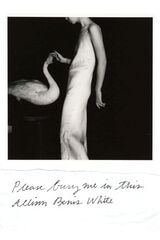
The speaker in Please Bury Me in This grieves the death of her father and the loss of several women to suicide while contemplating her own death and the nature of language as a means of human connection that transcends our temporal lives. This book is also concerned with the intergenerational trauma of the children of Holocaust survivors.
[more]
cover of Pocket Sundial

Pocket Sundial

Lisa Zeidner

University of Wisconsin Press, 1988

In this, the fourth volume to win the Brittingham Prize in Poetry, Lisa Zeidner’s twenty-two poems introduce a surprising range of characters, from a cryogenically preserved caveman to a 78-year-old widow arrested for shoplifting. Some of the narratives collected here are unusually long (like “Dementia Colander,” a mock-epic about the history of an unnamed nation whose king suffers a rare disease). These poems attempt to offer not just poetic moments, glimpses of joy or loss, but a sense of self in time and history—whole lives in all of their busy-ness and disorder. Lisa Zeidner’s dark wit considers any subject, from the Holocaust to child abuse, a subject for intellectual playfulness and emotional discovery.
    Despite the range of subjects, the poems in Pocket Sundial are bound by a concern for time, for how we think about time. These are poems about memory, foresight, anticipation, regret—all of chronology’s complexities.
[more]
cover of Poem Containing History: Textual Studies in The Cantos

Poem Containing History

Textual Studies in The Cantos

Lawrence S. Rainey, Editor

University of Michigan Press, 1997
No poet of the twentieth century has aroused more controversy than Ezra Pound, and no work by him has seemed more important or more problematic than The Cantos. A Poem Containing History offers nine new essays that examine Pound's major poem from a historical and contextual perspective, in which the work's textual development is brought to center stage. The result is a significant reconsideration not just of Pound's achievement, but of modernist poetics and its relations with history.The contributors, all major scholars, examine The Cantos from their beginnings in the late 1910s to their inconclusive ending with Pound's death in 1972. Together the essays reconstruct the many contexts in which Pound lived and wrote, and how these affected the evolution of his most important work. Several essays offer comprehensive surveys of the text's publication history, while most examine the development of particular groups of cantos that were produced in succeeding decades. Repeatedly the essays show that Pound's poem was an unstable work in process, one that readily accommodated input from a variety of agents other than Pound himself, and one that may ultimately have escaped his control altogether. This book will appeal to readers interested in modern poetry and twentieth-century history.
[more]
cover of Poems

Poems

François Villon

Northwestern University Press, 2012

One of the most original and influential European poets of the Middle Ages, François Villon took his inspiration from the streets, taverns, and jails of Paris. Villon was a subversive voice speaking from the margins of society. He wrote about love and sex, money trouble, "the thieving rich," and the consolations of good food and wine. His work is striking in its directness, wit, and gritty urban realism. Villon’s writing spurred the development of the psychologically complex first-person voice in lyric poetry. He has influenced generations of avant-garde poets and artists. Arthur Rimbaud and Paul Verlaine have emulated Villon’s poetry. Claude Debussy set it to music, and Bertolt Brecht adapted it for the stage. Ezra Pound championed Villon’s poetry and became largely responsible for its impact on modern verse. With David Georgi’s ingenious translation, English-speaking audiences finally have a text that captures the riotous energy and wordplay of the original. With a newly revised French text that reflects the latest scholarship, this bilingual edition also features inviting and informative notes that illuminate the nuances of Villon’s poems and the world of medieval Paris.


[more]
cover of Poems Old & New 1918-1978

Poems Old & New 1918-1978

Janet Lewis

Ohio University Press, 1981

Kenneth Rexroth wrote: “Janet Lewis uses reason to veil and adorn the flesh of feeling and intuition. This is the way the greatest poetry has always been written.”

The poems in this collection range over a period of 60 years. The style is spare, direct, cutting to the core of subject. Richness of intelligence and a concern for the human has also characterized every phase of Lewis’ development.
[more]
cover of Poems Talking to Poems: Setting Your Poetry Manuscript Apart

Poems Talking to Poems

Setting Your Poetry Manuscript Apart

Edited by Jeffrey Levine and Kristina Marie Darling

Tupelo Press, 2025

This handbook demystifies the process of crafting a full-length poetry collection. 

Poems Talking to Poems presents practical guidance for sequencing, structure and architecture, revision, and choosing titles for sections as well as the poetry manuscript as a whole. This guide also includes insider tips about how contests work, the literary marketplace, and how you can set your work apart. 

With essays by such literary luminaries as Ilya Kaminsky, Katie Farris, Kristina Marie Darling, Jeffrey Levine, and many other distinguished contributors, this anthology is a concise and comprehensive field guide to perfecting your book and getting it into print.
 
[more]
cover of Poems While We Dream: Sonnets and Songs

Poems While We Dream

Sonnets and Songs

Roger Armbrust

Parkhurst Brothers, Inc., 2021

Armbrust writes sonnets on a variety of themes, primarily addressed to his muse and his lovers. Since 1979, when his first book of poetry went to press, he continues to write, as if he opens a vein to pour his own blood onto the page to do it.
[more]
cover of Poems and Fancies with The Animal Parliament

Poems and Fancies with The Animal Parliament

Margaret Cavendish, Duchess of Newcastle

Iter Press, 2018

Margaret Cavendish released her Poems and Fancies during a brief reprieve from exile, and at a time when international conversations on questions regarding science, mathematics, and metaphysics significantly advanced the state of knowledge across Britain and Europe despite war and political turmoil. This volume offers the first complete modernized version of the third edition of Cavendish’s book, including prefaces and dedications, all 274 poems on nature’s various avatars, interludes and masques, and the final prose parable, The Animal Parliament. Cavendish offers views on physics, chemistry, algebraic geometry, medicine, political philosophy, ethics, psychology, and animal intelligence, as she develops her own theory of vital matter within the scope of nature’s ordering principles.

The Other Voice in Early Modern Europe. The Toronto Series: Volume 64

[more]
cover of Poems and Meditations

Poems and Meditations

Anne Bradstreet

Iter Press, 2019
This volume presents all the surviving writings of the poet Anne Bradstreet (ca. 1612–1672): the poems published during her lifetime in The Tenth Muse Lately Sprung Up in America; or, Several Poems (London, 1650), poems added to the posthumous edition of Bradstreet’s Several Poems (Boston, 1678), and the material in her hand and that of her son preserved in a manuscript volume known as the Andover manuscript. Extensive footnotes illuminate Bradstreet’s broad reading in the medical, scientific, and historical literature of her day, as well as her interest in recent and current English history and politics.
[more]
cover of Poems and Prose: A Bilingual Edition

Poems and Prose

A Bilingual Edition

Georg Trakl, translated from the German and with an introduction by Alexander Stillmark

Northwestern University Press, 2005

A comprehensive English-language edition of verse by the Austrian poet

An undeniable aura surrounds the name of Georg Trakl, a poet of intense inner vision and originality whose work stands alongside that of Yeats, Valéry, and T. S. Eliot. Besides Rilke, his more famous admirers include Karl Kraus and Martin Heidegger. The distinctive tone of Trakl's work-especially admired by his patron Ludwig Wittgenstein-is autumnal and melancholy. Trakl was writing at a time of spiritual and social disintegration on the eve of the First World War, when personal values and perceptions tended to be subsumed in a more generalized anguish and exaltation. Neo-romantic, early modernist, his rich, vitally sensuous poetry can be seen to mark the transition from impressionism to expressionism, but at the same time transcends such categories. Trakl's poetry has previously only been available in English in short selections or in anthologies. This bilingual edition, the most comprehensive to date, gives readers the chance to get to know Trakl's work more fully than ever before.
 

[more]
cover of Poems and Selected Letters

Poems and Selected Letters

Veronica Franco

University of Chicago Press, 1998

Veronica Franco (whose life is featured in the motion picture Dangerous Beauty) was a sixteenth-century Venetian beauty, poet, and protofeminist. This collection captures the frank eroticism and impressive eloquence that set her apart from the chaste, silent woman prescribed by Renaissance gender ideology.

As an "honored courtesan", Franco made her living by arranging to have sexual relations, for a high fee, with the elite of Venice and the many travelers—merchants, ambassadors, even kings—who passed through the city. Courtesans needed to be beautiful, sophisticated in their dress and manners, and elegant, cultivated conversationalists. Exempt from many of the social and educational restrictions placed on women of the Venetian patrician class, Franco used her position to recast "virtue" as "intellectual integrity," offering wit and refinement in return for patronage and a place in public life.

Franco became a writer by allying herself with distinguished men at the center of her city's culture, particularly in the informal meetings of a literary salon at the home of Domenico Venier, the oldest member of a noble family and a former Venetian senator. Through Venier's protection and her own determination, Franco published work in which she defended her fellow courtesans, speaking out against their mistreatment by men and criticizing the subordination of women in general. Venier also provided literary counsel when she responded to insulting attacks written by the male Venetian poet Maffio Venier.

Franco's insight into the power conflicts between men and women and her awareness of the threat she posed to her male contemporaries make her life and work pertinent today.


[more]
cover of Poems by a Sixteenth-Century Gentlewoman, Maid, and Servant

Poems by a Sixteenth-Century Gentlewoman, Maid, and Servant

Isabella Whitney

Iter Press, 2023

A collection of poems by the first English woman to publish secular poetry under her own name.

Isabella Whitney (c. 1547–after 1624) was the first English woman to publish original secular poetry under her own name. She published two poetic miscellanies of poems: The Copy of a Letter (1567) and A Sweet Nosegay (1573), which include her own work as well as a total of six poems by five different male authors. This edition of her writings prints modernized texts of the complete miscellanies and adds to them six poems attributed to Whitney by largely twentieth-century critics. These poems provide a rich portrait of sixteenth-century female courtship and its dangers, a unique view of class and gender in Whitney’s lifetime, and a portrait of London as a burgeoning market of practical goods and luxury items from foodstuffs to imported silk.
 
[more]
cover of Poems from Captured Documents: A Bilingual Edition

Poems from Captured Documents

A Bilingual Edition

Thanh T. Nguyen

University of Massachusetts Press, 1994

Written in journals and notebooks by ordinary soldiers who fought against American forces in Vietnam, the poems collected in this volume fill a longstanding void in the literature of that war. In addition to offering a revealing window into another culture – a culture that prizes poetry as an integral part of social life – the pieces provide a rare look at the conflict from the perspective of those who served in the National Liberation Front, the People’s Armed Forces, and the People’s Army of Vietnam. 

The format of this edition is bilingual, to enable both Vietnamese and American readers to share and appreciate these poignant and deeply personal documents, which were often written under fire and always in the face of death. 
[more]
cover of Poems from Guantanamo: The Detainees Speak

Poems from Guantanamo

The Detainees Speak

Marc Falkoff

University of Iowa Press, 2007

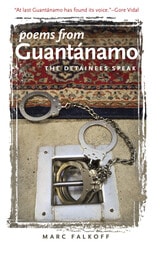
Since 2002, at least 775 men have been held in the U.S. detention center at Guantánamo Bay, Cuba. According to Department of Defense data, fewer than half of them are accused of committing any hostile act against the United States or its allies. In hundreds of cases, even the circumstances of their initial detainment are questionable.

This collection gives voice to the men held at Guantánamo. Available only because of the tireless efforts of pro bono attorneys who submitted each line to Pentagon scrutiny, Poems from Guantánamo brings together twenty-two poems by seventeen detainees, most still at Guantánamo, in legal limbo.

If, in the words of Audre Lorde, poetry “forms the quality of light within which we predicate our hopes and dreams toward survival and change,” these verses—some originally written in toothpaste, others scratched onto foam drinking cups with pebbles and furtively handed to attorneys—are the most basic form of the art.
[more]
cover of Poems from the Greek Anthology: Expanded Edition

Poems from the Greek Anthology

Expanded Edition

Translated, with a Foreword, by Kenneth Rexroth

University of Michigan Press, 1999

"The first translation from the Greek that I ever did was the apple orchard of Sappho in my fifteenth year. It left me so excited with accomplishment that I couldn't sleep well for nights. Since that time, on the freight trains of my youthful years of wandering, in starlit camps on desert and mountain ranges, in snow-covered cabins, on shipboard, in bed, in the bath, in love, in time of loneliness and despair, in jail, while employed as an attendant of the insane, and on many other jobs and in many other places, the Anthology and the lyric poets of Greece have been my constant companions." --Kenneth Rexroth from the Foreword
Friend to the Beats, organizer of the Six Gallery poetry reading in 1955, and iconoclastic poet extraordinare, Kenneth Rexroth here turns his imagination to a selection of verses from the Greek Anthology. In his lively style he successfully captures the spirit of the originals by such poets as Sappho, Anyte, Glykon, Antipatros, Leonidas, Askelpiades, and Ammianos. Students of the classics as well as poets and translators will welcome this collection for the insight and dexterity of its unconventional editor.
Kenneth Rexroth (1905-1982), poet, critic, and translator, is also noted for his translations from the Chinese and Japanese. Widely prolific, he helped usher in the Beat movement in the 1950s and is widely considered to have invented the idea of San Francisco as a center of literary innovation. David Mulroy is Associate Professor in the Department of Foreign Languages and Linguistics, University of Wisconsin, Milwaukee. He is the translator of Early Greek Lyric Poetry and Horace's Odes and Epodes.
[more]
cover of Poems in Absentia & Poems from The Island and the World

Poems in Absentia & Poems from The Island and the World

Pedro da Silveira, Translated by George Monteiro

Tagus Press, 2019
Born on the island of Flores, between Europe and the United States, Pedro da Silveira captures the islander's longing for migratory movement, leading to departure and an inevitable return. These fresh and original poems, now available in this masterful translation, express a deep connection to place, particularly, the insular world of the mid-­Atlantic islands of the Azores. In Poems in Absentia & Poems from The Island and the World, we find yearning, hope, and loss in equal measure. In plain and direct language, we experience the emotions of dreaming and diminution as well as the discovery of illusions. Behind the poet's searing irony, we recognize a capacious and adventurous spirit.
[more]
cover of Poems of Guido Gezelle: A Bilingual Anthology

Poems of Guido Gezelle

A Bilingual Anthology

Edited by Paul Vincent

University College London, 2016

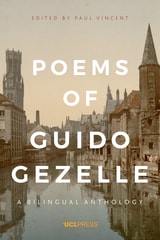
The Bruges-born poet-priest Guido Gezelle(1830–1899) is generally considered one of the masters of 19th-century European lyric poetry. At the end of his life and in the first two decades of the 20th century, Gezellewas hailed by the avant-garde as the founder of modern Flemish poetry. His unique voice was belatedly recognised in the Netherlands and often compared with his English contemporary Gerard Manley Hopkins (1844–1889). In this bilingual anthology, award-winning translator Paul Vincent selects a representative picture of Gezelle’soutput, from devotional through narrative, to celebratory and expressionistic. Gezelle’sfavourite themes are childhood, the Flemish landscape, friendship, nature, religion and the Flemish vernacular, and his apparently simple poems conceal a sophisticated prosody and a dialogue with spiritual and literary tradition. However, an important barrier to wider international recognition of his lyric genius up to now has been the absence of translations that do justice to the vigour and musicality of Gezelle’sWest Flemish idiom. Two of the translations included go some way to redressing the balance: ‘TheWatter-Scriever’ by Scotland’s national poet Edwin Morgan and ‘A Little Leaf . . .’ by Francis Jones. Both translators make brilliant use of their own vernaculars (Glaswegian and North Yorkshire respectively) to bring Gezelleto life for the non-Dutch-speaking reader.
[more]
cover of Poems of Love and Marriage

Poems of Love and Marriage

John Ciardi

University of Arkansas Press, 1989

Collected from his published and heretofore unpublished work, the love poems of John Ciardi in Poems of Love and Marriage are a rich display of gentle wit, emotion, and craft. Not merely lyrics of youthful romance, these span the course of a love affair, of a life shared from first blush to old age.

These poems never disturb the sanctity of the private moment, but transcend the specific situation and bloom into universal recognition. And in his usual way of basking in those qualities which transform the ordinary into the unique, John Ciardi finds poignancy and truth in those elements of love and living together that so often go unnoticed.
[more]
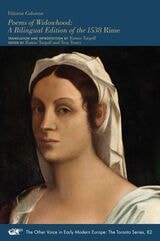
cover of Poems of Widowhood: A Bilingual Edition of the 1538 "Rime"

Poems of Widowhood

A Bilingual Edition of the 1538 "Rime"

Vittoria Colonna

Iter Press, 2021

Vittoria Colonna’s 1538 Rime, originally issued without her permission by a small Parma press, was the first of many editions of her poetry published during her lifetime. Born into one of the most powerful families in Rome and connected to many of the great political, religious, and artistic figures of the period, Colonna was uniquely positioned to transform the landscape of women’s writing. The first woman to see her own poems appear in print in a single-author volume, she led the way for hundreds of other women of her time to publish their own works. Comprising more than one hundred and forty sonnets and two canzoni, the Rime expresses Colonna’s anguish over the loss of her husband and her struggle both to preserve his memory and secure her own future.

This volume presents the first complete English translation of the 1538 Rime and restores the original Italian texts from the blemished Parma printing and later composite editions, a boon to readers of both languages.

 
[more]
cover of Poems of a Penisist

Poems of a Penisist

Mutsuo Takahashi

University of Minnesota Press, 2012

“In the name of / Man, member, / and the holy fluid, / Amen,” begins Mutsuo Takahashi’s epic one-thousand-line erotic fantasy poem, “Ode,” the centerpiece of his groundbreaking collection of queer poetry, Poems of a Penisist. Takahashi’s work, reminiscent of Walt Whitman’s, is a celebration of the male body, treating homosexual desire as something sacred. Stunningly beautiful and passionate, Poems of a Penisist is one of the most important compilations of homoerotic poetry written in the twentieth century.

[more]
cover of Poems of the Five Mountains: An Introduction to the Literature of the Zen Monasteries

Poems of the Five Mountains

An Introduction to the Literature of the Zen Monasteries

Marian Ury

University of Michigan Press, 1992

This second, revised edition of a pioneering volume, long out of print, presents translations of Japanese Zen poems on sorrow, old age, homesickness, the seasons, the ravages of time, solitude, the scenic beauty of the landscape of Japan, and monastic life. Composed by Japanese Zen monks who lived from the last quarter of the thirteenth century to the middle of the fifteenth century, these poems represent a portion of the best of the writing called in Japanese gozan bungaku, “literature of the five mountains.”
“Five mountains” or “five monasteries” refers to the system by which the Zen monasteries were hierarchically ordered and governed. For the monks in the monasteries, poetry functioned as a means not only of expressing religious convictions and personal feelings but also of communicating with others in a civilized and courteous fashion. Effacing barriers of time and space, the practice of Chinese poetry also made it possible for Japanese authors to feel at one with their Chinese counterparts and the great poets of antiquity. This was a time when Zen as an institution was being established and contact with the Chinese mainland becoming increasingly frequent—ten of the sixteen poets represented here visited China.
Marian Ury has provided a short but substantial introduction to the Chinese poetry of Japanese gozan monasteries, and her translations of the poetry are masterful. Poems of the Five Mountains is an important work for anyone interested in Japanese literature, Chinese literature, East Asian Religion, and Zen Buddhism.
[more]
cover of Poems, 1922-1961

Poems, 1922-1961

Donald Davidson

University of Minnesota Press, 1966
Poems, 1922-1961 was first published in 1966.This volume contains a collection of the most important work of Donald Davidson, one of America’s greatest contemporary poets. The selection range from the time of his association with the Fugitive group of Southern writers during the 1920’s to his most recently published book of poems, The Long Street (1961). The Tall Men, first published in 1927, is included here in its revised version of 1938. Among the other early poems are selections from An Outland Piper (1924) and from Lee in the Mountains and Other Poems (1938).The critic Louis D. Rubin, Jr. calls this “the life work of a master poet.” He comments: “These poems don’t date; they represent no outmoded school or clique . . . and the new poems have a simplicity about them that does not hide so much as it enhances their rich imaginativeness and wealth of imagery. These are the poems of a man of great sensitivity and an exciting imagination and command of the language.”
[more]
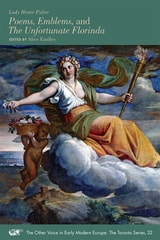
cover of Poems, Emblems, and The Unfortunate Florinda

Poems, Emblems, and The Unfortunate Florinda

Lady Hester Pulter

Iter Press, 2014

Scholars who study early modern women’s writing have been eager for a full-text edition of the works of Hester Pulter since her manuscript was discovered in the mid-1990s. Now that Alice Eardley has brought together all of Pulter’s writing—poetry, emblems, and a prose romance—in a modern-spelling edition, students and academics will be able to access a remarkable body of work. The introduction does a brilliant job of situating Pulter in various milieux (the Civil War, religion, science) and in assessing the genres in which she worked. Eardley’s edition is clear and comprehensive enough to be useful to a wide audience of non-specialists, but its learned glosses are also illuminating for more experienced readers of early modern texts.
[more]