Results by title
1066 books match the query 'Political' and 76 start with p
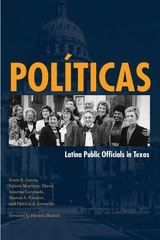
Políticas
Latina Public Officials in TexasBy Sonia R. García, Valerie Martinez-Ebers, Irasema Coronado, Sharon A. Navarro, and Patricia A. Jaramillo
University of Texas Press, 2008
In the decades since Latinas began to hold public office in the United States in the late 1950s, they have blazed new trails in public life, bringing fresh perspectives, leadership styles, and policy agendas to the business of governing cities, counties, states, and the nation. As of 2004, Latinas occupied 27.4 percent of the more than 6,000 elected and appointed local, state, and national positions filled by Hispanic officeholders. The greatest number of these Latina officeholders reside in Texas, where nearly six hundred women occupy posts from municipal offices, school boards, and county offices to seats in the Texas House and Senate.
In this book, five Latina political scientists profile the women who have been the first Latinas to hold key elected and appointed positions in Texas government. Through interviews with each woman or her associates, the authors explore and theorize about Latina officeholders' political socialization, decision to run for office and obstacles overcome, leadership style, and representational roles and advocacy. The profiles begin with Irma Rangel, the first Latina elected to the Texas House of Representatives, and Judith Zaffirini and Leticia Van de Putte, the only two Latinas to serve in the Texas Senate. The authors also interview Lena Guerrero, the first and only Latina to serve in a statewide office; judges Linda Yanes, Alma Lopez, Elma Salinas Ender, Mary Roman, and Alicia Chacón; mayors Blanca Sanchez Vela (Brownsville), Betty Flores (Laredo), and Olivia Serna (Crystal City); and Latina city councilwomen from San Antonio, El Paso, Dallas, Houston, and Laredo.
Positivism in Mexico
By Leopoldo Zea; Translated by Josephine H. Schulte
University of Texas Press, 1974
Positivism, not just an “ivory tower” philosophy, was a major force in the social, political, and educational life of Mexico during the last half of the nineteenth century. Once colonial conservatism had been conquered, the French Intervention ended, and Maximilian of Hapsburg executed, reformers wanted to create a new national order to replace the Spanish colonial one. The victorious liberals strove to achieve “mental emancipation,” a kind of second independence, which would abolish the habits and customs imposed on Mexicans by three centuries of colonialism.
At this singular moment in Mexican history, positivism was offered as an extraordinary means and pathway to a new order. The next stage was the education of the Mexican people in this liberal philosophy and their incorporation into the process of development achieved by modern nations.
Leopoldo Zea traces the forerunners of liberal thought and their influence during Juárez’s time and shows how this ideology degenerated into an “order and progress” philosophy that served merely to maintain colonial forms of exploitation and, at the same time, to create new ones that were peculiar to the neocolonialism that the great nations of the world imposed on other peoples. Zea examines the regime of Porfirio Díaz and its justification by the positivist philosophers of the period. He concludes that the conflict between exploited social groups, on the one hand, and foreign interests and a middle class on the margin of an oligarchy, on the other, brought about the movement known as the Mexican Revolution.
Postpolitics and the Aesthetic Imagination
Juan Meneses
University of Minnesota Press, 2025
Igniting political power through the lens of art and the imagination
Postpolitics and the Aesthetic Imagination investigates the erosion of meaningful political action in today’s world. Gathering writings from an array of scholars, editor Juan Meneses asks: can an aesthetic theory of postpolitics help us understand and counteract the most insidious processes of depoliticization?
The contributors to this volume explore how the aesthetic imagination can play a crucial role in reenvisioning key political elements, including governance, agency, rights, and responsibility. With a survey of various artistic mediums—film, dance, music, literature, and digital media—the essays illustrate how the aesthetic can reveal ways to breathe new life into the work of emancipatory politics. Reclaiming the arts and humanities as vital to political life, the contributors revisit but also move beyond the social sciences’ central focus on neoliberalism and public administration to address other topics such as tech-capitalism, race, environmental violence, and patriarchy.
Postpolitics and the Aesthetic Imagination argues for a conscious deployment of aesthetics to resist political anesthesia and promote a more just society, underscoring the role of the imagination in political engagement and change.
Contributors: Jacquelyn Arcy, U of Wisconsin–Parkside; Christopher Breu, Illinois State U; Stephen Charbonneau, Florida Atlantic U; Eric Lemmon, Webster U; Robert P. Marzec, Purdue U; Allison Page, Rutgers U–Camden; Matthew Scully, U of Lausanne; Erik Swyngedouw, U of Manchester; Sherryl Vint, U of California, Riverside.

Pothole Confidential
My Life as Mayor of MinneapolisR.T. Rybak
University of Minnesota Press, 2016
A pajama party at the Minneapolis–St. Paul International Airport inadvertently helped launch R.T. Rybak’s political career (imagine a rumba line one hundred protesters long chanting, “We deserve to sleep, hey!”), but his earliest lessons in leadership occurred during his childhood. Growing up in a middle-class neighborhood, attending private school with students who had much more than he did, spending evenings at his family’s store in an area where people lived with much less, he witnessed firsthand the opportunity and injustice of the city he called home.
In a memoir that is at once a political coming-of-age story and a behind-the-scenes look at the running of a great city, the three-term mayor takes readers into the highs and lows and the daily drama of a life inextricably linked with Minneapolis over the past fifty years. With refreshing candor and insight, Rybak describes his path through journalism, marketing, and community activism that led to his unlikely (to him, at least) primary election—on September 11, 2001. His personal account of the challenges and crises confronting the city over twelve years, including the tragic collapse of the I-35W bridge, the rising scourge of youth violence, and the bruising fight over a ban on gay marriage (with Rybak himself conducting the first such ceremony at City Hall on August 1, 2013), is also an illuminating, often funny depiction of learning the workings of the job, frequently on the fly, while trying to keep up with his most important constituency, his family.
As bracing as the “fresh air” campaign that swept him into office, Rybak’s memoir is that rare document from a politician: one more concerned with the people he served and the issues of his time than with burnishing his own credentials. As such, it reflects what leadership truly looks like.
Power in Modernity
Agency Relations and the Creative Destruction of the King’s Two BodiesIsaac Ariail Reed
University of Chicago Press, 2020
He mobilizes this theory to investigate the onset of modernity in the Atlantic world, with a focus on rebellion, revolution, and state formation in colonial North America, the early American Republic, the English Civil War, and French Revolution. Modernity, Reed argues, dismantled the “King’s Two Bodies”—the monarch’s physical body and his ethereal, sacred second body that encompassed the body politic—as a schema of representation for forging power relations. Reed’s account then offers a new understanding of the democratic possibilities and violent exclusions forged in the name of “the people,” as revolutionaries sought new ways to secure delegation, build hierarchy, and attack alterity.
Reconsidering the role of myth in modern politics, Reed proposes to see the creative destruction and eternal recurrence of the King’s Two Bodies as constitutive of the modern attitude, and thus as a new starting point for critical theory. Modernity poses in a new way an eternal human question: what does it mean to be the author of one’s own actions?
Pragmatism and Political Theory
From Dewey to RortyMatthew Festenstein
University of Chicago Press, 1997
The book's second part traces how Dewey's approach has been differently developed, especially in the work of three contemporary pragmatic thinkers: Richard Rorty, Jurgen Habermas, and Hilary Putnam. This first full-length critical study of the relationship between the pragmatist tradition and political philosophy fills a significant gap in contemporary thought.
Pragmatist Politics
Making the Case for Liberal DemocracyJohn McGowan
University of Minnesota Press, 2012
In our current age of cynicism, John McGowan suggests that the time is right to take a fresh look at pragmatism, the philosophy of American democracy. As McGowan shows, pragmatism can be an inspiring alternative to the despair that seems to dominate contemporary American politics. Pragmatist Politics is passionate and convincing, both heartfelt and clear-eyed. It offers an expansive vision of what the United States could be and should be.
From John Dewey and William James, McGowan derives a history of democracy as a way of life, characterized by a distinctive ethos and based on an understanding of politics as potentially effective collective agency. That democratic ideal is wedded to a liberalism that focuses on extending the benefits of democracy and of material prosperity to all. Beyond the intellectual case for liberal democracy, McGowan turns to how James, especially, was attuned to the ways that emotional appeals often trump persuasion through arguments, and he examines the work of Kenneth Burke, among others, to investigate the link between liberal democracy and a comic view of human life. Comedy, McGowan notes, allows consideration of themes of love, forgiveness, and generosity that figure far too infrequently in philosophical accounts of politics.
In McGowan’s work, the combination of pragmatism and comedy takes us on a wide-ranging exploration of what American politics—and by extension American life—could actually be like if it truly reflected American values.
Prehistoric Social, Political, and Economic Development in the Area of the Tehuacan Valley
Some Results of the Palo Blanco ProjectEdited by Robert D. Drennan
University of Michigan Press, 1979
Pressing Freedom
A NovelRoger Armbrust
Parkhurst Brothers, Inc., 2017
An investigative reporter for a statewide newspaper connects the dots on an interstate jewel fencing scheme which leads to the capitol city mayor’s door, and implicates a would-be governor. The reporter, a Vietnam vet whose keeps his black ops background under wraps, is attacked by rogue cops, who also threaten his daughter and his girlfriend. His USMC training, unknown to his assailants, saves him from serious injury, but danger on the national scene draws his attention. With a former United States Senator who shares his concern for the unstable new administration in Washington, the reporter finds himself in the midst of a plot to return the federal government to stability, but by means that shock him to the core. A political thriller born of our current national turmoil, this first novel by a seasoned journalist will leave the reader with wide eyes and a quickened heartbeat.
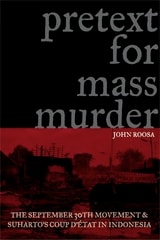
Pretext for Mass Murder
The September 30th Movement and Suharto's Coup d'Etat in IndonesiaJohn Roosa
University of Wisconsin Press, 2006
In the early morning hours of October 1, 1965, a group calling itself the September 30th Movement kidnapped and executed six generals of the Indonesian army, including its highest commander. The group claimed that it was attempting to preempt a coup, but it was quickly defeated as the senior surviving general, Haji Mohammad Suharto, drove the movement’s partisans out of Jakarta. Riding the crest of mass violence, Suharto blamed the Communist Party of Indonesia for masterminding the movement and used the emergency as a pretext for gradually eroding President Sukarno’s powers and installing himself as a ruler. Imprisoning and killing hundreds of thousands of alleged communists over the next year, Suharto remade the events of October 1, 1965 into the central event of modern Indonesian history and the cornerstone of his thirty-two-year dictatorship.
Despite its importance as a trigger for one of the twentieth century’s worst cases of mass violence, the September 30th Movement has remained shrouded in uncertainty. Who actually masterminded it? What did they hope to achieve? Why did they fail so miserably? And what was the movement’s connection to international Cold War politics? In Pretext for Mass Murder, John Roosa draws on a wealth of new primary source material to suggest a solution to the mystery behind the movement and the enabling myth of Suharto’s repressive regime. His book is a remarkable feat of historical investigation.
Finalist, Social Sciences Book Award, the International Convention of Asian Scholars
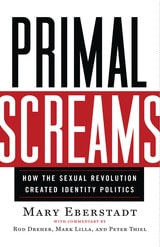
Primal Screams
How the Sexual Revolution Created Identity PoliticsEberstadt, Mary
Templeton Press, 2021
Who am I? The question today haunts every society in the Western world.
Legions of people—especially the young—have become unmoored from a firm sense of self. To compensate, they join the ranks of ideological tribes spawned by identity politics and react with frenzy against any perceived threat to their group.
As identitarians track and expose the ideologically impure, other citizens face the consequences of their rancor: a litany of “isms” run amok across all levels of cultural life, the free marketplace of ideas muted by agendas shouted through megaphones, and a spirit of general goodwill warped into a state of perpetual outrage.
How did we get here? Why have we divided against one another so bitterly? In Primal Screams, acclaimed cultural critic Mary Eberstadt presents the most provocative and original theory to come along in recent years. The rise of identity politics, she argues, is a direct result of the fallout of the sexual revolution, especially the collapse and shrinkage of the family.
As Eberstadt illustrates, humans have forged their identities within the kinship structure from time immemorial. The extended family, in a real sense, is the first tribe and teacher. But with its unprecedented decline across various measures, generations of people have been set adrift and can no longer answer the question Who am I? concerning primordial ties. Desperate for solidarity and connection, they claim membership in politicized groups whose displays of frantic irrationalism amount to primal screams for familial and communal loss.
Written in her impeccable style and with empathy rarely encountered in today’s divisive discourse, Eberstadt’s theory holds immense explanatory power that no serious citizen can afford to ignore. The book concludes with three incisive essays by Rod Dreher, Mark Lilla, and Peter Thiel, each sharing their perspective on the author’s formidable argument.
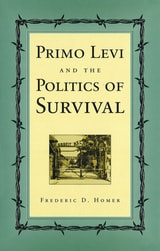
Primo Levi and the Politics of Survival
Frederic D. Homer
University of Missouri Press, 2001
At the age of twenty-five, Primo Levi was sent to Hell. Levi, an Italian chemist from Turin, was one of many swept up in the Holocaust of World War II and sent to die in the German concentration camp in Auschwitz. Of the 650 people transported to the camp in his group, only 15 men and 9 women survived. After Soviet liberation of the camp in 1945, Levi wrote books, essays, short stories, poetry, and a novel, in which he painstakingly described the horrors of his experience at Auschwitz. He also spent the rest of his life struggling with the fact that he was not among those who were killed.
In Primo Levi and the Politics of Survival, Frederic D. Homer looks at Primo Levi's life but, more important, shows him to be a significant political philosopher. In the course of his writings, Levi asked and answered his most haunting question: can someone be brutalized by a terrifying experience and, upon return to "ordinary life," recover from the physical and moral destruction he has suffered? Levi used this question to develop a philosophy positing that although man is no match for life, he can become better prepared to contend with the tragedies in life.
According to Levi, the horrors of the world occur because of the strength of human tendencies, which make relationships between human beings exceedingly fragile. He believed that we are ill-constituted beings who have tendencies toward violence and domination, dividing ourselves into Us and Them, with very shallow loyalties. He also maintained that our only refuge is in education and responsibility, which may counter these tendencies. Homer calls Levi's philosophy "optimistic pessimism."
As Homer demonstrates, Levi took his past experiences into account to determine that goodwill and democratic institutions do not come easily to people. Liberal society is to be earned through discipline and responsibility toward our weaknesses. Levi's answer is "civilized liberalism." To achieve this we must counter some of our most stubborn tendencies.
Homer also explores the impact of Levi's death, an apparent suicide, on the way in which his work and theories have been perceived. While several critics discount Levi's work because of the nature of his death, Homer argues that his death is consistent with his philosophy. A book rich in brutally honest philosophy, Primo Levi and the Politics of Survival compels one to look at serious questions about life, tragedy, optimism, solidarity, violence, and human nature.
Principles of Instrumental Logic
John Dewey's Lectures in Ethics and Political Ethics, 1895-1896Donald F. Koch
Southern Illinois University Press, 1998
John Dewey delivered two sets of related lectures at the University of Chicago in the fall quarter 1895 and the spring quarter 1896. Designed for graduate students, the lectures show the birth of Dewey’s instrumentalist theory of inquiry in its application to ethical and political thinking.
From 1891 through 1903, Dewey attempted to develop a revolutionary experimentalist approach to ethical inquiry, designed to replace the more traditional ways of moral theorizing that relied on the fixed moral knowledge given in advance of the situations in which they were applied. In the lectures on the logic of ethics, he sets forth and defends the view that the "is" in a moral judgment such as "This is good" is a coordinating factor in an inquiry. Although the subject matter of the lectures is highly technical, its significance is paramount. It provides the key to and opens the door for a theory that preserves the difference between strictly scientific inquiry and moral inquiry even while it provides a "scientific treatment" of the latter.
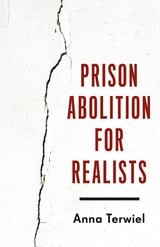
Prison Abolition for Realists
Anna Terwiel
University of Minnesota Press, 2025
A lucid guide to the radical politics of prison abolitionists
There is growing recognition that mass incarceration is unjust and undemocratic, but prison abolition continues to be dismissed as naïve, idealistic, and out of touch with reality. Anna Terwiel challenges this view, carefully examining the work of abolitionist thinkers and activists since the 1960s to argue that prison abolition is a realist political project. Abolition, Terwiel shows, is oriented toward practical realities and offers concrete proposals for radical democratic change.
Based on insightful readings of renowned abolitionists such as Michel Foucault, Liat Ben-Moshe, and Angela Y. Davis, Prison Abolition for Realists illuminates the realist aspects of their approaches as well as the important differences between them. Distinguishing between paranoid, purist, and agonistic styles of abolitionism, Terwiel argues that an agonistic approach holds the most promise for democratic change to carceral systems. Embodied in the work of Davis, agonistic abolitionism combines radical critique with efforts to build new democratic institutions while accepting that all political achievements will be imperfect. Pursuing examples of what this looks like in practice, Terwiel explores grassroots transformative justice efforts, like those of Communities Against Rape and Abuse. She also proposes a “right to comfort” to support incarcerated people’s demands for air conditioners in extremely hot prisons, showing how state institutions, civil law, and rights claims can be potential resources for abolitionists.
Nuanced and illuminating, Prison Abolition for Realists affirms abolition’s viability during a time of multiple, ongoing crises. While many despair at the state of the world, Terwiel reveals how abolition offers an actionable politics of the possible. Far from being unrealistic, abolition is an indispensable part of a realist politics.
Retail e-book files for this title are screen-reader friendly with images accompanied by short alt text and/or extended descriptions.
Retail e-book files for this title are screen-reader friendly with images accompanied by short alt text and/or extended descriptions.
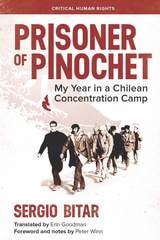
Prisoner of Pinochet
My Year in a Chilean Concentration CampSergio Bitar
University of Wisconsin Press, 2017
Prisoner of Pinochet is the gripping first-person chronicle of Bitar's year as a political prisoner before being expelled from Chile; a poignant narrative of men held captive together in a labor camp under harsh conditions, only able to guess at their eventual fate; and an insightful memoir of the momentous events of the early 1970s that led to seventeen years of bloody authoritarian rule in Chile. Available in English for the first time, this edition includes maps and photos from the 1970s and contextual notes by historian Peter Winn.
Private Correspondences
Trudy Lewis
Northwestern University Press, 1996
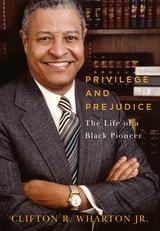
Privilege and Prejudice
The Life of a Black PioneerClifton R. Wharton
Michigan State University Press, 2015
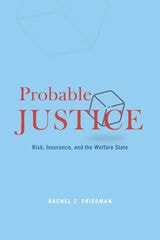
Probable Justice
Risk, Insurance, and the Welfare StateRachel Z. Friedman
University of Chicago Press, 2020
Probable Justice traces a history of social insurance from the eighteenth century to today, from the earliest ideas of social accountability through the advanced welfare state of collective responsibility and risk. At the heart of Rachel Z. Friedman’s investigation is a study of how probability theory allows social insurance systems to flexibly measure risk and distribute coverage. The political genius of social insurance, Friedman shows, is that it allows for various accommodations of needs, risks, financing, and political aims—and thereby promotes security and fairness for citizens of liberal democracies.
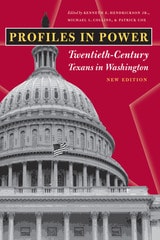
Profiles in Power
Twentieth-Century Texans in Washington, New EditionEdited by Kenneth E. Hendrickson, Jr., Michael L. Collins, and Patrick Cox
University of Texas Press, 2004
Profiles in Power offers concise biographies of fourteen twentieth-century Texans who wielded significant political power and influence in Washington, D.C. First published in 1993 by Harlan Davidson, it has been revised and updated with new chapters on John Nance Garner and Henry Gonzalez and expanded chapters on Lyndon Johnson, Barbara Jordan, Ralph Yarborough, Jim Wright, and John Tower. Demonstrating the validity of a biographical approach to history, the book as a whole covers all the major political issues of the twentieth century, as well as the pivotal role of Texans in defining the national agenda.
Prolegomena to Any Future Materialism
A Weak Nature AloneAdrian Johnston
Northwestern University Press, 2019
Adrian Johnston’s trilogy Prolegomena to Any Future Materialism aims to forge a thoroughly materialist yet antireductive theory of subjectivity. In this second volume, A Weak Nature Alone, Johnston focuses on the philosophy of nature required for such a theory. This volume is guided by a fundamental question: How must nature be rethought so that human minds and freedom do not appear to be either impossible or inexplicable within it? Asked differently: How must the natural world itself be structured such that sapient subjects in all their distinctive peculiarities emerged from and continue to exist within this world?
In A Weak Nature Alone, Johnston develops his transcendental materialist account of nature through engaging with and weaving together five main sources of inspiration: Hegelian philosophy, Marxist materialism, Freudian-Lacanian metapsychology, Anglo-American analytic neo-Hegelianism, and evolutionary theory and neurobiology. Johnston argues that these seemingly (but not really) strange bedfellows should be brought together so as to construct a contemporary ontology of nature. Through this ontology, nonnatural human subjects can be seen to arise in an immanent, bottom-up fashion from nature itself.
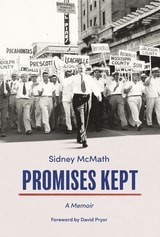
Promises Kept
A MemoirSidney S. McMath
University of Arkansas Press, 2003
Winner of the 2006 Booker Worthen Literary Prize and the 2004 Ragsdale Award
A dominating spirit of public service animated the life of Sidney Sanders McMath (1912–2003), the thirty-fourth governor of Arkansas. Promises Kept, completed and published when McMath was in his nineties, tells his story in his own words—from the piney hills of South Arkansas to the battlefields of World War II; through the human dramas of the courtroom to the marbled corridors of the State Capitol.
In Promises Kept, McMath recounts a rural upbringing that grounded him in the concerns of everyday Arkansans. He tells his life story through key milestones, including distinguished military service and a dramatic political rise to governor of Arkansas. During his four years in office, he pursued reform and modernization by expanding roads and electricity to rural areas, fighting the poll tax, building the state’s first medical center, opening Democratic primaries to Black voters, and standing with President Harry Truman in resisting the segregationist Dixiecrats. McMath’s political career ended amid unproven allegations tied to the highway program—charges he addresses directly here—and concludes with his return to the law, where landmark cases earned him honors.
Throughout, McMath reveals the excitement and the hard choices of real democracy, offering compelling human stories and a crucial perspective of a pivotal time in Arkansas history.
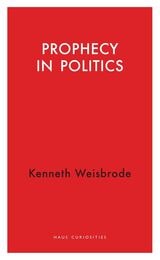
Prophecy in Politics
Or, the Wigram AspectKenneth Weisbrode
Haus Publishing, 2026
Ralph Wigram was a minor British bureaucrat who is known to a small part of posterity only because Winston Churchill paid tribute to him as the man who warned of the Nazi threat with such persistence, conviction, and hard evidence that Churchill had the wherewithal to make the case to the British people. Wigram died at the end of 1936, just before the war he warned against had begun. He might have changed the course of history—if only people had believed him.
Prophets like Wigram are a permanent fixture of a world without certainty. Oracles, shamans, wiseacres, astrologers, and swamis of all shades populate our myths, legends, and Bibles. Today, our lives are inundated with the wisdom of professional forecasters, intelligence analysts, and threat mongers. Why do many of us, and especially our leaders, find it so difficult to heed warnings? We tend to underreact to some, overreact to others, and then point fingers when what “nobody ever anticipated” comes to pass. Why is prophecy so dogged?
Prophecy in Politics takes up a vast, complex, and well-worn subject—the future—and reduces it to its most essential aspects, especially belief. It revisits a half-dozen familiar and not-so-familiar incidents of prophecy, from the warnings given to Stalin about Operation Barbarossa to those given to Bill Clinton and George W. Bush about “terrorism,” to the Cassandras periodically promising collapse in the financial markets, to uncover a pattern of complacency and neglect. Finally, Ken Weisbrode proposes what all of us might do to overcome complacency and make prophecy work better for us. This is not a handbook or an attempt to stand in the vanguard of political or strategic thought on futurism, futures studies, or futurology; rather, it is a concise overview and an idiosyncratic but nevertheless useful guide to thinking about the past and present condition of prophecy.
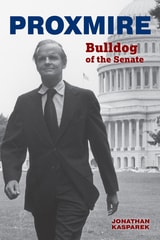
Proxmire
Bulldog of the SenateJonathan Kasparek
Wisconsin Historical Society Press, 2019
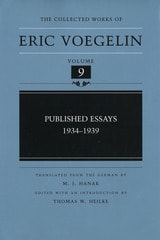
Published Essays, 1934-1939 (CW9)
Eric Voegelin, Edited & Intro by Thomas W. Heilke, & Translated by M. J. Hanak
University of Missouri Press, 2001
In this collection of essays, which covers the years from 1934 to1939, we see Eric Voegelin in the role of both scholar and public intellectual in Vienna until he was forced to flee the Nazi terror that descended on Austria in 1938. Revealing the broad spectrum of thinking and scientific study of this relatively young scholar, Voegelin's essays range from Austrian politics, Austrian constitutional history, and European racism to questions of the formation and expression of public opinion, theories of administrative law, and the role of political science in public university education. Several essays serve as useful commentaries on, elaborations of, or synopses of arguments Voegelin made in the five books he had published between 1928 and 1938.
Within these topical headings, there are multiple thematic threads that wind their way through these essays and that remain of interest to contemporary readers. Thirteen of the pieces contained in this collection are short items that Voegelin published in trade journals and newspapers, of which nine appeared in the Wiener Zeitung in 1934 and the Neue Freie Presse in 1937. In these we see two brief periods in which Voegelin played the role of public intellectual not only as a lecturer but also in print.
These essays will be of interest to a wide range of scholars, including constitutional historians, historians of political science, political theorists, and students of Voegelin's later work.
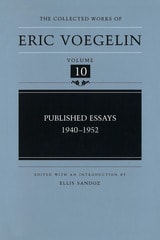
Published Essays, 1940-1952 (CW10)
Eric Voegelin & Edited & Intro by Ellis Sandoz.
University of Missouri Press, 2000
Published Essays, 1940-1952, includes some of Eric Voegelin's most provocative and interesting essays. Containing his first publications after he fled Vienna and settled in the United States following Hitler's annexation of Austria, this volume provides eyewitness commentary on the rise of National Socialism from the first days of World War II onward. A major study entitled "Growth of the Race Idea" presents a masterful summary of the two volumes on that subject Voegelin first published in 1933. A related essay of wide interest is entitled "Nietzsche, the Crisis, and the War."
Another facet of Voegelin's thought incorporated within this volume of the Essays is his extraordinary analysis of the diplomatic correspondence conducted between the Western powers, the papacy, and the Great Khans, whose breathtaking expansion of the Mongol Empire for a time threatened to extinguish Western civilization itself and resulted in a two-century domination of Russia. Another major study is "The Origins of Scientism," an illuminating analysis of the grounds of much of modern philosophy and of all modern political ideologies.
There are also surveys of the state of political theory in the late forties, penetrating studies of utopian thought with essays on Thomas More and Goethe, and a concluding essay that explores the intricacies of "Gnostic Politics"—a familiar theme from Voegelin's contemporaneous New Science of Politics. This volume of published essays shows Eric Voegelin at his most accessible best.
Published Essays, 1966-1985 (CW12)
Eric Voegelin & Edited & Intro by Ellis Sandoz
University of Missouri Press, 0