Results by title
471 books match the query 'Power' and 85 start with p
Power of Petitioning in Early Modern Britain
Edited by Brodie Waddell and Jason Peacey
University College London, 2024
The humble petition was ubiquitous in early modern society and featured prominently in crucial moments such as the outbreak of civil wars and in everyday local negotiations about taxation, welfare, and litigation. People at all levels of society, from noblemen to paupers, used petitions to make their voices heard, and these are valuable sources for mapping the structures of authority and agency that framed early modern society.
The Power of Petitioning in Early Modern Britain offers a holistic study of this crucial topic in early modern British history. The contributors to this volume survey a vast range of sources, showing the myriad ways people petitioned the authorities from the sixteenth to the eighteenth centuries. They cross the jurisdictional, sub-disciplinary, and chronological boundaries that have otherwise constrained the current scholarly literature on petitioning and popular political engagement. Teasing out broad conclusions from innumerable smaller interventions in public life, they not only address the aims, attitudes, and strategies of those involved but also assess the significance of the processes they used. This volume makes it possible to rethink the power of petitioning and to re-evaluate broad trends regarding political culture, institutional change, and state formation.

Power of the Weak
STUDIES ON MEDIEVAL WOMENEdited by Jennifer Carpenter and Sally-Beth MacLean
University of Illinois Press, 1996
sixteenth centuries, these essays suggest that influence and power may
have paradoxically been available to women despite, and sometimes precisely
because of, their subordinate position in society. Striking for its range
of scholarship, this collection explores the power and independence, relationships
and influence of medieval queens, holy women, mothers, widows, Jewish
conversas, and others. Latin and Anglo-Norman hagiography, confessors'
manuals, coronation rituals, responsa literature, and legal theory
are represented.
"An intriguing exploration
of a basic paradox of medieval society, and an excellent blend of theory
and gender studies with detailed work relevant for social and political
history." -- Joel Rosenthal, author of Patriarchy and Families
of Privilege in Fifteenth-Century England
JENNIFER CARPENTER
is a lecturer in history at the University of Otago, Dunedin, New Zealand.
Power to Hurt
THE VIRTUES OF ALIENATIONWilliam Monroe
University of Illinois Press, 1998
Chosen as a Choice Magazine's Outstanding Academic Book for 1999.
Power to the Partners
Organizational Coalitions in Social Justice AdvocacyMaraam A. Dwidar
University of Chicago Press, 2025
A vital examination of how social and economic justice organizations overcome resource disadvantages and build political power.
Why do some coalitions triumph while others fall short? In Power to the Partners, Maraam A. Dwidar documents the vital role of social and economic justice organizations in American politics and explores the process by which they strategically build partnerships to advance more effective and equitable advocacy. Using original data tracking the collaboration patterns of more than twenty thousand nationally active advocacy organizations, Dwidar evaluates the micro- and macro-level conditions surrounding these groups’ successful efforts to collectively shape public policy.
Power to the Partners reveals that while organizational advocates for social and economic justice are at a disadvantage in the American lobbying landscape—financially, tactically, and politically—coalition work can help ameliorate these disparities. By building and sustaining coalitions with structures and memberships that facilitate clarity, learning, and diverse perspectives, these advocates can successfully—and uniquely—make their mark on American public policy. Dwidar’s work offers critical insights for scholars and practitioners alike, from groundbreaking academic findings to evidence-based lessons for political organizers.
Power to the People
The Graphic Design of the Radical Press and the Rise of the Counter-Culture, 1964-1974Geoff Kaplan
University of Chicago Press, 2013
Power to the Transfer
Critical Race Theory and a Transfer Receptive CultureDimpal Jain
Michigan State University Press, 2020
Power, Change, and Gender Relations in Rural Java
A Tale of Two VillagesAnn R. Tickamyer
Ohio University Press, 2012
Women’s status in rural Java can appear contradictory to those both inside and outside the culture. In some ways, women have high status and broad access to resources, but other situations suggest that Javanese women lack real power and autonomy. Javanese women have major responsibilities in supporting their families and controlling household finances. They may also own and manage their own property. Yet these symbols and potential sources of independence and influence are determined by a culturally prescribed, state-reinforced, patriarchal gender ideology that limits women’s autonomy. Power, Change, and Gender Relations in Rural Java examines this contradiction as well as sources of stability and change in contemporary Javanese gender relations.
The authors conducted their research in two rural villages in Yogyakarta, Indonesia, during three important historical and political periods: the end of the New Order regime; the transitional period of reformation; and the subsequent establishment of a democratic government. Their collaboration brings a unique perspective, analyzing how gender is constructed and reproduced and how power is exercised as Indonesia faces the challenges of building a new social order.

Power, Community and the State
The Political Anthropology of Organisation in MexicoMonique Nuijten
Pluto Press, 2003
Power, Culture and Place
Essays on New York CityJohn H. Mollenkopf
Russell Sage Foundation, 1988
Power, Institutions, and Leadership in War and Peace
Lessons from Peru and Ecuador, 1995–1998By David R. Mares and David Scott Palmer
University of Texas Press, 2012
In January 1995, fighting broke out between Ecuadorian and Peruvian military forces in a remote section of the Amazon. It took more than three years and the interplay of multiple actors and factors to achieve a definitive peace agreement, thus ending what had been the region's oldest unresolved border dispute. This conflict and its resolution provide insights about other unresolved and/or disputed land and sea boundaries which involve almost every country in the Western Hemisphere.
Drawing on extensive field research at the time of the dispute and during its aftermath, including interviews with high-ranking diplomats and military officials, Power, Institutions, and Leadership in War and Peace is the first book-length study to relate this complex border dispute and its resolution to broader theories of conflict. The findings emphasize an emerging leadership approach in which individuals are not mere captives of power and institutions. In addition, the authors illuminate an overlap in national and international arenas in shaping effective articulation, perception, and selection of policy.
In the “new” democratic Latin America that emerged in the late 1970s through the early 1990s, historical memory remains influential in shaping the context of disputes, in spite of presumed U.S. post–Cold War influence. This study offers important, broader perspectives on a hemisphere still rife with boundary disputes as a rising number of people and products (including arms) pass through these borderlands.
Power, Money, and Media
Communication Patterns and Bureaucratic Control in Cultural ChinaChin-Chuan Lee
Northwestern University Press, 2000
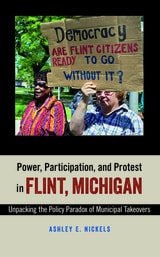
Power, Participation, and Protest in Flint, Michigan
Unpacking the Policy Paradox of Municipal TakeoversAshley E. Nickels
Temple University Press, 2019
When the 2011 municipal takeover in Flint, Michigan placed the city under state control, some supported the intervention while others saw it as an affront to democracy. Still others were ambivalent about what was supposed to be a temporary disruption. However, the city’s fiscal emergency soon became a public health emergency—the Flint Water Crisis—that captured international attention.
But how did Flint’s municipal takeovers, which suspended local representational government, alter the local political system? In Power, Participation, and Protest in Flint, Michigan, Ashley Nickels addresses the ways residents, groups, and organizations were able to participate politically—or not—during the city’s municipal takeovers in 2002 and 2011. She explains how new politics were created as organizations developed, new coalitions emerged and evolved, and people’s understanding of municipal takeovers changed.
Inwalking readers through the policy history of, implementation of, and reaction to Flint’s two municipal takeovers, Nickels highlights how the ostensibly apolitical policy is, in fact, highly political.
Power, Patronage, and the Local State in Ghana
Barry Driscoll
Ohio University Press, 2023
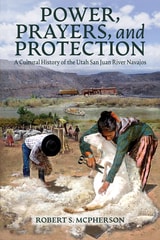
Power, Prayers, and Protection
A Cultural History of the Utah San Juan River NavajoRobert S. McPherson
University Press of Colorado, 2022
Navajo oral tradition is rich in stories and themes that form the basis for ceremonial performance. Everything that is physical, emotional, or spiritual has been placed in this world by the holy people at the time of creation, a process recognized in these accounts and teachings. Each chapter references sacred narratives that provide power through prayers that bring protection and a path for believers to follow. Topics include life on the river before and during the introduction of the white man, efficacy of the chantways, teachings of medicine people, childhood memories, arrival of trading posts, encounters with the automobile and other technology, livestock reduction and its aftermath, and the development of the Aneth oilfield with its ensuing protests. This is the Navajo elders’ story as seen through their eyes and told in their voice.
Power, Profit and Prestige
A History of American Imperial ExpansionPhilip S. Golub
Pluto Press, 2010
Power, Profit and Prestige applies incisive historical and sociological analysis to make sense of the United States’ post-Cold War imperial behaviour.
Philip Golub studies imperial identity formation and shows how an embedded culture of force and expansion has shaped American foreign policy. He argues that the US logic of world power and deeply rooted assumptions about American primacy inhibits democratic transformation at domestic and international levels. This resistance to change may lead the US empire into a crisis of its own making.
This enlightening book will be particularly useful to students of history and international relations as they explore a world where America is no longer able to set the global agenda.
Power, Protest, and the Public Schools
Jewish and African American Struggles in New York CityMelissa F. Weiner
Rutgers University Press, 2012
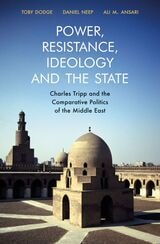
Power, Resistance, Ideology and the State
Charles Tripp and the Comparative Politics of the Middle EastEdited by Daniel Neep, Toby Dodge, and Ali M. Ansari
Gingko, 2025
Power, Resistance, Ideology and the State: Charles Tripp and the Comparative Politics of the Middle East seeks to present a new understanding of a region of unprecedented volatility, where postcolonial projects of state-driven development have now expired, old ruling elites have been delegitimized, and political Islam discredited. The work of Charles Tripp, professor at the School of Oriental and African Studies (SOAS) for over three decades, has shaped a distinct approach to the study of Middle East politics with an analytical sensibility that is empirically rich, theoretically insightful, and historically sensitive. This volume brings together contributions from ten political scientists and historians from across Europe, the United States, and the Middle East, each of which takes Tripp’s work as an intellectual point of departure for studying Middle East politics.
Against this background, the contributors explore the contemporary developments that have emerged to fill the intellectual and material shortcomings created by the systemic failures of economics and politics in the region.
The contributions focus on four themes that are central to an understanding of Middle East politics—power, resistance, ideology, and the state—to examine political trends in cases ranging from Iran and Iraq to Jordan, Lebanon, and Syria. Each chapter combines extensive field research and a knowledge of regional politics with methodological and philosophical reflexivity to produce a collection of papers at the cutting edge of contemporary Middle East Studies.
Power, Trust, and Meaning
Essays in Sociological Theory and AnalysisS. N. Eisenstadt
University of Chicago Press, 1995
Framed by a new introduction and an extensive epilogue, which are themselves important statements about processes of institutional formations and cultural creativity, the essays trace the major developments of contemporary sociological theory and analysis. Examining themes of trust and solidarity among immigrants, youth groups, and generations, and in friendships, kinships, and patron-client relationships, Eisenstadt explores larger questions of social structure and agency, conflict and change, and the reconstitution of the social order. He looks also at political and religious systems, paying particular attention to great historical empires and the major civilizations.
United by what they reveal about three major dimensions of social life—power, trust, and meaning—these essays offer a vision of culture as both a preserving and a transforming aspect of social life, thus providing a new perspective on the relations between culture and social structure.

Practice, Power, and Forms of Life
Sartre’s Appropriation of Hegel and MarxTerry Pinkard
University of Chicago Press, 2022
Jean-Paul Sartre’s Critique of Dialectical Reason, released to great fanfare in 1960, has since then receded in philosophical visibility. As Sartre’s reputation is now making a comeback, it is time for a reappraisal of his later work. In Practice, Power, and Forms of Life, philosopher Terry Pinkard interprets Sartre’s late work as a fundamental reworking of his earlier ideas, especially in terms of his understanding of the possibility of communal action as genuinely free, which the French philosopher had previously argued was impossible.
Pinkard reveals how Sartre was drawn back to Hegel, a move that was itself incited by Sartre’s newfound interest in Marxism. Pinkard argues that Sartre constructed a novel position on freedom that has yet to be adequately taken up and analyzed within philosophy and political theory. Through Sartre, Pinkard advances an argument that contributes to the history of philosophy as well as key debates on action and freedom.
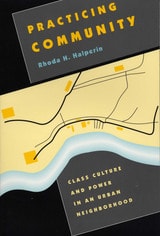
Practicing Community
Class Culture and Power in an Urban NeighborhoodBy Rhoda H. Halperin
University of Texas Press, 1998
Cincinnati's East End river community has been home to generations of working-class people. This racially mixed community has roots that reach back as far as seven generations. But the community is vulnerable. Developers bulldoze "raggedy" but affordable housing to build upscale condos, even as East Enders fight to preserve the community by participating in urban development planning controlled by powerful outsiders.
This book portrays how East Enders practice the preservation of community. Drawing on more than six years of anthropological research and advocacy in the East End, Rhoda Halperin argues for redefining community not merely as a place, but as a set of culturally embedded and class-marked practices that give priority to caring for children and the elderly, procuring livelihood, and providing support for family, friends, and neighbors. These practices create the structures of community within the larger urban power structure.
Halperin uses different genres to weave the voices of East Enders throughout the book. Poems and narratives offer poignant insights into the daily struggles against impersonal market forces that work against the struggle for livelihood. This firsthand account questions commonly held assumptions about working-class people. In a fresh way, it reveals the cultural construction of marginality, from the viewpoints of both "real East Enders" and the urban power structure.
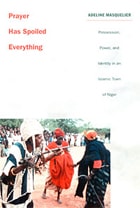
Prayer Has Spoiled Everything
Possession, Power, and Identity in an Islamic Town of NigerAdeline Masquelier
Duke University Press, 2001
To explore the role of bori possession in local definitions of history, power, and identity, Masquelier spent a total of two years in Niger, focusing on the diverse ways in which spirit mediums share, transform, and contest a rapidly changing reality, threatened by Muslim hegemony and financial hardship. She explains how the spread of Islam has provoked irreversible change in the area and how prayer—a conspicuous element of daily life that has become virtually synonymous with Islamic practice in this region of west Africa—has thus become equated with the loss of tradition. By focusing on some of the creative and complex ways that bori at once competes with and borrows from Islam, Masquelier reveals how possession nonetheless remains deeply embedded in Mawri culture, representing more than simple resistance to Islam, patriarchy, or the state. Despite a widening gap between former ways of life and the contradictions of the present, it maintains its place as a feature of daily life in which villagers participate with varying degrees of enthusiasm and approval.
Specialists in African studies, in the anthropology of religion, and in the historical transformations of colonial and postcolonial societies will welcome this study.

Prayer and Power
George Herbert and Renaissance CourtshipMichael C. Schoenfeldt
University of Chicago Press, 1991
Before entering the priesthood, Herbert nourished contacts in court, was elected University Orator at Cambridge, and served in Parliament. In turning to God, Schoenfeldt argues, Herbert did not simply turn away from the secular world but also turned its language, particularly the language of courtesy, into the medium for his lyric worship of God. The confluence of courtesy and spirituality in Herbert's poetry provides a fascinating insight into a society searching for an appropriate discourse of reverence in a time of baffling change. The first five chapters investigate the manifold ways in which Herbert's life and works exemplify the interdependence of social and religious behavior in the English Renaissance. The sixth and final chapter extends this investigation into the nervous eroticism of Herbert's poems.
Considering The Temple as well as Herbert's letters, speeches, Latin poems, collections of foreign proverbs, translations, The Country Parson, and less familiar lyrics, Schoenfeldt offers a thorough and detailed reading of Herbert's rich and conflicted corpus. Prayer and Power is not only a bold redefinition of the accomplishment of one of the finest poets of the English Renaissance but also the first sustained study to advance a cultural poetics of the religious lyric.
Precolumbian Water Management
Ideology, Ritual, and PowerEdited by Lisa J. Lucero and Barbara W. Fash
University of Arizona Press, 2006
Precolumbian Water Management examines water management from both economic and symbolic perspectives. Water management facilities, settlement patterns, shrines, and water-related imagery associated with civic-ceremonial and residential architecture provide evidence that water systems pervade all aspects of ancient society. Through analysis of such data, the contributors seek to combine an understanding of imagery and the religious aspects of water with its functional components, thereby presenting a unified perspective of how water was conceived, used, and represented in ancient greater Mesoamerica. The collection boasts broad chronological and geographical coverage—from the irrigation networks of Teotihuacan to the use of ritual water technology at Casas Grandes—that shows how procurement and storage systems were adapted to local conditions.
The articles consider the mechanisms that were used to build upon the sacredness of water to enhance political authority through time and space and show that water was not merely an essential natural resource but an important spiritual one as well, and that its manipulation was socially far more complex than might appear at first glance. As these papers reveal, an understanding of materials associated with water can contribute much to the ways that archaeologists study ancient cultural systems. Precolumbian Water Management underscores the importance of water management research and the need to include it in archaeological projects of all types.
Prisms of the People
Power & Organizing in Twenty-First-Century AmericaHahrie Han, Elizabeth McKenna, and Michelle Oyakawa
University of Chicago Press, 2021
Prisms of the People addresses those questions and more. Using data from six movement organizations—including a coalition that organized a 104-day protest in Phoenix in 2010 and another that helped restore voting rights to the formerly incarcerated in Virginia—Hahrie Han, Elizabeth McKenna, and Michelle Oyakawa show that the power of successful movements most often is rooted in their ability to act as “prisms of the people,” turning participation into political power just as prisms transform white light into rainbows. Understanding the organizational design choices that shape the people, their leaders, and their strategies can help us understand how grassroots groups achieve their goals.
Linking strong scholarship to a deep understanding of the needs and outlook of activists, Prisms of the People is the perfect book for our moment—for understanding what’s happening and propelling it forward.
Profiles in Power
Twentieth-Century Texans in Washington, New EditionEdited by Kenneth E. Hendrickson, Jr., Michael L. Collins, and Patrick Cox
University of Texas Press, 2004
Profiles in Power offers concise biographies of fourteen twentieth-century Texans who wielded significant political power and influence in Washington, D.C. First published in 1993 by Harlan Davidson, it has been revised and updated with new chapters on John Nance Garner and Henry Gonzalez and expanded chapters on Lyndon Johnson, Barbara Jordan, Ralph Yarborough, Jim Wright, and John Tower. Demonstrating the validity of a biographical approach to history, the book as a whole covers all the major political issues of the twentieth century, as well as the pivotal role of Texans in defining the national agenda.
Projections of Power
Framing News, Public Opinion, and U.S. Foreign PolicyRobert M. Entman
University of Chicago Press, 2003
To answer these questions, Robert M. Entman develops a powerful new model of how media framing works—a model that allows him to explain why the media cheered American victories over small-time dictators in Grenada and Panama but barely noticed the success of far more difficult missions in Haiti and Kosovo. Discussing the practical implications of his model, Entman also suggests ways to more effectively encourage the exchange of ideas between the government and the media and between the media and the public. His book will be an essential guide for political scientists, students of the media, and anyone interested in the increasingly influential role of the media in foreign policy.
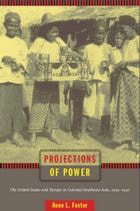
Projections of Power
The United States and Europe in Colonial Southeast Asia, 1919-1941Anne L. Foster
Duke University Press, 2010
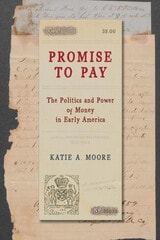
Promise to Pay
The Politics and Power of Money in Early AmericaKatie A. Moore
University of Chicago Press, 2024
Promise to Pay follows America’s first paper money—the “bills of credit” of British North America—from its seventeenth-century origins as a means of war finance to its pivotal role in catalyzing the American Revolution. Katie A. Moore combs through treasury records, account books, and the bills themselves to tell a new story of money’s origins that challenges economic orthodoxy and mainstream histories. Promise to Pay shows how colonial governments imposed paper bills on settler communities through existing labor and kinship relations, their value secured by thousands of individual claims on the public purse—debts—and the state’s promise to take them back as payment for taxes owed. Born into a world of hierarchy and deference, early American money eroded old social ties and created new asymmetries of power, functioning simultaneously as a ticket to the world of goods, a lifeline for those on the margins, and a tool of imperial domination.
Grounded in sustained engagement with scholarship from multiple disciplines, Promise to Pay breathes new life into old debates and offers an incisive account of the centrality of money in the politics and conflicts of empire, community, and everyday life.
Promise to Pay
The Politics and Power of Money in Early AmericaKatie A. Moore
University of Chicago Press, 2024
An incisive account of the crucial role money played in the formation and development of British North America.
Promise to Pay follows America’s first paper money—the “bills of credit” of British North America—from its seventeenth-century origins as a means of war finance to its pivotal role in catalyzing the American Revolution. Katie A. Moore combs through treasury records, account books, and the bills themselves to tell a new story of money’s origins that challenges economic orthodoxy and mainstream histories. Promise to Pay shows how colonial governments imposed paper bills on settler communities through existing labor and kinship relations, their value secured by thousands of individual claims on the public purse—debts—and the state’s promise to take them back as payment for taxes owed. Born into a world of hierarchy and deference, early American money eroded old social ties and created new asymmetries of power, functioning simultaneously as a ticket to the world of goods, a lifeline for those on the margins, and a tool of imperial domination.
Grounded in sustained engagement with scholarship from multiple disciplines, Promise to Pay breathes new life into old debates and offers an incisive account of the centrality of money in the politics and conflicts of empire, community, and everyday life.
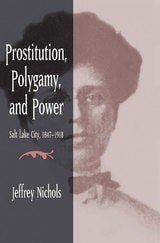
Prostitution, Polygamy, and Power
Salt Lake City, 1847-1918Jeffrey Nichols
University of Illinois Press, 2002
Jeffrey Nichols examines how prostitution became a focal point in the moral contest between Mormons and gentiles and aided in the construction of gender systems, moral standards, and the city's physical and economic landscapes. Gentiles likened polygamy to prostitution and accused polygamous Mormons of violating Christian norms of family structure and sexual behavior. Defending their church and its ideals, Mormons blamed gentiles for introducing the sinful business of prostitution into their honorable city. Nichols traces the interplay of prostitution and reform from the 1890s, when the Church of Jesus Christ of Latter-day Saints began to move away from polygamy, to World War I, when Mormon and gentile moral codes converged at the expense of prostitutes. He also considers how the conflict over polygamy distinguished Salt Lake City from other cities struggling to abolish prostitution in the Progressive Era.
Prostitution, Power and Freedom
Julia O'Connell Davidson
University of Michigan Press, 1998
The author has conducted an impressive amount of research in nine countries, including conversations with male and female sex tourists, adult and child prostitutes, procurers, and clients. Through her research, O'Connell Davidson demonstrates the complexity of prostitution, arguing that it is not simply an effect of male oppression and violence or insatiable sexual needs, nor is it an unproblematic economic encounter. The book provides a sophisticated explanation of the economic and political inequalities underlying prostitution, but also shows that while prostitution necessarily implies certain freedoms for the clients, the amount of freedom experienced by individual prostititutes varies greatly.
This highly accessible book will be of great interest to those in gender and women's studies, sexuality and cultural studies, the sociology of work and organizations, and social policy. General readers will also appreciate having new ways of thinking about this age-old social phenomenon.
Julia O'Connell Davidson is Lecturer in Sociology, University of Leicester.

Proust in the Power of Photography
Brassaï
University of Chicago Press, 2001
Drawing on his own experience as a photographer and author, Brassaï discovers a neglected aspect of Proust's interests, offering us a fascinating study of the role of photography both in Proust's oeuvre and in early-twentieth-century culture. Brassaï shows us how Proust was excessively interested in possessing portraits of his acquaintances and how the process by which he remembered and wrote was quite similar to the ways in which photographs register and reveal life's images. This book-beautifully translated by Richard Howard-features previously obscure photographs from Brassaï's High Society series and offers a rare glimpse into two of France's most fascinating artistic minds.
Public Lettering
Script, Power, and CultureArmando Petrucci
University of Chicago Press, 1993
buildings, commercial graphics, signs, epitaphs on tombstones,
graffiti—is a fixture of urban life. In Public
Lettering, Armando Petrucci reconstructs the history of
public writing in the West and traces its social functions
from the eleventh century through the modern period.
Taking the city of Rome as a case study, Petrucci begins
with a consideration of the first civic inscriptions after
ancient times. Substantial chapters on the uses of public
writing in the industrial revolution and the early twentieth
century prepare the way for his provocative discussions of
public lettering in the the contexts of fascism, post-war
radicalism, and the student revolutions of 1968 and 1977.
Throughout, Petrucci is concerned with the relations
between the functions and styles of letters and the places
where they appear. Writing, he argues, is one of the
instruments of public power; display lettering is often the
image and mirror of power itself, making the social use of
written forms a type of conquest. Because of Rome's role as
a “World-City,” Petrucci's interdisciplinary study has
wide-ranging implications for our understanding of the social
function of graphic design.

Purpose & Power In Retirement
New Opportunities for Meaning and SignificanceHarold Koenig
Templeton Press, 2003
Eighty million baby boomers are heading toward retirement. Some are retiring now, either out of choice or because they have been laid off. Others will work for a few more years until their retirement plans kick in, until they feel they can retire, or until they're forced to retire. Whatever their age at retirement, they will have better health and live longer than their parents. And each of them will face these questions:
•Do I want a reason to get up in the morning and be excited about the day ahead?•Do I still want to make a difference in the world?
They need a vision—a goal that takes into account their experience, wisdom, strengths, and limitations, and gives purpose to their lives.
Dr. Harold G. Koenig, with expertise in the fields of geriatrics, mental health, and religion, explains that the notion of retirement was in fact a marketing tool developed in the post–World War II period. Continuing today, society's image of retirement is based largely on myths, such as: things will get better when you retire—you'll be able to do everything you wanted to but couldn't when you worked. In fact, these beliefs can be harmful, leading to emotional issues, identity crises, and problems with physical health.
Citing current scientific and medical research, Koenig illustrates how having a purpose motivates and energizes people in their retirement years. He presents a step-by-step guide to identifying a goal toward which they can strive. And he shows how striving for that goal in itself brings meaning, satisfaction, and a sense of reward to retirement years.
"Finding purpose is more urgent than ever during the retirement years, when the search for purpose becomes one of the deepest of human longings," says Koenig. His Purpose and Power in Retirement is an invaluable resource for everyone heading toward retirement, and for anyone seeking meaning in life.

Puyo Runa
Imagery and Power in Modern AmazoniaNorman E. Whitten Jr. and Dorothea Scott Whitten
University of Illinois Press, 2007
The Andean nation of Ecuador derives much of its revenue from petroleum that is extracted from its vast Upper Amazonian rain forest, which is home to ten indigenous nationalities. Norman E. Whitten Jr. and Dorothea Scott Whitten have lived among and studied one such people, the Canelos Quichua, for nearly forty years. In Puyo Runa, they present a trenchant ethnography of history, ecology, imagery, and cosmology to focus on shamans, ceramic artists, myth, ritual, and political engagements. Canelos Quichua are active participants in national politics, including large-scale movements for social justice for Andean and Amazonian people. Puyo Runa offers readers exceptional insight into this cultural world, revealing its intricacies and embedded humanisms.